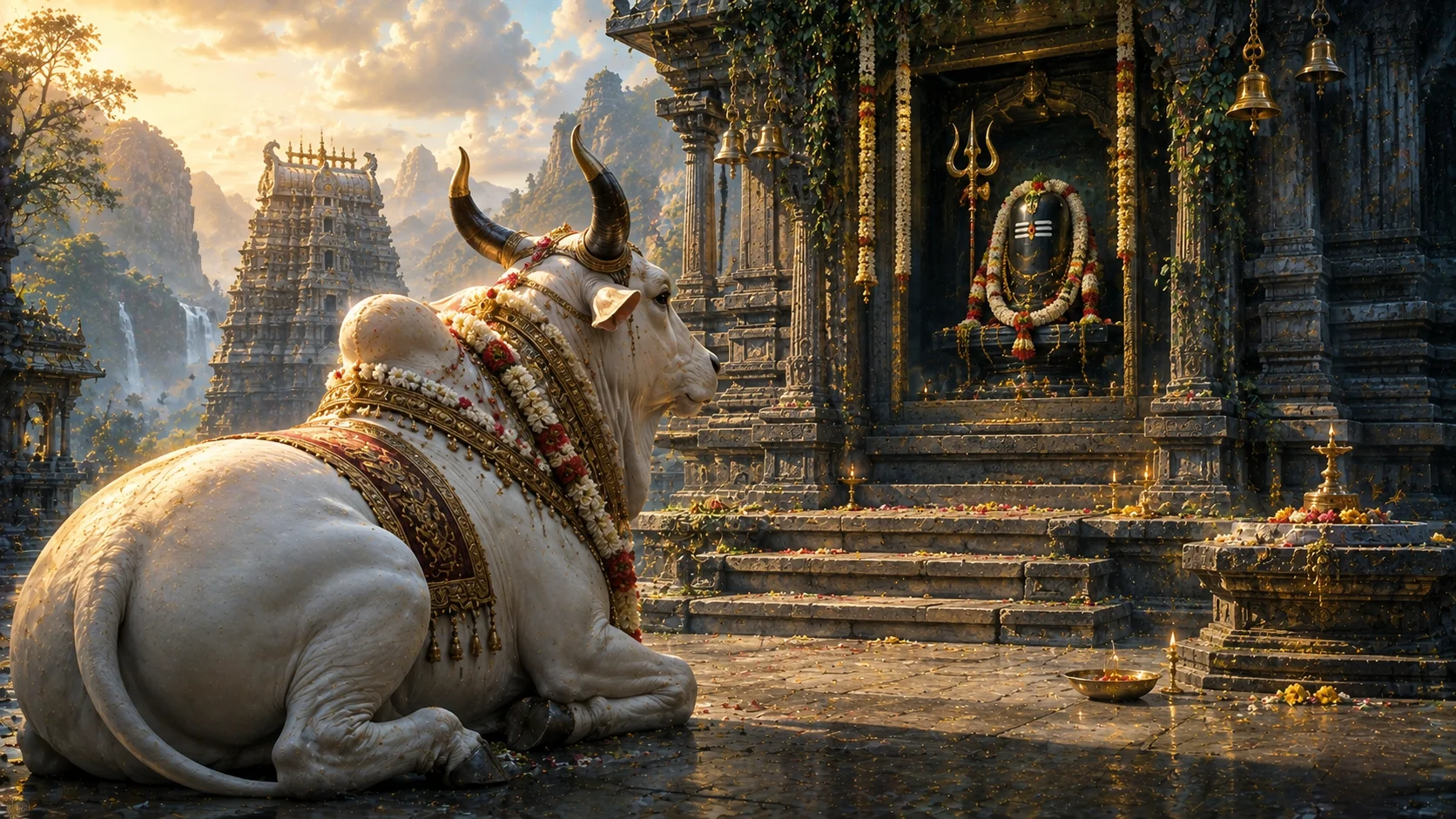
Nandi is the sacred white bull of Hindu tradition — the vahana and constant gatekeeper of the great god Shiva, and the foremost of his devotees. His seated image, gazing eternally toward the sanctum, greets every pilgrim at the threshold of a Shiva temple, and devotees still lean close to his ear to whisper the wishes they have come to lay before the god.
The Joyful One at the Threshold
The name Nandi comes from the Sanskrit Nandī, "the joyful, the happy one," and it suits him: he is never rendered as a beast of burden bent under duty but as a being lit with contentment, seated calmly at the gate he has chosen to keep. He is shown as a great white bull, powerful through the shoulder and hump, most often carved seated or reclining, his head turned in permanent attention toward the inner shrine. That single posture — a bull that faces not outward toward the world but inward toward its lord — is the whole of his character rendered in stone. Wherever a Shiva temple stands, from a village shrine to a great South Indian gopuram, a Nandi faces the sanctum before it, and the devotee passes him on the way to darshan, brushing past devotion itself before reaching the god it is devoted to.
Whispering Into a Stone Ear
The custom that has kept Nandi close to ordinary worship, rather than remote as a theological abstraction, is the practice of leaning toward his carved ear and speaking a wish there before addressing Shiva directly. It casts Nandi not merely as a guardian to be passed but as an intermediary worth confiding in — the first listener in the temple, chosen because his devotion is already perfect and his loyalty to the god beyond question. A worshipper who trusts Nandi with a private hope is, in effect, asking the most faithful being in the temple to carry it forward on their behalf.
A Son Born of Austerity, Not of Birth
Puranic tradition does not treat Nandi as an animal born in the ordinary way. He is described as the son of the sage Shilada (also rendered Shailada), granted through the sage's long austerities and a boon of Shiva — a child obtained by penance rather than begotten by nature. The precise shape of that origin story shifts from Purana to Purana, as origin tales for major Shaiva figures often do, but the through-line holds constant across the retellings: Nandi enters the world already marked as Shiva's, brought into being by a devotee's longing and a god's grace rather than by chance.
Chief Among the Ganas of Kailash
At Mount Kailash, Shiva's mountain seat, Nandi holds no ordinary place among the god's attendant hosts, the ganas. He stands as their chief, the foremost of that unruly and devoted company, and in certain traditions he carries the honorific Nandikeshvara — "Lord Nandi" — a title that lifts him out of the category of mount and gatekeeper altogether and into something closer to a minor deity in his own right, worshipped and addressed rather than simply depicted. Where Shiva is Lord of Kailash, Nandi is spoken of as lord over those who serve him there.
The Curse That Named a Coming Ruin
Among the episodes later Puranic and regional retellings attach to him — attestation for this story varies by text — is Nandi's confrontation with the demon-king Ravana, who mocked the bull's appearance while attempting to wrench Mount Kailash from its foundations. Nandi's response was not violence but a curse and a prophecy: he foretold that monkeys would one day be the instrument of Ravana's ruin, a foreshadowing later readers have connected to Hanuman and the vanara army that would help bring down Ravana's kingdom. The episode casts Nandi as more than a silent attendant — capable, when provoked, of pronouncing judgment that echoes forward through the wider mythic history of Lanka.
Teacher of Dance, Keeper of the Natya Shastra
A separate strand of later Shaiva theology credits Nandi as a teacher of the arts of dance and music, linked to the transmission of the Natya Shastra tradition and standing beside Shiva during the god's cosmic dance, the tandava. This is not presented as a single originating myth so much as a theological elaboration built up over time within particular Shaiva textual lineages — Nandi as custodian of an art form as sacred, in its own domain, as the temple rites he guards at the door.
The Bull as Dharma Standing on Four Legs
Nandi's whiteness and his bull-form are read as more than physical description. The white bull stands for purity, for strength, and for dharma — righteousness itself. In one widely repeated symbolic reading tied to the broader Hindu cosmology of the yugas, dharma is pictured as a bull standing on four legs in the Satya Yuga, the first and most virtuous age, and losing a leg with each age that follows as righteousness in the world diminishes. Nandi's four sturdy legs, in this reading, are dharma's own — a creature whose very stance is a measure of the age.
Nandin and the Regional Variations of a Shared Name
The term Nandin circulates in various regional and sectarian Shaiva traditions as a broader label for Shiva's bull vehicle, and it is worth holding apart from Nandi as a distinct figure with his own biography — sage's son, chief of the ganas, gatekeeper of Kailash. Across regions and lineages the name and the precise role attached to it shift in minor ways, a reminder that Shaivism is not one uniform tradition but a family of related devotional cultures, each keeping its own version of the bull at the gate.
Present in the Epics, Absent from Their Center
Nandi appears throughout the Mahabharata and across the Puranas — the Shiva Purana and the Skanda Purana among them — always as part of Shiva's retinue, always recognizable, but never as the protagonist of an extended independent narrative built around him alone. His presence in these texts is steady rather than central: he belongs to the scenes he appears in, but the great sustained epics belong to others. That is not diminishment so much as a description of his role — he is defined by faithful proximity to Shiva, not by a story that could stand apart from him.
A Devotion With No Life Outside Shiva's Cult
Worship of Nandi is bound tightly to Shaivism specifically. He is not approached as an independent deity with a following of his own outside devotion to Shiva; his shrines and his images exist because Shiva's do, and his devotees are, by and large, Shiva's devotees first. His identity remains fused to his god's, and that fusion is precisely what his temple placement, always facing the sanctum, never elsewhere, expresses in stone.
Monoliths at Chamundi Hills and Lepakshi
South Indian temple tradition, especially across Tamil Nadu and Karnataka, has produced some of the most celebrated monumental images of Nandi in the entire Shaiva world. The great monolithic Nandi carved into the hillside at Chamundi Hills near Mysore and the massive stone bull at Lepakshi stand today as major pilgrimage destinations and works of sculptural artistry in their own right, drawing visitors who come as much for the scale and craft of the carving as for devotion. These monoliths are where Nandi's temple role — small, seated, facing inward — is magnified into something the size of a hillside, impossible to walk past without pausing.
Suyasha, a Consort Named in Later Texts
Later textual traditions occasionally give Nandi a consort named Suyasha, though the detail is minor and not universally attested across Shaiva literature. It surfaces as one thread among the many later elaborations — like the Natya Shastra connection — that later tradition wove around a figure whose core identity had already been fixed centuries earlier: bull, gatekeeper, son of Shilada, chief of the ganas, eternally facing his lord.
The Bull Who Never Looks Away
What endures, across every elaboration later tradition has added, is the single image fixed at the temple door: a great white bull, seated, facing the sanctum, gazing without interruption at the god he serves. Whether approached as Shilada's son, as Nandikeshvara ruling the ganas of Kailash, as the pronouncer of a curse against Ravana, or simply as the silent listener into whose ear a wish is whispered, Nandi's devotion is the constant beneath all the variations — strength given the shape of loyalty, and dharma given the shape of a bull that will not turn its head.
Sources & traditions
- EncyclopediaWikipedia — Nandi (Hinduism)
- TraditionHindu texts, oral tradition and village tellings (South Asia)
Myths change from area to area and from time to time. This chronicle follows the most widely told versions; tellings in other villages, regions and eras may differ.