Achelous was the god of the greatest river in Greece and the chief of all river-gods — a powerful, shape-shifting deity who fought the hero Heracles for the hand of a princess, lost a horn in the struggle, and so gave the world one of its most enduring symbols: the cornucopia, the horn of plenty.
The Chief of the River-Gods
Achelous was the personification of the Achelous River, the longest in Greece, and as such he was regarded as the eldest and most senior of all the thousands of river-gods (the Potamoi, sons of Oceanus and Tethys). He was a god of fresh water and fertility, depicted as a powerful figure who could take many forms — appearing as a man, as a man-faced bull, or as a great serpent — for like many water-deities, Achelous was a shape-shifter.
The Fight for Deianira
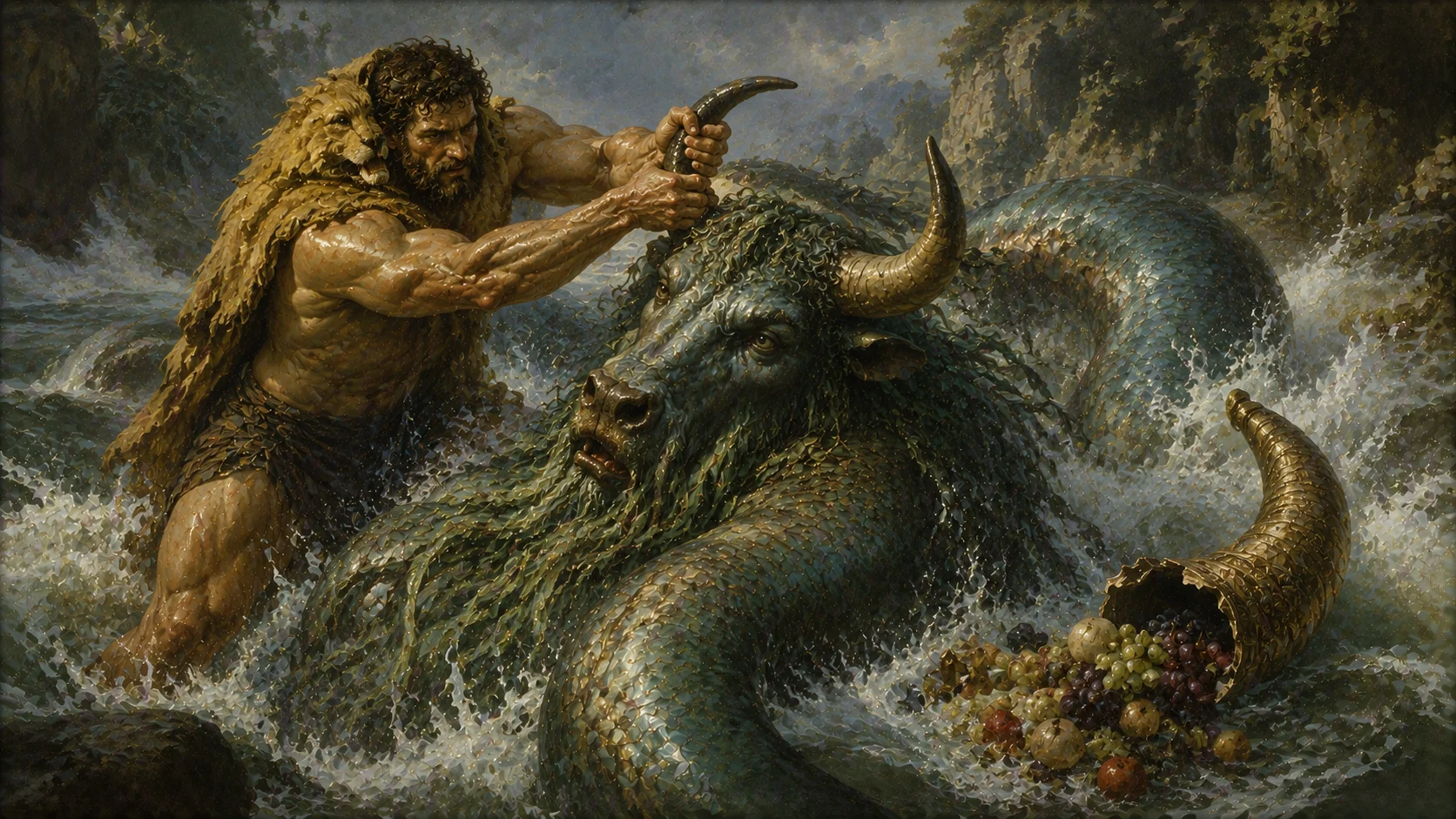
His most famous myth is his wrestling match with Heracles. Both the river-god and the hero sought to marry the beautiful princess Deianira, and they fought a tremendous duel to decide the matter. Achelous used his shape-shifting powers, transforming first into a writhing serpent, then into a charging bull — but Heracles, the supreme wrestler, matched him at every turn. As Achelous charged in bull-form, Heracles seized him by the horns, wrestled him to the ground, and broke off one of his horns, finally defeating him. The river-god, humbled, conceded, and Heracles won Deianira.
The Horn of Plenty
The broken horn became something wonderful. In one tradition, the river-nymphs (Naiads) took Achelous's severed horn and filled it with fruits and flowers, and it became the cornucopia — the “horn of plenty” that overflows endlessly with the bounty of the earth, a symbol of abundance and harvest that endures to this day on coins, in art, and at every celebration of plenty. (In another version, Achelous recovered his own horn by trading the magical horn of Amalthea for it.) From a god's defeat sprang an eternal emblem of abundance.
The Father of Waters
Achelous endures as the grand old man of Greece's rivers, the shape-shifting god of fresh water and fertility, and the unlikely origin of the cornucopia. He represents the life-giving and untameable power of the river — a force even Heracles could only defeat by seizing it by the horns — and from his loss, the world gained its symbol of endless plenty.
Even a god lost a horn to Heracles — and from that broken horn poured the endless bounty of the earth.
A God Older Than the Poems About Him
Homer already treated him as a fixed point. In the Iliad, when the poet needs a yardstick for elemental power, he reaches for two names together — Achelous and Oceanus, the world-river that encircles everything — and then says plainly that Zeus outmatches them both. Being the thing Zeus has to be measured against is its own kind of status. Hesiod's Theogony places him more formally, among the rivers born to Oceanus and Tethys: Hesiod counts three thousand of them and names only a couple of dozen, and Achelous is one of the named.
The god had a body of actual water behind the poetry. The real Achelous rises in the Pindus mountains and runs south to the Ionian Sea, marking the old boundary between Aetolia and Acarnania, and ancient observers watched it do something no marble god could do: build new land. Writing in the fifth century BCE, Thucydides described the river depositing so much silt at its mouth that it had already welded part of a cluster of small islands, the Echinades, onto the mainland — and expected the rest to follow before long. A river that forked, coiled, and physically remade the coastline gave the Greeks a god who forked, coiled, and remade himself.
An Oath Sworn on Water
Achelous had no single great sanctuary the way Zeus had Olympia or Athena had the Acropolis. His shrine was wherever fresh water rose out of the ground. Across Attica and beyond, householders and travellers carved small votive reliefs into the rock beside springs and inside caves, and an extraordinarily consistent trio appears on them: goat-legged Pan with his pipes, a line of Nymphs dancing hand in hand, and, watching from the edge of the panel, a bearded, horned head that is unmistakably Achelous. He is rarely the subject of these dedications, but he is almost never left out of them — the senior, fixed presence that made a spring a proper sacred place rather than merely running water. This was religion practised at the level of the household and the village rather than administered by a priesthood, which is exactly why it has left so many small, personal traces and so few grand ones.
That everyday intimacy reached the language too. Ancient writers record Greeks using the name Achelous in prayers, sacrifices and oaths as a word for fresh water itself — the same habit of speech that let bread be called by Demeter's name and wine by Dionysus's. A god whose name and whose element had become interchangeable had won a kind of permanence that no cult statue could have given him.
Father of Sirens and Sacred Springs
The broken horn is what everyone remembers about Achelous. His children are what actually shaped the map. Ancient sources cannot agree on which Muse he fathered them with — Melpomene, Terpsichore and Calliope are each named in different tellings — but they agree that he was the father of the Sirens, the bird-bodied singers who nearly undid Odysseus. The pairing is less strange than it looks: springs and rivers were already bound up with poetic inspiration in the Greek imagination, so a river-god fathering the deadliest voices in myth was an extension of what water already meant to poets, not a contradiction of it.
His daughters worked more quietly. Callirhoe, one of his Naiad daughters, bore Acarnan to the hero Alcmaeon, and Acarnan gave his name to Acarnania — the very region the river ran along, so that the god's own bloodline named the land he watered. Further east, the nymph Castalia, whom at least one ancient poet counted a daughter of Achelous, gave her name to the spring at Delphi where the Pythia purified herself before prophesying and from which poets long afterwards claimed their inspiration. By that reckoning, the water at the very centre of Greek prophecy traced its ancestry back to the river-god Heracles had thrown to the ground.
The Flood That Made the Echinades
Ovid gives Achelous a story the Greek mythographers largely skip, and lets the god tell it himself: an explanation for the cluster of small islands off his own coast. Sheltering Theseus and his companions in his cave while the river runs too high to cross, Achelous says the Echinades were once nymphs who held a sacrifice and forgot to invite him. He rose in fury, tore the ground out from under them and swept them into the sea, where they hardened into the islands that still carry the name. He then points out one island lying apart from the rest: Perimele, thrown from a cliff into the sea by her own father, Hippodamas, as punishment for yielding to the river-god — and saved only because Achelous himself begged the god of the sea to give her solid ground rather than let her drown.
It is worth reading beside Thucydides's dry, geological note on the same islands, written some four centuries earlier. One account makes the Echinades out of divine rage and remorse; the other out of silt, arriving year after year. The ancient world kept both, and neither seems to have needed to defeat the other.
The Face That Watches From the Wall
Greek art gave Achelous a signature so distinctive that archaeologists still call it the “Achelous mask”: a bearded human face turned full-on to the viewer rather than shown in profile like almost every other figure in archaic and classical art, fitted with a bull's horns and a bull's ears. The frontal stare alone was enough to identify him. The mask turns up on temple roof ornaments, on drinking vessels, and on the coinage of Greek cities in Sicily and southern Italy, where the man-faced bull became the standard way to picture a river at all. And note which way round he is assembled: the Minotaur is a man's body under a bull's head, while Achelous inverts it — a bull's body carrying a bearded man's face — or else appears simply as a man wearing the horns, sometimes finishing below the waist in a serpentine coil. Horned, watchful, and unmistakably a creature of water rather than of the labyrinth.
Deianira Remembers It Differently
The wrestling match that cost Achelous his horn looks like a triumph from Heracles's side of it. Sophocles gives it a second telling, and it is not a triumph at all. Women of Trachis opens with Deianira herself recalling the courtship — not as a contest fought nobly for her hand, but as plain terror at being wooed by a suitor who arrived as a bull, then as a coiling serpent, then as a man with a bull's face, and who could be neither reasoned with nor refused. She says she prayed to die before she would have to share his bed. Read against her account, the wedding-duel starts to look less like a romance and more like a rescue.
It is also, unknowingly, the first link in the chain that kills Heracles. The marriage Achelous lost put Deianira on the road where the centaur Nessus attacked her, and Nessus's dying gift — his poisoned blood, offered to her as a love-charm — is what she would later use, in desperate innocence, to destroy the husband she loved. Achelous never touches that story again. But the wedding his defeat purchased is the hinge the whole of it turns on, which is a strange kind of revenge for a god who never had to lift a hand to take it.
Why a River Needed a Face
Rivers do not behave like the rest of the physical world. They give and they take in the same afternoon, feeding a valley for a generation and then, in one flood season, drowning it — and unlike a mountain or a shoreline, a river will not stay where you left it. That restlessness is what the Greeks kept returning to in Achelous, and it is why he outlasted his own defeat. The horn Heracles broke off became the emblem of everything a river gives; the god it was broken from is the reminder that the same water can take it all back.
Sources & traditions
- EncyclopediaWikipedia — Achelous
- TraditionGreek texts, inscriptions and later retellings (Greece)
Myths change from area to area and from time to time. This chronicle follows the most widely told versions; tellings in other villages, regions and eras may differ.