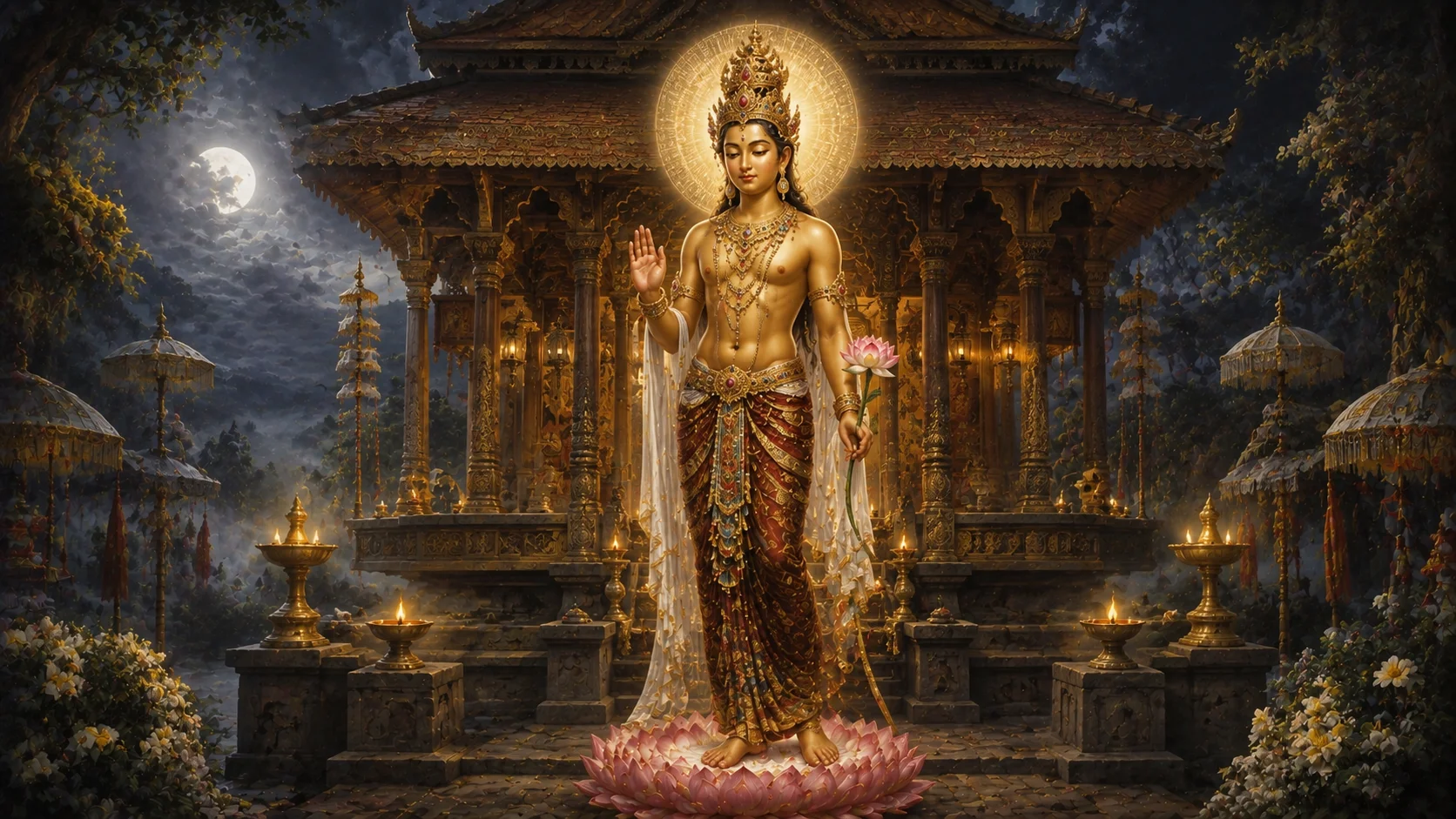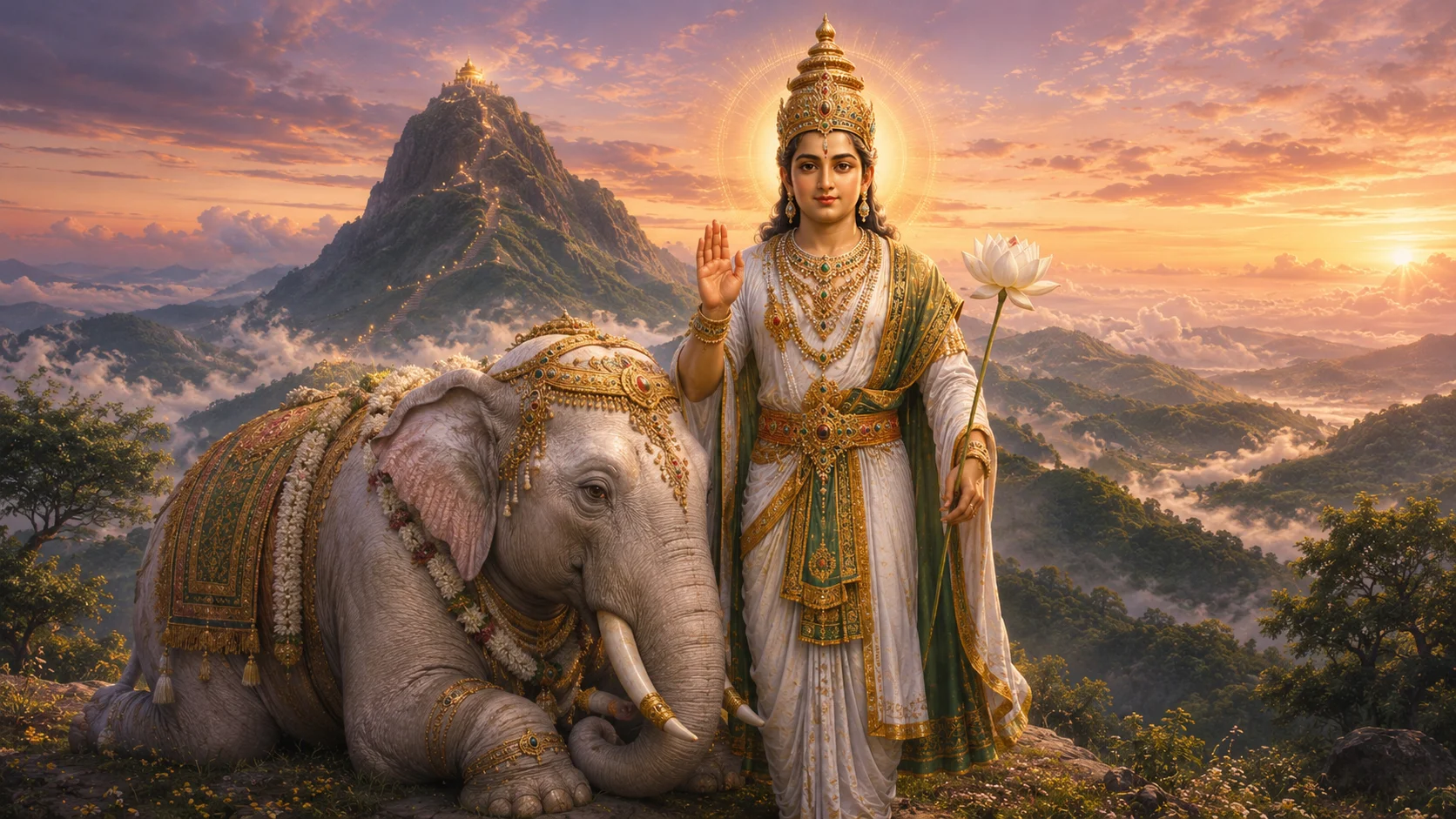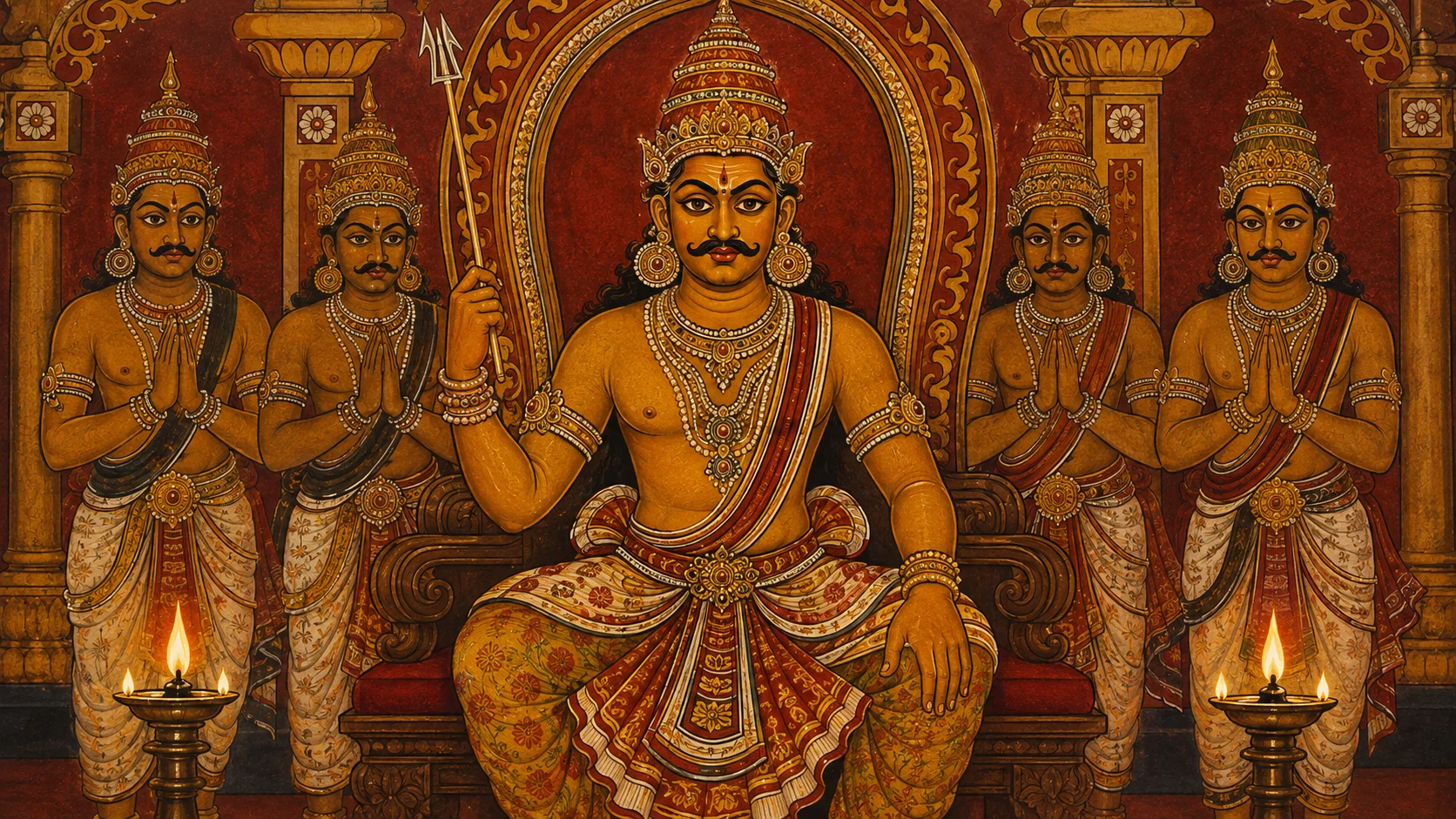
Vesamuni Deviyo (වෙසමුණි දෙවියෝ) is the guardian king of the northern quarter and the overlord of the yakku in Sinhala Buddhism, known in Pali as Vessavaṇa and in Sanskrit as Vaiśravaṇa. Sri Lankan Buddhists honour him as a deva of the Cātummahārājika heaven, a follower of Lord Buddha and a stream-enterer (sotāpanna), and as the authority under whose warrant — varam — every yaksha of this island must act. Ritual texts of the low country more often address him by his royal style, Vesamuni Raja or Vesamuni Rajjuruwō; both are reverent forms of the one name.
\n\nIt is he who, in the Āṭānāṭiya Sutta, brings the protective verses before Lord Buddha — the verses chanted at the close of an all-night pirit ceremony in Sri Lankan temples today. The king whose warrant the ädurā invokes on the tovil ground and the king who offered that protection are one and the same.
\n\nThe Name and Its Forms
\n\nSinhala වෙසමුණි reaches the language through Pali rather than directly from Sanskrit: Vaiśravaṇa (Sanskrit), Vessavaṇa (Pali), Vesamuṇi (Sinhala). The Pali tradition explains the name not by descent but by dominion — the Āṭānāṭiya Sutta states that this Kuvera has a royal city named Visāṇā, and is therefore called Vessavaṇa. Kuvera, there, is the personal name; Vessavaṇa is the throne. The commentaries treat Vessavaṇa as an office rather than an everlasting individual: when one holder's life-span ends, Sakka appoints his successor.
One of the Satara Varam Deviyo
\n\nThe phrase satara varam deviyo (සතර වරම් දෙවියෝ), the four warrant gods, carries two living senses in Sinhala. The first is canonical, and it is the sense in which Vesamuni Deviyo is counted among them: the Four Great Kings of the Cātummahārājika realm, who guard the quarters and are subordinate to Sakka in Tāvatiṃsa.
\n\n- \n
- Dhataraṭṭha — the east, lord of the gandhabbas \n
- Virūḷhaka — the south, lord of the kumbhaṇḍas \n
- Virūpakkha — the west, lord of the nāgas \n
- Vesamuni Deviyo (Vessavaṇa) — the north, lord of the yakkhas \n
The second sense belongs to the island's own devāle religion: the four gods warranted to protect Lanka, first firmly evidenced in the Laṅkātilaka inscription of 1344, which records images of Upulvan, Saman, Vibhīṣaṇa and Skanda-Kandakumāra. Membership there is genuinely disputed and shifted with period and district, Nātha, Pattini, Dedimuṇḍa and Dēvol appearing in some reckonings and not others. Vesamuni Deviyo is not normally counted in that second set — a difference of office rather than of rank. He has no great devālaya and no annual perahera; his domain is the pirit hall and the tovil ground.
\n\nOverlord of the Yakku
\n\nThe yakkhas — Sinhala yakā, plural yakku — are a class of powerful non-human beings, and to render the word as "demons" imports a category the tradition does not use. Over that whole host Vesamuni Deviyo is king. Sinhala sources say that every yaksha which has come to this island holds its warrant from him, and without it may receive no dola pudu, the offerings set out for it, and may do nothing at all. His club, the gadāvudha, is recorded as the weapon he bore while still a worldling, laid aside when he became a follower of Lord Buddha.
\n\nThe Varam and the Authority of the Tovil Ground
\n\nAuthority in the Sinhala ritual system descends in a chain. It begins with Lord Buddha, whose authority persists by delegation, and passes to Sakka, from Sakka to the guardian kings, from Vesamuni Deviyo to each yaksha; only at the end does it reach the command of the ädurā. The exorcist orders nothing in his own name: in yak tovil the yakku are commanded in the name of Lord Buddha and of Vesamuni Deviyo, and a resisting yaksha is told that the order is not the ädurā's own.
\n\nThe warrant is bounded, and the boundary is the heart of the matter. The tradition holds that the yakku were barred from inhabiting this island in body and forbidden to kill, and were permitted only the glance — diṣṭiya — by which affliction falls. Illness comes by that look; assault does not. This is why the rites take the form they do: the afflicted are not rescued from a battle but restored through a proceeding, in which a licence granted is shown to have been exceeded.
\n\nThe specialists who conduct these rites are properly the yakädurā, ädurā or yakdessā. The great low-country ceremonies include the Sanni Yakuma with its Daha-ata Sanniya, the Suniyama, the Rata Yakuma and the Dēvol Maḍuva; the up-country tradition has the Kohomba Kankāriya. None of this is the worship of yakku: tovil manages dangerous beings under Buddhist authority, and "demon worship" and "devil dancing" are colonial mislabels the tradition rejects. Vesamuni Deviyo himself is worshipped — as a god.
\n\nThe igaha
\n\nThe token of that authority is the igaha (ඊ ගහ), the arrow, identified in the low-country tradition with Vesamuni Deviyo's own weapon and used in śāntikarma to drive off the yakku. The gokkola craft of young coconut leaf makes an ornamental igaha with a triśūla head, laid on the patient's head to invite blessing and afterwards carried to a high place away from the house. Sinhala tradition preserves a body of Vesamuni mantras as well, with a warning that they must not be used without a teacher's instruction.
\n\nThe Āṭānāṭiya Sutta and the Pirit Hall
\n\nIn the Āṭānāṭiya Sutta, the thirty-second discourse of the Dīgha Nikāya, Vessavaṇa comes with the other three Great Kings to Lord Buddha at Rājagaha. He reports that many yakkhas do not accept the teaching, because the precepts run against their habits, and may therefore trouble those who dwell in lonely places. He offers a protection, the Āṭānāṭiya rakkhā, composed at the assembly of the Four Great Kings; Lord Buddha accepts it in silence and afterwards teaches it to the monks.
\n\nThe protection opens with homage to the seven Lord Buddhas, from Vipassī through to Lord Gotama Buddha, then surveys the four quarters with their kings and hosts. Its mechanism is juridical rather than magical: one who is harassed names the offending yakkha aloud before the yakkha assembly and the Great Kings, and the offender is punished or cast out — the same logic of warrant that governs the tovil ground. In Sri Lanka the Āṭānāṭiya stands within the Catubhāṇavāra, the Pirit Potha, and is chanted near the end of an all-night pirit in the hours before dawn.
\n\nIn the Island's Own Landscape
\n\nThe Mahāvaṃsa records that when King Paṇḍukābhaya laid out Anurādhapura he set the banyan tree of Vessavaṇa near the western gate — a shrine to this deity in the island's first planned capital. In painting he appears as Sri Lankan tradition presents him: not a solitary armoured general but one of four crowned royal devas with their entourages, as at the Kelaniya Rajamahā Vihāra. Sinhala popular tradition also names Dedimuṇḍa Devatā Baṇḍāra, guardian of the Lord Buddha Sāsana, as his grandson and his emissary against Māra.
\n\nA Note on the Name Vaiśravaṇa
\n\nThe Sanskrit form Vaiśravaṇa is a patronymic, "son of Viśravas," and in Hindu tradition it belongs to Kubera, a distinct figure: the yakṣa-king and lord of wealth, half-brother of Rāvaṇa, who ruled Lanka until Rāvaṇa drove him from it. The two traditions share the epithet, the northern quarter and lordship over the yakṣa host. What Buddhist sources do not give him is Kubera's story: no Viśravas as father, no Rāvaṇa as brother, no rule over Lanka and no expulsion. Kubera's iconography — dwarfish, pot-bellied, three-legged, with its jewel-bearing mongoose — belongs to that Hindu figure and to no depiction of Vesamuni Deviyo. Vesamuni Deviyo is not the Hindu Kubera under a Sinhala name.
\n\nPali literature does make the splendour of Vessavaṇa proverbial, and his city Ālakamandā a byword for riches — but that is a literary attribute, not why anyone approaches him here. Sinhala sources describe his powers as the removal of yakṣa, preta and amanuṣya affliction and the giving of sarva ārakṣāva, protection on every side. A devotee comes to him for safety, not prosperity.
\n\nHow He Is Honoured
\n\nVesamuni Deviyo is invoked wherever protection is asked for: in pirit, in bali and in yak tovil. He is a deva and not a refuge — refuge in Sinhala Buddhism is the Triple Gem alone — but within the order Lord Buddha established he is the king to whom the yakku answer. That is his standing in the island: a stream-enterer and a follower of Lord Buddha; one of the satara varam deviyo; king of the north; holder of the warrant that binds every yaksha of Lanka; and the deity who brought before Lord Buddha the protection chanted, night after night, in the temples of this country.
Sources & traditions
- EncyclopediaWikipedia — Vaiśravaṇa
- TraditionSinhalese Buddhist texts, oral tradition and village tellings (Sri Lanka)
Myths change from area to area and from time to time. This chronicle follows the most widely told versions; tellings in other villages, regions and eras may differ.