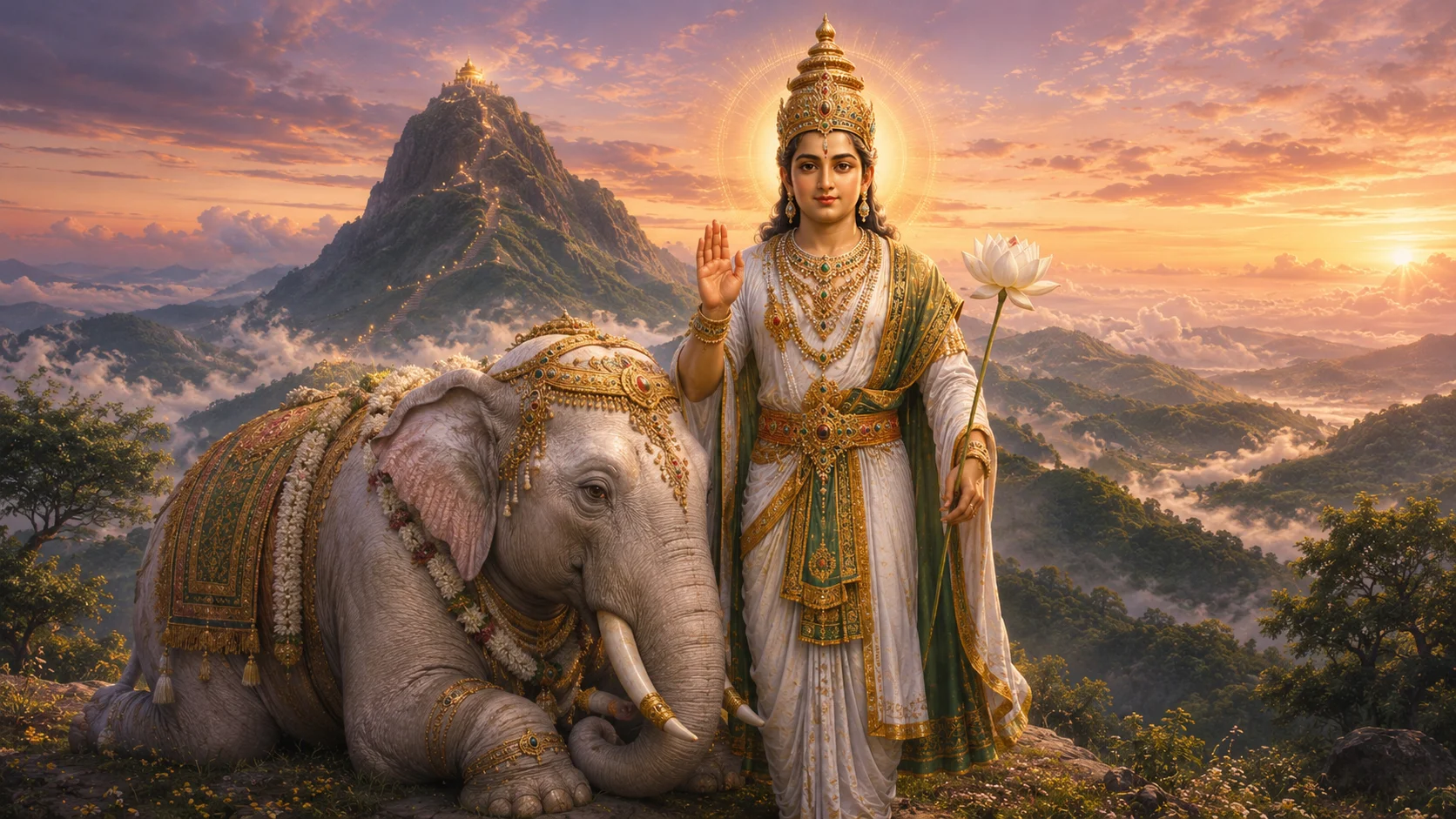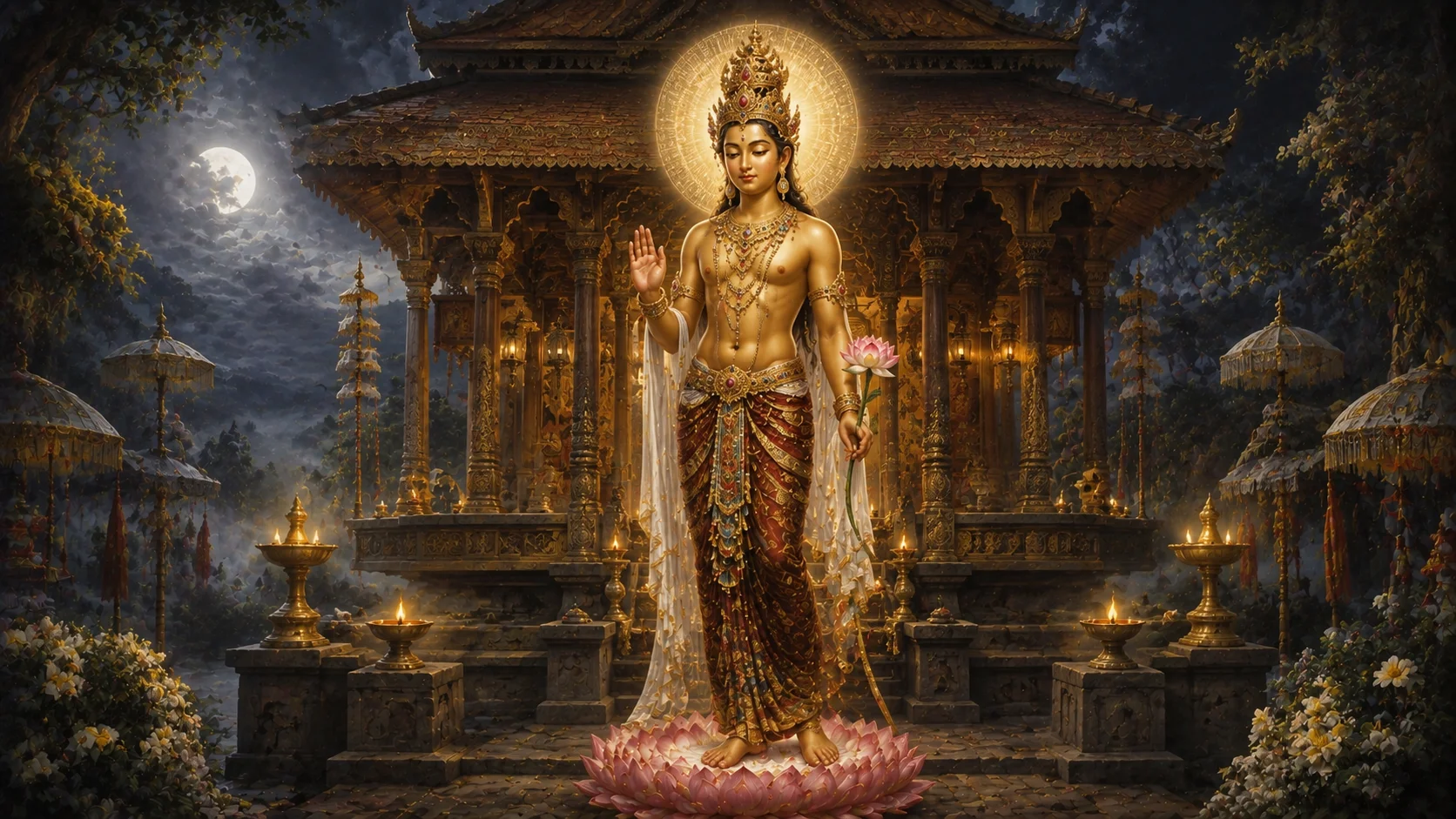
Natha Deviyo is one of the four great guardian gods of Sri Lankan Buddhism — a deity of the highest rank, widely identified with the bodhisattva Avalokiteśvara (Lokeśvara, “Lord of the World”), the embodiment of infinite compassion, and held by many to be the bodhisattva destined to become Maitreya, the future Lord Buddha. Senior among the island’s protective deities, Natha is a being far advanced upon the path to Buddhahood, a compassionate guardian who watches over the island, its people, and the Dharma itself.
The Lord of the World
Natha (from Nātha, “Lord” or “Protector,” a contraction of Lokeśvara-Nātha) entered Sri Lankan Buddhism from the Mahāyāna traditions that flourished on the island in the first millennium, when the cult of the great bodhisattva Avalokiteśvara — the supreme figure of compassion, who hears the cries of all beings — took root. As the Theravada tradition became dominant, this bodhisattva-deity was preserved as Natha Deviyo, a guardian god of the highest dignity, his Mahāyāna origin remembered in his identification with the all-compassionate Lord of the World.
The Bodhisattva Who Will Be Lord Buddha
A widespread belief holds that Natha is none other than the bodhisattva who will be reborn as Maitreya (Sinhala: Maitri), the Lord Buddha of the future age, who will appear when the teaching of the present Lord Buddha has faded, to renew the Dharma for the world. This identification gives Natha a unique standing among the guardian deities: he is not merely a powerful god but a being on the very threshold of Buddhahood, the next Buddha-to-come, worthy of the deepest reverence. His chief historical shrine stood at Kandy, beside the Temple of the Tooth, marking his place at the heart of the island’s Buddhist devotion.
The Compassionate Guardian
As one of the Sathara Varan Deviyo — the Four Guardian Gods who protect Sri Lanka and its Buddhism — Natha holds, in many reckonings, the senior place, his compassionate nature setting him above the fiercer guardian deities. Devotees invoke him for protection, for spiritual progress, and for the welfare of the island and the faith. In the Buddhist understanding, such gods are themselves beings within the round of rebirth, who have earned their exalted state by merit and who support the Dharma — and Natha, as bodhisattva and future Lord Buddha, is the supreme example of the deity advanced upon the path to liberation.
Legacy
Natha Deviyo endures as one of the most revered guardian gods of Sri Lankan Buddhism — the compassionate bodhisattva Avalokiteśvara in Sinhala guise, the future Lord Buddha Maitreya, senior of the Four Guardian Gods. In him the Buddhist tradition of the island preserved the great Mahāyāna ideal of compassion and the hope of the Buddha-to-come, woven into the protective divine order that watches over Lanka. As the Lord of the World and the next Lord Buddha, Natha remains a deity of singular dignity and reverence.
The Abhayagiri Inheritance
The Mahayana current that carried Natha to Sri Lanka had an institutional home, and modern visitors rarely connect it to him at all: the Abhayagiri Vihara at Anuradhapura, a monastic fraternity that for more than a thousand years stood doctrinally apart from the conservative Mahavihara down the road. Where the Mahavihara guarded a narrow, textually exact Theravada, Abhayagiri opened its doors to Mahayana teaching and, later, to the esoteric Vajrayana practice arriving from India — bodhisattva devotion, tantric ritual, the cult of compassionate saviour-figures who postponed their own Buddhahood to labour for others. It is from this soil, not from the Pali canon, that a being like Natha could take root in a Theravada country at all. When Parakramabahu I forced the unification of the Sangha under Mahavihara orthodoxy in the twelfth century, Abhayagiri’s independent existence as a teaching lineage ended — but the figures its monks had venerated did not vanish with it. Avalokiteśvara survived by changing address: from doctrine to devale, from a bodhisattva argued over in debate halls to a guardian god given a shrine, a priesthood, and an annual procession. Natha is, in good part, what remained standing after the fraternity that had nurtured his cult was absorbed into the orthodoxy that opposed it.
A Devale Older Than the Relic Beside It
Walk the grounds of Kandy’s sacred precinct today and the building most visitors overlook is, by most reckonings, the oldest one there. The Natha Devale was raised in the fourteenth century, during the Gampola period, when Kandy was not yet the capital of anything — some two centuries before the Tooth Relic and its temple arrived in the city they now define. Its architecture gives away its borrowing at a glance: a squat, thick-walled stone gedige, the vaulted form Sri Lankan builders adapted from South Indian temple design and had already put to Buddhist use centuries earlier at shrines such as the Nalanda Gedige in the central hills. The result is a deity of Mahayana descent housed in a Dravidian stone box, on ground that would later become the ceremonial heart of a Theravada kingdom — the whole tangled genealogy of the god, standing in one small building.
Senior in Rank, Quiet in Practice
Stand outside the Kataragama Devale or the Pattini shrine on an ordinary evening and the crowds tell their own story: oil lamps by the hundred, vows made and favours asked, the whole theatre of petition. Walk the short distance to the Natha Devale and the same evening is nearly silent. Custom still accords Natha precedence in the great Kandy Esala Perahera, his procession walking first among the four devale peraheras that accompany the Tooth Relic’s casket — yet ceremonial precedence has not translated into popular devotion for a very long time. The Nayakkar kings, who ruled Kandy from 1739 until the kingdom fell to the British in 1815, were South Indian nobility, Hindu by origin, who patronised Buddhism as their office required while keeping their ancestral devotions alongside it; the cults of Vishnu and Kataragama flourished in that period, gods who granted the kind of immediate, transactional favour a court and its subjects both wanted. Natha was never quite that sort of god to ask things of. He kept the throne of precedence and lost the crowd.
The Guardian Who Cannot Be a Refuge
There is a quiet doctrinal knot at the centre of Natha’s cult that Sri Lankan Buddhism has never needed to resolve loudly, only to live with. Theravada holds that only the Triple Gem — Lord Buddha, Dharma, Sangha — is a true refuge, and that a deva, however exalted, is still a being turning in saṃsāra; to treat one as a saviour would be a category error. Natha is the sharpest test of that line the tradition permits. He is not merely powerful, as Kataragama is powerful, or protective, as Pattini is protective — he is, by the very belief that defines him, nearer to Buddhahood than any other figure a Sri Lankan Buddhist will petition in this life. Practice resolves the tension by keeping the two registers apart: one asks Natha for protection and worldly welfare, as one might ask any senior deva, while the reverence owed a Lord Buddha waits on an age that has not yet arrived. He is worshipped, in effect, on credit.
One Bodhisattva, Many Names
Natha is a local face on one of the widest-travelled figures in religious history. The same bodhisattva of compassion became Guanyin in China, shifting over centuries from a princely Indian form into an androgynous and often explicitly female saviour, invoked by sailors and by women wanting children; Kannon in Japan, multiplied into a set of specialised forms with different numbers of arms and faces for different kinds of suffering; and Chenrezig in Tibet, patron of the country and the being whose earthly emanation the Dalai Lamas are held to be. The serene face-towers of the Bayon at Angkor, raised under Jayavarman VII, are most often identified with the same bodhisattva under the name the Khmer used, Lokeshvara — though scholars have never entirely agreed whose face it is. Each culture kept the essential promise — a being who hears suffering and defers his own liberation to answer it — and dressed it in local expectation. What is distinctive to Sri Lanka is the second identity fused onto the first: here the bodhisattva of compassion is also Maitreya, the Lord Buddha still to come, and he holds down a working post as a state guardian, with a devale, a priesthood, and a fixed place in a royal procession.
The Procession That Still Walks Each August
None of this is history in the sense of something finished. Every Esala — the moon-month falling across July and August — the festival still opens with the kap situveema, the planting of a sanctified young jak sapling in the precincts of each of the four devales, Natha’s among them; and Natha’s procession still takes its customary place among the five that move through Kandy’s streets behind the drummers, the whip-crackers, and the caparisoned elephants. Tourists photograph the spectacle without knowing which casket belongs to which god, which is fitting enough for a deity whose whole character is modesty in the presence of higher business. Between festivals the devale receives fewer private visitors than its neighbours do. What the building and the procession preserve between them, quietly and without needing an audience, is a claim that sits strangely at the centre of the Sinhala pantheon: that the deity people are looking at is, on the tradition’s own timetable, already becoming something else.
Sources & traditions
- TraditionSinhalese Buddhist texts, oral tradition and village tellings (Sri Lanka)
Myths change from area to area and from time to time. This chronicle follows the most widely told versions; tellings in other villages, regions and eras may differ.