Saman Deviyo — venerated also as Sumana Saman Deviyo, or by the older names Sumana and Samanta — is one of the oldest attested guardian deities in Sinhalese Buddhist tradition. He is the guardian of Sri Pada, the sacred mountain known to the world as Adam's Peak, and of the surrounding Sabaragamuwa Province, and he stands among the principal guardian deities invoked across the island for protection and blessing. His name is inseparable from the mountain he watches over and from the devotion of the pilgrims who climb it, and to speak of him at all is to speak the honorific that tradition has never let fall away: Saman Deviyo.
The Deity of Sumanakuta
Long before Saman Deviyo appears in devotional art or in the ritual calendar of Sabaragamuwa, he appears in the chronicles. The Mahavamsa's account of the Lord Buddha's legendary third visit to Sri Lanka places its climax at Sumanakuta — the peak that bears, in one reading of its name, an echo of Saman Deviyo himself. This makes him one of the earliest named guardian figures woven into the island's Buddhist chronicle tradition, a deity whose association with the mountain is not a later folk accretion but part of the founding narrative by which Sri Lanka's Buddhist landscape was first described. The peak he guards has carried his name in devotional memory for as long as that memory has been recorded.
Before the Lord Buddha at the Summit
Chronicle tradition holds that at the time of the Lord Buddha's visit, Saman Deviyo was already a local deity of the Sabaragamuwa region — a spirit of the mountain and its people before he became, in the fullest sense, its guardian. It was in this capacity that he is said to have received the Lord Buddha at Sumanakuta, present at the moment when the mountain's sanctity was, in devotional memory, sealed for all the centuries that followed. This transition — from a regional deity to the appointed protector of the holiest site on the summit — is the hinge on which the entire tradition of Saman Deviyo turns.
The Request for the Sacred Footprint
The devotional account tells that Saman Deviyo, in the presence of the Lord Buddha, asked for something the pilgrims of every generation since could venerate: an impression of the Lord Buddha's footprint upon the summit of the peak. This request, granted, became Sri Pada itself — "the sacred foot" — the mark that gives the mountain its name in Sinhala and that remains the object toward which the entire pilgrimage is oriented. In this telling, Saman Deviyo is not merely a bystander to the mountain's holiness; he is the reason its central relic exists at all, the deity whose devotion asked for a permanent sign and was answered.
Stream-Entry at the Feet of the Teacher
The same tradition describes Saman Deviyo as attaining Sotapanna, the first stage of enlightenment — stream-entry — upon hearing the Lord Buddha's teaching during this encounter. It is worth being honest about what this account is and is not. Historians treat the narrative of the Lord Buddha's three visits to Sri Lanka, including the meeting at Sumanakuta, as chronicle and devotional tradition — drawn from the Mahavamsa and Dipavamsa — rather than as independently verifiable history. Scholars have also noted that such conversion narratives, in which a local deity hears the Dhamma and is transformed by it, recur throughout the Mahavamsa as part of how the chronicle narrates Buddhism's arrival and its authority over the island's older spiritual landscape. None of this diminishes what the tradition means to those who hold it; it simply distinguishes the register of sacred narrative from the register of documented history, a distinction this account preserves rather than blurs.
Guardian of the Climb
Whatever the precise historicity of the founding encounter, the living reality of Saman Deviyo's guardianship is not in doubt. He is the deity most centrally and consistently associated with the Sri Pada pilgrimage as it is practised today. Pilgrims undertaking the ascent — through the pilgrimage season's long lines of lanterns and resting stations, through cold pre-dawn hours climbing toward the summit to see sunrise over the footprint — traditionally seek his blessing and his protection for the journey. Of everything attested about Saman Deviyo, this is the aspect most uniformly and currently attested: a mountain god whose worshippers still climb toward him.
Tutelary Lord of Sabaragamuwa
Saman Deviyo's guardianship is not confined to the peak alone. He is understood as the tutelary deity of the wider Sabaragamuwa Province, the region cradling the mountain's lower slopes and approaches. As with guardian deities elsewhere on the island, his protection is understood to extend from the sacred summit outward into the everyday life, land, and people of the province that bears his association — a guardian of place in the fullest sense, both of the holy site and of the human community gathered around it.
Among the Island's Great Protectors
Saman Deviyo is consistently counted among the principal guardian deities of Sri Lanka in Sinhalese Buddhist folk-religious tradition, named alongside such figures as Vishnu Deviyo, Kataragama (Skanda), Natha, and Pattini. It should be said plainly that the exact grouping and hierarchy of these guardian deities — sometimes described as the Satara Varam Deviyo, the "four guardian gods" — varies by region, period, and text. Different traditions draw the list differently, and no single fixed roster or ranking has ever been the settled word across the island. What remains constant is that Saman Deviyo's place among this company of protectors is not disputed, even where the company's full membership is.
Under the Authority of Vishnu Deviyo
In some strands of tradition, Saman Deviyo is understood as acting under the authority of Vishnu Deviyo, who in these strands is regarded as the overarching guardian of the Sasana — the Buddhist dispensation — in Lanka. This hierarchical relationship belongs to devotional and folk-religious framing rather than to settled doctrine, and its precise nature is itself disputed and variable across sources and communities. Saman Deviyo's own standing as guardian of Sri Pada is not diminished by this framing; it simply situates him within a wider devotional order that different traditions describe somewhat differently.
A Protector, Not a Refuge
Saman Deviyo's place in Theravada Buddhist cosmology follows the same pattern as other Sinhalese guardian deities: a being of great power, reaching as far as stream-entry itself, yet still subordinate to the Lord Buddha and the Dhamma. He is venerated for worldly protection and blessing — safety on the mountain path, welfare for Sabaragamuwa, favour for those who ask it of him — not worshipped as a path to liberation. This reflects a broader and important principle within Sinhalese Buddhist practice: the devas, Saman Deviyo among them, are protectors of the Sasana, not objects of refuge in the sense reserved for the Triple Gem — the Lord Buddha, the Dhamma, and the Sangha. Devotion to Saman Deviyo and taking refuge in the Triple Gem are, in this tradition, two related but distinct acts.
The Youthful Guardian in White
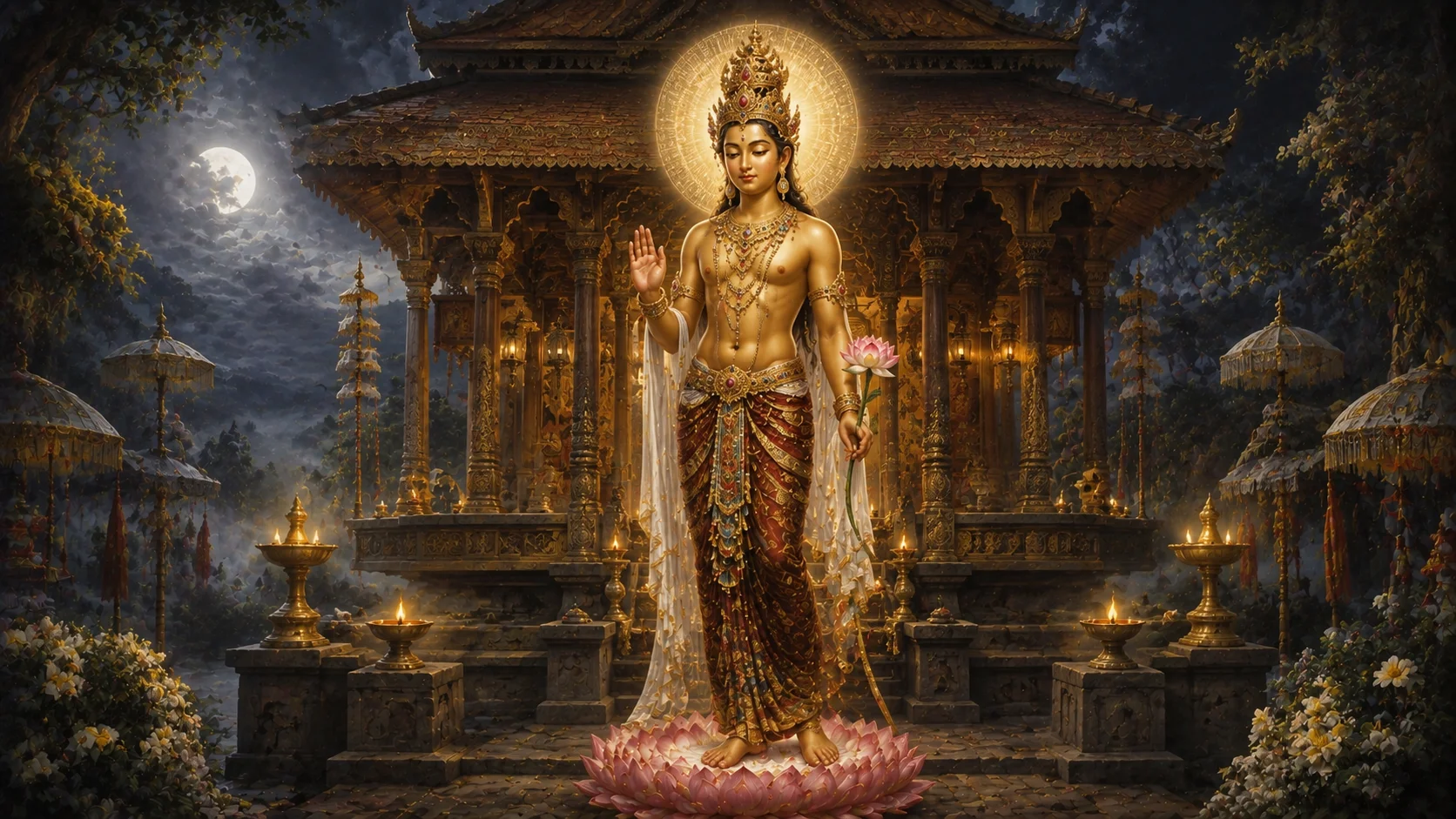
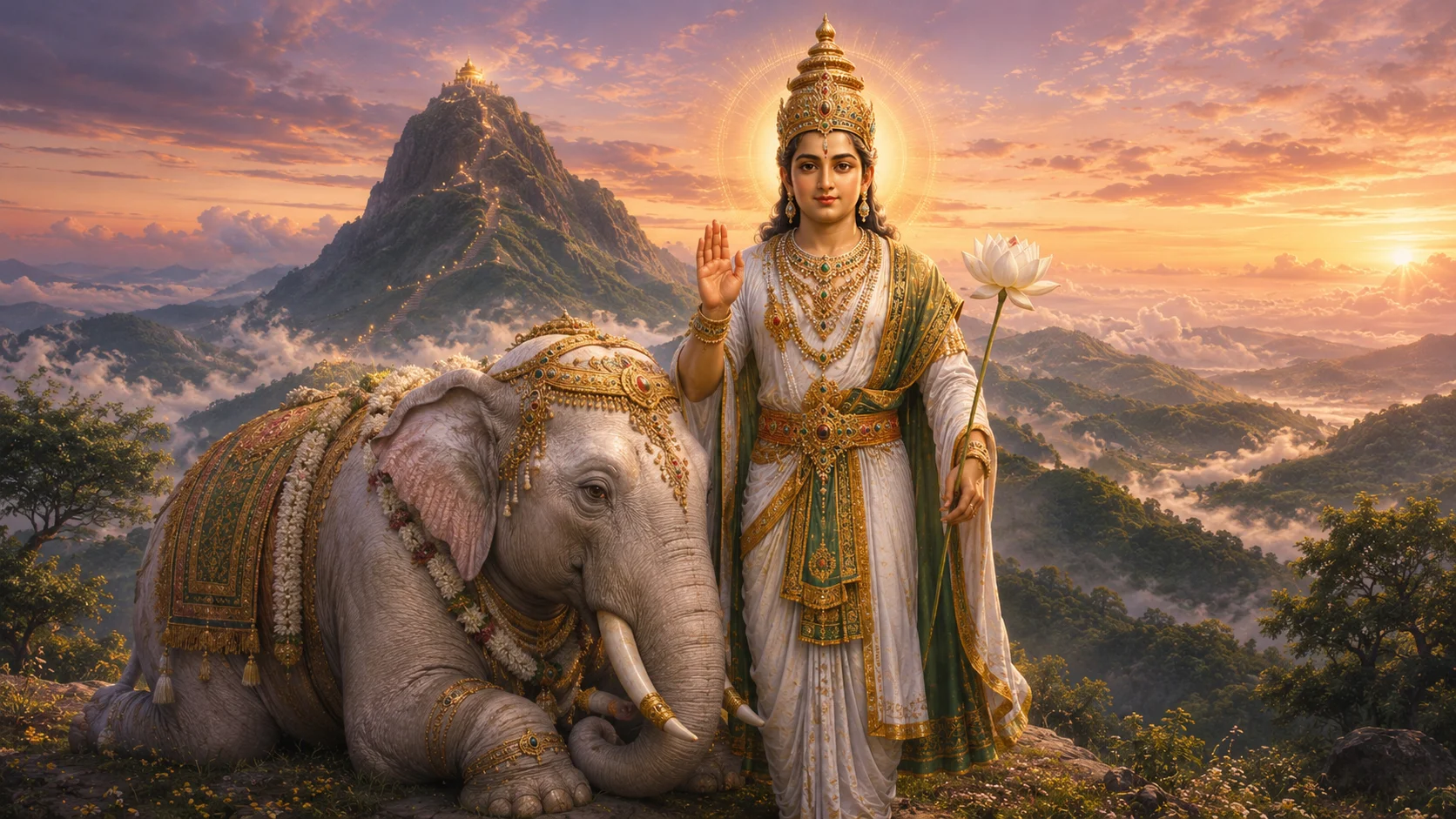
Iconographic convention presents Saman Deviyo as a youthful and benevolent figure, often depicted white or fair-complexioned, seated or standing in association with an elephant — a recurring vahana, or mount, in his portrayal at devale shrines — and sometimes shown holding a lotus flower. These details are drawn from devale statuary and mural tradition rather than from a single canonical scriptural source, and they vary in their particulars from shrine to shrine and across periods. What persists across this variation is the consistent impression of gentleness and benevolence: a guardian rendered not as a fearsome warrior figure but as a serene and youthful protector, fitting for a deity whose domain is a place of pilgrimage rather than conquest.
The Maha Saman Devale
Near Ratnapura in Sabaragamuwa Province stands the Maha Saman Devale, the principal historic shrine dedicated to Saman Deviyo. As a devale — a shrine to a guardian deity, architecturally and ritually distinct from a purely Buddhist vihara, though frequently sited alongside one — it has functioned for centuries as the ceremonial heart of his veneration. The devale has undergone multiple historical reconstructions, including damage attributed to conflict in the Portuguese era and its subsequent restoration, a history of destruction and renewal not uncommon among the island's major devale sites. It hosts an annual perahera, a procession festival honouring Saman Deviyo, consistent with the broader devale-perahera tradition observed at other major guardian-deity shrines such as those of Kataragama and the Natha, Pattini, and Vishnu devales of Kandy.
What the Mountain Still Holds
Local tradition at Sri Pada also speaks of other guardian or attendant spirits associated with the mountain and its surrounding forest, though the specific named company that accompanies Saman Deviyo as chief guardian is far less uniformly attested across sources than his own central role, and is best approached with caution rather than presented as settled detail. Likewise, later syncretic or Hindu-influenced identifications of Saman Deviyo with other regional deity figures exist within folk tradition, but they are not uniformly accepted and should not be taken as settled fact. What is settled, and living, is this: the veneration of Saman Deviyo continues today as an active practice, not a relic of text or history. It is expressed each pilgrimage season on the paths of Sri Pada and each year in the rituals and perahera of the Maha Saman Devale — the guardian of the mountain still watching, in the eyes of those who climb toward him, over the footprint the Lord Buddha is said to have left in his keeping.
Sources & traditions
- EncyclopediaWikipedia — Sumana Saman
- TraditionSinhalese Buddhist texts, oral tradition and village tellings (Sri Lanka)
Myths change from area to area and from time to time. This chronicle follows the most widely told versions; tellings in other villages, regions and eras may differ.