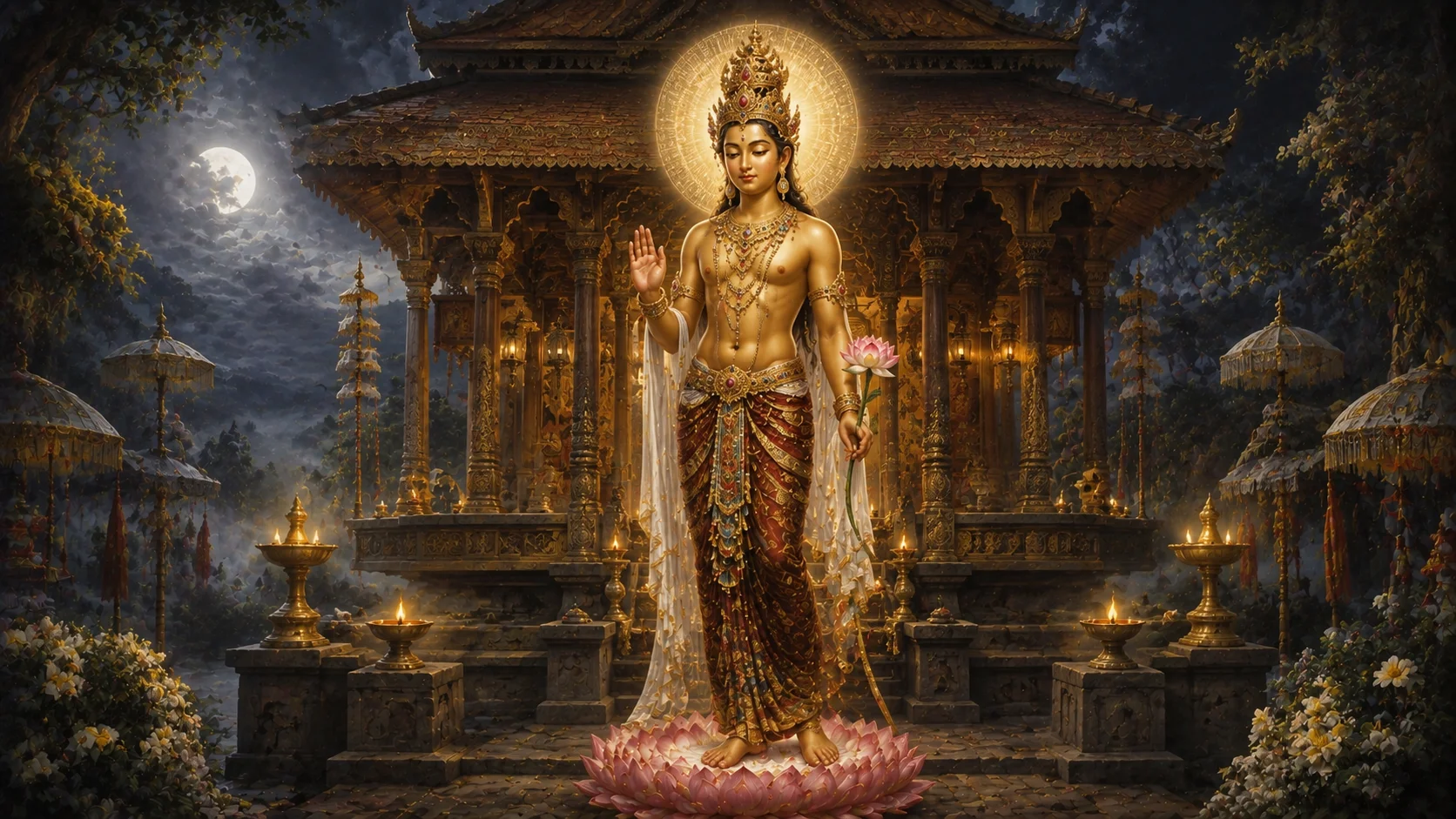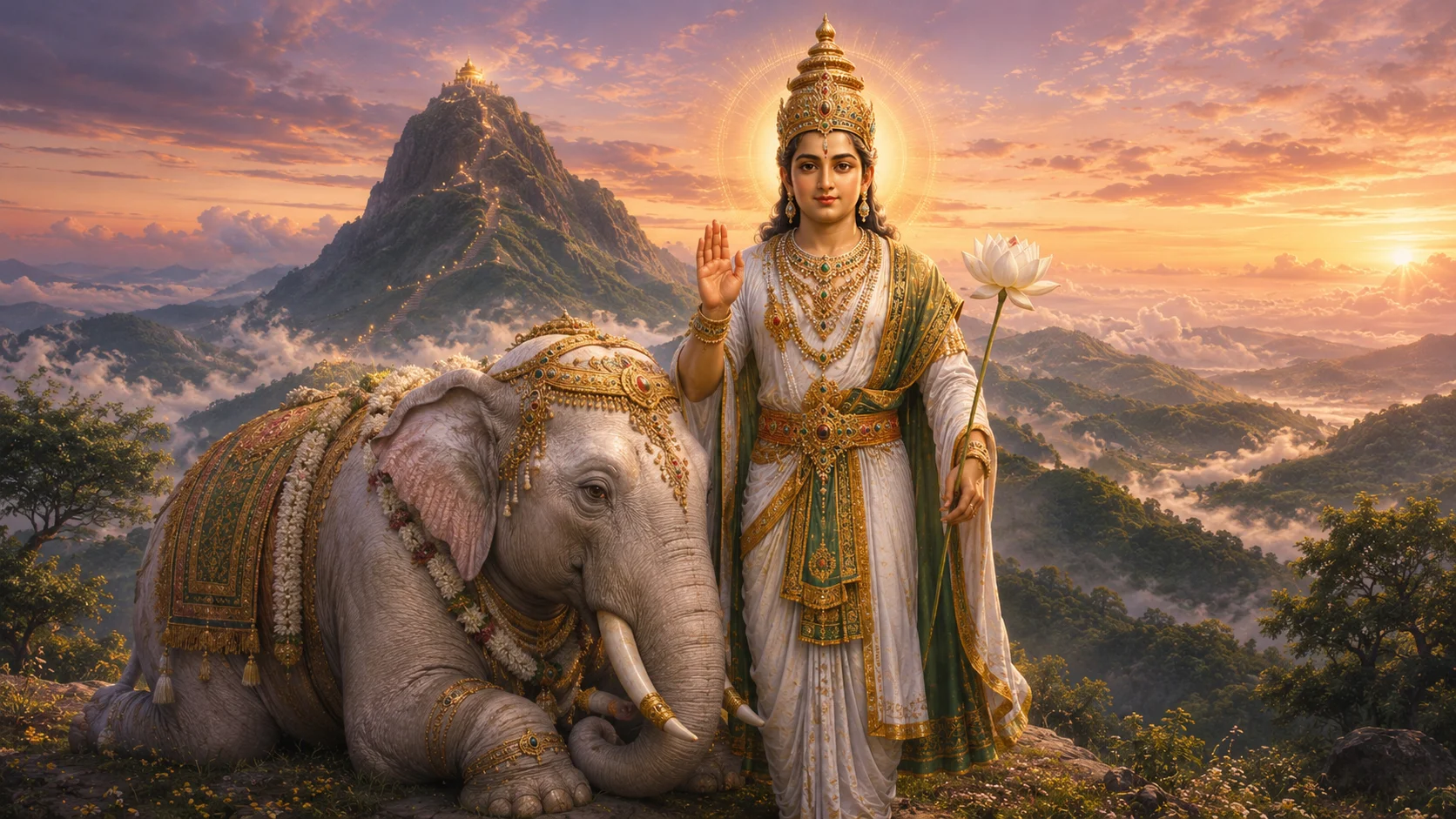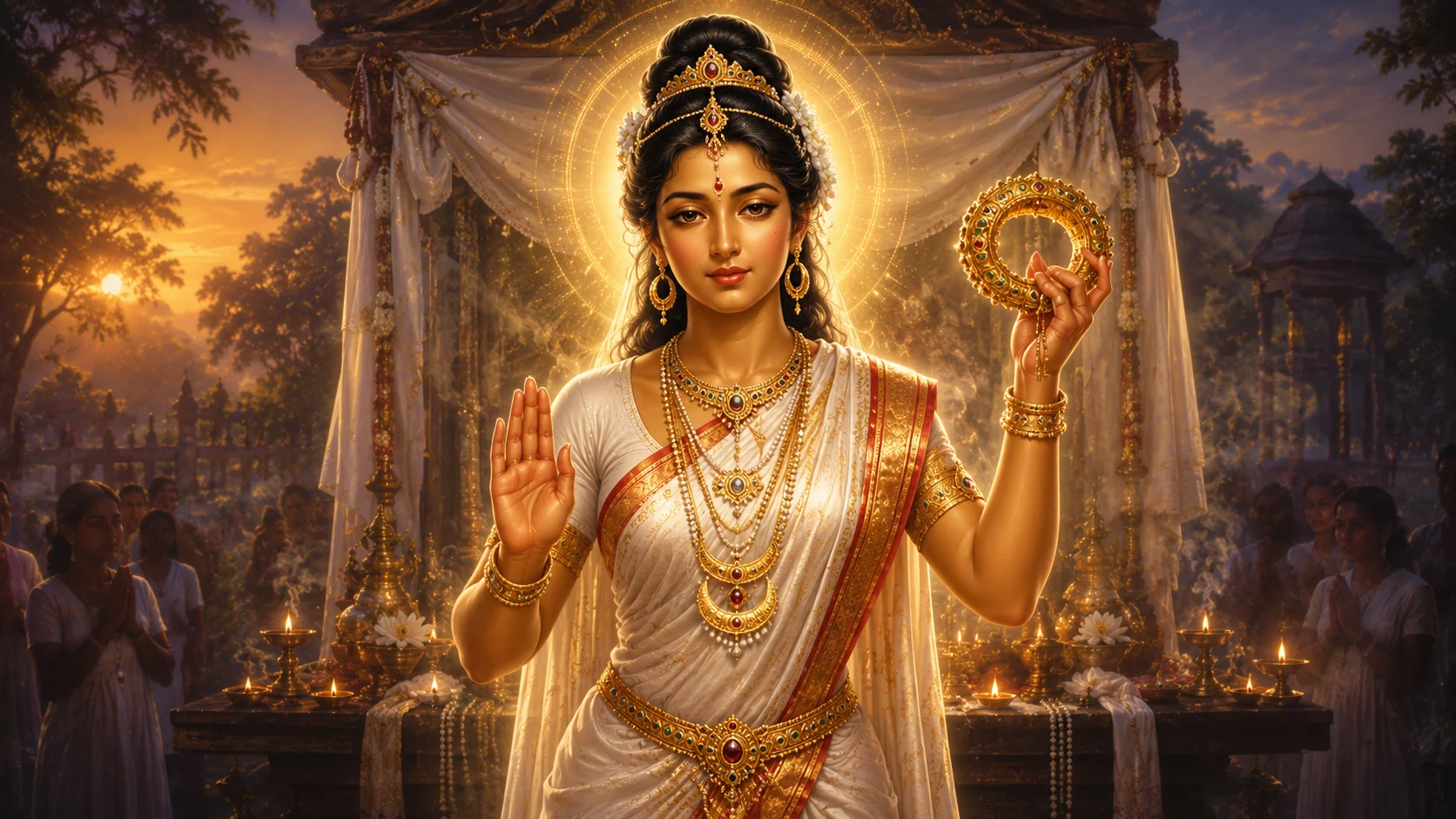
Pattini — the Goddess Pattini, Pattini Deviyo — is the great mother-goddess of Sri Lankan Buddhism, the deity of chastity, marital fidelity, health, and protection against disease, and the only major female figure among the island’s great guardian deities. A goddess of immense compassion and power, born of the legend of a wronged and virtuous wife who became divine, Pattini is invoked above all against epidemics and sickness, and as the divine guardian of women, virtue, and the wellbeing of the people.
The Goddess Born of Virtue
Pattini’s cult descends from the ancient South Indian legend of Kannagi, the heroine of the Tamil epic Cilappatikāram — the virtuous and faithful wife whose innocent husband was wrongly executed by the king for a theft he did not commit. In her grief and righteous fury, the chaste Kannagi proved her husband’s innocence, tore off her own breast and cast it upon the city of Madurai, and by the power of her virtue called down a fire that consumed the unjust city. Through the sheer force of her chastity and her wronged virtue she became a goddess — Pattini, the deified ideal of the faithful wife, whose purity is power.
Goddess of Health and Protection
In Sri Lanka, Pattini became above all a goddess of healing and protection against disease, especially the great epidemic illnesses — smallpox, measles, and the fevers — that once ravaged the island. In times of plague the people turned to her, and her cult included elaborate rituals and the gammaduwa ceremonies performed for the health and prosperity of whole communities. Her sacred emblem is the anklet (the very anklet by which Kannagi proved her husband’s innocence), and her power flows from her perfect virtue. She is a goddess of life, health, and the protection of the vulnerable.
The Divine Mother of the Island
Pattini is counted among the great guardian deities of Sri Lanka — in many reckonings one of the Four Guardian Gods, and the foremost goddess of the Sinhala Buddhist pantheon. She is revered as a compassionate mother-figure, the protectress of women and of marital fidelity, the guardian of health and of the moral order. Her worship, shared in varying forms by Buddhists and Hindus, and bridging Sri Lanka and South India, makes her one of the most important and beloved female deities of the region — the divine embodiment of virtue’s power to protect and to heal.
Legacy
Pattini endures as the great goddess of Sri Lankan Buddhism — the deity of chastity, fidelity, healing, and protection, born of the legend of the faithful Kannagi, the foremost female guardian of the island and its people. In her the tradition honoured the power of virtue, the protective compassion of the divine mother, and the hope of deliverance from disease. As the goddess whose chastity is power and whose mercy is healing, Pattini remains a beloved and potent deity across Sri Lanka and South India.
The King Who Carried Her Across the Water
Sri Lankan tradition does not simply borrow Kannagi’s story — it names the moment the goddess crossed the water. The Cilappatikāram itself records that a king of Lanka stood among the rulers assembled when the Chera king Cheran Senguttuvan consecrated the first temple raised to Kannagi, and Sinhala chronicle tradition names that king as Gajabahu I, remembering him returning home with the insignia of the goddess — her anklets — and planting her cult in the soil of the island. Historians argue hard over how literally to take any of it; the meeting of those two records is one of the most disputed dates in South Asian chronology. The story does real work regardless: it explains how a goddess born inside a Tamil epic became, within a few centuries, one of the most thoroughly Sinhalese of all deities, worshipped in villages that had never heard of Madurai.
Born From a Mango, Not From a Womb
Village Sri Lanka did not leave Pattini exactly as she arrived. Alongside the epic of Kannagi’s vengeance, the island’s ritual poetry gives its goddess a second and stranger origin: she is born from a mango rather than from a mother — a fruit that yields a divinity. It is a birth with no womb in it, and no wrong done yet. In this telling Pattini is not a woman remade by tragedy but a divinity who enters the world already whole and consents to live a human life. The two accounts are not rivals; they stand side by side in the same ritual calendar, each answering a different question — the epic explains her fury, the mango explains her innocence.
The Fourth Shrine at the Temple of the Tooth
In Kandy, Pattini stands at the very centre of the island’s Buddhist establishment. Four devales — shrines to four guardian deities — are set around the Sri Dalada Maligawa, the temple that holds the Lord Buddha’s tooth relic: Natha, Vishnu, Kataragama, and Pattini, the only woman among them. Her shrine keeps its own lay priests, the kapuralas, who tend her rites quite separately from the Buddhist monks next door — a division of ritual labour that runs through most of Sinhalese devotional life. When the great Esala Perahera fills Kandy’s streets each year with drummers, dancers, and caparisoned elephants, the procession from her devale takes its place among the four that escort the relic through the city.
Navagamuwa and the Ritual of the Horns
Beyond Kandy, the devale at Navagamuwa, in the lowlands east of Colombo, is counted the foremost of Pattini’s houses, and tradition ties its founding to the same king who is said to have carried her home. Her worship also produced one of the most startling rituals in the Sinhalese calendar: the ankeliya, or horn-pulling, in which two teams drawn from rival halves of a village locked curved wooden “horns” together and hauled against one another until one horn broke. It was performed as an act of devotion, yet the rivalry it staged ran hot enough that colonial officials moved against the ritual after it spilled into real village violence — a reminder that a goddess of order and virtue could preside over a ceremony built entirely on contest and rupture.
Kannaki Amman: One Goddess, Two Congregations
Pattini’s story never stopped belonging to the Tamil communities of Sri Lanka. In Hindu temples across the island’s east above all, and in the north, the same goddess is worshipped as Kannaki Amman — Kannagi herself, unmediated by any Sinhalese retelling, with her own priests, her own festival calendar, and her own long standing in Sri Lankan Tamil devotional life. Sinhala Buddhists and Sri Lankan Tamil Hindus reached her by different roads and keep different names for her, yet both trace their goddess to the same wronged wife and the same burning city. Few figures on the island make the kinship between its two great religious communities as plainly visible as she does.
Why a Goddess of Virtue Became a Goddess of Plague
It is worth asking why a story about marital fidelity should have turned, on Sri Lankan soil, into the island’s chief defence against epidemic disease. The answer sits in what Kannagi actually did: she did not merely suffer, she proved something — her husband’s innocence, her own uncompromised virtue — and the proof carried force enough to burn down a city. A people with no answer for the sicknesses that arrived in a village without warning reached for a power that worked on the same logic: not medicine, but a moral force absolute enough to turn affliction aside. Pattini’s cult does not ask the sick to understand disease. It asks them to stand close to a virtue so complete it once levelled a kingdom, and to hope that some of that force turns outward, toward them, rather than onward, toward ruin.
Sources & traditions
- EncyclopediaWikipedia — Pattini
- TraditionSinhalese Buddhist texts, oral tradition and village tellings (Sri Lanka)
Myths change from area to area and from time to time. This chronicle follows the most widely told versions; tellings in other villages, regions and eras may differ.