There is a place on every old Sri Lankan road where travellers still fall silent — the sandhiya, the three-way junction, where one path becomes two. Ask an elder why, and they will not laugh. They will lower their voice and tell you a name that has frightened this island for a thousand years: Mahasona, the Great Demon of the Cemetery.
But here is the question that makes his legend so unsettling — the question the old stories dare you to ask: what kind of horror is so terrible that even the gods could not simply destroy it, and instead had to stitch it back together from the body of a man and the head of a beast?
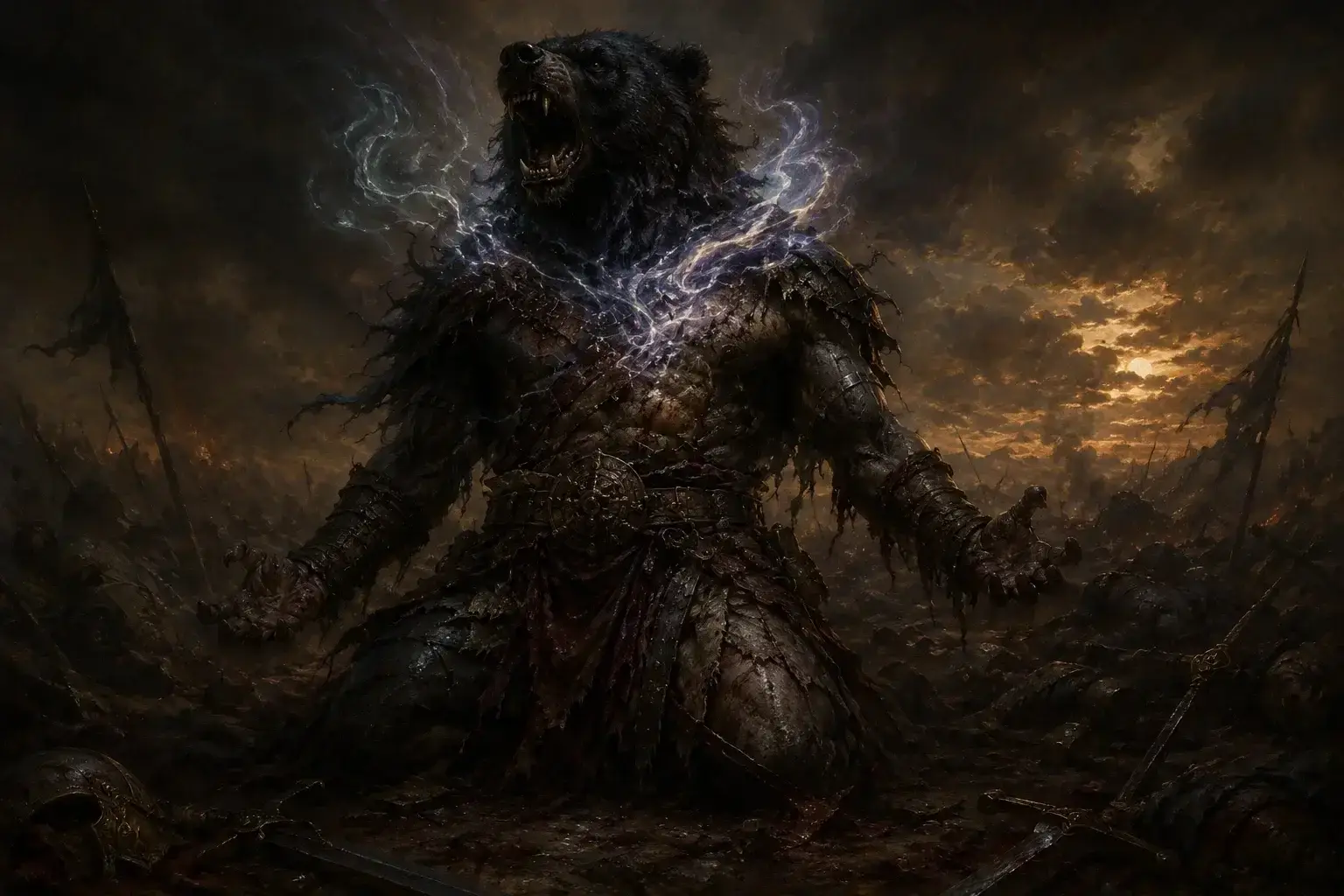
A Death That Did Not End
Before he was a demon, he was a champion. The chronicles remember him as Jayasena — a warrior of monstrous strength who, drunk on his own legend, challenged the giant Gotaimbara to single combat. It was not a fair fight. Gotaimbara struck once, and Jayasena's head left his shoulders before his body knew it had lost.
That should have been the end. In most stories, it would be. But the death of a proud and violent man is a dangerous thing, and Jayasena's rage did not die with him. Something lingered over the corpse — a fury too large for the grave.
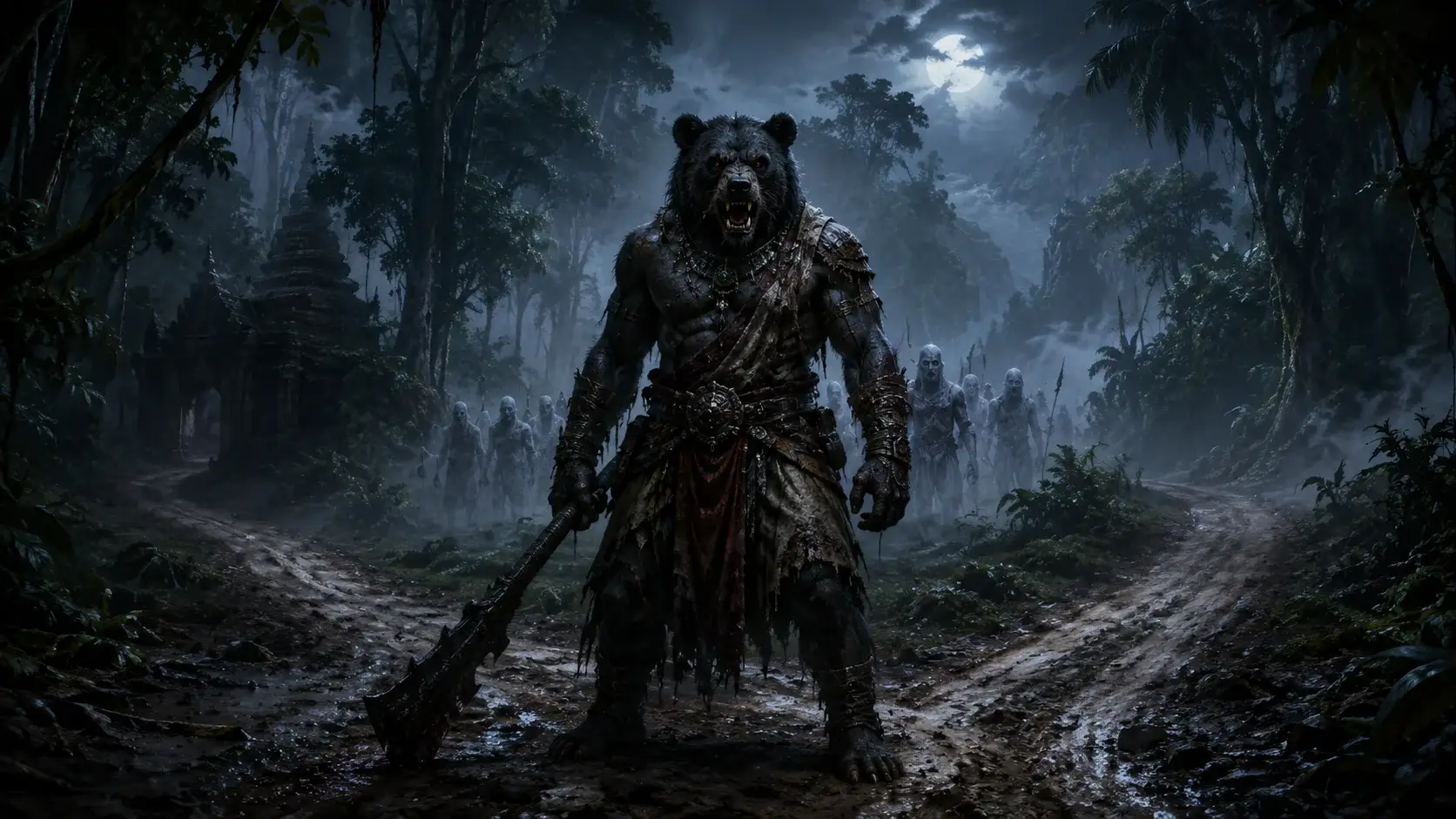
And then comes the detail that no one who hears it ever forgets. To raise him as a guardian-demon, a new head was needed for the headless body. The first creature to pass was a bear. So they took the bear's head and set it upon the warrior's shoulders — and Mahasona opened eyes that were neither animal nor human, and stood up into a new and terrible existence.
He wears the head of a beast and the wound of a man — and remembers being neither.
The Shadow That Carries Sickness
Mahasona does not hunt with claws. He hunts with presence. The folklore is precise about this, and that precision is what makes it crawl under your skin: it is said that if his shadow so much as brushes across you in the dark — at the cemetery, at the lonely junction, in the grey hour before dawn — you are already marked.
The victim does not feel a wound. They feel, instead, a slow wrongness: a fever that climbs and will not break, a wasting of the body, nights of delirium where they speak to someone no one else can see. Village memory blamed a whole category of mysterious, fatal illness on the touch of his shadow. To meet Mahasona was not to be attacked. It was to be chosen.
And he is never alone. The tradition gives him a retinue of thirty thousand spirits — an army of the restless dead moving with him through the night like a tide.
The Only Cure Is a Dance
Here the story turns from horror into something stranger and more beautiful. Because Sri Lanka did not only remember the demon — it remembered how to fight him. The answer was not a sword or a prayer alone. It was a performance: the Mahasona Samayama, an all-night exorcism of drums, fire, and masked dance.
Picture it. The sick person lies at the centre of a cleared courtyard. Around them, through the whole length of the night, drummers build rhythms that climb and break and climb again. Dancers in painted masks become the demon — taunting him, bargaining with him, daring him out of the body of the afflicted and into the open where he can be sent away. Offerings are laid. Torches roar. And the logic of it is profound: to defeat a thing of darkness and fury, you do not meet it with more fury — you meet it with art, with rhythm, with the entire community awake and unafraid until the sun comes up and breaks his power.
If the rite holds until dawn, the fever breaks. The demon is gone. The drums fall silent. And everyone present has spent the night staring straight at death — and outlasted it.
Why He Still Matters
It is easy to file Mahasona away as a scary story for children. But look closer and you find something older and sharper: a civilisation's attempt to give a face to the things that terrified it most — sudden sickness, the unquiet dead, the danger of the night road, the thin and frightening border between the living and the gone.
Mahasona is what fear looked like before we had other words for it. And the Mahasona Samayama is what courage looked like in answer: not a hero with a weapon, but a whole village refusing to let one of their own be taken without a fight.
Kin in the Dark
Mahasona does not stand alone in the island's demonology. He belongs to a feared company of yakku — among them Riri Yaka, the blood demon whose domain is wounds and madness, and Kalu Kumara, the Dark Prince who preys on the dreaming. Together they form a map of a vanished cosmology, one where every terror had a name, a story, and — mercifully — a ritual that could send it back into the dark.
So the next time you stand at a place where one road becomes two, and the light is going, and the silence feels a little too deep — you will know whose road you are standing on.
The Name Is a Place
In Sinhala he answers to more than one name. He is Maha Sohona and Maha Sohon Yaka as often as he is Mahasona, and every version of it is an address rather than a description. Maha is great. Yaka — from the Pali yakkha, the Sanskrit yaksha — is the demon-class that Buddhism inherited from an older Indian world and never quite tamed. And sohona is the cremation ground: the burning place, the patch of scrub beyond the last house where the dead are taken and the living do not go after dark.
That is the whole of him. He is not a demon who happens to haunt cemeteries; he is what the cemetery becomes when you give it a body. In the traditional layout of a Sri Lankan village the sohona sits deliberately outside the boundary — past the paddy, past the last lamp, in the direction nobody builds towards. Mahasona is the personification of that decision. Everything the village pushed to its edge, he rules.
There is a sharp irony buried here that the tradition never resolves. The charnel ground is also, in Buddhist practice, a place of discipline: monks have meditated among corpses for two and a half thousand years precisely to burn the illusion of permanence out of themselves. The same ground that produces the island's most feared demon is the ground where a monk goes to become fearless. Sri Lanka held both truths at once and did not blink. The cemetery is where you learn there is nothing to fear, and it is where the thing you fear most lives.
Anchored in the Age of Heroes
The story of Jayasena and Gotaimbara does not float free in time. It is pinned, deliberately, to the most heroic century the island remembers.
Gotaimbara is not a folk invention. He appears in the Mahavamsa, the great Pali chronicle of Sri Lanka, as one of the Dasa Maha Yodhayo — the Ten Great Warriors who served King Dutugemunu in the second century BCE, the champions whose strength the chronicle catalogues with obvious relish. These are the men of the island's founding war story, figures a Sinhala child still learns by name. The chronicle is even blunt about the joke in Gotaimbara: he was a small man. His name comes from the strength in his arms, not his height.
The demon's biography attaches itself to these men. Note what that does. It is not enough, in this tradition, for a demon to be old — he must be historically old, grafted onto the age of kings and chronicles, so that the fever in your child's bed tonight runs in a direct line back to a duel fought before the common era. The chronicle supplies the heroes; the later ritual and folk tradition supplies what happened to the loser. A monk's history and an exorcist's history, growing into each other over centuries until neither can be pulled loose.
Why a Bear, of All Things
Modern readers hear bear's head and picture something almost comic. Sri Lankans do not, and the reason is standing in the dry-zone scrub right now.
The island's bear is the sloth bear — walaha — and among the people who share country with it, it is reckoned the most dangerous animal in the jungle, ahead of both the leopard and the elephant. The reason is not appetite but temperament. Elephant and leopard hear a human coming and move away. The sloth bear is short-sighted, absorbed in whatever it is digging at, and reacts to being startled by charging — and the recorded injuries run to torn scalps, lost eyes, broken jaws. It is an animal that takes faces. In the dry-zone villages there is usually somebody who carries the proof of it.
So when the story says the first creature to pass was a bear, it is not reaching for an exotic monster. It is reaching for the one animal that already erases faces, and setting it on the shoulders of a man who has just lost his own head. Some tellings name a tiger instead, and at least one names a boar — but the bear is the version the island kept. And the tradition adds a detail that is easy to skate past: the head was fitted on backwards.
That is the whole horror in one stroke. It is not that Mahasona is part animal. It is that the join is visible and botched — a man's body carrying the thing that destroys men's faces, wearing it the wrong way round, permanently unable to be either.
Warrant: How a Demon Is Legally Bound
The single most misunderstood thing about Sinhala demonology is that it is not a war between good and evil. It is a hierarchy, and it runs on permission.
Above the yakku stand the deviyo, the gods; above everything stands the Lord Buddha. A demon may afflict a human being only under a varam or varama — a warrant, a licence, granted from above and bounded in scope and duration. The tradition traces the founding warrant to the Lord Buddha himself, who is said to have bound the yakku and set the terms on which they may touch the island at all. Mahasona is not free to do as he likes. He is a subordinate with delegated authority, and that is precisely the hinge on which the entire cure turns.
Because if the demon's power is a warrant, then it can be argued with. The exorcist's real weapon is not force but jurisdiction: he recites the demon's origin story back at him, names the authority that licensed him, establishes the limits of that licence, and demonstrates — publicly, at volume, with the whole village watching — that the warrant over this particular patient has run out. It is closer to a legal proceeding than a battle. The demon does not lose. He is dismissed.
This is why knowing the myth matters so much in practice. The origin story is not colour. It is evidence, and the exorcist must be able to recite it correctly or the case fails.
The Architecture of the Night
The Mahasona Samayama is built, not improvised, and it is built twice over — once in bamboo and coconut leaf, once in time.
In space, the family raises a temporary ritual structure in the swept yard: a frame of posts and crossbeams hung with young coconut fronds (gok kola), plantain stems, leaves and flowers, and set with trays of offerings — cooked rice, betel, flowers, oil lamps — each tray addressed to a specific power, because in this system you do not petition the universe in general. You petition by name. The enclosure is not scenery. It stands in for the demon's own country, built at the edge of the house so that the thing can be met on ground of the village's choosing.
In time, the rite runs the length of the night, and the mood is engineered to change with it. The evening is formal: invocation, offering, the drums establishing the rhythms that will carry everything else. The deep middle of the night belongs to the demon — the masked dancer, the torches, the handfuls of powdered resin (dummala) hurled into the flame of the pandama so that a soft yellow torch becomes a roaring flare and a face appears out of nowhere in the orange light. And then, towards morning, the tone breaks: the demon is drawn into comedy. He is mocked, out-argued, made ridiculous, reduced from terror to buffoon in front of an audience that has been awake and frightened for hours and now, at last, laughs.
That laughter is not a break in the ritual. It is the ritual — comic drama sits at the centre of these ceremonies, not at their margins. A thing you can laugh at cannot hold you, and the patient laughing near dawn with everyone else is the visible sign of the cure.
The men who do this are specialists. The edura or yakadura — also called kattadiya, drawn traditionally from the berava caste, whose right to perform these rites is hereditary — carries a memorised repertoire of invocations. The drum under his hands is the double-headed yak beraya, the low-country drum that gives this entire family of rituals its sound and its name. Nothing about the night is casual.
Four Different Powers, Four Different Rites
Outsiders flatten all of this into "Sri Lankan exorcism." The tradition is far more precise, and the first job of a practitioner is diagnosis — deciding which system the patient's affliction belongs to.
- Yaktovil — demon rites, including the Mahasona Samayama, for affliction traced to a yaka.
- Bali — rites addressed not to demons but to the planets, in which images of the planetary deities are moulded in clay, some of them three metres tall, and the malign influence of a planetary period is drawn out of the patient's horoscope and into the effigy.
- Kankariya — the great deity rituals of the up-country, above all the Kohomba Kankariya of the Kandyan districts, which invoke a collectivity of gods for prosperity and protection rather than expelling anything.
- Pirit — the monastic thread. Monks chant protective Pali suttas and tie a blessed cord at the wrist.
That last line needs a correction that is usually got wrong in both directions. Monks do not perform thovil: the drums, the masks and the offerings belong to the edura, not to the sangha. But it is not true that the monastery has nothing to say to the yakku. It has the Atanatiya Sutta, recited precisely to ward them off — and the difference is instructive, because the monastic version does its work by authority alone, restrained and quiet, where the exorcist's version does it by staying up all night and shouting.
So Sri Lanka has run two complete systems side by side for centuries without either swallowing the other: the monastery deals in merit and impermanence, the exorcist deals in warrants and offerings, and an afflicted family may quite reasonably use both in the same week. Mahasona lives entirely in the second system — and note that he is also distinct from the eighteen sanni demons of the Daha-ata Sanniya, each of whom owns one named disease. Mahasona is not one sickness. He is the cemetery itself.
How to Recognise Him
He is unmistakable in the carved mask tradition of the southern coast, where Ambalangoda has supplied the island's masks for generations.
Look for the join. Mahasona's mask is a beast's face on a demon's frame — a heavy snouted muzzle, protruding tusks, bulging eyes, and colouring that runs to blood-red and black rather than the paler tones given to gentler figures. The carving is deliberately overloaded: cobras coiling from the head, a mane of flame.
The texts go further than any mask can hold. They give him a height measured in tens of metres, skin the colour of blood, extra eyes and extra arms, a pike in one hand and a great animal gripped in the other whose blood he is drinking. Read that description again and notice what it is actually doing. It is not trying to be plausible. It is reproducing the sensation of the illness — the feeling of being an object, held, small, in the fist of something enormously larger than you.
The workshops that carve him carve everything else as well. Ambalangoda's families supply all three of the island's mask families: the raksha and demon masks for ritual, the sanni masks for the eighteen sicknesses, and the fifty-odd kolam masks — kings, headmen, villagers, bullocks, monkeys — for a village comedy that is watched rather than survived. The same street, the same chisel, the same hands. Sacred terror and popular entertainment are not kept in separate buildings here, and that is very characteristic of how the island keeps its demons: never quarantined, always within reach of the ordinary.
The Junction, the Hour, the Rule
Return to the three-way junction where this account began. It is worth saying why that particular geometry, and not the crossroads of European folklore.
The Sinhala term is tun man handiya, the meeting of three roads, and the tradition names his haunts flatly and without poetry: the graveyard, the big rocks and the hills, and the place where three roads meet. It is a category of dangerous ground rather than a metaphor. It is where boundaries fail — not one village and not the next, not a destination, a place that is only ever in between. Charms are set at such junctions. Offerings are left there. The same logic governs the hours, because the tradition is equally flat about when he takes people: at dusk, and at night, when they are alone. Those are the seams of the day, moments that belong to neither side.
Everything about Mahasona is built out of thresholds. A body that is neither man nor beast. A ground that is neither village nor wilderness. An hour that is neither night nor day. A state that is neither health nor death but the long wasting fever in between. He is not a monster who lives at the border. He is the border, given a shape so that it can be spoken to.
What Survives
Thovil is still performed in Sri Lanka. It is not a reconstruction and it is not a museum piece: families still call an edura, drums still go all night in coastal and rural districts, and people who work in offices on Monday will sit up in a swept yard on Saturday because someone they love is not getting better. Where the tradition is alive it deserves the present tense.
What has changed is the surrounding world. Hospitals now handle the fevers that folk memory once laid at Mahasona's feet, masks carved in Ambalangoda hang on walls in countries that have never heard the drum they were made to dance to, and thovil sequences are performed on festival stages for audiences who came to watch rather than to be healed. Some of that is loss and some of it is simply survival — a tradition finding somewhere to stand while its original job is taken over by a clinic.
But look at what the clinic does not take over. Someone is always sick without explanation. Somebody's family is always awake at three in the morning with nothing useful to do. What the Mahasona Samayama handed out on that night was work — a drum to hold the beat, a lamp to keep alight, a torch to carry, an offering to set down, a line in the argument to answer — and it handed it to everyone in the yard, at full volume, until it got light. Medicine took the fever. It has never yet taken the night.
Sources & traditions
- EncyclopediaWikipedia — Maha Sona
- TraditionSinhalese Buddhist texts, oral tradition and village tellings (Sri Lanka)
Myths change from area to area and from time to time. This chronicle follows the most widely told versions; tellings in other villages, regions and eras may differ.