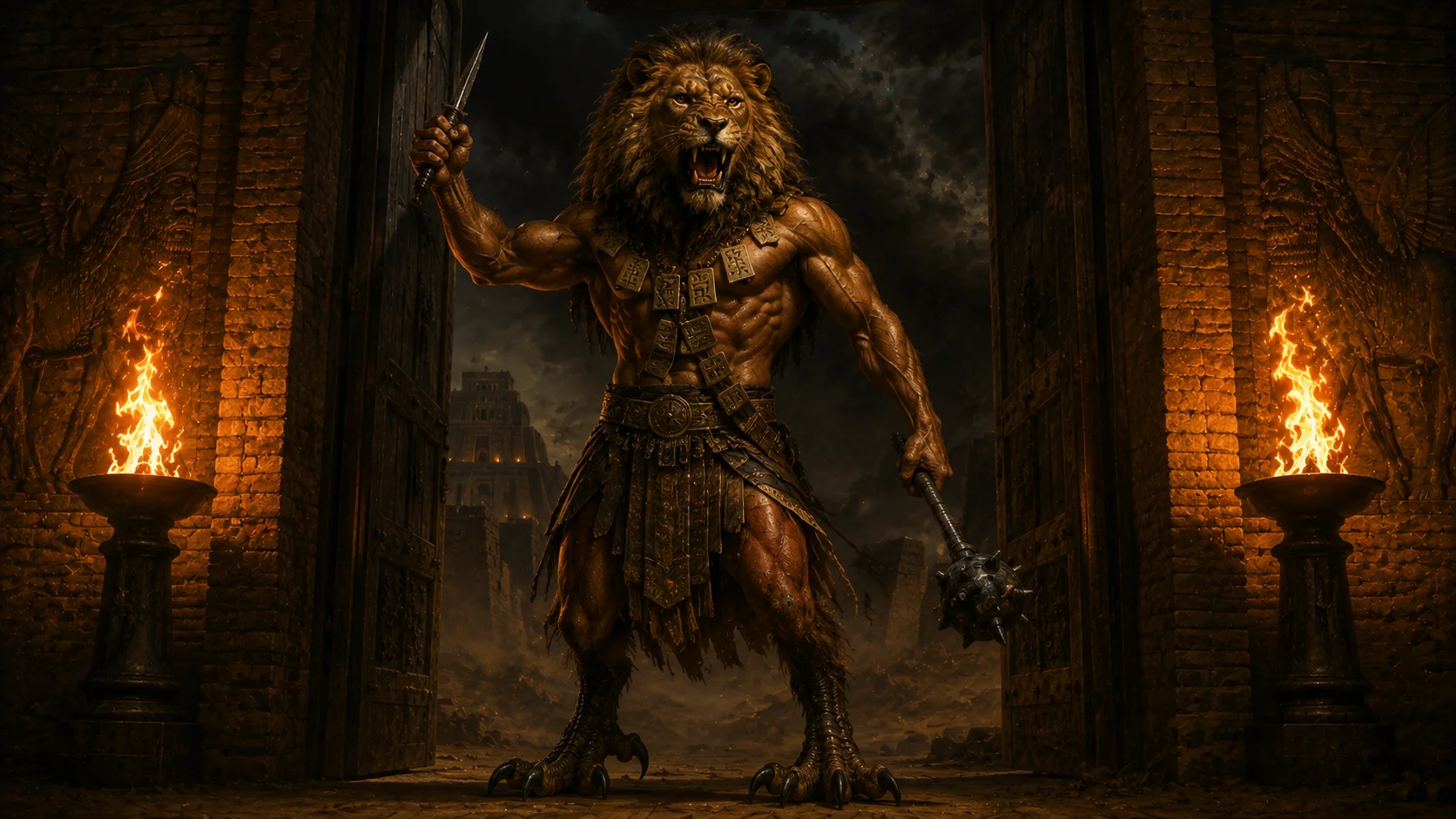
Ugallu, whose name means "Big Weather-Beast" or "Big Storm-Beast" in Akkadian — rendered in Sumerian as u4-gal-la, "great day" or "great storm," and sometimes translated from the logogram UD.GAL.LA as "Great Lion-Demon" — is one of the most distinctive hybrid guardians of Mesopotamian religion: a being with the roaring head and mane of a lion set upon a muscular human body, standing on taloned lion's feet. Attested across Neo-Assyrian apotropaic figurines and cylinder seals, Ugallu belongs to the wider Mesopotamian class of protective demons — spirits whose fearsome appearance served not to terrorize the households and temples they guarded, but to defend them.
A Name Written in Storm and Day
The name Ugallu carries the weight of tempest within it. In Akkadian it reads as "Big Weather-Beast," a title that ties the figure to the violent, unpredictable forces of storm and wind that so occupied the Mesopotamian imagination. Its Sumerian root, u4-gal-la, folds together the sign for "day" or "storm" with "great," a linguistic overlap that reflects how closely the ancient Mesopotamians associated the blaze of daylight with the crash of weather — both immense, both beyond full human control. Some translators of the cuneiform logogram UD.GAL.LA have rendered the name instead as "Great Lion-Demon," emphasizing the creature's most visible feature over its meteorological origin. Both readings are, in a sense, correct: Ugallu is a storm given a lion's face, a chaotic natural force made monstrous and then made manageable.
The Shape of the Rampant Lion-Man
Ugallu's iconography is unmistakable once learned. Neo-Assyrian craftsmen depicted the demon as a rampant lion-man: a lion's head, complete with mane, set atop a powerfully built human torso and human legs, the whole figure finished with the taloned feet of a lion rather than human ones. This hybridity was not incidental decoration but a deliberate visual grammar — the fusion of predator and human signaled a being that operated between categories, neither fully animal nor fully person, and therefore suited to stand at thresholds, the literal in-between spaces of a building. Figurines of this type have been recovered from Neo-Assyrian sites, their lion-headed silhouettes still legible after thousands of years, evidence of how widely and consistently the image was reproduced.
Guardian Wearing a Predator's Face
Despite the ferocity of its appearance, Ugallu's function within Mesopotamian magical practice was overwhelmingly protective. It belonged to the broad category of apotropaic demons — beings invoked or physically installed specifically to repel evil rather than to inflict it. This is a recurring and important feature of Mesopotamian demonology: many of the era's most monstrous-looking figures were not enemies of humankind at all, but hired terrors, set loose against other terrors. A homeowner or priest did not fear Ugallu; they relied on it, trusting that a creature dreadful enough to frighten off disease-demons and malevolent spirits was exactly the kind of protector a vulnerable threshold required.
Among Tiamat's Eleven
Ugallu's story does not begin as a guardian, however. Babylonian tradition, as preserved in the Enuma Elish, places Ugallu among the eleven monstrous warriors fashioned by the primordial chaos-mother Tiamat to fight against the champion-god Marduk. In that account, Tiamat armed herself for cosmic war by creating a host of terrible allies — among them the dragon-like Mushussu, the venomous serpent Bashmu, a company of scorpion-men, and Ugallu itself — a monstrous army meant to overwhelm the younger gods and preserve the old order of primeval chaos against the new. Ugallu's place in this list marks it as a being of formidable, even world-threatening power, no mere household spirit but a creature that once stood on the losing side of the struggle that shaped the cosmos.
Defeat, and a Different Kind of Service
Marduk's victory over Tiamat and her monstrous army is one of the central events of Mesopotamian cosmology, and what happened next to the defeated creatures is just as significant as the battle itself. Rather than being destroyed or erased from memory, tradition — as reflected in later apotropaic ritual texts — describes Tiamat's former warriors, Ugallu included, as repurposed: bound now to guard the very doorways and temples of the civilization that had defeated them. This conversion of chaos-monster into subordinate guardian is a recurring and deeply characteristic pattern in Mesopotamian religious thought, one in which victory did not mean annihilation of the losing side's power but its capture and redirection. Ugallu's claws and lion's roar, once instruments of Tiamat's rebellion, became instruments of the new order's defense.
Buried Beneath the Threshold
This transformation was not merely a literary or theological idea; it shaped real ritual practice on a massive scale. Ugallu was one of the standard figures in the sets of clay and bronze apotropaic figurines that were deliberately buried under thresholds, door sockets, and building foundations in Neo-Assyrian palaces, including at Nimrud, ancient Kalhu. These burials were prescribed by ritual programs — texts conventionally grouped under names like the Ritual for Warding Off Evil, and associated with the Mīs Pî ("mouth-washing") and namburbi traditions of protective and purification magic. A figurine of Ugallu placed beneath a doorway was not a decorative object; it was an active, consecrated defense, installed through precise ritual procedure to hold its post unseen beneath the floor for as long as the building stood.
A Company of Guardians
Ugallu did not stand watch alone. Assyrian apotropaic deposits typically arranged protective figures in sets, and Ugallu is listed among a company that included Lulal, the hairy hero-figure Lahmu — distinct from the deity of the same name associated with the primordial waters of the Apsu — the fish-garbed apkallu sages, and dog-headed or mushussu-form figures. These were often buried in groupings of five pairs, a deliberate ritual arrangement that suggests the Mesopotamians conceived of household and temple protection as a coordinated defense rather than the work of a single spirit. Ugallu's presence within this roster situates it as one voice in a larger chorus of guardianship, each figure contributing a particular form of vigilance against a particular category of threat.
In the Service of the Storm-Gods
Ritual and lexical texts also connect Ugallu to the retinue of powerful warrior deities, associating the lion-demon with Ninurta and, at times, with Marduk himself as a subordinate agent. This placement makes sense within the broader logic already described: having been conscripted after Tiamat's defeat, Ugallu's continuing power was understood to operate under the authority and command of the gods who had proven themselves masters over chaos. Ugallu's ferocity was not diminished by its change of allegiance — if anything, its usefulness as a guardian depended on that ferocity remaining intact — but its violence was now channeled, directed by higher divine will rather than exercised on its own account.
Paired at the Doorway with the Bull-Man
Among the most consistent details of Ugallu's ritual deployment is its frequent pairing with the kusarikku, the bull-man, in apotropaic figurine deposits. The two figures were commonly set to flank a doorway together, one guardian on each side, forming a matched defense against demonic incursion, disease-bearing spirits, and general misfortune. This pairing pattern — lion-headed guardian and bull-headed guardian, standing shoulder to shoulder at the threshold — reflects a Mesopotamian visual and ritual convention in which symmetry itself carried protective meaning, the doorway sealed on both sides by beings whose hybrid, more-than-human strength was thought sufficient to turn back whatever might try to cross.
A Figure Recognized in the Wider Art of Lion-Demons
Lion-headed imagery of this general type appears widely across Mesopotamian glyptic art, from cylinder seals and orthostat reliefs of the Old Babylonian period through the Neo-Assyrian era, and scholars are careful to note that not every lion-headed figure depicted in this long visual tradition can be confidently labeled Ugallu specifically without accompanying inscriptional evidence. The type was popular and recurring, drawn upon across centuries, and it is only where text and image meet — where a label or a securely identified ritual context survives — that a given lion-headed figure can be tied with certainty to Ugallu's own name and story rather than to the broader family of lion-demons it belonged to.
Named in the Catalogues of Demons
Ugallu also appears within the great incantation series known as Utukkū Lemnūtu, "Evil Demons," a corpus that catalogues the many classes of harmful and protective spirits recognized in Mesopotamian magical practice and invoked or exorcised according to precise ritual formula. Its inclusion in such a catalogue underscores how systematically the Mesopotamians classified their supernatural world, sorting spirits by kind, origin, and function so that the correct ritual response — protection, invocation, or banishment — could be applied to each. Ugallu's place in this taxonomy, alongside its appearance in the burial rituals already described, shows a figure whose identity was carefully fixed within both the textual and the physical dimensions of Mesopotamian religious life.
Confirmed by the Figure's Own Inscribed Name
The identification of Ugallu with this specific lion-headed figurine type rests on firmer ground than art history alone. Some Neo-Assyrian apotropaic figurines excavated at Nineveh and Nimrud carry inscribed labels that name the figure explicitly as Ugallu, removing ambiguity from at least a portion of the surviving evidence. This inscriptional confirmation is central to the modern scholarly understanding of the figure, most thoroughly analyzed in F. A. M. Wiggermann's standard study, Mesopotamian Protective Spirits: The Ritual Texts (1992), which remains the key modern source for establishing both Ugallu's identity and its precise ritual function within the broader system of Mesopotamian apotropaic magic.
Chaos Conscripted into the Defense of Order
Taken as a whole, Ugallu exemplifies one of the most distinctive theological patterns in Mesopotamian thought: the conviction that agents of primordial chaos, once subdued by a champion deity, need not be destroyed to be neutralized. Instead they could be conscripted, their raw power redirected into the service of the very civilization they had once threatened — set to guard temples, palaces, and private homes against the disorder they themselves had once embodied. Ugallu's long journey from one of Tiamat's eleven monstrous warriors to a lion-headed sentinel buried beneath the doorsteps of Assyrian palaces captures, in a single figure, the Mesopotamian conviction that order is not achieved by eliminating chaos but by binding it, turning its own terrible strength outward against every new threat that might come knocking at the threshold.
Sources & traditions
- EncyclopediaWikipedia — Ugallu
- TraditionAkkadian texts, inscriptions and later retellings (Mesopotamia)
Myths change from area to area and from time to time. This chronicle follows the most widely told versions; tellings in other villages, regions and eras may differ.