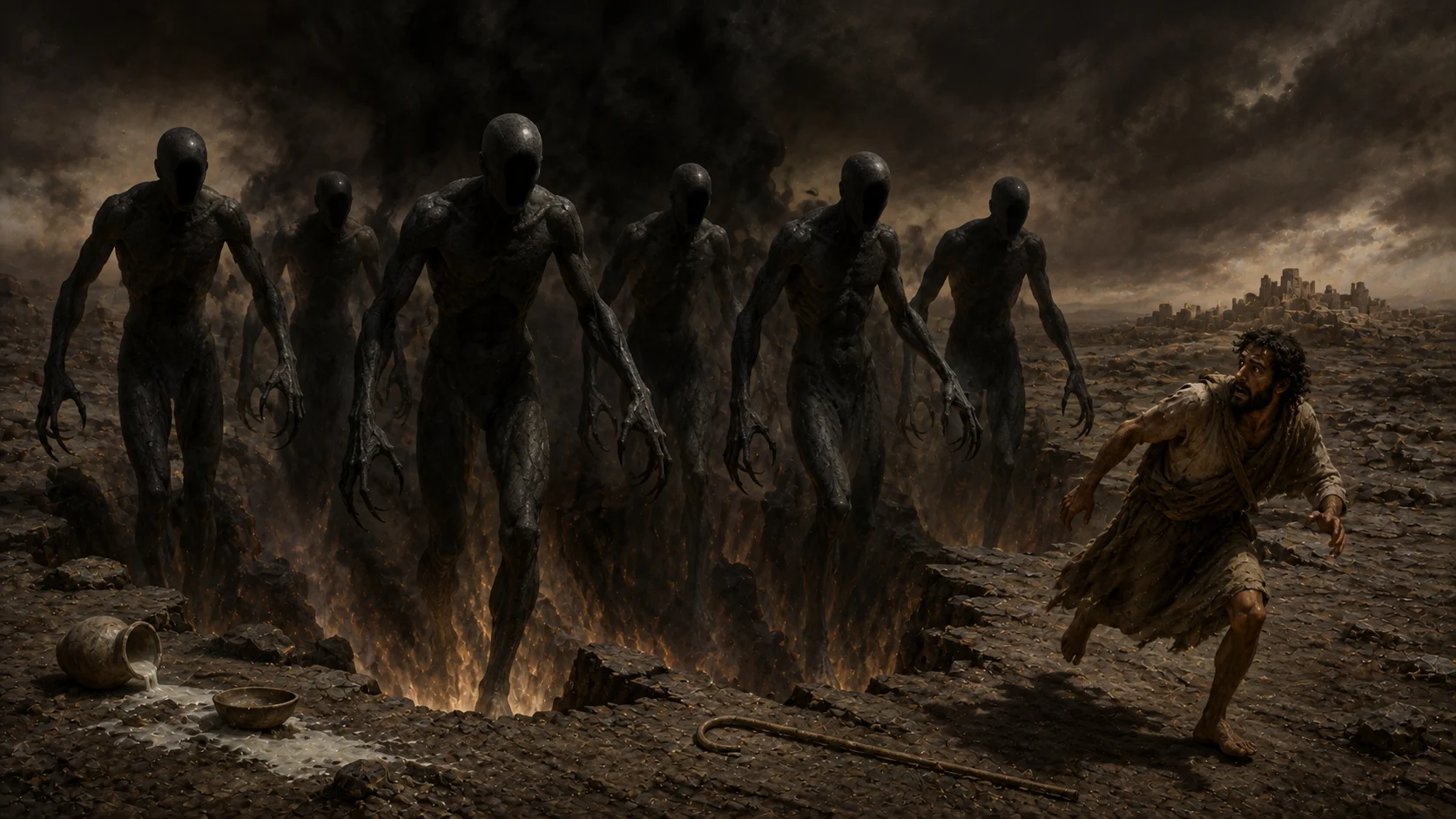
Gallu — Akkadian gallû, rendered in Sumerian as gal5-lá — names a class of underworld demons in Mesopotamian religion rather than a single unique being. In the oldest texts "the Gallu" is a collective: a body of enforcers bound to the service of the dead, dispatched whenever the law of the netherworld requires a body to be taken. Later Akkadian usage, and further still in modern popular retellings, sometimes narrows the plural into one named figure, a singular demon called simply "the Gallu." Both usages exist in the record, and neither should be allowed to swallow the other — the demon-class is the older and better-attested sense, and the individualized Gallu of later fashioning is a separate, secondary development from it, not proof that a lone Gallu was always meant.
The Class Behind the Name
To speak correctly of the Gallu is to speak of a category of spirit, one entry among the crowded ranks of Mesopotamian demonology. The great compiled series of incantation literature, works such as Utukkū Lemnūtu — "Evil Demons" — set the gallû alongside other classes with their own names and their own natures: the utukku, the asakku, the alû. Each class had its habits, its dangers, its proper counter-rite. The gallû were reckoned distinct from these neighbors even where their menace overlapped, and Mesopotamian scholars and exorcists clearly thought the distinctions mattered enough to preserve them across centuries of copying. To flatten all these classes into one interchangeable "demon" is to lose exactly the kind of careful taxonomy the ancient sources themselves insisted on keeping.
Sent Up From the Land of No Return
The gallû's clearest and best-known role belongs to the Sumerian and Akkadian myth known as Inanna's, or Ishtar's, Descent to the Netherworld. Inanna travels down into the realm of the dead and is held there, and only escapes by the intervention of powers above who secure her release. But the underworld's law is exact and does not bend for a goddess: no one leaves the land of no return, the kur-nu-gi-a, without providing a substitute to remain in their place. To enforce that law, Ereshkigal, queen of the dead, sends the gallû demons up with Inanna as she returns to the world of the living. Their task is not vengeance and not appetite. It is enforcement — the fixed requirement of the underworld's own order, carried out by agents whose only function is to see that the ledger is balanced.
What They Would Not Take
The text is unusually precise about what separates the gallû from ordinary spirits of the dead. The formula recurs: they know no food, they know no drink. They do not eat the presented bread; they do not drink the poured water. No offering sways them, and no prayer turns them aside. This is a deliberate and repeated contrast with the ordinary ghosts, the etemmu, who could be placated by exactly such gifts — the funerary offerings that sustained the departed and kept them content in the world below. The gallû's refusal marks them as something categorically different: not the hungry dead, but the machinery of death's own law, untouchable by any of the customary transactions between the living and the departed. Where a ghost might be reasoned with, a gallû could not, and the myth makes a point of saying so more than once.
The Hunt That Followed Inanna Home
As Inanna makes her way back through the world with the gallû at her side, she is followed at every step by their demand for a substitute. The myth stages this as a procession of near-misses: figures she encounters who might be seized are spared, one after another, because each is found in mourning, in genuine grief, dressed in the marks of loss that show they have not forgotten her. The gallû, true to their nature, accept none of these as satisfying the law until the right substitute is found — they cannot be bought off with the wrong offering any more than they can be bought off with bread and water. The sequence builds toward a single figure who has not mourned at all, and it is there that the hunt ends.
The Seizing of Dumuzi
That figure is Dumuzi, in Akkadian Tammuz, Inanna's own husband. Found seated in splendor rather than grieving her absence, he becomes the one the gallû seize, and they drag him down to take the place Inanna has vacated in the land of the dead. This is the moment that defines the gallû's mythic character more than any other: agents of underworld law who pursue a divine consort with the same indifference they would show any other soul owed to the ledger. They do not choose Dumuzi out of malice toward him personally — the myth gives them no motive beyond the mandate itself — and that absence of personal cause is precisely the point. The gallû act only within their commission from Ereshkigal, and Dumuzi's fate is the working-out of a cosmic rule, not the object of a demon's private cruelty.
Kin Among the Host of Ereshkigal
In the underworld texts, the gallû do not act alone in the wider sense that other messengers and beings belonging to Ereshkigal's court appear alongside them. The netherworld of Sumerian and Akkadian literature is populated, not empty: gatekeepers, messengers, and other servants of the queen of the dead all have their roles in maintaining its order, and the gallû take their place among this retinue as her most feared instrument for retrieval rather than her only agent. Their standing within this court is that of enforcers specifically, distinguished from doorkeepers or heralds by the singular task of laying hands on the living or the returning dead and compelling them downward.
The Company of Seven
Some later Assyrian and Babylonian texts describe seven gallû demons acting together, a grouping that echoes a broader Mesopotamian pattern of demons appearing in sevens — comparable to the Sebitti, "the Seven," known elsewhere in the tradition. This sevenfold gallû is attested, but it is not universal: the exact number and the makeup of the group vary from text to text and across periods, and earlier or differently sourced material does not insist on seven at all. The pattern is worth naming precisely because it recurs rather than because it is fixed — sevens carried their own weight in Mesopotamian religious thought, and a gallû host cast in that number draws on that resonance without becoming the only correct count.
When the Word Outgrew the Myth
Beyond the Descent of Inanna, the term gallû broadened over time in Akkadian and Assyro-Babylonian incantation literature to describe any fierce, relentless demon afflicting a person with illness or misfortune. In this wider usage the word is less a proper name than a category of threat, invoked by name in protective and apotropaic rites meant to drive such an affliction away. The gallû of the exorcism texts is the same essential figure as the gallû of the underworld myth — pitiless, unmoved by pleading — but transposed from the single grand narrative of Inanna and Dumuzi into the everyday concern of a household or a sufferer seeking relief from sudden calamity.
Against the Exorcist's Circle
It was the āšipu, the exorcist-priest of Mesopotamian religious practice, who took up the gallû by name in the rites meant to counter them. These protective and apotropaic performances treated the gallû as a real and present danger to health and fortune, one that had to be named, addressed, and turned back through the proper ritual means — incantation, protective figure, and rite performed with precision, since the gallû's own nature made it deaf to ordinary bargaining. That the exorcist's repertoire needed to reckon with the gallû at all speaks to how seriously this class of demon was regarded outside the confines of the Inanna myth: not a figure confined to one sacred story, but a recognized category of danger that ordinary religious practice had to be equipped to meet.
A Face No One Can Confirm
Unlike Pazuzu or Lamashtu, whose iconography is secure and instantly recognizable across surviving plaques and amulets, no single image can be confidently and exclusively identified as "the Gallu." Scholarship has sometimes associated generic composite demon figures — hybrid forms combining human and animal features, monstrous in aspect — with the gallû class on plaques and protective amulets, but this attribution remains disputed rather than settled. The honest position is that the gallû, for all their vivid presence in the mythic and incantation texts, left behind no fixed and certain visual type of their own. Their power in the tradition rests almost entirely in the word and the narrative role, not in a settled image.
Weeping for the Shepherd
The seizing of Dumuzi by the gallû is not merely a dramatic incident within one myth — it is the founding event behind an entire cycle of mourning that persisted across Mesopotamian religious life. Seasonal rites lamenting Dumuzi, known in his Akkadian form as Tammuz, are attested in later Babylonian practice, and the memory of this mourning tradition reached far enough to be noted even outside Mesopotamia proper, as in the biblical reference to women weeping for Tammuz. The gallû's action against Dumuzi is thus bound directly to one of the major dying-god and fertility traditions of the ancient Near East: the demons who enforce the underworld's claim are, by that same act, the hinge on which a whole cycle of seasonal grief and renewal turns.
What the Merciless Ones Reveal
Taken together, the gallû embody a particular conception of the underworld that runs through Sumerian and Akkadian religious thought: a realm governed by inflexible cosmic law rather than by mercy, negotiation, or sentiment. Their refusal of food, drink, and prayer is not simple cruelty but the narrative expression of a law that answers to no appeal. In seizing Dumuzi they set in motion one of the central myths explaining death, mourning, and seasonal renewal within this tradition, and in the wider exorcism literature they stand as a name given to any affliction too relentless to be reasoned with. Whether understood as a single feared figure or, more properly, as the whole faceless class of underworld enforcers acting under Ereshkigal's command, the gallû remain a stark and carefully preserved piece of how this tradition imagined the boundary between the living and the dead, and what it cost to cross it.
Sources & traditions
- EncyclopediaWikipedia — Gallu
- TraditionAkkadian texts, inscriptions and later retellings (Mesopotamia)
Myths change from area to area and from time to time. This chronicle follows the most widely told versions; tellings in other villages, regions and eras may differ.