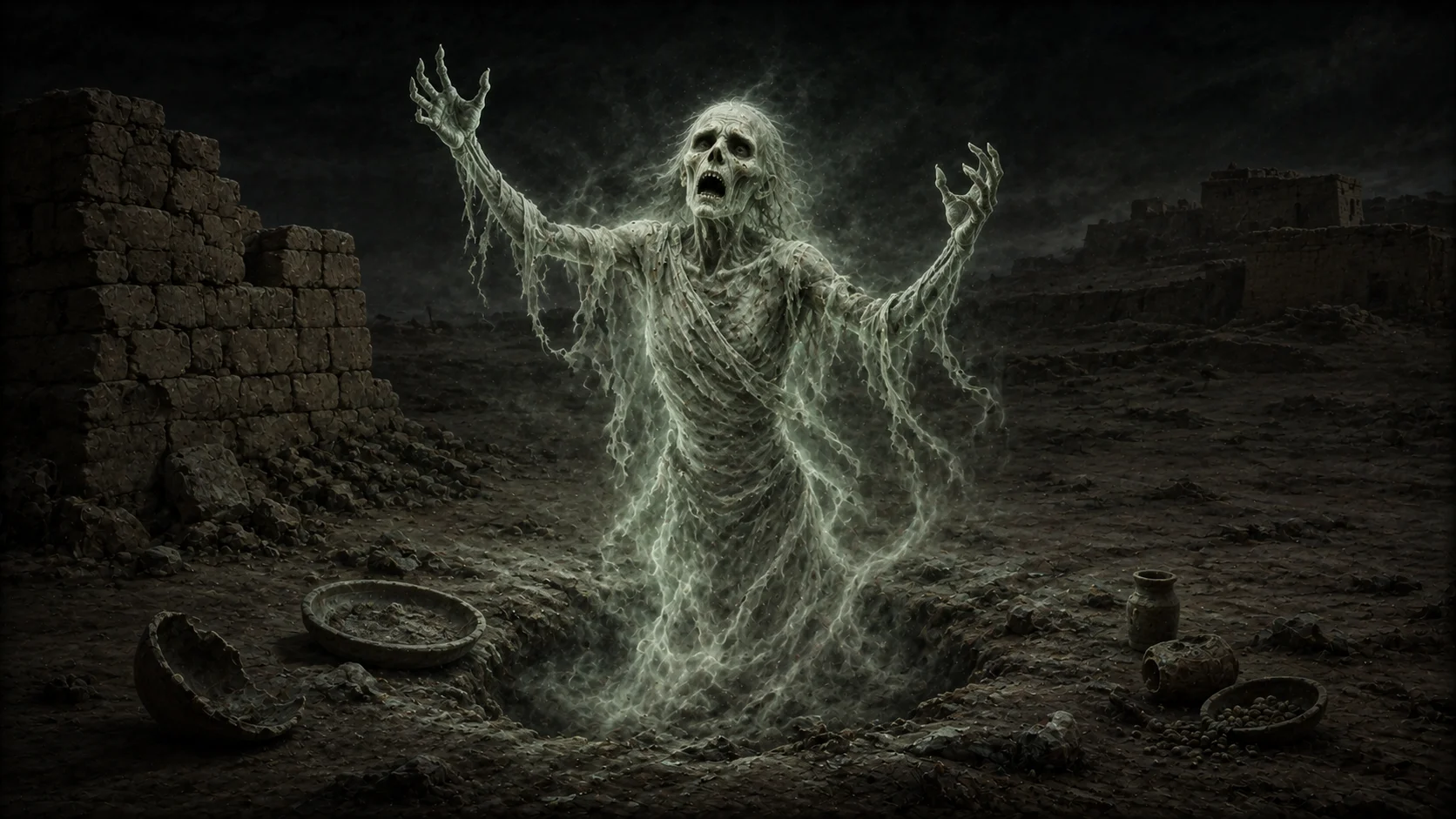
Edimmu, more precisely rendered etemmu in standard Akkadian (edimmu and ekimmu are variant transliterations found in older Assyriological and popular writing), is the term for the spirit of the dead in Sumero-Akkadian belief, and specifically for that spirit when it has become a restless, wandering, and dangerous presence among the living. It is not, in the surviving cuneiform sources, a distinct species of vampire or blood-drinker — that image belongs to modern popular fiction and should not be mistaken for the Mesopotamian tradition itself. What the ancient texts describe is something both simpler and, to the people who lived with the belief, considerably more frightening: an ordinary human soul, denied the care owed to it after death, that will not stay where it belongs.
What the Word Actually Names
Every person, in Mesopotamian understanding, possessed an etemmu, a spirit or ghost-self that survived the death of the body and descended into the netherworld. The word was not itself a name for a monster. It was closer to a general term, comparable to "spirit of the dead" or "shade," used of anyone once they had died. Whether that etemmu became a source of misfortune depended entirely on what happened next — on how the body was treated, how the person had died, and whether the living continued to attend to it. The malevolent, wandering ghost that later writers labelled edimmu or ekimmu is this same etemmu in its worst-case condition: uncared for, unsettled, and turned against the household it once belonged to.
The Realm Beneath and Its Queen
The destination of the etemmu was kur-nu-gi-a, "the land of no return," also called Irkalla, a shadowed underworld ruled by the goddess Ereshkigal together with her consort Nergal. Mesopotamian cosmology did not offer a reward for virtue there or a punishment for wickedness in the manner of later traditions; instead, the comfort or misery of the dead in Irkalla was understood to depend largely on how they had died and, crucially, on whether their descendants continued to sustain them from above. A spirit that arrived in Irkalla properly buried and properly remembered was expected to settle into a quiet, if dim, existence. A spirit that did not have these things could not settle at all.
The Bad Death
Certain deaths were understood to carry a particular risk of producing a wandering etemmu regardless of what the family did afterward. Dying violently, dying alone in the open desert far from kin, drowning, or simply going unburied — bones left exposed, never given to the earth — were all counted among the "bad deaths" that Mesopotamian belief treated as inherently unsettling to the spirit. Such a death interrupted the natural passage into Irkalla, leaving the etemmu caught at the threshold, neither properly among the dead nor able to remain among the living, and primed to become hostile even before any failure of ritual compounded the problem.
The Debt the Living Owed the Dead
Central to Mesopotamian religion was the kispu, the funerary offering: regular gifts of food, water, and beer poured out and set before the dead, typically the responsibility of the eldest son or, where none existed, a designated ritual substitute. This was not a onetime funeral rite but an ongoing obligation, performed on a recurring schedule for as long as the family wished its ancestors to remain at peace. The kispu was the mechanism by which the dead continued to be fed and remembered from beyond the grave, and Mesopotamian belief held this obligation with real seriousness: neglect it, and the etemmu who depended on it went hungry in the most literal cosmological sense.
When the Offerings Stop
It is precisely this neglect — the kispu withheld, whether through carelessness, poverty, a family line that died out, or simple forgetting — that the tradition names as the specific mythic cause of a peaceful etemmu turning into a hostile one. Deprived of the food and water it required, the spirit was believed to leave the underworld and return to the world of the living to demand what it had been denied. This is the core mechanism at the heart of the belief: the edimmu is not born evil, nor sent by a god as punishment upon a stranger. It is, in the most exact sense, a family's own dead, made dangerous by the family's own failure to remember them.
What the Returning Dead Were Said to Do
Once returned, the etemmu was understood to afflict its surviving relatives, and sometimes others, with illness, insomnia, and psychological distress — symptoms recorded and diagnosed in Mesopotamian medical-magical practice much as a physician today might record a case history. Being "seized" or "gripped" by the hand of a ghost was a recognised category of affliction, treated by the same specialists who treated demonic possession and other forms of magical harm. The etemmu's demand, in every account, remains consistent with its origin: it wants what it lacked in death, the offerings, the remembrance, the name spoken aloud, and it will not withdraw until it receives some form of that restitution.
Company Kept in the Incantation Tablets
The etemmu-ghost does not appear alone in the Mesopotamian catalogue of dangers. It is listed alongside classes of evil spirits such as the utukku, the alu, the gallu, and Lamashtu in the great incantation series known as the Utukku Lemnutu, "Evil Demons," and in the related Shurpu tablets, both compiled to name, diagnose, and expel the forces believed to trouble human life. Yet the texts preserve an important distinction: unlike the utukku, alu, gallu, or Lamashtu, all of whom are primordial demonic beings, the etemmu was once a person. It is grouped with these agents of misfortune functionally, by what it does to the living, but it remains categorically different in what it is — human grief and human neglect given a second, unhappy existence, rather than a demon that was always a demon.
The Exorcist's Work
Diagnosing and treating an attack attributed to a wandering etemmu fell to the asipu, the exorcist-priest, who worked from the same body of medical-magical literature that catalogued the ghost's symptoms in the first place. The asipu's task was to identify that a ghost, rather than some other spirit or a purely physical ailment, was responsible for a sufferer's illness or torment, and then to address the actual cause of the ghost's grievance. Because that grievance was almost always rooted in neglected rites, the remedy typically involved renewed funerary offerings and formal exorcism rituals intended to satisfy the etemmu and send it back to Irkalla, rather than punishment or banishment alone — the goal was resolution, not mere expulsion, since a spirit turned away without being fed would simply remain hungry and dangerous.
An Obligation That Reached the Throne
The duty of ancestor-offering was not confined to ordinary households. Royal inscriptions and texts such as the Genealogy of the Hammurabi Dynasty show Mesopotamian kings performing kispu for their royal ancestors, extending the same logic of remembrance and obligation to the level of the state. Because the rite carried real weight, it also carried real political stakes: disputed lines of succession are known to have invoked the obligation to perform ancestor-offerings as part of a claim to legitimate inheritance, meaning that who fed the royal dead was, in a very real sense, tied to who had the right to rule the living.
A Presence Without a Face
Unlike the great gods of Mesopotamia, who were given standardized cult statues and instantly recognisable iconography, individual etemmu or edimmu ghosts were not depicted in any securely attested visual tradition. They exist in the surviving record as textual beings, described in incantations and diagnostic lists rather than carved or painted. Apotropaic figurines and plaques were indeed buried at household thresholds as protection against demonic harm, including the alu- and utukku-type spirits, but direct, unambiguous evidence tying such objects specifically to edimmu is lacking, and any claim of a settled edimmu iconography should be treated as uncertain rather than established fact.
The Weight the Belief Still Carries
What the etemmu tradition preserves, above all, is the depth of the bond Mesopotamian society drew between correct burial, ongoing remembrance, and the wellbeing of the community as a whole. The belief system did not treat death as an ending that the living could set aside once the funeral was complete; it treated the dead as continuing dependents, owed food, water, and a name spoken, indefinitely. To fail in that duty was not merely disrespectful — it was understood to produce active, tangible harm, sickness and torment visited on the very family that had forgotten to feed its own ancestors. In this sense the edimmu stands not as an isolated monster but as the shadow cast by an entire ethical system: a warning built into the mythology itself that the debt owed to the dead does not simply disappear when the mourners go home, and that among the oldest and most widespread fears in the human record is the fear of the wronged dead returning to ask, at last, for what they were owed.
Sources & traditions
- EncyclopediaWikipedia — Edimmu
- TraditionAkkadian texts, inscriptions and later retellings (Mesopotamia)
Myths change from area to area and from time to time. This chronicle follows the most widely told versions; tellings in other villages, regions and eras may differ.