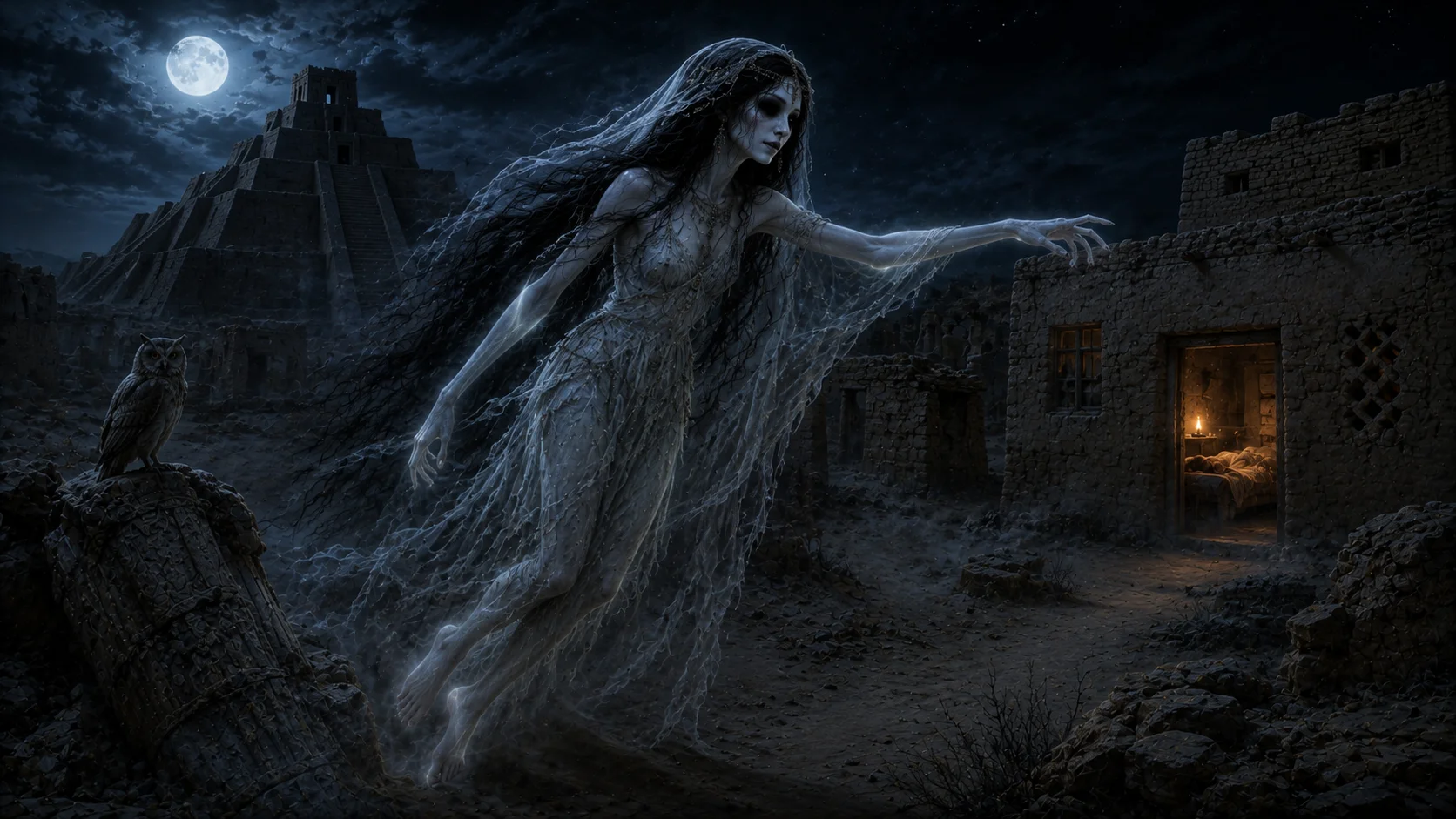
Ardat-Lili is a dreaded female night-demon of Akkadian and Babylonian lore, the restless, unwed spirit who haunts the dark in search of the love and motherhood denied her in life. Her name means roughly "maiden of the night" or "handmaid of Lilu," built from Akkadian ardatu, a young woman or maiden, joined to the broader class of night-spirits called lilû and lilītu to which she belongs. She is counted among the sinister trio of lilu-demons attested in Mesopotamian sources: the male Lilû, the female Lilītu, and Ardat-lilî herself — three distinct but closely related beings who appear together, again and again, in the incantation series of the exorcists.
The Maiden Frozen at the Threshold
At the heart of Ardat-Lili's character lies a single, unbearable image: a young woman who died before marriage, before childbirth, before she could become what Mesopotamian society expected every woman to become — a wife and a mother. Whether she is imagined as a ghost who perished in this unfinished state, or as a spirit fated from the start to exist outside the normal order of household life, the sources agree on the consequence. She does not rest. She remains fixed at the threshold of womanhood, unable to cross into the roles that would have completed her, and that arrested state curdles into something dangerous. As a restless ghost-demon she roams the night seeking to intrude upon human households, to insert herself where a wife or mother should be, and to claim by force or by stealth what was never rightfully given to her in life.
A Name Among the Udug-Hul
Ardat-Lili is not a figure of casual folk memory alone; she is a named and catalogued presence within the great Utukkū Lemnūtu — "Evil Demons" — incantation series, part of the larger Udug-hul corpus that formed a central pillar of Mesopotamian exorcistic literature. In these texts she appears among long rosters of malevolent spirits, invoked by name so that she might then be bound, addressed, and driven out. This placement matters: it tells us that Ardat-Lili was not a vague superstition whispered at the edges of belief but a recognized entry in the working demonology of the āšipu, the exorcist-priest, whose professional task was to know exactly which evil had entered a house and exactly which words would remove it.
Classed Among the Utukku and Rabisu
Within the formal taxonomy that Mesopotamian scholar-priests used to organize the unseen world, Ardat-Lili is classified as a type of utukku or rabisu-class demon — categories of malevolent, ambiguous spirits that stood apart from the great gods and from clearly defined divine beings. She is grouped, in the demonological lists, among the "evil udug" and "evil alû" — restless, dangerous entities drawn from the ranks of the improperly dead rather than from any divine genealogy. Unlike the great gods of the Mesopotamian pantheon, she has no attested parents, no spouse, and no offspring anywhere in the surviving corpus. She is not a goddess with a family history to be traced; she is a category of danger given a name, a condition personified rather than a person with a lineage.
Where Grief Meets Demonology
To understand why a dead, unmarried woman was thought capable of becoming something so feared, one has to understand the anxiety underneath her. Mesopotamian funerary custom held that the dead needed proper burial and, crucially, needed descendants to remember them and make offerings on their behalf. A person who died without marriage and without children had no one bound by duty to tend to their memory in this way — and a ghost deprived of that care was believed to become dangerous, aggrieved, and prone to wandering. Ardat-Lili represents this fear given a specific, gendered shape: the ghost of a woman whose proper life-course was interrupted, whose unfulfilled destiny as wife and mother became, in death, an active and hostile hunger. Her story ties funerary custom directly to demonology — improper death produces a wandering danger, and it falls to the living to manage it through ritual.
Through the Window, Into the Dark Hours
The texts describe her as entering houses through windows or cracks, particularly at night, targeting men in their sleep. This mode of entry — slipping through the small, overlooked openings of a home rather than through its guarded door — reflects a broader Mesopotamian understanding of demons as beings that exploit the vulnerabilities and negligences of ordinary domestic life. A house that seemed secure by day could still be breached in the vulnerable hours of sleep, when the sleeper's own vigilance was down and a spirit like Ardat-Lili could press her unwanted, phantom intimacy upon him. This structure — a female night-spirit intruding through an opening to visit sleeping men — bears a notable resemblance to the much later Jewish tradition of Lilith, though scholars are careful to stress that a direct, provable line of descent from Ardat-Lili to Lilith remains a hypothesis rather than a settled fact. The parallel is real and worth noting; the genealogy is not proven.
A Threat to the Marriage Bed and the Cradle
Ardat-Lili's danger was understood as running along two connected fronts. To men, she came as an unwanted phantom presence in sleep, associated with disruption of legitimate marriage and with sterility — the very fertility and family life she herself had been denied, she was thought to menace in others. To households more broadly, she was linked with miscarriage and infertility, disruptions to the proper working of procreation that Mesopotamian medicine and religion treated as inseparable concerns. She appears in medico-magical diagnostic texts, edited in the modern era by scholars such as R. Campbell Thompson and reworked in later editions of the Udug-hul material, as one of several possible causes — alongside Lilû and Lilītu — of nocturnal disturbances and reproductive troubles in both men and women. In this sense she was not only a nighttime terror but a diagnostic category, a name a physician-priest might reach for when a couple could not conceive or a pregnancy failed.
The Exorcist's Answer
Against a demon defined by intrusion into the household, Mesopotamian religion offered a correspondingly domestic remedy: ritual protection of the house and the bedroom itself. Incantations against Ardat-Lili formed part of the standard repertoire performed by the āšipu, typically recited alongside parallel rites addressing Lilû and Lilītu, since the three were so often treated as a linked threat rather than three unrelated dangers. The purpose of these rites was direct and practical: to bar her from entering a household, to close the cracks and windows through which she was believed to slip, and to protect the marriage bed from her interference. This was not abstract theology but applied ritual technology, deployed by a trained specialist on behalf of an anxious family.
A Face Never Quite Seen
Unlike some of the other great demons of Mesopotamian religion — Pazuzu with his instantly recognizable grotesque head, Lamashtu with her lion-headed, serpent-gripping iconography — Ardat-Lili has left behind no confidently identified monumental image. No relief or statuary has been securely attributed to her specifically. Occasionally, generic depictions of female night-demons found on protective amulets have been proposed by scholars as possible representations of her, but such attributions remain uncertain and disputed among Assyriologists. She survives, in other words, far more as a name and a function within incantation literature than as a visual figure with a settled artistic tradition — a demon known through what was said and recited about her rather than through what was carved or painted of her.
Disputed Boundaries Within a Shared Family
Even among specialists, the precise distinctions between Lilû, Lilītu, and Ardat-Lili are not fully settled. The three are consistently listed together in incantation series, treated as a related cluster of night-spirits rather than as entirely separate problems, and this close association has made it genuinely difficult for modern scholarship to draw firm lines around what, exactly, set Ardat-Lili apart from her two counterparts in the eyes of the ancient exorcists who invoked all three. What can be said with confidence is her particular emphasis: where Lilû and Lilītu carry their own associations within the wind-borne, night-haunting category of spirit, Ardat-Lili's defining trait, the detail that recurs and anchors her identity, is her characterization as the maiden denied marriage and motherhood — the unfulfilled woman whose grief becomes intrusion.
What Endures in Her Name
Ardat-Lili preserves, in a single figure, one of the oldest and most unsettling intuitions in Mesopotamian religious thought: that a life interrupted before its proper completion does not simply end, but persists as an active, restless force in need of ritual management. She is not a deity to be worshipped, and the surviving record grants her no parents, no husband, no children of her own — only a condition, translated into a name, invoked in incantations, and warded off at the window and the threshold. Treated within her own tradition and on her own terms, she stands as a reminder of how deeply Mesopotamian religion bound together funerary custom, medicine, and demonology: an unmarried death, in this worldview, was never merely a private sorrow, but a wound in the social and cosmic order that the living were obliged, carefully and ritually, to close.
Sources & traditions
- EncyclopediaWikipedia — Ardat-lilî
- TraditionAkkadian texts, inscriptions and later retellings (Mesopotamia)
Myths change from area to area and from time to time. This chronicle follows the most widely told versions; tellings in other villages, regions and eras may differ.