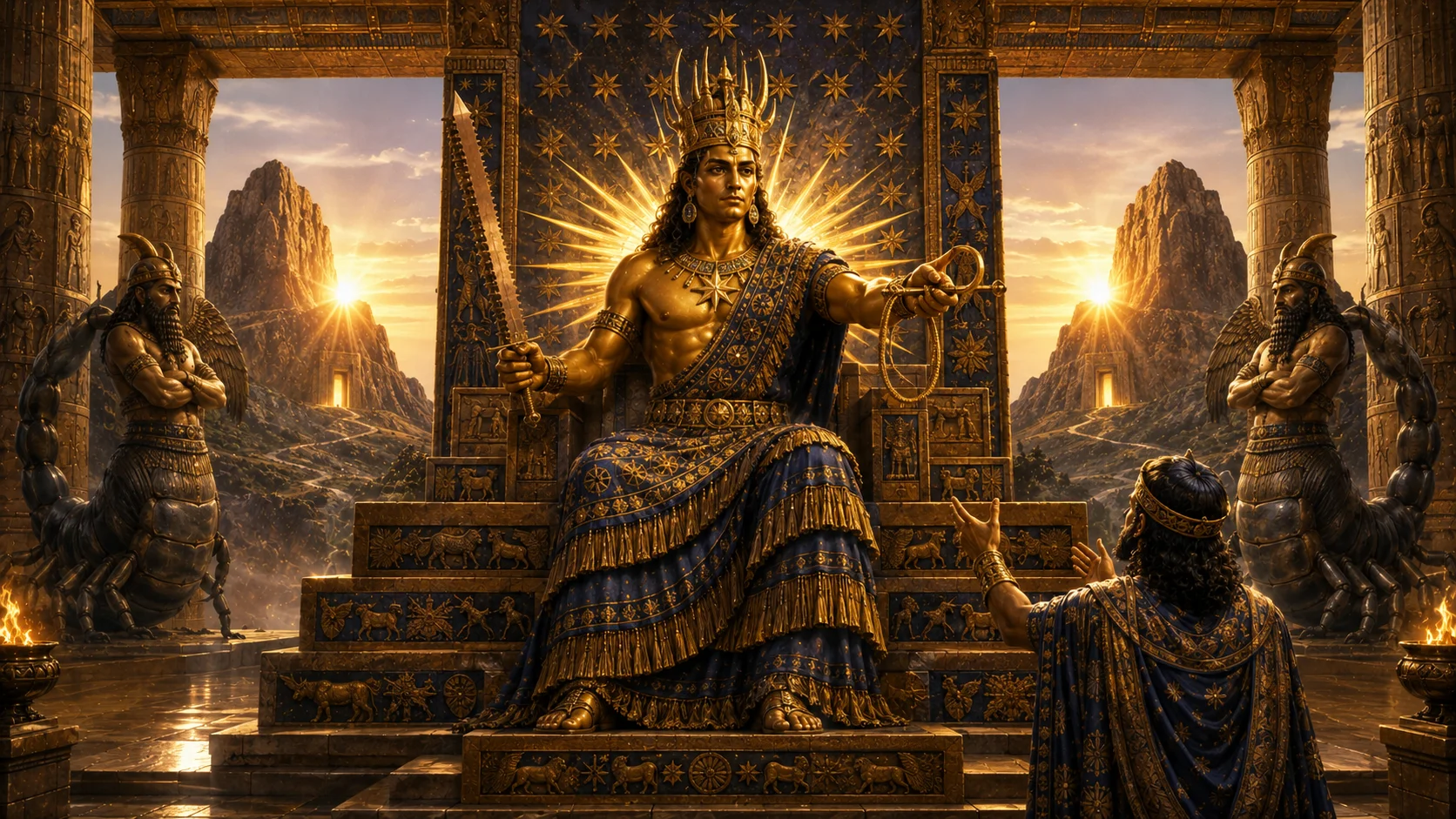
Shamash is the sun-god of the Akkadian world and the supreme lord of justice, the all-seeing eye of heaven who crosses the sky each day and beholds every deed done beneath it. To the Akkadians, Babylonians, and Assyrians he was the divine judge, the god from whom kings received the law and to whom the wronged appealed; for the sun that illuminates all things could hide nothing from his sight, and so the god of light became the god of truth. He is the Semitic heir of the Sumerian sun-god Utu, and across the long life of Mesopotamian religion the two names named the same radiant power, worshipped under one identity as it passed from Sumerian city to Akkadian empire.
Son of the Moon, Twin of the Morning Star
Shamash's place in the pantheon was fixed by birth. He was the son of the moon god Sin, known to the Sumerians as Nanna, and so the sun was reckoned the child of the night sky's own light-bearer, born each dawn from the darkness his father ruled. Beside him stood his twin sister Ishtar, the Sumerian Inanna, goddess of the planet Venus, and together with their father the three formed the great triad of astral deities: moon, sun, and the wandering star of the morning and evening. This triad was not merely poetic; it structured how the Mesopotamians read the sky itself, each god a visible power moving in ordered procession above the earth. Shamash's consort was Aya, called Sherida in Sumerian, the goddess of dawn, whose union with the sun-god marked the daily renewal of his light as it broke over the eastern horizon.
The Shining Houses of Sippar and Larsa
Shamash's worship centered on two great temples, both bearing the same name, E-babbar, the Shining House. In the north, at Sippar, and in the south, at Larsa, these temples stood as twin seats of his cult, attested from as early as the third millennium BCE and maintained across the long centuries of Sumerian, Akkadian, Babylonian, and Assyrian rule that followed. That his sanctuaries multiplied rather than concentrated in one city speaks to how thoroughly his worship threaded through Mesopotamian civic life; wherever kings needed a witness to their justice, the shining house of the sun stood ready to receive their offerings and their oaths.
The Journey Across the Vault of Heaven
Each dawn, the Mesopotamians taught, Shamash emerged through the gates of the eastern mountains, climbed the arch of the sky through the day, and at dusk passed through corresponding gates in the western mountains, descending to journey through the underworld by night before rising once more at daybreak. In the tradition preserved in the Epic of Gilgamesh, the eastern gates through which the sun passes are guarded by scorpion-people, fearsome sentinels who mark the boundary between the world of the living and the twilight lands beyond it. Because his light touched every corner of the earth in the course of this daily transit, nothing could be hidden from him: not the crime committed in secret, not the false oath, not the injustice tucked away from human eyes. Scholars note that the precise character of his nightly passage is not perfectly consistent across the surviving texts — the Sumerian hymns to Utu and the later Akkadian material do not always agree on how the sun's night domain relates to that of the other astral gods — but the core image endures unbroken: a god who sees by day what no darkness can conceal, and who carries that same unblinking sight into the hours when he himself is unseen.
Witness to Every Oath
Because he alone among the gods observed the whole of human action without interruption, Shamash became the necessary witness of all contracts, treaties, and sworn promises. To swear an oath in Mesopotamia was very often to swear it by Shamash, invoking the one power incapable of missing a broken word. Old Babylonian royal inscriptions call upon him as guarantor of treaties between kings, binding rulers to their word under the eye of a god who could not be deceived by distance, darkness, or the passage of time. This function bound the sun-god intimately to the machinery of law long before any human court convened, for the oath sworn before Shamash was already, in a sense, tried before the highest judge there was.
The Rod and Ring on the Stele of Hammurabi
Nowhere is Shamash's role as source of justice more vividly preserved than at the summit of the Code of Hammurabi, where the Babylonian king is carved standing before the enthroned sun-god, receiving from his hand the rod and the ring, the emblems of righteous authority. In this single image the entire Mesopotamian theory of kingship is made visible: earthly law does not originate with the king himself but flows down to him from divine justice, and he governs legitimately only insofar as he remains the faithful servant of Shamash's truth. The king who departs from that truth forfeits the authority the sun-god lent him. It is a theology of governance in which the throne is borrowed, not owned, and the lender is the god who sees everything.
Judge of Heaven and Earth
Among his many titles, Shamash was called Judge of Heaven and Earth, Light of the Gods, and the one who illuminates darkness — epithets that name in different words the same single office. He was understood to judge not only the affairs of mortals but disputes among the gods themselves, a position that placed him at the moral center of the Mesopotamian cosmos rather than merely at its physical one. The Great Hymn to Shamash, preserved in a Neo-Assyrian and Babylonian recension, praises him at length as the illuminator of all lands, the one whose light reaches every people and every place, and whose judgment falls with equal weight on gods and on the humblest of mortals. Few surviving compositions of Mesopotamian devotional literature match this hymn's sustained celebration of a single deity's moral authority.
Two Gods of the Oracle
Shamash presided also over the arts of divination, and above all over extispicy, the reading of omens in the entrails of sacrificial animals. Diviners of the Old Babylonian period and after, the baru priests, invoked him together with the storm god Adad as the two gods of the oracle, seeking from the sun's unerring sight the truth that no human eye could otherwise obtain. That seers turned to Shamash for this purpose follows naturally from everything else known of him: a god who witnessed all things was, by that same nature, the god best placed to reveal what was hidden, whether the hidden thing was a broken oath or the shape of what was yet to come.
Companion to Gilgamesh in the Cedar Forest
Shamash was not only a distant judge but an active helper of the just and the daring. In the Epic of Gilgamesh he stands as the patron of the hero Gilgamesh, invoked before the great expedition against Humbaba, guardian of the Cedar Forest, and answering that invocation with real aid: as Gilgamesh and Enkidu face the monstrous guardian, Shamash sends the thirteen winds against Humbaba, pinning the giant in place so that the two heroes might overcome him. It is one of the clearest portraits in Mesopotamian literature of a god intervening directly on behalf of a mortal he favors, and it marks Shamash as a deity of active providence, not only distant oversight. He appears likewise in the surviving material of the Atrahasis tradition, consistent throughout with his broader character as a power that sustains order against chaos.
Rays Upon His Shoulders
Mesopotamian artists rendered Shamash as a bearded god from whose shoulders rays of light streamed outward, marking him unmistakably among the seated or standing figures of divine art. He is frequently shown holding a saw-toothed knife, or the rod and ring of righteous authority later given to Hammurabi, and his presence is signaled on cylinder seals and on the boundary markers called kudurru by his solar emblem: a four-pointed star or rosette wrapped in wavy rays, the visual shorthand for the sun's own disk. This emblem traveled widely across the ancient Near East, carried on seals and monuments far from the temples where his formal cult was maintained, so that the sign of Shamash's disk became recognizable well beyond the borders of any single kingdom that worshipped him.
Light Against the Dark, Order Against Chaos
As the patron of travellers, who depend on the sun to find their way across unmarked country, and as the natural enemy of the demons and spirits said to flee before his rising light, Shamash occupied a role that extended his justice into the everyday: he was as much a practical guide through physical darkness as he was a moral guide through hidden wrongdoing. The two functions were never really separate in Mesopotamian thought. A god who lit the traveller's road and a god who exposed the perjurer's lie were the same power, applied to two different kinds of darkness — one that swallowed a path, and one that swallowed the truth.
The Enduring Image of the Radiant Judge
Shamash stands among the noblest conceptions of Mesopotamian religion, the marriage of the sun's daily miracle with the moral idea of justice, light made into law. Twin brother to Ishtar, son of Sin, husband of Aya, he bound the astral order of the heavens to the human order of courts, oaths, and kingship, so that a single god's rising and setting carried the weight of both cosmology and law. His emblem spread across the ancient Near East, and his role as divine lawgiver echoes in the legal and religious traditions that followed Mesopotamia, most visibly in the enduring image of Hammurabi receiving the rod and ring from his outstretched hand. As the radiant judge who sees all and wrongs none, the Akkadian sun-god endures as the very image of justice illuminated.
Sources & traditions
- EncyclopediaWikipedia — Shamash
- TraditionAkkadian texts, inscriptions and later retellings (Mesopotamia)
Myths change from area to area and from time to time. This chronicle follows the most widely told versions; tellings in other villages, regions and eras may differ.