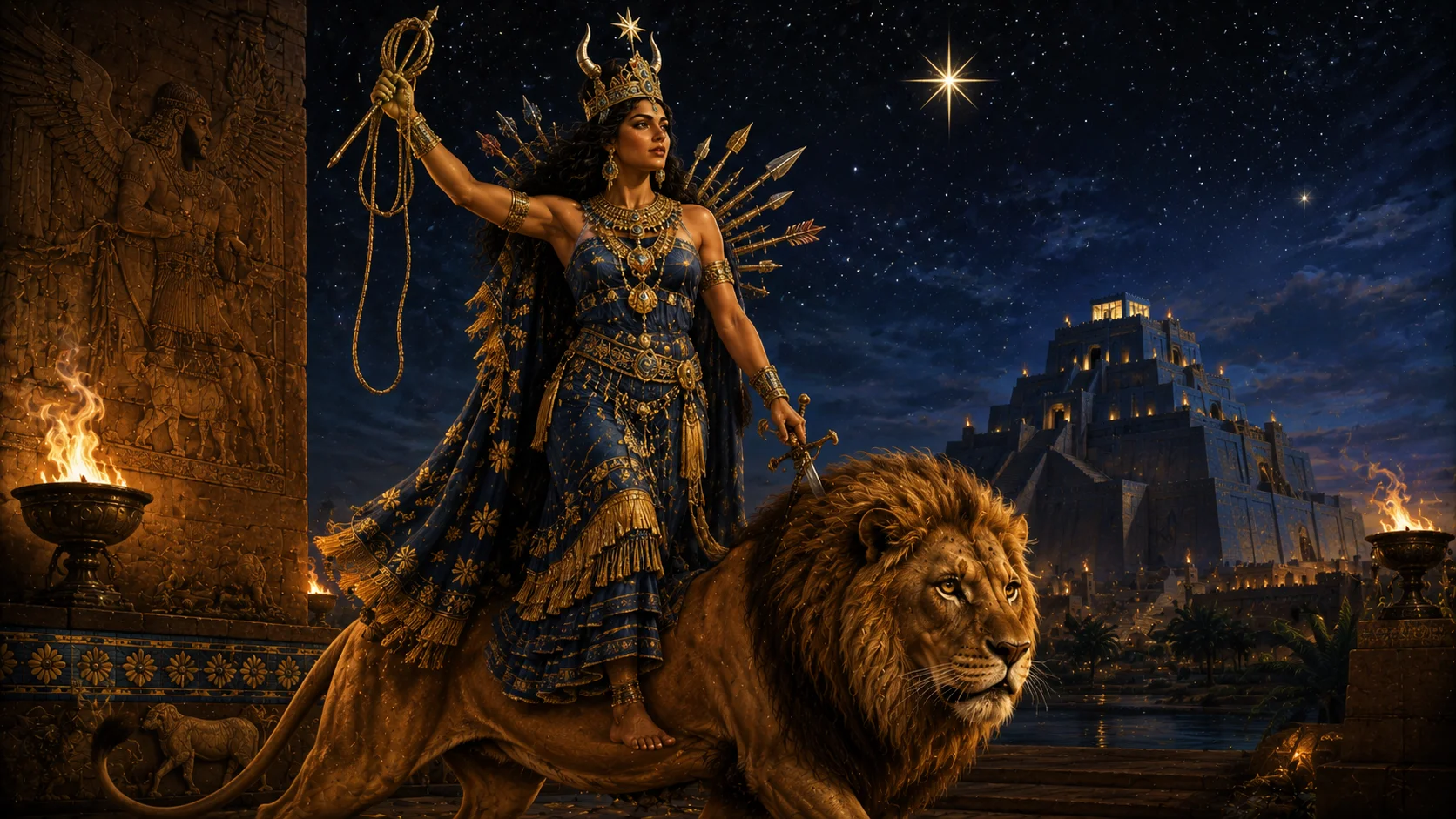
Ishtar is the great goddess of the Akkadian-speaking world, the radiant and terrible Lady of love and war, of sexual desire and of battle, the most widely venerated deity of ancient Mesopotamia. She is the Akkadian, Babylonian, and Assyrian heir of the Sumerian Inanna, and under her Semitic name she reigned for over two thousand years as the Queen of Heaven, the Morning and Evening Star, whose planet is Venus and whose nature unites the two forces that most disorder human life: love and violence. Among the deities of Mesopotamia she stands apart for the sheer breadth of her portfolio; scholars of the region have long noted that no other god or goddess of the land between the rivers so deliberately fused domains that elsewhere stayed separate, and it is this fusion, rather than either half alone, that made her worship so pervasive.
Lady of the Morning and Evening Star
Ishtar was identified with the planet Venus, which shines as both the morning star and the evening star, appearing and vanishing from the sky in a rhythm the Mesopotamians watched and recorded with great care. This double appearance mirrored her double nature and gave her worship its central symbolism of transformation, disappearance, and return. As the evening star she was the goddess of love, desire, and sexual union, patroness of lovers and of the sacred precincts where her devotees served; as the morning star she was the goddess of war, the fierce one who led armies and delighted in the clash of battle. The Akkadians and their Assyrian successors prayed to her for victory and for passion alike, addressing her sometimes as a gentle bestower of pleasure and sometimes as a merciless bringer of ruin, and never treated these as contradictions to be resolved but as two faces of a single overwhelming power.
Daughter of Heaven, Child of Uncertain Descent
In the great majority of texts Ishtar is named as the daughter of Anu, the sky god known to the Sumerians as An, and it is to her father Anu that she turns in her most consequential myths when she needs a weapon or a champion. Yet other, older Sumerian material makes her instead the daughter of the moon god Nanna, called Sin in Akkadian, and this is not a contradiction later scribes ever fully reconciled. Assyriologists recognize the discrepancy as a genuine and lasting inconsistency within the surviving sources rather than evidence of a single fixed lineage that copyists simply garbled. Much of this fluidity in her family stems from a broader process: over the centuries Ishtar absorbed and merged with a great many earlier local goddesses across different Mesopotamian cities, a layering scholars call syncretism, and it is this accumulation of separate older cults beneath one great name that makes a single, pure account of her mythology so elusive to reconstruct.
The House of Heaven at Uruk
Her principal cult center was the city of Uruk, where her temple the Eanna, the House of Heaven, stood as one of the most important religious complexes in the whole of Mesopotamia from the Uruk period onward, its history stretching back to the very beginnings of Mesopotamian urban civilization. Generations of kings rebuilt and enriched the Eanna, and the city's identity became bound to hers in a way matched by few other god-and-city pairings in the ancient Near East. Beyond Uruk she was venerated with equal devotion in Assyria, at Nineveh and at Arbela, where distinct local hypostases of the goddess, Ishtar of Nineveh and Ishtar of Arbela, each received their own temples, priesthoods, and royal attention, effectively functioning as related but separately addressed manifestations of the one great goddess.
The Seven Gates of the Silent Land
The most famous of Ishtar's myths is her descent into the underworld, told in the Akkadian poem known as the Descent of Ishtar and paralleled by the older Sumerian composition Inanna's Descent to the Netherworld. In it the goddess resolves to enter the realm of the dead, ruled by her sister Ereshkigal, and passes through seven gates in succession. At each gate the gatekeeper strips her of one garment or ornament, her crown, her jewels, her robes, until she arrives at last before Ereshkigal's throne naked and stripped of all power. There she is struck down, killed, and hung upon a hook like a piece of meat. This gatekeeper episode, the sequential loss of regalia at seven successive thresholds, is among the best-attested and most carefully structured sequences in all of Mesopotamian mythology, surviving in both the Sumerian and Akkadian recensions with only minor differences between them.
What Stopped When the Goddess Did Not Return
The Akkadian version of the descent adds a consequence found less explicitly in the Sumerian original: with Ishtar trapped in the underworld, all sexual and reproductive activity ceases upon the earth, for she who governed desire was no longer present to kindle it. This detail reveals how directly the Mesopotamians understood Ishtar's presence to be bound up with the vitality of the living world, not merely as its patron from a distance but as the animating force whose absence brought a kind of universal barrenness. Her revival, and the anxious business of arranging her return, therefore mattered to more than the mythic narrative alone; it stood for the restoration of ordinary life itself.
The Price of Return
Ishtar is not permitted to leave the underworld for nothing. The law of that realm demands a substitute, someone to remain below in her place, and returning to the world above accompanied by fearsome demons who might drag any single person down instead of her, she finds her husband Dumuzi, the Akkadian Tammuz, seated upon his throne, unmourning and untroubled by her absence. Enraged at his indifference, she consigns him to take her place in death. His sister Geshtinanna pleads on his behalf, and the two are ultimately granted an arrangement by which they alternate below the earth, each spending half the year in the netherworld while the other walks the world above, a division of the year between mourning and renewal that echoed the seasonal rhythms the myth was understood to explain.
The Sacred Marriage of Land and King
Ishtar's bond with Dumuzi extended far beyond myth into the ritual life of Mesopotamian kingship. The Sacred Marriage, known to scholars as the hieros gamos, was a rite in which the reigning king was symbolically wedded to Ishtar, standing in the role of her shepherd-consort Dumuzi, in order to secure the fertility of the land and the legitimacy of his own rule. Through this ceremony the well-being of the kingdom, its harvests, its herds, its continuity, was bound directly to the favor of the goddess, and a king's fitness to rule was understood, in part, through his standing in her eyes.
The Goddess Who Refused No Answer Kindly
In the great Epic of Gilgamesh, Ishtar appears in her most dangerous aspect. Smitten by the hero Gilgamesh's beauty and prowess, she offers him marriage and the riches that would come with it. He refuses her outright, and does so by cataloguing the fates of her former lovers, each of whom her love had ruined or transformed, among them a lover she turned into a wolf, driven from human company by his own former hunting dogs. Enraged at the insult, Ishtar climbs to heaven and demands of her father Anu that he give her the Bull of Heaven to loose upon Uruk. Anu is reluctant, warning of the destruction the bull will bring, but yields to her fury. When Gilgamesh and his companion Enkidu together slay the bull, Ishtar's wrath only deepens, and the killing sets in motion consequences that shadow the rest of the epic. Here Ishtar is the proud, perilous deity whose desire is as consuming as her fury, a goddess no mortal could safely refuse or possess without cost.
Lions, Stars, and the Marks of Her Presence
Ishtar's iconography is among the most recognizable in Mesopotamian religious art. She is closely associated with lions, frequently depicted standing upon one or flanked by a pair of them, an image that fused her martial ferocity with regal command over the fiercest of animals. Her other great emblem is the eight-pointed star, sometimes rendered as a rosette, which marked her identity as the goddess of Venus across seals, temple reliefs, and boundary stones throughout the region. In Babylon, the monumental Ishtar Gate bore her name as one of the city's principal deities, even though its glazed brick reliefs were given chiefly to the mushhushshu dragon of Marduk and the bull of the storm god Adad, a reminder that a gate could honor a goddess by name and association even where the images upon it belonged to others.
Queen of Heaven, Lady of Battle
Ishtar accumulated a vast array of epithets and local hypostases over her long worship, among them Queen of Heaven and Lady of Battle, titles that captured her celestial majesty and her fearsome martial character in turn. Her warlike aspect found its fullest expression in Assyria, where she was invoked above all as a granter of victory in war. Assyrian kings, including Ashurbanipal, called upon Ishtar of Nineveh and Ishtar of Arbela specifically before and during military campaigns, treating these two forms of the goddess as powerful and immediate patrons of royal conquest, their favor sought as a precondition for the king's success on the battlefield.
Priests Who Served a Goddess Beyond Ordinary Categories
The cult of Ishtar included the gala or kalû priests, whose ritual laments and liturgies formed an essential part of her worship, and it was also known, according to the surviving sources, for cultic personnel described as androgynous or of a third gender, the assinnu and the kurgarrû. Their presence within her service was understood as a direct reflection of the goddess's own mythic power to overturn the ordinary categories of gender and social order, a power as central to her identity as her rule over love or over war. That her cult made room for such figures speaks to how thoroughly the Mesopotamians conceived of Ishtar as a deity whose very nature was to cross boundaries other gods left untouched, between love and violence, between the living world and the land of the dead, between one gender and another.
The Enduring Weight of Her Name
Ishtar's worship spanned more than two millennia and touched nearly every major center of Mesopotamian civilization, from Uruk's ancient Eanna to the Assyrian sanctuaries of Nineveh and Arbela to the gate that carried her name into Babylon. She was, by the testimony of her sources, singular among Mesopotamian deities in the range of what she held together: a single goddess who was patron of desire and patron of the battlefield, who died and returned from the land of no return, and who traversed the sky each day and night as the brightest of the wandering stars. To speak her name was to invoke both the tenderness of love and the terror of war in a single breath, and it is this union, resistant to easy separation, that defined her place at the very center of Mesopotamian religious life for as long as her temples stood.
Sources & traditions
- EncyclopediaWikipedia — Inanna
- TraditionAkkadian texts, inscriptions and later retellings (Mesopotamia)
Myths change from area to area and from time to time. This chronicle follows the most widely told versions; tellings in other villages, regions and eras may differ.