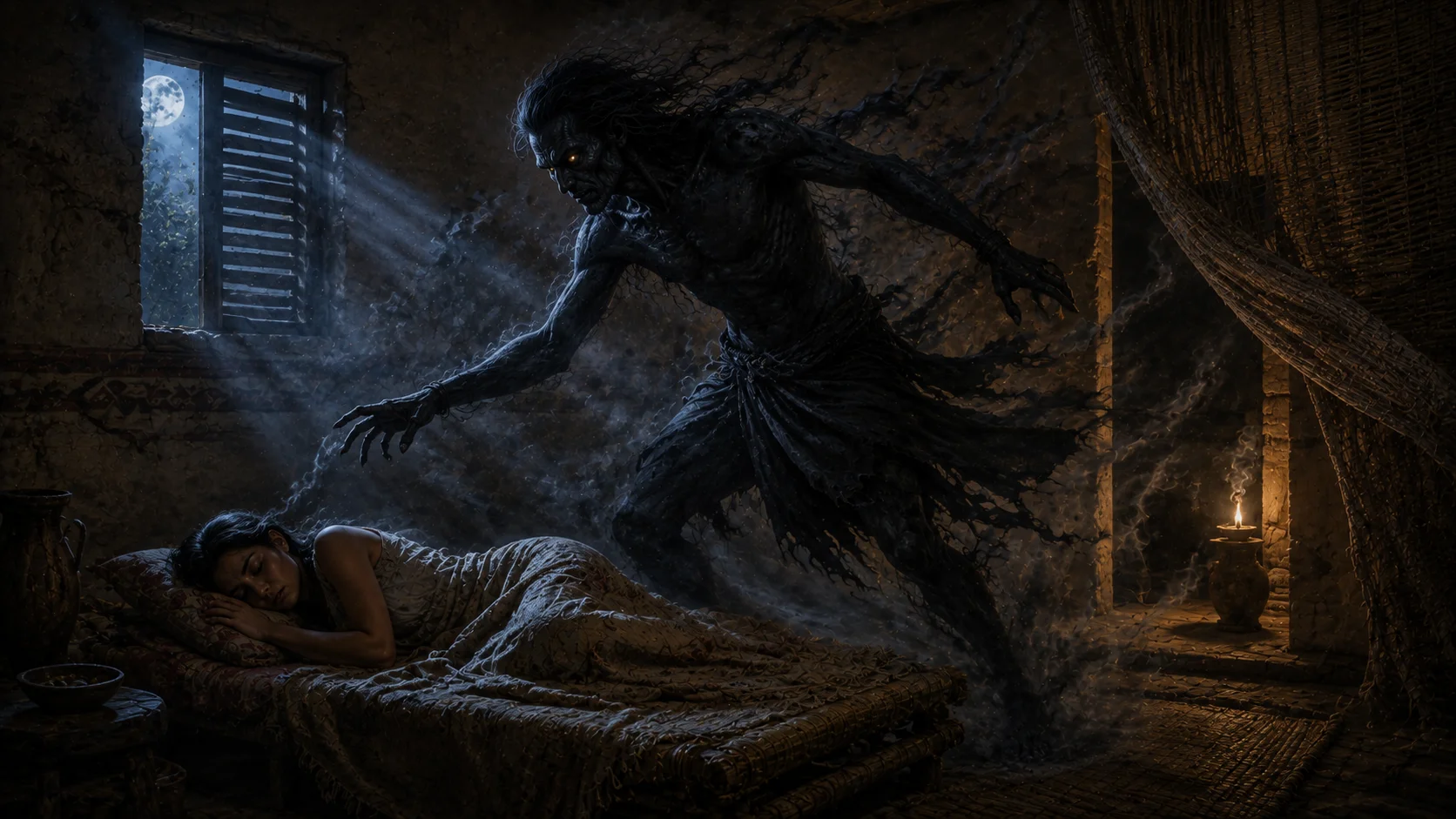
Lilu is a male wind-and-night spirit of Akkadian and Sumerian demonology, an insubstantial being of the dark air rather than a creature of flesh, and the masculine figure in a linked group of restless spirits that also includes the feminine Lilītu and the Ardat-lilî, the "maiden of the night." Ancient exorcistic literature treats these three together as a kind, distinguished from one another by sex and marital state, and united by a shared danger: they haunt the hours of sleep, the empty places of the world, and the fragile threshold where a household's future children are made or lost.
A Name Carried on the Wind
The name Lilu is built from a root shared across Sumerian and Akkadian, lil, meaning wind, breath, or night air. It is not a name that describes a body. It describes a condition: motion without weight, presence without substance, the sense of something passing through a room that leaves no mark but is felt all the same. Where many Mesopotamian supernatural figures are given faces, weapons, and thrones, Lilu is given only a current of air and a time of day. That absence of fixed form is itself the point. The lil-spirits were understood as beings that belonged to no household, no temple, and no settled place, and a spirit with no home was, to the Mesopotamian mind, a spirit that answered to no one and could not be bargained with in the ordinary way.
Kin Without a Hearth
Lilu belonged to a broad class of wandering spirits distinct from the etemmu, the ghosts of the properly dead who might at least be appeased with offerings at a tended grave. The lil-demons had no grave, no descendants to pour water for them, and no cult of their own. Mesopotamian belief located them in ruins, in the open steppe, and in the desert beyond the reach of canal and city wall — the same wilderness that stood, in the literature of the age, for everything outside the ordered world the gods and kings maintained. A spirit of the settled world could be negotiated with. A spirit of the waste land could only be driven off, and it is in that register of pure expulsion, rather than appeasement, that most surviving references to Lilu are written.
The Trouble That Comes in Sleep
The affliction most consistently attached to Lilu in incantation texts is disturbed sleep: nightmares, restlessness, and dreams of a sexual character visited upon the sleeper. In this role Lilu functions as an early conceptual ancestor of the figure later ages would call the incubus, a presence that comes to a person specifically through the vulnerability of sleep rather than through open attack. Scholars of Mesopotamian religion are careful, however, to treat this as a family resemblance rather than a proven lineage. The later and much more famous figure of Lilith in Jewish tradition is frequently mentioned in the same breath as Lilu and Lilītu because the names sound related and the territory of night-terror overlaps, but the line of transmission between the Akkadian lil-spirits and the later Lilith material is disputed among Assyriologists rather than settled, and the two should be understood as adjacent traditions in conversation across centuries rather than as one figure under two names.
The Huluppu-Tree and Its Uninvited Tenants
The clearest narrative glimpse of this family of spirits comes not through Lilu directly but through his female counterpart, Lilītu, in the Sumerian material that serves as prologue to part of the Gilgamesh tradition — the episode of the huluppu-tree. In that tale the goddess Inanna plants a huluppu-tree, intending in time to make from its wood a throne and a bed for herself. But before the tree can grow to maturity, it is claimed by unwelcome tenants: the Anzu-bird nests in its branches, a serpent that will not be charmed coils at its roots, and a demoness of the lil-class makes her dwelling in its trunk. Only when Gilgamesh intervenes and drives all three out is Inanna able to have her tree. Lilu himself, the masculine figure, is less directly named in this particular episode than Lilītu is, but the passage stands as the best-attested narrative evidence for the lil-class of spirit as a whole, and it frames these beings exactly as the wider tradition does elsewhere: as squatters in places that belong to the ordered, cultivated world, who must be forcibly removed before that world can function as intended.
Named in the Books Against Evil
Lilu and the lil-spirits more broadly appear within the great bilingual incantation series known as Udug-hul, the "Evil Utukku," preserved in both Sumerian and Akkadian as Utukkū Lemnūtu. This corpus is one of the central surviving collections of Mesopotamian exorcistic literature, a systematic catalogue of the malevolent spirit-classes that could afflict a household, paired with the ritual remedies prescribed against each. That Lilu is catalogued here at all is telling: it places him not among the great named gods of misfortune with individual myths and temples, but among a taxonomy of dangers that the professional exorcist was expected to recognise, name correctly, and expel by the correct formula. Correct naming mattered enormously in this tradition — a spirit addressed by the wrong classification could not be reliably banished.
Calling on Ea and Asalluhi
When the lil-demons were driven from a sufferer, the ritual specialists of Mesopotamia did not rely on Lilu's name alone to banish him. They invoked the standard machinery of exorcism built around the god Ea, also called Enki, the deity of wisdom and the sweet waters who was held to know the origin and nature of every affliction, and his son Asalluhi, later identified closely with Marduk, who carried Ea's remedies into the world and applied them on his father's instruction. This father-and-son structure recurs through nearly the whole of Mesopotamian magical practice: the exorcist-priest did not claim personal power over a spirit like Lilu, but positioned himself as the voice carrying out a solution that originated with Ea and was executed through Asalluhi. Against a spirit as formless and homeless as Lilu, this appeal to the highest authorities of magical knowledge was the most dependable weapon available.
A Threat at the Cradle
Beyond disturbed sleep, the lil-demons were counted among the spirits believed to endanger infants, pregnant women, and the safe delivery of children — placing Lilu and his kin in the same functional territory occupied by other Mesopotamian child-endangering demons, most famously Lamashtu. It is important to hold Lilu and Lamashtu apart rather than blend them: they are separate figures in the textual and iconographic record, with different names, different associated rituals, and, in Lamashtu's case, a well-documented visual type that Lilu simply does not share. What they have in common is the category of danger they represent, not an identity. Mesopotamian demonology organised its fears with some precision, and a household under threat needed to know which spirit it was actually facing, since the wrong diagnosis meant the wrong incantation.
A Shape Without a Portrait
Unlike Lamashtu, who was carved and cast in recognisable form, or Pazuzu, whose grimacing, wing-spread image is instantly identifiable across museum collections, Lilu has no firmly established iconography in the archaeological record. He survives almost entirely as a textual presence — a name in incantation lists, a category in the exorcist's taxonomy — rather than as a figure anyone commissioned an amulet or statuette to depict in a fixed way. Any modern image of Lilu with a specific face, wings, or posture should be understood as interpretive reconstruction, not as attested ancient tradition. This absence is consistent with what the name itself suggests: a being made of wind and night air was, perhaps fittingly, never quite pinned down in stone.
One Name, Many Spirits
Assyriological scholarship, including entries in the Reallexikon der Assyriologie and the work of scholars such as Jo Ann Scurlock on Mesopotamian magic and medicine, has raised a further complication worth preserving rather than smoothing over: "lilu" may function in some texts less as the proper name of one individual demon and more as a generic term for an entire class of spirit, a label that could be applied to different named threats depending on context. This class-versus-individual ambiguity is itself a recognised and openly discussed problem in the field, not an error to be resolved by picking one reading and discarding the other. Lilu, in other words, may be best understood as sitting somewhere between a specific figure and a category — a demon and also a description of a kind of demon.
Guarding the Marriage Bed
Because the lil-spirits were tied so closely to sterility, night terror, and disturbance of a sexual character, they became a standard target of Mesopotamian incantations concerned with marriage and fertility. A household's continuation through healthy children was among the most closely guarded concerns in Mesopotamian domestic religion, and a spirit believed capable of visiting a sleeper with unwanted dreams, or of threatening the safe conception and birth of an heir, represented a direct threat to that continuity. Protective formulas invoked against Lilu and his kin were therefore not abstract theological exercises but practical instruments woven into the ordinary anxieties of marriage, pregnancy, and the raising of the next generation.
The Logic Behind the Triad
The grouping of Lilu, Lilītu, and the Ardat-lilî together reveals something of how Mesopotamian demonology organised the dangers it catalogued. Spirits were classified not only by the harm they caused but by kinship-like groupings that mirrored the structure of a human household turned inside out: a male figure, a female figure, and an unmarried "maiden" figure who, tellingly, never achieves the married state that Mesopotamian society treated as the normal and desired outcome for a woman. This triadic, household-shaped structuring of malevolent spirits recurs across the wider corpus of Akkadian exorcistic literature, and the lil-demons stand as one of its clearest examples: a family of night and wind, defined by everything a proper household was supposed to have and did not.
What the Wind Still Carries
Lilu endures in the record less as a dramatic mythic actor with a story of his own than as a category the Mesopotamians needed and named: the trouble that comes with no fixed address, the disturbance that arrives on the night air and cannot be reasoned with because it belongs nowhere and to no one. Attested across incantation series, named beside Lilītu in the great catalogues of evil, and invoked against with the authority of Ea and Asalluhi rather than any story of his own defeat, Lilu represents a particular and enduring strand of ancient thought — the conviction that some dangers are formless by nature, and that naming them correctly is the first and most necessary act of defense against them.
Sources & traditions
- EncyclopediaWikipedia — Lilu (mythology)
- TraditionAkkadian texts, inscriptions and later retellings (Mesopotamia)
Myths change from area to area and from time to time. This chronicle follows the most widely told versions; tellings in other villages, regions and eras may differ.