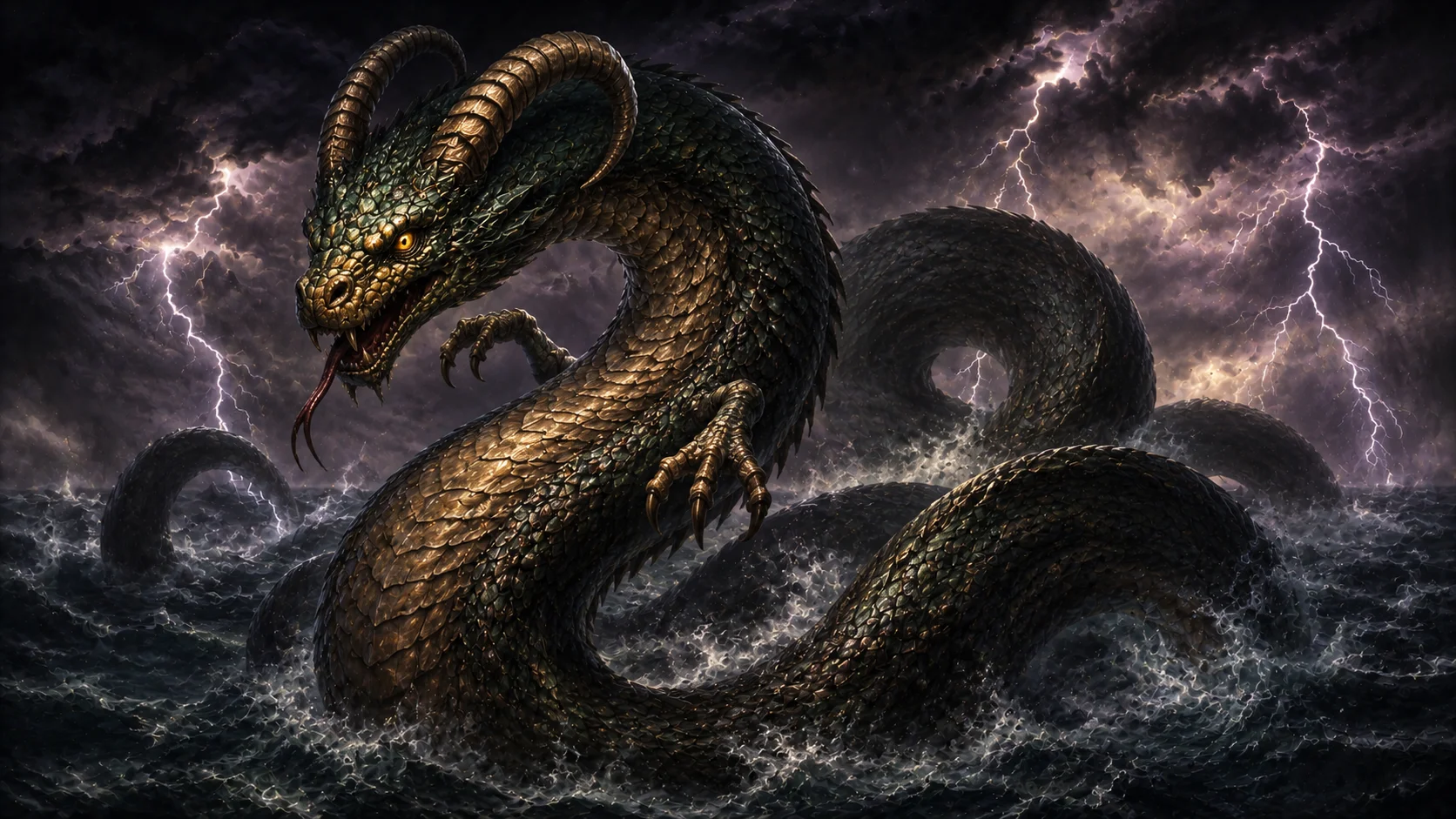
Bashmu, also written Bašmu, is a horned serpent-dragon of Akkadian and Sumerian tradition, a composite being of scaled coils, clawed forelegs, and a crowned horned head that belongs to the wider Mesopotamian family of dragon-serpents alongside the mushhushshu and the ushumgallu. Its name is generally rendered "venomous snake" or "horned serpent," a description that is at once zoological and theological: a real fear of the desert and marsh viper given monstrous, cosmic form. Bashmu is known to Assyriologists not from a single continuous epic but from fragments scattered across incantation texts, lexical monster-lists, god-lists, and the carved surfaces of boundary stones and cylinder seals, and it is honest to say at the outset that no one unbroken narrative of Bashmu survives; what follows is the reconstructed portrait scholars have assembled from those pieces.
A Name Written in Venom
In the cuneiform lexical tradition, names were rarely ornamental; they described function. Bashmu's name places venom, not merely the creature's shape, at the center of what it was understood to be. This matters because it tells us how the Mesopotamians categorized the being: not primarily as a dragon of storm or flood, though it shared territory with such creatures, but as the incarnation of the serpent's most feared weapon, poison delivered without warning. Texts concerned with protection against snakebite invoke Bashmu by name, treating it less as a distant mythic antagonist and more as the mythic explanation for a very present danger, the kind that could kill a farmer in a reed marsh or a traveler crossing open desert. The name is therefore a hinge between two registers of Mesopotamian thought that moderns tend to separate: the cosmic battle of gods against chaos-monsters, and the practical, everyday ritual of asking for safety from a real animal's real bite.
The Shape of the Horned Serpent
Where Bashmu is described physically, in incantations, in lexical entries, and in the images carved onto kudurru boundary stones and cylinder seals, the consistent elements are these: a long, scaled, serpentine body; a head bearing horns; and, in many though not all renderings, forelegs, sometimes described as present with no matching hind legs, so that the creature moves as much like a serpent as like a four-legged beast. Wings appear in some depictions, marking Bashmu as a full composite chimera rather than an ordinary snake grown large. This partial, asymmetrical anatomy, forelegs but no hindlegs, horns but not always wings, is itself part of what identifies the creature as Bashmu rather than as one of its relatives, since Mesopotamian artists and scribes distinguished these dragon-serpents from one another by exactly such details. The horned head in particular carries theological weight in Mesopotamia, where horns on any figure, divine, animal, or hybrid, marked divine or supernatural power; a horned serpent was, by the visual grammar of the era, unmistakably no ordinary reptile.
Kin Among the Dragon-Serpents of the Two Rivers
Mesopotamian religious imagination did not treat "dragon" as a single undifferentiated category. Scholars, most notably F. A. M. Wiggermann in his study of Mesopotamian protective spirits, have shown that the scribes maintained a careful taxonomy of serpent-dragons, each with its own name, appearance, and role. Bashmu stood alongside the mushhushshu, the "fierce serpent" associated above all with the god Marduk and, earlier, with Ninazu and Tishpak, and alongside the ushumgallu, the "great dragon," a term also used honorifically of powerful kings and gods themselves. Bashmu was distinguished from the mushhushshu chiefly by its more purely serpentine body and its reduced or absent hind legs, where the mushhushshu was typically shown as a fuller four-legged beast. This differentiation matters: it shows that the Mesopotamians were not painting with one broad brush labeled "monster" but maintaining a deliberate, structured bestiary in which each dragon-serpent occupied its own niche of danger and meaning.
A Foe in the Cycle of Ninurta
Bashmu is counted among the monstrous adversaries associated with the mythic cycle of the warrior god Ninurta, known in some tellings as Ninĝirsu, a cycle that includes the tale of Ninurta and the Turtle and the broader pattern of combat myths in which the god subdues the primeval chaos-beings of mountain and sea to secure the order of the world. In this framework Bashmu belongs to the class of monstrous forces that stand outside, and against, the settled world that the gods maintain: creatures of the wild margins, the deep waters, and the untamed mountains, whose defeat by a champion deity is what allows irrigation, kingship, and the ordered cosmos of Sumer and Akkad to exist at all. It should be said plainly that the surviving material does not offer a single, complete account of Ninurta's confrontation with Bashmu specifically in the way that, for instance, later traditions preserve complete combat narratives; rather, Bashmu's place in this cycle is attested through its association with the broader category of monsters that the Ninurta myths concern themselves with defeating.
Among the Eleven of Tiamat's Making
In the tradition surrounding the Babylonian creation epic, the Enuma Elish, the primeval sea-mother Tiamat, moving to war against the younger generation of gods, is said to have brought forth a company of monstrous beings to fight in her cause, a company that later tradition numbers at eleven and that includes hybrid creatures such as the mushhushshu, the ushumgallu, the lahmu, and the scorpion-men. Bashmu is named among this company of chaos-creatures in some versions of this tradition, standing as one of the primordial monsters arrayed against the order that would follow Tiamat's defeat. It is worth being precise here, in the spirit of honest scholarship rather than tidy storytelling: Assyriologists note that Bashmu's inclusion among the eleven is not perfectly consistent across the surviving copies and recensions of this material. Ancient scribal traditions themselves varied on exactly which monsters belonged to Tiamat's brood in any given telling, and modern reconstruction reflects that variation rather than smoothing it away.
Bound to Threshold and Boundary Stone
Defeat, in Mesopotamian religious thought, did not mean erasure. A chaos-monster subdued by a god was very often repurposed, its terrible power turned outward against lesser threats rather than annihilated. This pattern shaped how images of dragon-serpents like Bashmu were used in daily religious and civic life. Bashmu appears among the mythological figures carved on kudurru, the inscribed boundary stones that recorded royal land grants and invoked divine witnesses and protectors over them, shown as a horned serpent-dragon set among other divine emblems. Its presence there marks it as a recognized figure of official religious iconography, a being whose fearsome nature made it useful precisely as a guardian: an image capable of frightening away those who would violate a boundary or break an oath, because everyone understood exactly what power that horned coil represented.
Words Spoken Against the Bite
Beyond epic and iconography, Bashmu occupies a working role in Mesopotamian ritual life, appearing in incantation literature, including namburbi rituals aimed at averting evil omens and texts concerned with asakku-demons and exorcism, where it is invoked or described in connection with protection against snakebite and venom. This apotropaic use reflects the practical anxiety underlying the mythic figure: venomous serpents were a genuine, everyday danger in the marshes, riverbanks, and open country of Mesopotamia, and naming the great mythic serpent in a protective formula was a way of enlisting cosmic authority against a very physical threat. Here the distance between "myth" and "medicine" collapses; the ritual specialist reciting an incantation against snakebite was drawing on the same body of belief that shaped the epic battles of the gods, treating Bashmu as a force whose name carried power whether encountered in the reeds or in sacred text.
The Coiled Star Above the Marsh
Mesopotamian sky-lore extended Bashmu's presence into the heavens themselves. Late Babylonian astrological and astronomical texts, including star-lists, associate Bashmu with a constellation, recorded as MUL.BASHMU, "the Serpent," which modern scholarship has linked to the constellation later known as Hydra. In this celestial role, the venomous horned serpent of incantation and epic became also an object charted by the astronomer-priests who tracked the movements of the sun-god Shamash and the courses of the planets, a reminder that in Mesopotamia the boundary between the monstrous, the ritual, and the astral was porous. A creature feared on the ground and invoked against poison in a sickroom could also, without contradiction, be traced coiling across the night sky, its danger transposed into a fixed and legible pattern that priests could read and record season after season.
Bashmu Beside Mushhushshu and Ushumgallu
It is worth dwelling further on how carefully the sources distinguish Bashmu from its two closest relatives, since conflating them is one of the easiest ways to misrepresent this tradition. The mushhushshu, whose name is sometimes translated "fierce serpent" or "splendor serpent," became specifically the sacred creature of Marduk, the god who inherited it from Ninazu and Tishpak, and it was typically depicted with a fuller set of legs and a more consistently four-footed dragon form; its image, famously, still marches in glazed brick relief along the Ishtar Gate tradition. The ushumgallu, "great dragon," functioned partly as an honorific title, applied not only to monstrous beings but poetically to kings and gods as an epithet of overwhelming power. Bashmu, by contrast, kept its identity anchored to the serpent proper, with reduced limbs and an emphasis on venom rather than storm or splendor. The three names were not interchangeable synonyms for "big scary snake"; they named distinct beings with distinct associations, iconographies, and ritual uses, and the lexical lists that record them preserve that distinction with evident care.
What the Fragments Do Not Agree On
Because Bashmu survives in incantations, monster-lists, god-lists, and images rather than in one sustained epic narrative, several aspects of its mythology remain genuinely unsettled among scholars rather than fixed. There is no single canonical origin story for Bashmu that all sources agree on. Its precise physical description shifts somewhat across periods and text types, forelegs present in some renderings and absent in others, wings appearing in some images and not in others. Its place among Tiamat's eleven monsters is attested but not textually uniform. None of this uncertainty is a modern failure to understand an ancient tradition clearly; it reflects the actual, layered way Mesopotamian religious literature was composed and copied across many centuries and city traditions, each scribal school inheriting and slightly reshaping what came before. Presenting Bashmu honestly means holding these variations rather than flattening them into a single invented account.
The Chaos That Is Mastered, Not Destroyed
Taken together, the fragments describe a figure whose meaning rests less on a single dramatic climax than on a consistent symbolic role played out across many contexts: Bashmu as a chaos-monster, a primordial danger of venom and wilderness that stands, in the company of the mushhushshu, the ushumgallu, and the other creatures of Tiamat's brood, against the order that the gods, and Ninurta above all among them, labor to establish and protect. That danger is never simply erased. It is subdued, and in being subdued it is set to new work, guarding a boundary stone, warding off a snake's bite through a spoken formula, tracing a fixed path across the night sky. In this the horned serpent stands as one clear expression of a wider Mesopotamian conviction: that the forces of chaos in the world are not annihilated by divine order but bound into its service, their raw power never denied, only redirected, so that what once threatened the world's edges could be asked, in the end, to help keep it safe.
Sources & traditions
- EncyclopediaWikipedia — Bašmu
- TraditionAkkadian texts, inscriptions and later retellings (Mesopotamia)
Myths change from area to area and from time to time. This chronicle follows the most widely told versions; tellings in other villages, regions and eras may differ.