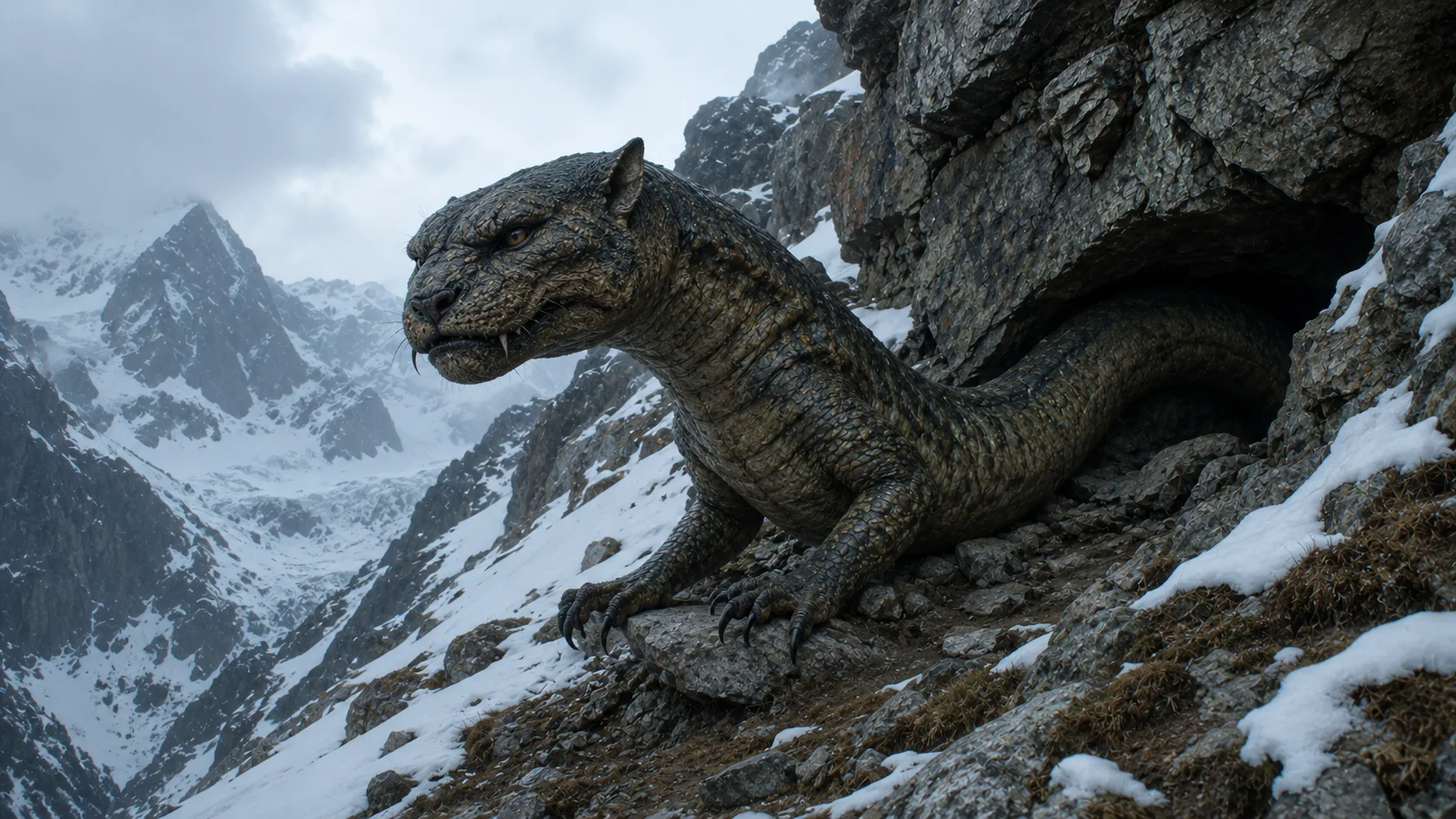
The Tatzelwurm, whose German name translates roughly as "clawed worm," is a cryptid of the Alps, reported chiefly from the folklore of Austria, Bavaria, and Switzerland. Described as a short, stubby creature between roughly a third of a meter and a full meter in length, it is said to combine a lizard- or worm-like body with large clawed front legs, no visible hind legs, and a cat-like or toad-like face. It has no documented role as a deity or in any ritual practice; its place in Alpine tradition is that of a local cautionary figure, a mountain hazard invoked to explain strange encounters in remote, high terrain.
A Name Carved From Dialect
Tatzelwurm, sometimes spelled Tatzelworm, is not the only name the creature carries in the valleys where it was reported. In Swiss and southern German accounts it is often called the Stollenwurm, or "tunnel-worm," a name that leans on the creature's association with rocky crevices and burrow-like hiding places. Some Austrian tellings instead use Springwurm, "jumping worm," a name that foregrounds the sudden leap witnesses claimed the creature was capable of. These are not competing creatures or rival legends; they are the same reported animal filtered through the dialect of whichever valley was doing the reporting, a reminder that Alpine folklore before the era of standardized print traveled village to village and changed its vowels, if not its shape, along the way.
The Shape Witnesses Agreed On, Mostly
Descriptions of the Tatzelwurm are consistent in their broad strokes and inconsistent in their details, which is itself characteristic of testimony gathered from scattered herders and travelers rather than from a single controlled source. The body is usually given as short and stubby rather than long and serpentine, worm- or lizard-like, running from perhaps thirty centimeters to a full meter. The face is the detail witnesses returned to most: cat-like in some tellings, toad-like in others. The front limbs are large and clawed, prominent enough to have given the creature its name, while the hind portion of the body is often described as legless, or as tapering away without any hind legs visible at all. No two regional accounts line up perfectly, and that variance is part of the record rather than a flaw in it.
Ground the Creature Was Said to Keep
Folklore places the Tatzelwurm in rocky crevices, scree slopes, and high alpine meadows, generally well above the villages and away from cultivated land. This is terrain that herders and travelers crossed out of necessity rather than choice, moving livestock to summer pasture or crossing passes on foot, and the creature's reported range tracks that pattern closely. A being said to live in scree and stone, encountered only at altitude, fits naturally into the broader category of legend meant to caution people who had to work in dangerous, isolated ground — a way of naming a risk before anyone could say exactly what the risk was.
A Bite Feared More Than Seen
Local tellings attribute a venomous or poisonous bite, or in some versions a poisonous breath, to the Tatzelwurm, and describe it as capable of a startling leap and a hiss when disturbed. Herders and hikers who claimed an encounter typically framed it as sudden and unwelcome rather than sought out — the creature bursting from a crevice or scree pile rather than being tracked or hunted. This aggressive, dangerous reputation reinforced the creature's function as a hazard-legend: something that gave shape and a face to the genuine risks of falling rock, cornered wildlife, and difficult footing at altitude, in a form that could be talked about around a fire.
Newspapers, Not Manuscripts
Unlike mythic figures with roots in ancient epic or scripture, the Tatzelwurm's earliest written trail runs through nineteenth-century Alpine regional folklore collections and local newspapers, rather than through any older literary tradition. It is a legend that entered print at roughly the same moment ordinary rural reporting did, which is part of why its record reads more like a collection of witness accounts than a structured myth cycle. The systematic gathering and later analysis of these newspaper reports is often credited to the Austrian mountaineer and cryptozoology writer Ulrich Magin, whose work on the historical press coverage did much to assemble what had been scattered local items into a single recognizable body of Tatzelwurm testimony.
A Disputed Photograph
The most frequently cited piece of physical evidence is a photograph that circulated in the early twentieth-century press, sometimes called the "Balkan Tatzelwurm" or the "Meran photograph," attributed in various tellings to a Swiss or Tyrolean photographer and occasionally given the name Balkin. Its authenticity has never been established, and it is widely suspected among those who have examined the record to be faked or misattributed. Like much of the Tatzelwurm's documentary trail, the photograph has functioned less as proof and more as a recurring reference point — the single image people mean when they say "the Tatzelwurm photo," regardless of what it actually shows or where it actually came from.
No Bone Has Ever Answered
No skeletal remains, no type specimen, and no biological description recognized by science exists for the Tatzelwurm. Everything that survives is folkloric testimony, gathered secondhand from herders and travelers, together with a small number of disputed historical photographs and illustrations. This absence of physical evidence sets the Tatzelwurm apart from creatures with even partial fossil or forensic claims behind them, and it is the central reason the legend has stayed a folklore subject rather than crossing into any recognized zoological inquiry.
Salamander, Stoat, or Something Unclaimed
Naturalists and folklorists who have tried to explain the legend without invoking an undiscovered animal have proposed several candidates for misidentification. The alpine salamander, Salamandra atra, a genuinely dark, stubby, slow-moving amphibian of high Alpine ground, is commonly suggested. Stoats or weasels glimpsed at an odd angle or in poor light are another proposed source, as is the ocellated lizard, whose size and coloring could plausibly be stretched into something stranger by an unexpected encounter at dusk. None of these explanations is confirmed, and none has closed the question. The origin of the legend remains genuinely unresolved, sitting in the gap between "clearly some real animal, misread" and "clearly an invention," without firm evidence settling it either way.
A Cryptid, Not a Kin of Dragons
Because the Tatzelwurm is a folk-cryptid rather than a figure drawn from a structured mythological pantheon, it carries no attested relationships to named gods or other classical mythic beings within its own Alpine tradition. It should not be folded into the broader European inheritance of named dragons, worms, or serpent-deities from other cultures; whatever surface resemblance its clawed, stubby body bears to those older figures, the Tatzelwurm's own record gives it no kinship, no origin story, and no place in anyone's genealogy of gods. It stands alone as a regional hazard-legend, and its record gives no grounds for connecting it to any named being outside its own testimony.
From Herders' Tale to Catalogue Entry
In the twentieth and twenty-first centuries, the Tatzelwurm found a second life in cryptozoology compendiums — the kind of literature associated with Bernard Heuvelmans and, later, catalogues in the style of Loren Coleman — where it is typically filed alongside other unconfirmed regional cryptids rather than treated as a folklore subject in its own right. It has also occasionally surfaced in regional Alpine tourism and folklore branding, a small, local curiosity rather than a headline attraction. What it has not developed is any significant standalone literary tradition of the kind built up around major mythological monsters; there is no epic, no canonical narrative, no single authoritative telling — only the accumulated, dialect-varied testimony of the valleys that reported it.
What the Record Actually Holds
Strip away the disputed photograph and the cryptozoology catalogues, and what remains of the Tatzelwurm is a consistent regional pattern: a short, clawed, cat- or toad-faced creature reported from rocky, high-altitude ground across Austria, Bavaria, and Switzerland, known by different names in different dialects, feared for a bite or breath no one could verify, and never once backed by a bone, a body, or a confirmed specimen. That pattern is the whole of the evidence, and it has proven durable precisely because it asks so little of belief — not a god, not a monster from an old book, just an animal the mountains might or might not actually hold.
Sources & traditions
- EncyclopediaWikipedia — Tatzelwurm
- TraditionLocal sightings, press reports and regional folklore (Alpine Europe)
Myths change from area to area and from time to time. This chronicle follows the most widely told versions; tellings in other villages, regions and eras may differ.