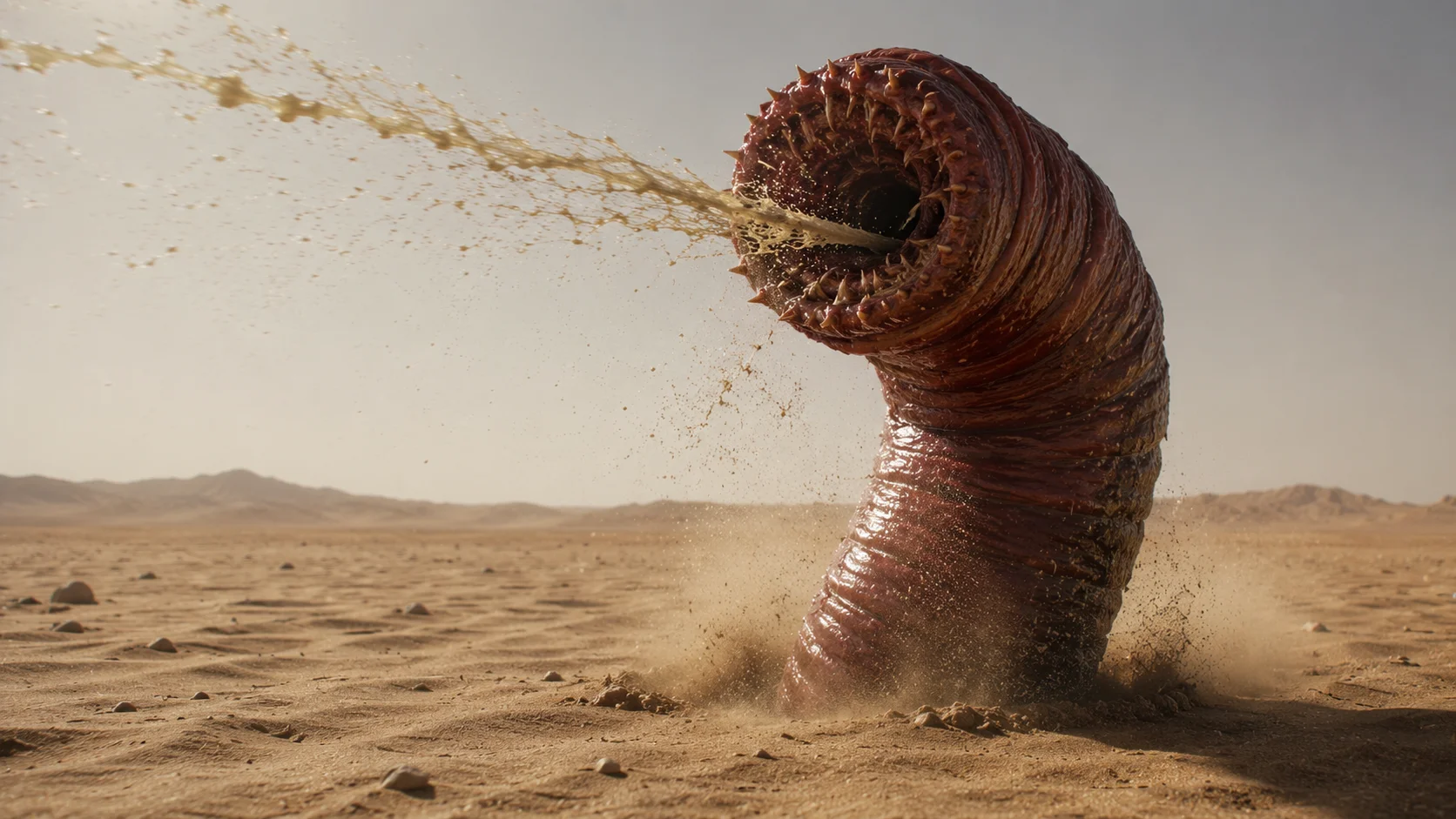
The Mongolian Death Worm is a cryptid of Mongolia, a large, deadly, red, worm-like creature said to inhabit the Gobi Desert, reputed to kill from a distance with a deadly venom or an electric discharge.
The Olgoi-Khorkhoi of the Southern Sands
In the native tongue of the herders who fear it, the creature is called olgoi-khorkhoi (Mongolian: олгой-хорхой), a name commonly translated as "large intestine worm." The description is unflattering by design: witnesses describe a thick, blood-red or dark-hued worm-like body, roughly half a meter to a meter and a half in length, smooth and sausage-like, bearing an unsettling resemblance to a cow's intestine rather than to any recognizable animal. Western sources have rendered the name inconsistently over the decades — "allghoi khorkhoi" and other variant Romanizations appear across different accounts — but these are not separate epithets, only the ordinary drift of transliterating Mongolian Cyrillic into English by writers working a generation or more apart.
A Creature Bound to the Driest Ground
The death worm's range in Gobi folklore is not the desert in general but its harshest interior: the driest, most remote reaches of the southern Gobi, where few travelers and fewer settlements intrude. Local tradition holds that the worm spends most of the year burrowed beneath the sand, unseen and presumably dormant. It is said to surface only in the hottest months, June and July being the times most consistently cited, and typically after rain has fallen — a detail that gives the legend an internal logic, tying the worm's rare appearances to the narrow window when the desert briefly turns hospitable.
Two Ways to Die Without Being Touched
What sets the olgoi-khorkhoi apart from ordinary desert hazards, in the testimony collected from Gobi herders, is that it is said to require no contact at all to kill. Two distinct methods are attested in local tradition. The first is a corrosive or poisonous venom that the worm can spray or squirt at a target from a distance, killing a person or a camel that strays too near without ever touching them. The second is a lethal electric shock or jolt, described as equally capable of killing a grown man or a full-sized camel. Both methods appear consistently enough across the oral record that they are treated as the creature's defining trait — not merely deadly, but deadly at range, which is precisely what makes it so feared by people who must cross its territory on foot or by camel.
An Explorer's Warning, Not a Sighting
The creature's first significant appearance in Western documentation traces to the American paleontologist Roy Chapman Andrews, who led the Central Asiatic Expeditions into the Gobi Desert for the American Museum of Natural History across the 1920s, from 1922 to 1930. In his 1926 book On the Trail of Ancient Man, Andrews recorded that Mongolian officials and local people repeatedly warned him about the worm before he ventured into its reputed territory. It is worth stating plainly what Andrews did not claim: he never reported a personal sighting, and he expressed skepticism about the creature even as he dutifully recorded the warnings he received. His account is valuable precisely because it is secondhand and honestly presented as such — a paleontologist noting what the Gobi's own people believed, without embellishing it into a firsthand encounter.
Mackerle's Expeditions into Herder Testimony
Decades later, the Czech researcher and cryptozoologist Ivan Mackerle took up the search in earnest, leading expeditions into the Gobi in 1990, 1992, and again in 2004–2005. Mackerle's method was to interview Gobi herders and locals directly, gathering oral testimony about sightings, encounters, and the circumstances under which the worm was said to appear. His published book and expedition reports remain a primary source for Western-language documentation of this testimony — but it is worth being clear-eyed about their nature. Mackerle did not obtain physical specimen evidence of any kind on any of his three expeditions. His contribution is a valuable but single-source-heavy record of what Gobi residents told him, not independent confirmation of the creature itself.
Explosives, Vibrations, and an Empty Result
Some of the more dramatic expedition attempts to provoke a sighting drew directly on advice from local herders, who reportedly suggested that vibrations or explosions might draw the worm up from beneath the sand. Mackerle's 2004–2005 trip and a later 2005 joint Mongolian-British expedition associated with Discovery Channel coverage both experimented with such methods in the field. Neither produced a specimen, a photograph, or any evidence beyond what expedition members reported having attempted. These episodes are documented in the record as exactly that — attempts — and should not be mistaken for near-successes or partial confirmations.
A Feared Hazard, Not a Spirit
What distinguishes the olgoi-khorkhoi within the broader landscape of Mongolian folklore is its character. As reported consistently by Andrews, Mackerle, and other collectors of local testimony, Gobi herders and nomads generally regard the death worm as a real, physical, and greatly feared hazard of the desert — not as a spirit, demon, or supernatural being of the kind that populates much of Mongolian oral tradition. This grounds the legend in a different register than ghost stories or ancestral-spirit tales: the worm is treated the way one might treat a venomous snake or a rabid animal, a natural threat to be avoided rather than appeased or exorcised. Symbolically, it functions as an embodiment of the Gobi's own lethal remoteness — the desert's harshest ground given a shape and a name.
The Skeptics' Case: Sand Boas and Legless Lizards
The scientific and skeptical literature has offered several rationalist explanations for the sightings underlying the legend, and these are worth stating exactly as they are framed: as hypotheses, not confirmed identifications. The most frequently cited candidate is the Tartar sand boa (Eryx tataricus), a snake native to the region whose thick, blunt-ended body could plausibly be mistaken for something stranger by a distant or frightened observer. Other writers have speculated about worm lizards, or amphisbaenians, and about large legless lizard species as possible sources of misidentification. None of these has been confirmed as the origin of any specific reported sighting; they remain proposed explanations circulating within cryptozoological and popular-science writing rather than established zoological findings.
What the Evidence Actually Shows
It bears stating plainly, as the scientific consensus: no physical specimen, no photograph, and no scientifically verified sighting of the Mongolian death worm has ever been produced or authenticated. Every account in the record, from Andrews's secondhand warnings to Mackerle's herder interviews to the failed expeditions of the 2000s, rests on oral tradition and traveler or expedition reports rather than on physical evidence of any kind. The olgoi-khorkhoi's status remains that of an unconfirmed cryptid — a creature attested richly in testimony and entirely absent from the fossil and specimen record.
From Gobi Testimony to Global Cryptozoology
The worm's passage into English-language cryptozoology owes much to writers such as the British zoologist Karl Shuker, whose compiled cryptid catalogues documented and popularized the creature for readers well beyond Mongolia in the late twentieth century. It is important to hold this literature at the correct distance: Shuker's work and similar compilations are cryptozoological and popular writing, not peer-reviewed zoology, and they function as one of the most notable "living cryptid" cases associated with Central Asia precisely because they gather and present testimony rather than generate new physical evidence.
A Second Life in Fiction and Television
Beyond the specialist cryptozoology shelf, the Mongolian death worm gained substantial Western popular-culture reception through the late twentieth and early twenty-first centuries. It has featured in cryptozoology-themed television programming covering unexplained and cryptid phenomena, and it has served as inspiration for creatures appearing in games and novels. This reception is worth understanding as a distinct, later layer, built atop but separate from the original Mongolian oral tradition — the herders' warnings to Andrews and Mackerle's interview subjects were describing a feared hazard of their own desert, not contributing to a piece of international entertainment.
The Worm That Remains Underground
Across nearly a century of Western attention — from Andrews's cautious 1926 notes, through Mackerle's three patient expeditions, to the explosive-assisted searches of the 2000s and the creature's later life on screen and in fiction — the olgoi-khorkhoi has never surfaced for a camera or a specimen jar the way it is said to surface after the summer rains. What persists instead is the testimony: consistent in its geography, consistent in its two lethal methods, consistent in its treatment as a real and dreaded thing rather than a ghost story, told by the people who actually cross the southern Gobi's driest ground and would rather not meet it there.
Sources & traditions
- EncyclopediaWikipedia — Mongolian death worm
- TraditionLocal sightings, press reports and regional folklore (Mongolia)
Myths change from area to area and from time to time. This chronicle follows the most widely told versions; tellings in other villages, regions and eras may differ.