Sharabha is one of Hindu mythology's most formidable composite beings — a creature described as part-lion and part-bird, in some tellings part-elephant as well, and in many textual accounts possessed of eight legs, a feature said to grant it strength surpassing even the lion, the forest's reigning predator. Sharabha's greatest renown comes from a single, sectarian episode: the form assumed by Lord Shiva to subdue the wrathful Narasimha, the man-lion avatar of Lord Vishnu, after his fury following the slaying of the demon Hiranyakashipu could not be calmed by any other means. This is a Shaiva narrative, told and elaborated in later Puranic sources, and it is not accepted across all of Hindu tradition — Vaishnava sources generally do not endorse it. Sharabha's earlier presence in Vedic-adjacent and epic literature, and its enduring life in South Indian temple sculpture as Sharabheshwara, mark it as a figure whose meaning shifts with the tradition that tells it.
A Body Beyond Any Single Beast
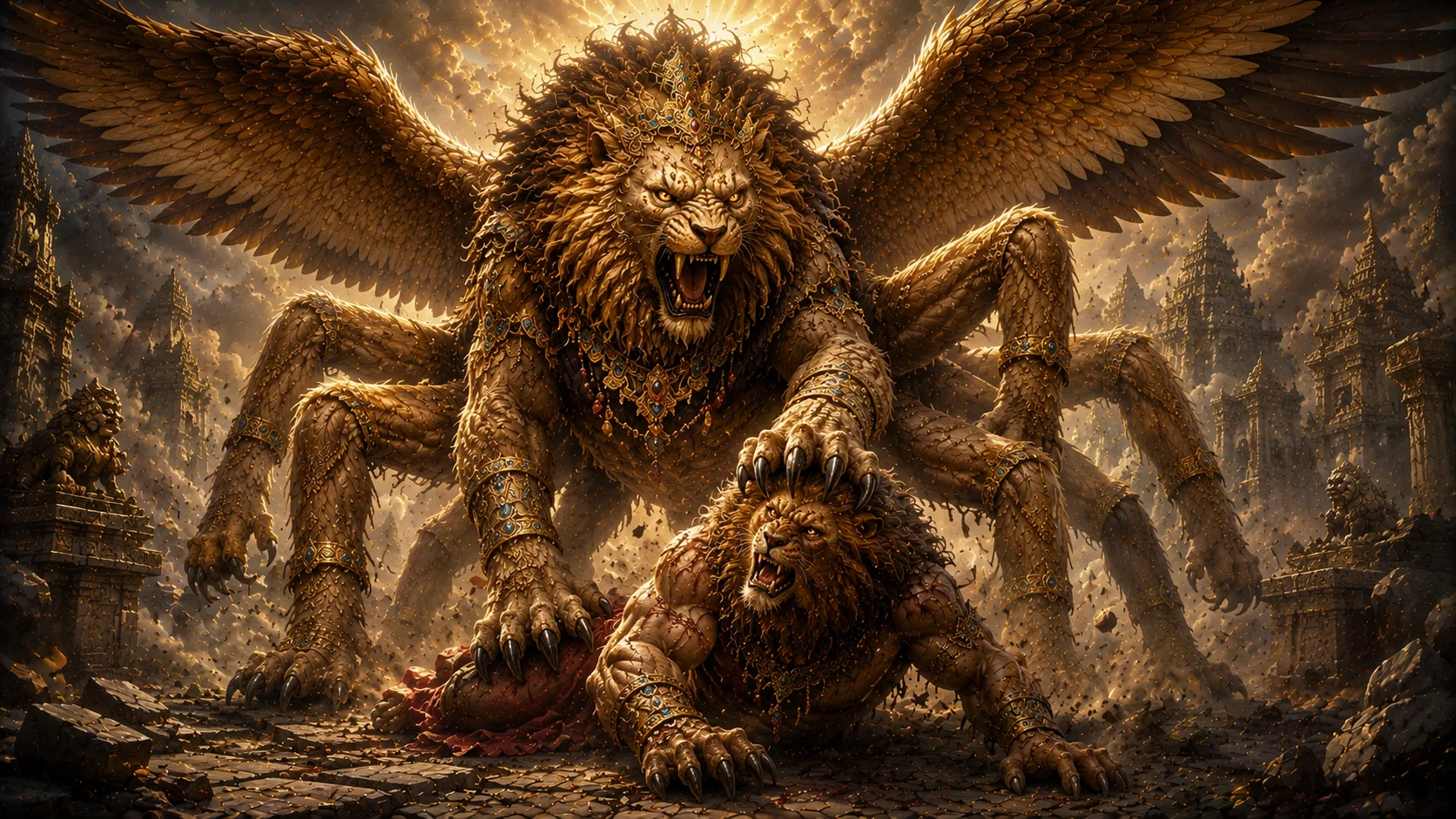
Descriptions of Sharabha resist easy categorization. The creature is consistently rendered as a hybrid — the powerful frame and mane of a lion fused with the wings, beak, or bird-like features of a great raptor, and in some depictions the bulk or trunk of an elephant besides. Textual accounts frequently give it eight legs, a detail repeated often enough across sources to be treated as one of Sharabha's defining traits rather than an isolated embellishment. Some renderings lean more avian, others more leonine, but the throughline across all of them is the same: Sharabha is not merely large or fierce in the way an ordinary predator is fierce. It is described as exceeding the lion in raw physical power, a creature whose very form signals that it stands outside the natural order of beasts — built specifically to be more than the strongest thing already known.
Strength That Outranks the Apex Predator
In the mythic imagination that produced Sharabha, the lion already occupies the top of the animal hierarchy — the measure against which all other strength is judged. Sharabha's entire iconographic purpose is to break that measure. Its eight-legged, composite form functions as a symbol of power that is uncontainable, power that cannot be captured by any single animal's attributes because no single animal's attributes are sufficient to express it. This is strength imagined specifically as strength-beyond-the-apex — a creature invented, in effect, to answer the question of what could plausibly overpower a lion, and then extended further still.
A Beast Named Before It Was a God's Form
Sharabha's identity does not begin with Shiva. The creature appears earlier in Vedic-adjacent literature and in the Mahabharata, listed among the dangerous beasts of forest and mountain — a real or quasi-mythical animal noted specifically for its capacity to kill lions. In these earlier references, Sharabha is not yet a divine transformation; it is simply one more entry in a catalogue of formidable wild creatures, alongside other fabulous animals said to inhabit mythic forests and high mountain country. Only later, in the Puranic period, did Sharabha's fuller mythologization take shape, elevating a dangerous forest beast into the specific, singular form of a great god. Because the sources diverge — Shaiva Puranas, general bestiary lists, and near-total silence in Vaishnava canon — the exact origin and parentage of Sharabha as an independent being, apart from its later identity as Shiva's assumed form, is not clearly fixed in the tradition. It is best understood as an open and disputed point rather than a settled fact.
The Fury That Would Not Subside
The central drama that gives Sharabha its lasting fame begins after Narasimha, the man-lion avatar of Lord Vishnu, has already accomplished his purpose. Hiranyakashipu, the demon whose tyranny Narasimha was sent to end, lies slain. But the terrible power that Narasimha embodied in that killing does not simply switch off. In the Shaiva telling, his rage continues to burn — a frenzy of destructive fury that no longer has an enemy to spend itself on, and that threatens to consume far more than the demon it was raised against. None among the gods or sages is able to approach him. None can calm what Narasimha has become.
Sharabeshwara: Shiva in Composite Form
It is at this point, in the Shaiva sources — the Shiva Purana and Linga Purana chief among them — that Lord Shiva takes on the form of Sharabha. This assumed form carries its own epithet, Sharabeshwara, or Sharabeshvara Murti, naming Shiva specifically as the great god manifest in the composite lion-bird-beast body. The choice of form is not incidental: Shiva does not simply overpower Narasimha as himself, but takes on the one shape mythologically defined as exceeding the lion's own power, meeting Narasimha's leonine fury with a strength built expressly to surpass it.
The Confrontation and Its Aftermath
As Sharabha, Shiva confronts the raging Narasimha directly. Accounts of the encounter describe Shiva-as-Sharabha attacking the man-lion form, in some versions pinning him, in others going so far as to describe a dismemberment of the lion-man body, all in the service of a single aim — to break the frenzy and calm the fury rather than to destroy Narasimha outright. Following this confrontation, Lord Vishnu's anger subsides. Some versions of the story carry the episode further still, describing Narasimha, once pacified, offering praise to Shiva. The sequence closes not on conquest for its own sake but on restoration — the terrible energy that had nowhere left to go is finally brought to rest.
A Doctrine Wearing the Shape of a Story
The Sharabha-Narasimha episode cannot be read simply as a piece of shared Hindu narrative furniture. It exists, in its Shaiva form, expressly to assert Shiva's supremacy over Vishnu — a sectarian claim carried inside a mythic scene. Vaishnava tradition, unsurprisingly, does not accept the story on these terms; where it appears at all in Vaishnava-oriented material, it is told differently or set aside entirely. This does not make the narrative any less real within the Shaiva textual tradition that preserves and elaborates it — it is well-attested there, repeated across Puranic sources and given lasting visual form in temple sculpture. But its strength as scripture belongs to one stream of Hindu practice, not to Hindu tradition as a single, undivided whole. To tell the story honestly is to tell it as what it is: a doctrinal narrative of real standing within Shaivism, contested or unrecognized outside it.
Carved Into Stone: Sharabha in the South
Sharabha's afterlife extends well beyond the page. In parts of South India, particularly Tamil Nadu, temple sculpture gives Sharabeshwara lasting physical form — carved images of the composite lion-bird-beast, often shown trampling or grasping the figure of Narasimha beneath it. These are not incidental decorative flourishes; they are devotional images, placed with intention in temples where Shaiva theology holds the central position, translating the Puranic episode into something worshippers could see, approach, and venerate directly. The iconography is instantly legible to anyone who knows the story: a multi-limbed, hybrid beast in the act of mastering a lion-headed man, the moment of pacification frozen permanently in stone.
An Independent Bestiary Presence
Separate from his identity as Shiva's assumed form, Sharabha also holds a place as a creature-type in his own right within some Hindu bestiary traditions — one of a broader company of fabulous animals said to inhabit mythic forests and mountains. In these contexts Sharabha functions less as a theological statement and more as folklore: a fearsome, larger-than-life animal among other fearsome, larger-than-life animals, part of the same imaginative landscape that populated the wild margins of the world with beasts no ordinary hunter could face. This dual life — mythic animal on one hand, divine avatar-form on the other — is part of what keeps Sharabha's exact nature open rather than fixed.
A Motif That Outlived Its Source Texts
The influence of the Sharabha narrative reached beyond the Puranic verses that first elaborated it. In regions where Shaiva theology took firm root, particularly in South India, the motif was absorbed into temple architecture and into festival iconography, carried forward generation after generation as a recognizable devotional image rather than a piece of text confined to manuscript. A story built to make a sectarian theological point became, over time, a living visual tradition — proof that the image of Shiva as the beast beyond the lion held enough force to move from doctrine into stone, procession, and ritual display.
Power Measured Against Power
What ties every strand of the Sharabha tradition together — the ancient lion-killing beast of epic lists, the eight-legged composite of the bestiaries, and Sharabeshwara pinning Narasimha in temple stone — is a single recurring idea: power that can only be depicted by exceeding the most powerful thing already known. The lion stood for supremacy among beasts; Narasimha, lion-headed and god-empowered, stood for a fury beyond even that. Sharabha was built, across every version of the myth, to answer both — a form conceived specifically to be more than enough.
Sources & traditions
- EncyclopediaWikipedia — Sharabha
- TraditionHindu texts, oral tradition and village tellings (South Asia)
Myths change from area to area and from time to time. This chronicle follows the most widely told versions; tellings in other villages, regions and eras may differ.