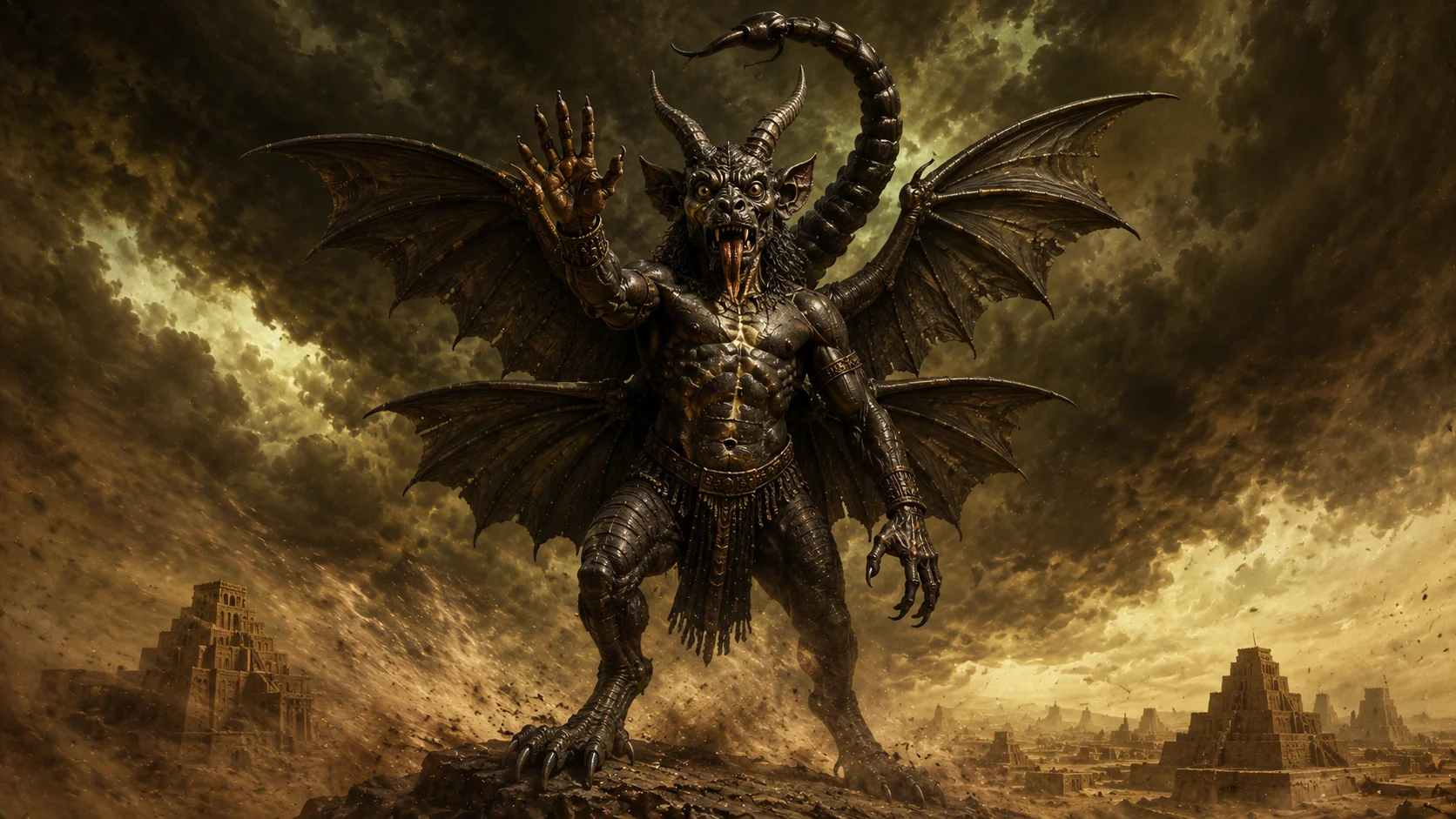
Pazuzu is a demon of Mesopotamian tradition, known above all from Assyrian and Babylonian sources of the first millennium BCE — roughly 900 to 500 BCE, the Neo-Assyrian and Neo-Babylonian centuries. He survives not as the hero of a continuous epic but as a presence carried on bronze: small pendant heads worn against the chest, full-body statuettes set up in the corners of houses, and plaques hung by a laboring woman's bed. To read Pazuzu is to read metal and stone rather than a story, and the metal is emphatic about who he is, even where it stays silent on what he did.
A Voice Cast in Bronze
Most of what can be said about Pazuzu with real confidence comes from his own mouth — or rather, from the first-person inscriptions cast onto the statuettes that carried his image. These are not myths in the narrative sense; they are declarations, short and self-identifying, the demon naming himself to whoever holds the object. That a figure this fearsome chose to introduce himself in writing, repeatedly, on object after object, is itself part of what made him useful: an amulet that announces its own authority does more work than one that merely looks fierce.
Son of Hanbi, King of the Wind-Demons
The genealogical claim appears again and again across the surviving statuette inscriptions, and its persistence is exactly what makes it trustworthy: Pazuzu names himself son of the god Hanbi, sometimes rendered Hanpa, and identifies himself as king of the lilû — the wind-demons, a class of malevolent spirits tied to storm and gale. Where so much about Pazuzu is reconstructed from fragments and inference, this lineage is one of the few facts that stands on direct, repeated textual evidence. A demon who is king of a whole category of lesser wind-spirits is not a freelance menace; he sits atop a hierarchy, and that rank is part of what qualifies him to be invoked against other powerful threats.
The Louvre Bronze and Its Own Testimony
The single most important physical witness to Pazuzu's self-understanding is a large bronze statuette now catalogued as AO 22205, held at the Louvre and dated to roughly 800 to 700 BCE. Cast into its back is a cuneiform inscription in which the figure describes himself as ruler of the wind demons and speaks of his power over winds that carry plague. It is a rare thing in Mesopotamian religion — a demon, rather than a temple or a king, leaving behind a first-person account of his own dominion, incised on the very body meant to represent him. Scholars return to this piece again and again as a primary source precisely because it is Pazuzu describing Pazuzu, not a scribe describing a rite performed in his name.
A Face Built to Be Recognized on Sight
The iconography is consistent enough across surviving pieces that it functions almost as a signature. Pazuzu is shown with a canine or leonine face, eyes bulging outward, a body given over to scales rather than skin, a scorpion's tail curling behind him, taloned bird feet in place of a human stance, and two pairs of wings rather than one. Nothing about this assembly reads as decorative. Each element belongs to a register of danger — predator, venom, storm-flight — stacked onto a single frame so that anyone encountering the image would read threat before they read anything else. That legibility mattered: an amulet has to be recognized instantly, by people who may not be able to read the inscription beneath it.
Worn Against the Body, Set Within the House
Pazuzu's presence took two physical forms. Small bronze pendant-heads, showing just the demon's face, were made to be worn — carried on the body as personal protection, close enough to be felt rather than merely displayed. Larger, full-figure statuettes, standing free rather than worn, were placed within houses, positioned as household guardians rather than personal talismans. The distinction matters: Pazuzu was not only a shield for an individual but a fixture meant to watch over a dwelling, a presence installed rather than carried, doing its work whether or not anyone in the house was thinking about it.
Set Against Lamashtu
The core of Pazuzu's protective function is his opposition to Lamashtu, a female demon whose threat was aimed specifically at pregnant women and infants — believed to bring on miscarriage and the death of small children. Despite his own terrifying form, Pazuzu's invoked role was not to threaten households but to defend them, and Lamashtu was the danger he was most consistently summoned against. This is the paradox at the center of his cult use: the more frightening he looked, the more plausible it was that he could face down something worse. His fearsomeness was not incidental to his protective role — it was the qualification for it.
Plaques at the Bedside
The ritual use of Pazuzu's image was at its most concrete in childbirth. Bronze plaques bearing his head at the top were hung near the beds of women who were pregnant or already in labor, placed there as a direct intervention at the moment of greatest danger. Some of these plaques go further than a single protective face: they depict Lamashtu herself being expelled, driven out or bound beneath a boat, with Pazuzu's image positioned above the scene. On these objects the confrontation between the two demons is not implied — it is staged, cast into the bronze as a single continuous composition, so that the object itself performs the myth-fragment of Pazuzu overpowering Lamashtu rather than simply asserting it in words.
Ruler of the Wind That Carries Plague
Pazuzu's dominion was specifically over the southwest wind, and in Mesopotamia that wind carried a double burden. During the dry season it was associated with famine and with locusts, the kind of wind that strips a harvest rather than nourishes it. It was also linked to epidemic disease — a plague-bearing wind, sweeping illness across a population the way it swept dust across a field. This dual association, agricultural ruin paired with sickness, is noted repeatedly in the Assyriological record and gives Pazuzu's kingship over the wind-demons a very earthly stake: the winds he ruled were the same winds that could empty granaries and fill sickbeds.
A Figure Without an Epic
Unlike the great gods of the Mesopotamian pantheon, Pazuzu has no surviving independent narrative — no epic recounting a journey, a battle, or a fall, of the kind that exists for figures such as Gilgamesh or Marduk. What can be reconstructed of him comes almost entirely from the short first-person inscriptions on his amulets and from the ritual context in which those amulets were used. This is not an absence to apologize for; it is the shape of the evidence itself. Pazuzu belongs to the category of Mesopotamian religion that lived in practice and object rather than in recited story, and his surviving voice is a magical one, declarative rather than dramatic.
One Demon Among a Catalogued Order
Pazuzu did not stand alone in the demonology of Assyria and Babylon. He belongs to a broader, systematized category of hybrid spirits, both threatening and protective, that included Lamashtu herself, the demon Lulal, and the various utukku and asakku types catalogued in incantation series such as Utukkū Lemnūtu, "Evil Utukku-Demons." The existence of such a catalogue says something important about how these societies understood the demonic: not as chaos beyond classification, but as an ordered field of named powers, each with a defined nature, that could be studied, invoked, and set against one another by those who knew the correct forms.
A Late Arrival, Specifically Assyro-Babylonian
Pazuzu does not appear in Sumerian sources at all. His cult and iconography belong specifically to the first-millennium BCE Assyro-Babylonian world, which makes him, in the long span of Mesopotamian religious history, a comparatively late figure — younger than Lamashtu, whose roots reach further back. This chronology matters for how he should be read: not as an ancient, foundational power inherited from the earliest Mesopotamian religious layer, but as a demon whose form and function crystallized within a specific, later cultural moment, one already dense with its own developed demonology.
What the Name Still Withholds
Even the most basic fact about Pazuzu, his name, resists full certainty. Its exact reading and etymology remain debated among scholars, unresolved despite the number of inscriptions that carry it. A second, related question is equally open: whether Pazuzu received anything that could be called worship in a formal cult sense, or whether his presence in Mesopotamian life was purely apotropaic and magical, invoked for protection without ever being the object of devotion in the way a temple god would be. These are not small gaps. They sit at the center of how Pazuzu should be understood, and the honest position is that the evidence, rich as it is in bronze, has not settled either question.
The Modern Face and the Ancient One
Pazuzu's most widely recognized modern appearance came through the 1973 film The Exorcist, where a statuette bearing his image serves as a harbinger of possession and horror. That portrayal has done more than any museum label to fix Pazuzu in popular imagination — but it inverts his ancient function almost completely. The figure that modern audiences meet as a pure agent of evil was, in his own time, invoked as a guardian: a demon fearsome enough to stand between a household and something worse. Assyriologists and museum curators, including those at the Louvre and the British Museum, have noted this discrepancy directly. The ancient bronze and the modern screen image share a face, but they do not share a purpose, and the gap between them is worth holding onto rather than resolving in either direction.
Sources & traditions
- EncyclopediaWikipedia — Pazuzu
- TraditionAssyrian texts, inscriptions and later retellings (Mesopotamia)
Myths change from area to area and from time to time. This chronicle follows the most widely told versions; tellings in other villages, regions and eras may differ.