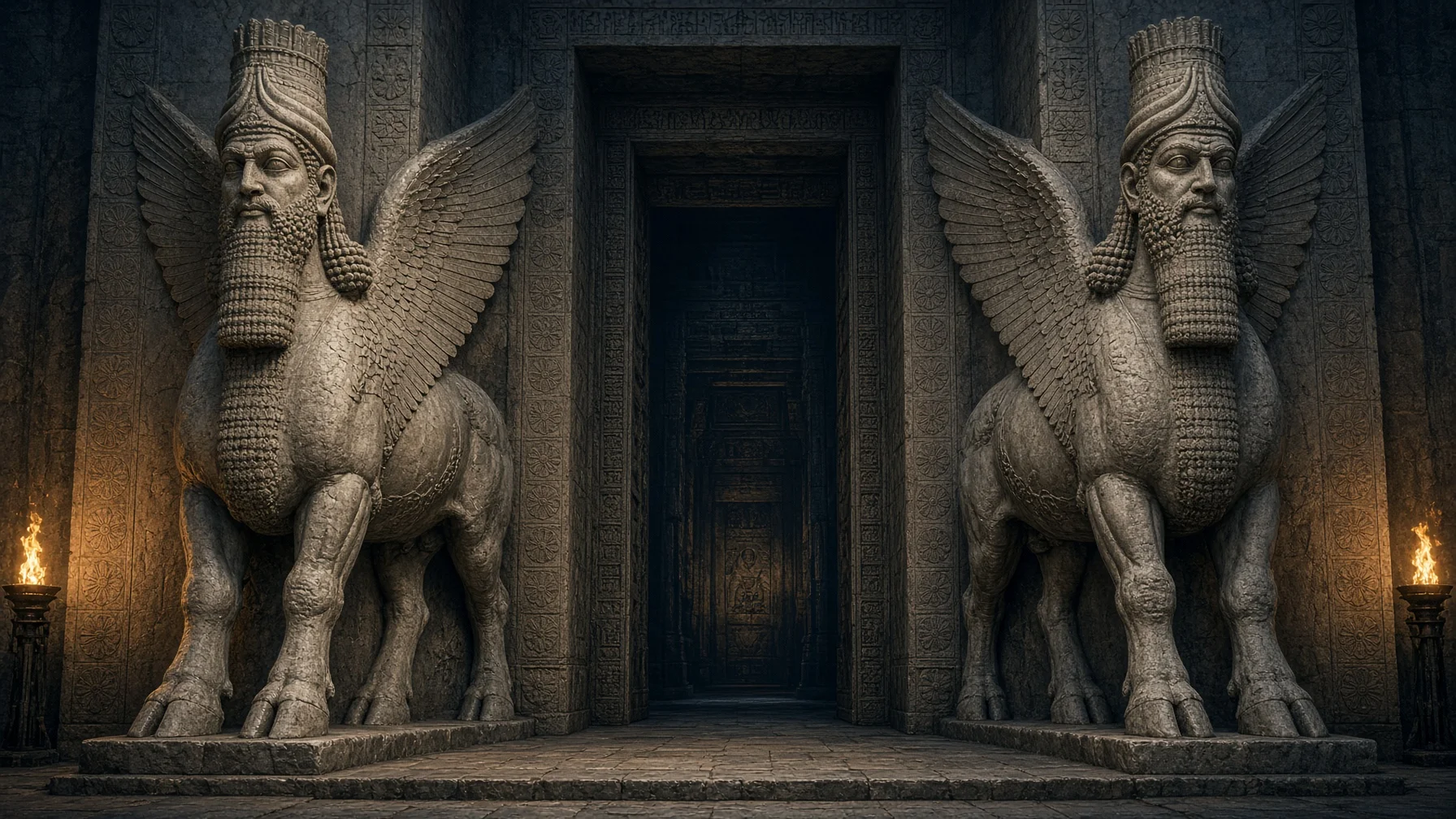
The Lamassu stands among the most immediately recognizable guardian-beings to survive from the ancient Near East — a composite protective spirit of Mesopotamian tradition, most magnificently attested in the monumental gate sculpture of the Neo-Assyrian royal palaces of the 9th through 7th centuries BCE. Carved from massive blocks of stone and set in facing pairs at the thresholds of kings, the Lamassu has endured across nearly three thousand years as an image of watchfulness, sanctioned power, and the line drawn between order and the chaos pressing in from outside.
A Body Built From Three Kinds of Strength
The standard Lamassu form fuses the body of a bull or a lion with the wings of an eagle and the bearded head of a human male, very often crowned with a horned headdress — in Mesopotamian visual language, a horned crown was not a mark of royalty but of divinity itself, signaling that the being before the viewer belonged to the sphere of the gods rather than to the court of mortal kings. Each element of the composite carried its own register of meaning: the bull or lion supplied raw physical power and the capacity to stand immovable; the eagle's wings supplied reach beyond the earthly, the vigilance of a creature that could see what approached from a distance; and the human head supplied intelligence, judgment, and the capacity to recognize and discriminate between friend and threat at the gate. Where a purely animal guardian might have symbolized brute strength alone, the human face gave the Lamassu something closer to discernment — a sentinel that watched and decided, not merely blocked.
The Sculptor's Trick of Five Legs
One of the most quietly ingenious features of the colossal gate Lamassu is a detail easy to miss and remarkable once seen: the figures were carved with five legs rather than four. This was not an error nor a flourish of abundance — it was a deliberate solution to a problem of viewing angle. A visitor approaching the palace gate head-on would see the Lamassu frontally, and from that angle the sculpture needed to read as a being standing planted on four legs, solid and immovable. That same visitor, having passed beneath the gate and turned to look back, or simply walking alongside the passage, would see the figure in profile — and from that angle it needed to read as a being striding forward on four legs, in motion, advancing with purpose. No single four-legged arrangement could satisfy both readings, so the sculptors added a fifth leg, invisible as an anomaly from either single vantage point but present in the stone to complete whichever image the approaching eye required. The effect, achieved centuries before any formal theory of multiple-viewpoint perspective, was a guardian that appeared simultaneously stationary and in motion — eternally standing watch, and eternally advancing to meet whatever came through the gate.
Stone Sentinels at Dur-Sharrukin, Nimrud, and Nineveh
The best-documented physical examples of the Lamassu come from the great Neo-Assyrian palace-building projects. At Dur-Sharrukin, the city built by Sargon II (reigned 721–705 BCE) at what is now Khorsabad, colossal Lamassu pairs flanked the gateways of the royal residence, greeting anyone who approached the king's presence with the sight of divine protection made monumental in stone. Related pairs stood at Nimrud, the city known in antiquity as Kalhu, and at Nineveh, the last great capital of the Assyrian empire. Many of these figures were removed in the era of nineteenth-century excavation and now stand in the British Museum, the Louvre, and the Iraq Museum. Others were not so fortunate: in 2015, Lamassu sculptures and related monuments at Nineveh and in the Mosul museum were deliberately destroyed by the group known as ISIS, an act of cultural destruction documented extensively by UNESCO and by archaeologists working in the region. The loss transformed the surviving Lamassu — those already resting in museum halls far from Iraq — into living evidence of a heritage that had been actively, violently targeted.
Words Spoken Against the Dark
The Lamassu was not only carved — it was also named, invoked, and addressed in the written record. Akkadian texts and royal inscriptions describe protective spirits summoned to guard entrances against evil forces, and the being called šēdu (often rendered in English as shedu) and the being called lamassu both appear in incantation and ritual literature, including the series known as Šurpu and other apotropaic ritual texts concerned with purification and protection. These were not idle poetic flourishes; they were functional religious technology, words spoken with the expectation that they would actually hold back harm. The stone colossi at the gates and the words spoken in the ritual texts worked as two expressions of the same conviction: that a threshold was a vulnerable place, and that vulnerability could be answered by naming and depicting a being whose entire nature was protective vigilance.
Guardian of the King and Guardian of the State
Scholars of Assyriology have long described the shedu and lamassu pairing as protective deities bound up with two overlapping concerns: the safety of the individual person, particularly the person of the king, and the security of the palace and, by extension, the state itself. Placed at the entrances to royal residences, the Lamassu did double duty — warding off literal enemies who might approach the gate with hostile intent, and warding off the unseen malevolent spirits that Mesopotamian religious thought held responsible for illness, misfortune, and disorder. The king's body and the kingdom's stability were, in this framework, protected by the same class of being, watching the same threshold, because in the logic of the ancient Near Eastern state the person of the ruler and the wellbeing of the realm were never fully separable.
Company Kept at the Palace Gate
The Lamassu rarely stood alone in the broader visual and religious world it belonged to. In the relief programs of palaces such as Nimrud and Khorsabad, the great gate figures were accompanied by other apotropaic beings, among them the apkallu — sage-genii sometimes shown cloaked in the stylized body of a fish, sometimes rendered with the head of a bird, figures associated with the transmission of divine wisdom and with ritual purification. The Lamassu is conceptually related to, yet clearly distinct from, other classes of spirit named in Mesopotamian demonological thought, such as the utukku, some of which were regarded as malevolent rather than protective. The ancient imagination, in other words, populated the space around a palace gate with an entire hierarchy of spirits — some benevolent, some hostile — and the Lamassu's identity was defined partly by its clear, unambiguous place among the protective ones.
Older Than the Winged Bull
The colossal winged-bull and winged-lion form most associated with the Lamassu today is, in the fullest sense, a Neo-Assyrian royal architectural innovation — a specific monumental solution developed for a specific kind of building at a specific point in Mesopotamian history. The underlying concept, however, reaches back considerably further. Precursor protective hybrid figures appear in earlier Mesopotamian art, including Sumerian and Old Babylonian glyptic (seal-carving) traditions and temple contexts, where the lamma or lamassu already functioned as a tutelary spirit — a personal or communal guardian — centuries before any sculptor set a five-legged colossus at a palace gate. The towering stone form that now stands as the being's most famous image should be understood as a late and spectacular architectural expression of a much older and more modest protective concept, rather than as the being's original or only form.
A Name That Shifted Its Shape
Reference literature in Assyriology notes a genuine and still-discussed point of terminological ambiguity around the Lamassu's gender and naming. Some Assyriologists have distinguished lamassu as the female protective spirit and shedu as her male counterpart, a distinction with roots in earlier usage. By the time of the Neo-Assyrian period, however, the term lamassu had become the conventional label applied in general usage to the human-headed winged bull and lion colossi themselves, regardless of the being's grammatical gender in Akkadian. This is a documented slippage between technical and popular usage, worth holding as an open question rather than papering over.
One Form Within a Wider Family
While the winged, human-headed bull is unquestionably the most iconic Lamassu form — most famously realized in Ashurnasirpal II's palace at Nimrud and in Sargon II's palace at Khorsabad — it was never the only shape Mesopotamian guardian-spirit iconography took. Related protective genii across different periods and city-states appear in other composite forms: bird-headed figures, lion-bodied guardians without a human head, and other combinations that varied by era and by regional workshop tradition. The Lamassu, properly understood, is best approached as one especially monumental and especially well-documented form within a much broader and longer-lived family of Mesopotamian guardian imagery, rather than as a single fixed type holding constant across the whole of Mesopotamian history.
Stone That Argued for a King's Legitimacy
Beyond its function as a literal ward against evil, the Lamassu carried an unmistakable symbolic charge: it embodied royal power and the divine sanction of kingship. A visitor who passed beneath a Lamassu gateway was not only passing a protective spirit — they were reading a political argument carved permanently in stone. The pairing of Lamassu imagery with royal inscriptions boasting of the king's might and of the favor shown to him by the gods was a documented and deliberate rhetorical strategy. The message at the threshold was cosmological as much as architectural: this ruler's authority did not rest on human force alone but stood under the same divine guardianship made visible in the colossus flanking the door. To enter the palace was to enter a space the gods themselves were understood to be actively watching over.
A Symbol Carried Forward Into the Present
The Lamassu's life did not end with the fall of the Assyrian palaces. In the modern era it has become a widely recognized symbol of Assyrian and broader Mesopotamian cultural heritage, adopted into contemporary Assyrian-diaspora iconography and into Iraqi cultural symbolism more broadly, appearing in art, civic imagery, and public memory as a marker of connection to that deep past. This modern symbolic life is a well-documented and significant post-antique development in its own right, and it deserves to be recognized honestly as exactly that — a later, ongoing chapter of meaning built on top of the being's foundation — rather than folded silently into the ancient religious and apotropaic function that remains the primary, best-attested sense of the Lamassu in the archaeological and textual record. Keeping the two distinct honors both: the ancient guardian who watched over kings and cities, and the modern symbol that carries the memory of that watchfulness forward for communities who claim it as their own.
What the Threshold Still Says
Seen whole, the Lamassu is less a single fixed monster than a long conversation a civilization kept having with itself about vulnerability and protection — carried on in stone at five-legged scale, in whispered ritual incantations, in the company of sage-genii and rival spirits, and now in the galleries of museums an ocean away from the gates the figures were built to guard. What persists across every version of that conversation is the same essential posture: a being planted at the boundary, facing outward, built from the strongest parts of three different kinds of creature, so that whatever crossed the threshold would have to reckon first with its gaze.
Sources & traditions
- EncyclopediaWikipedia — Lamassu
- TraditionAssyrian texts, inscriptions and later retellings (Mesopotamia)
Myths change from area to area and from time to time. This chronicle follows the most widely told versions; tellings in other villages, regions and eras may differ.