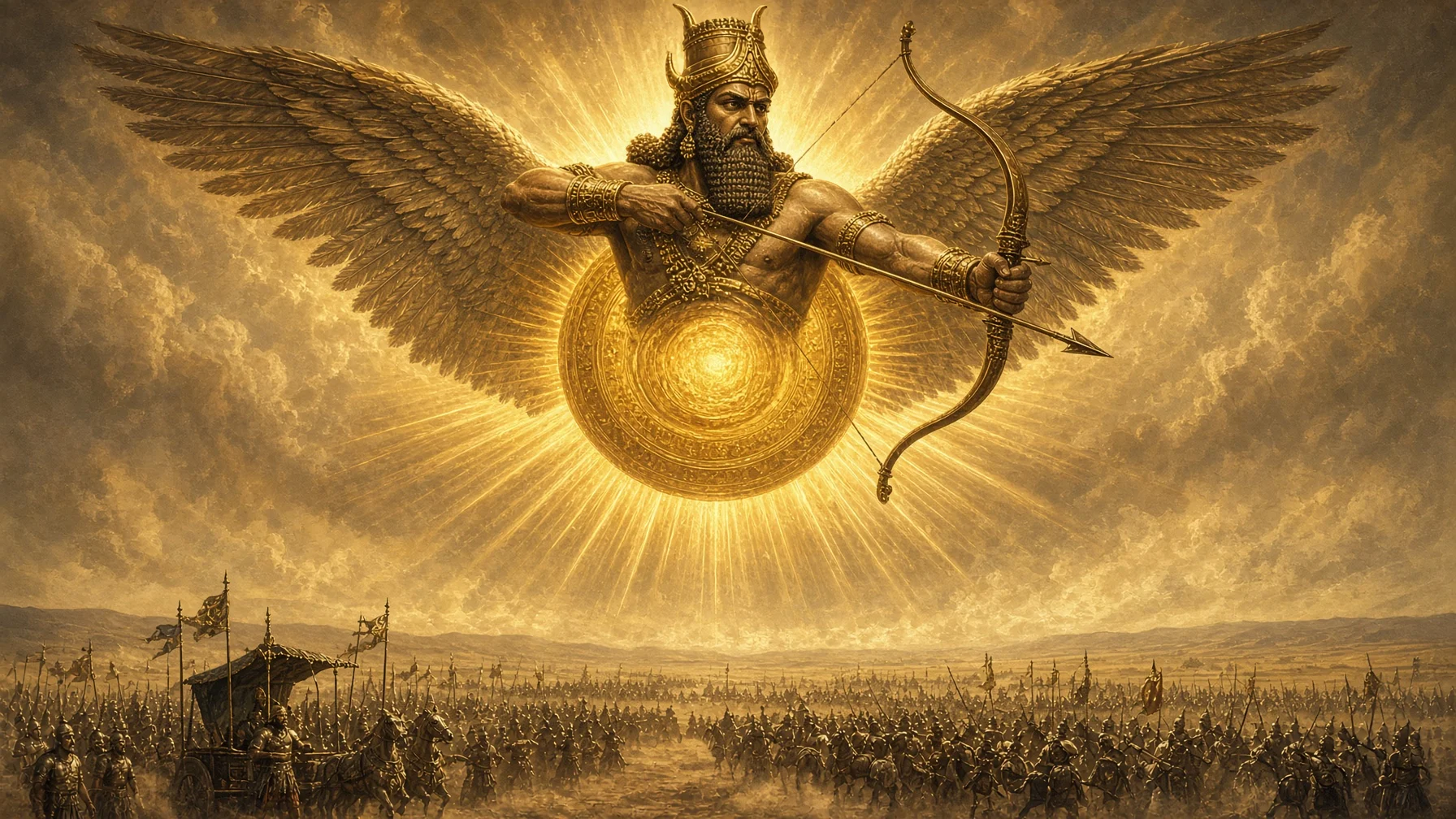
Ashur (Aššur) is the tutelary deity of the city of Ashur on the west bank of the Tigris, the original capital of Assyria — and one of the ancient Near East's most unusual cases of divine identity: the god, the city, and the land itself all bear the same name. That fusion, attested from the Old Assyrian period in the early second millennium BCE onward, is not incidental to who Ashur is. It is very nearly the whole of it. To speak of Ashur is to speak of the city that bore him and the state that grew from that city, three things folded into a single name across more than a thousand years of history.
A Name Shared by God, City, and Land
Few deities anywhere in the ancient world were bound this tightly to a single place. Most Mesopotamian gods had a home city — Marduk in Babylon, Enlil in Nippur — but retained an identity that could, in principle, be separated from it. Ashur's name does not permit that separation. The god was called Ashur; the city on the Tigris where he was worshipped was called Ashur; the land and later the empire that grew outward from that city were called Assyria, a Greek-mediated form of the same root. Scholars continue to debate the precise etymology and whether the god began as a numen of the city's rock outcropping — a local, perhaps pre-anthropomorphic sense of sacred place — before taking on a more personal, worshipped form. No single consensus has settled this question, and it is worth holding the uncertainty honestly rather than resolving it with invented certainty. What is clear is that this triple identity of god-city-land shaped everything that came after: an Assyrian could not conceive of loyalty to the state as separate from devotion to the god, because the words themselves would not allow it.
A Guarantor of Oaths in the Merchant Colonies
The earliest substantial evidence for Ashur comes not from grand temple inscriptions but from the ledgers and letters of merchants. The Old Assyrian trading colonies, documented above all in the archives of Kanesh (modern Kültepe) in Anatolia and dated to roughly the nineteenth century BCE, show Assyrian traders invoking Ashur in commercial and legal contexts — as a witness to contracts, a guarantor of treaties, a power whose name gave weight to a sworn word. In this earliest layer, Ashur is not yet a cosmic sky-god or a rival to Enlil and Marduk. He is, first and fundamentally, a city-god: the patron of Ashur the settlement, invoked by its merchants the way a hometown deity might be invoked by anyone far from home doing business under an oath that needed backing. It is worth sitting with this origin, because everything Ashur later became was built on top of it, not instead of it. The city always remained inside the god.
From City-God to King of the Pantheon
Ashur's theological stature rose in step with Assyria's political fortunes, and the correspondence between the two is one of the clearest examples in Mesopotamian religion of a god's rank tracking his people's power. As the Assyrian state expanded through the Middle Assyrian period and then, decisively, through the Neo-Assyrian empire of roughly 1300 to 609 BCE, Ashur was promoted into the position that Enlil held in the older Sumerian tradition and that Marduk held in Babylon: effectively the king of the gods, at least within the Assyrian religious system. This was not a gentle absorption of honors. It was a deliberate, sustained theological program, carried out by scribes and priests serving a state that needed its patron god to outrank the patron god of its great rival, Babylon.
The Vice-Regent Who Ruled in a God's Name
The political consequence of Ashur's elevation was a distinctive Assyrian conception of kingship. Assyrian monarchs did not, in the state ideology, rule as fully autonomous sovereigns in their own right. They styled themselves iššakku — vice-regent — of Ashur, governing on the god's behalf rather than in simple succession from earlier kings. Every royal act carried a second signature, invisible but constantly asserted: the king spoke and fought and built as Ashur's steward on earth. This is a genuinely distinctive feature among ancient Near Eastern monarchies, where kings more commonly claimed divine favor or even divinity themselves rather than framing the entire office as an extension of a single god's rule.
Holy War Waged in Ashur's Name
That theology had teeth. Assyrian military campaigns, some of the most extensive and feared of the ancient Near East, were consistently framed in royal annals as being waged by the command of Ashur — not merely with his blessing, but as direct execution of his will. Conquest was his conquest, extended through the king's army. This framing had a practical religious dimension as well: when Assyrian forces defeated a rival power, captured enemy gods or the cult objects belonging to them were sometimes brought back to Ashur's temple as tribute, a practice recorded in the royal annals themselves. A god's image or symbol, taken from a conquered city and installed among Ashur's own cult goods, made the subjugation legible in the terms Mesopotamian religion understood best — one god's supremacy demonstrated over another's, with the defeated god's own furnishings as the proof.
Sennacherib's Rewriting of the Creation of the World
The boldest single act of Ashur's theological promotion belongs to the reign of Sennacherib, who ruled from 704 to 681 BCE. Sennacherib sponsored a recasting of the Babylonian creation epic Enuma Elish — the great poem in which Marduk slays the primordial chaos-monster Tiamat and shapes the ordered cosmos from her body — with Ashur substituted directly into Marduk's role as world-creator and dragon-slayer. Scholars refer to this reworked composition as the Ashur version of Enuma Elish, and tablets carrying it have been recovered from ritual and cultic contexts in the city of Ashur itself. This was not subtle borrowing. It was an open claim, staged in the most sacred narrative Mesopotamian religion possessed, that the god of Assyria — not the god of Babylon — was the true architect of the universe. Given the centuries-long rivalry between Assyria and Babylon, culturally intertwined yet politically opposed, the gesture reads as both theology and statecraft in a single act.
A God Without a Mythology of His Own
One of the more striking scholarly observations about Ashur is also one of the most honest to sit with: he appears to have had no fixed, independent mythology or divine genealogy comparable to Marduk's or Enlil's. Rather than accumulating his own body of stories from the ground up, Ashur largely absorbed the myths, epithets, and iconographic attributes that already belonged to Enlil, and later to Marduk, as Assyrian theology worked to install him at the summit of the pantheon. He has been described by scholars as a theological composite — a god built substantially from borrowed material, assembled to fit the office Assyria needed him to hold. This does not diminish him within the tradition that worshipped him; it simply describes how his supremacy was constructed, layer by layer, out of older and more storied gods, in service of a state that required a supreme god of its own.
The House of the Universe on the Tigris
Ashur's principal sanctuary was the Ashur Temple, known as Esharra, meaning House of the Universe, standing in the city of Ashur itself. Its history stretches from the third millennium BCE through to the height of the Neo-Assyrian period, continuously rebuilt and expanded as the city's fortunes rose. Major renovations are credited to a succession of kings, among them Shalmaneser I and, later, Sennacherib — the same king responsible for the Ashur-centered creation epic, whose interest in elevating the god evidently extended to elevating his house as well. A temple maintained and enlarged across two thousand years is itself a form of testimony: generation after generation of Assyrian rulers judged Esharra worth the investment, long before and long after the empire reached its greatest extent.
The Winged Disk Above the King
Assyrian royal relief carving gave Ashur one of the most recognizable images in ancient Near Eastern art: a winged sun-disk, often with a bearded archer figure emerging from within it, hovering above the king in scenes of battle, ceremony, and royal action. Reliefs from Nimrud, known anciently as Kalhu, and from Khorsabad, ancient Dur-Sharrukin, preserve this motif in some of its clearest forms. The image made the theology visible without a word of text: the god's presence literally overhead, watching and, by implication, directing the king below. It should be noted, in fairness to the scholarship, that not every winged-disk image in Assyrian art is agreed to represent Ashur specifically — some scholars attribute certain instances to the sun-god Shamash instead, and the debate over which figure is intended in a given relief remains open rather than settled.
Mullissu, Ishtar of Nineveh, and Ishtar of Arbela
As Ashur absorbed Enlil's role within Assyrian theology, he absorbed something of Enlil's family structure as well. His consort in the developed Assyrian pantheon was Mullissu, a form of Ninlil, who had been Enlil's own consort in the older Sumerian tradition — another instance of the composite, borrowed quality of Ashur's supreme-god identity. He did not, however, stand at the center of the Assyrian state pantheon entirely alone. Ishtar of Nineveh and Ishtar of Arbela were both prominent goddesses within that same state religious system, worshipped alongside him as major figures in their own right rather than as minor attendants, reflecting a pantheon with more than one center of gravity even as Ashur held its formal apex.
The New Year Procession at Ashur
The city of Ashur hosted its own akitu, or New Year festival, in which the god's cult statue was processed through the city in a ritual reenactment of cosmic kingship. This festival was directly modeled on the Babylonian akitu held at Babylon in honor of Marduk — meaning Assyria's central religious celebration of its own supreme god was, in its very form, borrowed from and staged in rivalry with the analogous festival of the god Ashur had been theologically built to surpass. The akitu at Ashur is one more instance of a pattern that runs through this god's entire history: Assyrian religion asserting its supremacy over Babylon by taking Babylon's own religious forms and reoccupying them with an Assyrian god at the center.
Silence After Nineveh
Ashur's cult was inseparable from Assyrian political power, and it did not survive that power's collapse. Nineveh fell in 612 BCE, and the last organized Assyrian resistance ended by 609 BCE. With the empire gone, the state cult of Ashur as its supreme national god effectively ceased; there was no longer a state whose kings ruled as his vice-regents, no longer an imperial apparatus to sustain temple, festival, and priesthood at their former scale. The city of Ashur itself did see scattered later reoccupation, but the god who had once stood, in Assyrian theology, at the summit of the created world receded from active worship along with the empire that had placed him there. It is a stark illustration of how completely this particular divine identity depended on its city and its state — when god, city, and land shared one name, the fall of one meant the eclipse of all three together.
A Name Carried Forward by Later Communities
The story does not end entirely in silence, though what follows is a distinct phenomenon and should not be mistaken for a continuation of ancient cult practice. In the modern era, some Assyrian-identity communities — including descendants connected to the Assyrian Church of the East and secular Assyrian nationalist movements — have symbolically invoked Ashur's name and the winged-disk image associated with him as a marker of ethnic and cultural continuity, a link reaching back toward the ancient land and its heritage. This modern symbolic usage is meaningful in its own right as an expression of identity across a very long span of history, but it operates on different terms from the attested religious practice of the ancient state cult, and the two should be understood as separate chapters rather than one unbroken thread of active worship.
Sources & traditions
- EncyclopediaWikipedia — Ashur (god)
- TraditionAssyrian texts, inscriptions and later retellings (Mesopotamia)
Myths change from area to area and from time to time. This chronicle follows the most widely told versions; tellings in other villages, regions and eras may differ.