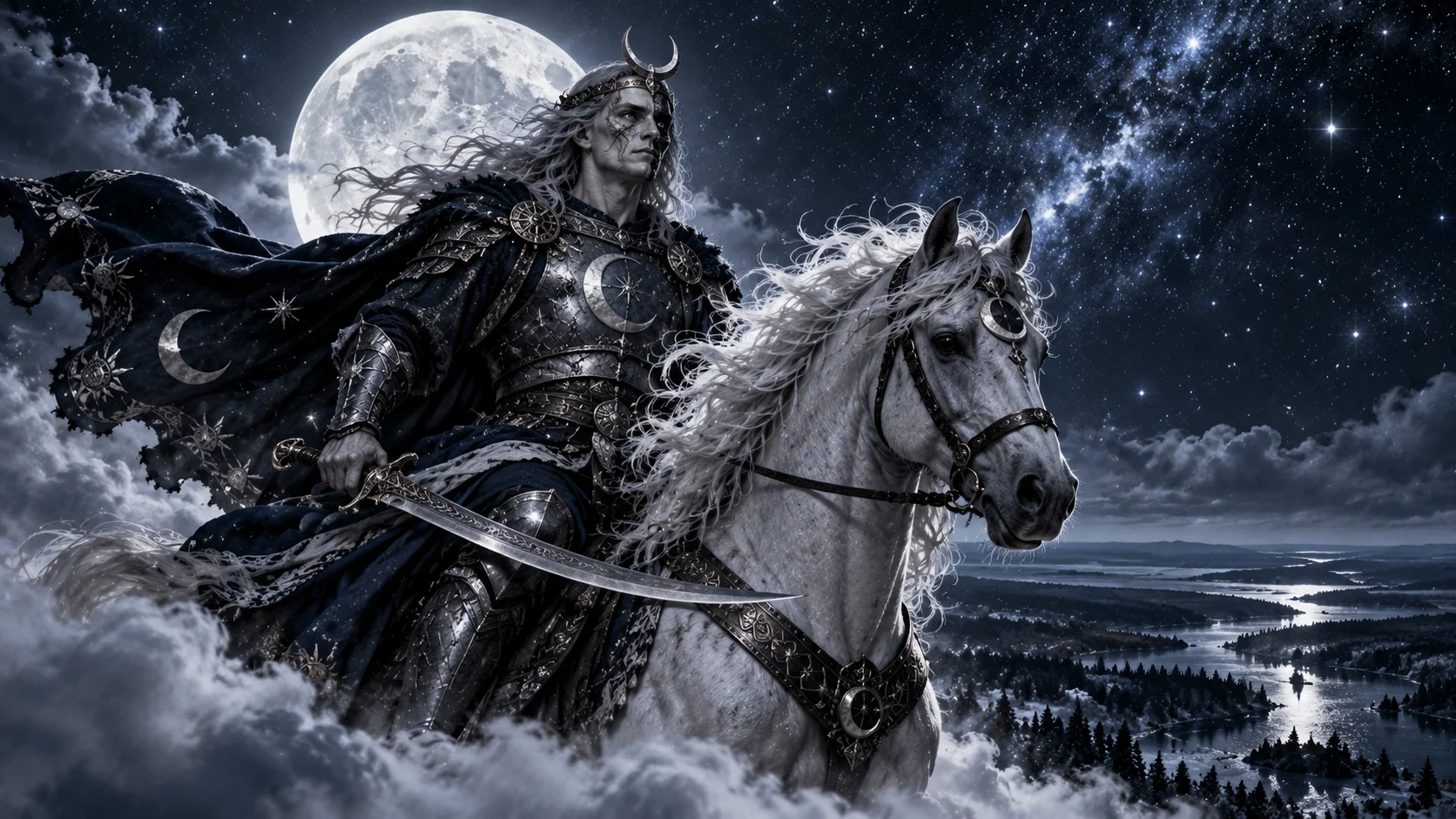
Mēness is the moon-god of Latvian Baltic mythology, one of the great celestial figures preserved in the dainas — the vast body of traditional folk songs collected by the folklorist Krišjānis Barons and later treated as scripture by the twentieth-century Dievturi revival movement. Where many neighboring traditions cast the moon as female and the sun as male, Latvian belief runs the opposite way: Saule, the sun, is a goddess, and Mēness, grammatically and mythologically masculine, is her often-troubled husband. Few figures in the Baltic pantheon carry as much narrative weight, because Mēness is not merely a marker of night — he is a character, a traveler, a suitor, and, in the most famous of his myths, a cautionary figure whose wounds explain the very shape of the sky.
The Wandering Husband of the Sky
In the mythological songs classified by Latvian folklorists as mītiskās dziesmas, Mēness appears again and again as a husband ill-suited to fidelity. The dainas describe a divine marriage between Mēness and Saule, but it is a marriage under strain — songs recount his absences, his wandering path across the night sky, and his attraction to other celestial women. This portrait of an unfaithful moon husband is one of the most consistent threads running through the surviving song cycles, and it gives Mēness a psychological complexity rare among sky deities: he is powerful and necessary to the cosmos, yet flawed in exactly the way that made him a compelling subject for centuries of oral composition.
Pērkons and the Scarring of the Moon
The best-known myth attached to Mēness is an etiological one, offered to explain why his face is not smooth and whole but marked and ever-changing. According to the dainas, Pērkons, the thunder god, struck Mēness — in some tellings slashing or cutting his face — as punishment for his infidelity to Saule, or for courting Saule's own daughter, the Saules meita. The wound becomes the moon's visible imperfection: the shadows and markings that people see on its surface, and the changing shape of its phases, are read in this tradition as the lasting evidence of divine punishment. It is a myth that does double work, moral and astronomical at once — it warns against betrayal within the sacred marriage of sun and moon, while also giving ordinary people, watching the sky each night, a story to attach to what they observed: a face that waxes, wanes, and never fully heals.
A Face That Changes Because It Is Not One Face
Beyond the single wounding myth, some daina variants offer a related explanation for the moon's shifting appearance: that Mēness's phases reflect not one scar but many relationships. He is imagined as having multiple wives or lovers among the daughters of Dievs, the supreme sky god, and among Saule's own daughters, and his changing face in the night sky becomes a record of that scattered devotion. Whether read as evidence of one great wound or of many entanglements, the underlying logic is the same: the moon's irregularity, so different from the sun's constant and dependable course, needed a story, and the story Latvian tradition told was one of a husband who could not stay faithful to a single hearth.
Guardian of the Night Road
Despite his troubled reputation as a spouse, Mēness held a serious and trusted role in Latvian folk belief: he was the protector of those who moved through darkness. Travelers on night roads and soldiers marching or standing watch after sunset invoked Mēness as their guide and guardian, since his light was the only illumination available once Saule had gone below the horizon. This protective function sits somewhat apart from the marital myths — it is less about Mēness the flawed husband and more about Mēness the reliable presence overhead, counting out the hours of darkness and watching over those who had no choice but to be abroad in it. The two aspects were not seen as contradictory; a god could be an unreliable partner in the divine household and still be a dependable light for a soldier far from home.
Counting the Nights: Mēness and the Calendar
Mēness's most practical gift to Latvian daily life was timekeeping. The lunar cycle structured much of the traditional agricultural and ritual calendar, giving farmers and households a rhythm to plant, gather, and mark ceremonies by. Central to this was the belief in the jaunais mēness, the new moon, regarded as an especially auspicious moment to begin new undertakings — a new task started under a new moon was thought to share in the freshness of the sky itself. This calendrical role reinforced Mēness's identity as a god fundamentally tied to time and its passage: not a static or distant deity, but one whose visible transformation, night after night, gave ordinary people a way to measure their lives.
The Moon's Daughters
Just as Saule was said to have daughters — the Saules meitas, celestial maidens who appear throughout the mythological song cycle — some dainas describe Mēness meitas, daughters of the moon, as parallel celestial figures. Their appearances are less developed in the surviving material than those of the sun's daughters, but the symmetry itself is telling: Latvian mythological imagination consistently built matching households in the sky, mirroring earthly family structures onto Saule and Mēness alike, and giving the moon a lineage of his own even as songs focused mainly on his failures as a husband.
Auseklis, Herald of the Dawn
Auseklis, the Latvian morning-star deity associated with the planet Venus as seen before sunrise, belongs to this same family of Baltic sky gods alongside Saule, Mēness, and Pērkons. His name derives from the Latvian ausma or aust, meaning dawn or the breaking of day, and that etymology is also his mythological function: Auseklis is the herald whose rising signals the retreat of night and the imminent return of Saule. In this sense he occupies a hinge position in the cosmology — the point where Mēness's dominion over darkness gives way to the sun's dominion over day, with Auseklis standing at the threshold between the two.
Rivals for the Daughters of the Sun
The dainas frequently place Auseklis in the role of suitor or bridegroom, courting the Saules meitas, and in some song variants this courtship puts him in direct rivalry with Mēness for the same celestial women. These courtship songs, alongside the myth of Pērkons's punishment of Mēness for pursuing Saule's daughter, form a recognized cycle within Latvian mythological folklore — a set of interlocking stories about desire, rivalry, and consequence played out among the sky gods. Some variants even place Auseklis as a son or close relative of Dievs, situating him in the same generational tier as Mēness and Saule's children, which only tightens the web of kinship and rivalry that these songs weave among the sky's principal figures.
The One Who Wakes the World
Beyond his role as a herald and suitor, Auseklis carried a secondary association with diligence and labor: as the morning star, he was thought to help awaken people and animals for the day's work. Where Mēness watches over the stillness of night, Auseklis rouses the world back into motion — a division of celestial labor that placed both gods at opposite ends of the same nightly cycle, one guarding sleep and travel in darkness, the other calling the household back to its tasks.
The Eight-Pointed Star
Auseklis is represented in Latvian folk symbolism by the Auseklis star, or Ausekļa zīme, an eight-pointed star that remains one of the most recognizable emblems of Latvian folk art. Historically, the symbol was carved onto gravestones and homestead markers as a protective sign, a way of invoking the herald star's watchfulness over both the living and the dead. Far from being a relic confined to the pre-Christian past, the Auseklis star endures today in Latvian jewelry, folk costume, and national iconography, one of the clearest living threads connecting the old sky religion to modern Latvian cultural identity.
A Name Reclaimed for a Nation
The endurance of Auseklis as a cultural symbol owes a great deal to the nineteenth-century Latvian national awakening. The poet Krišjānis Pēteris Ainars took the pen name Auseklis, drawing directly on the deity as a source of national identity during an era when interest in pre-Christian Baltic mythology was being revived as part of a broader cultural and political awakening. In choosing that name, the poet linked the ancient herald of dawn to a new kind of dawn — the emergence of a self-conscious Latvian national culture — a connection that helped keep the deity's name alive in public memory long after the old religious practices themselves had faded.
The Dievturi Revival and the Dainas as Source
Both Mēness and Auseklis belong to the pantheon systematized in the twentieth century by the Dievturi, the Latvian neopagan revival movement, which drew its primary material from Krišjānis Barons's monumental compilation of dainas, the Latvju dainas. This scholarly and spiritual project treated the folk songs not merely as literary artifacts but as a coherent religious record, from which a structured pantheon — Dievs, Saule, Mēness, Pērkons, Auseklis, and others — could be reconstructed. The Dievturi movement's reliance on the dainas underscores just how much of what is known about Mēness and Auseklis today survives because of oral tradition rather than temple inscriptions or priestly texts: these are gods who were sung into memory by generations of ordinary people before they were ever written down.
A Shared Baltic Sky
The mythology of Mēness and Auseklis does not stand alone; it belongs to a broader Baltic celestial religion shared with Lithuania, where cognate figures perform closely parallel roles — Mėnulis as the moon, Aušrinė as the morning star. Auseklis in particular is closely linked to Ausrinė, the Lithuanian morning-star deity, and the shared vocabulary and mythic structure between the two traditions point to a common Proto-Baltic origin predating the Christianization of the region in the thirteenth century. Understood this way, Mēness and Auseklis are not isolated Latvian curiosities but surviving branches of a much older Baltic sky religion, one whose full extent can only be glimpsed through the songs, symbols, and place-names that outlasted the conversion of the land beneath that sky.
Sources & traditions
- TraditionLatvian folk and village traditions (Baltic)
Myths change from area to area and from time to time. This chronicle follows the most widely told versions; tellings in other villages, regions and eras may differ.