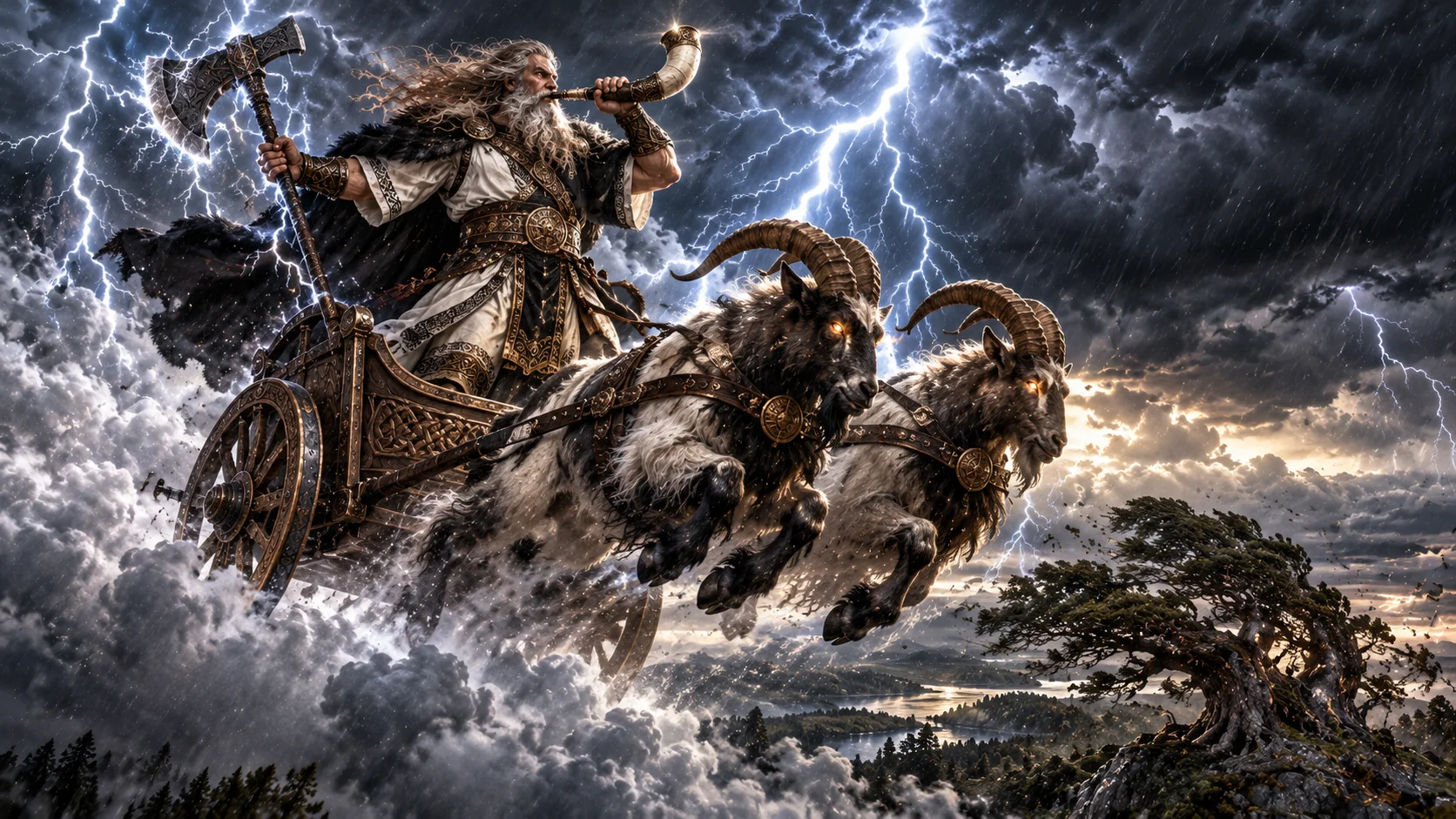
Perkūnas is the thunder-god and chief sky-deity of the Lithuanian and wider Baltic pantheon, ranked among the most important gods of the old Baltic world and recognized by scholars as a direct reflex of the Indo-European thunder-god type shared with Slavic Perun and Norse Thor.
The Voice Behind the Storm
Perkūnas rules thunder, lightning, rain, and the sky itself. His name descends from the reconstructed Proto-Baltic root Perkūna-, which scholars trace further back to Proto-Indo-European *perkʷunos — a root bound up with the oak tree. In Lithuanian the word perkūnas still echoes perkūs, the oak, and that linguistic bond mirrors the living cult: the oak was sacred to the thunder god not only in Lithuania but across the wider Baltic and Slavic world, so that to name the tree was almost to name the god. This is not a casual etymology — across the Indo-European thunder-god family, the storm deity and a particular tree species recur together often enough that comparative mythologists treat the pairing as inherited rather than coincidental, a fossil of belief embedded in vocabulary long after the ritual context that produced it had faded from memory.
A Fiery Beard and a Chariot of Thunder
Lithuanian folk tradition pictured Perkūnas as a vigorous, middle-aged man with a fiery red beard, driving a chariot — or riding a he-goat — across the heavens. The rattle of his wheels was the roll of thunder. In his hands he carried a stone axe or hammer, the weapon that struck lightning from the clouds and left, in peasant belief, the split trees and scorched stones that marked where he had passed. Villagers who found such stones sometimes kept them as household charms, believing a piece of the god's own weapon carried some of his protective force against fire, illness, or malevolent spirits — a practical folk theology that treated the aftermath of a storm as tangible evidence of divine passage rather than mere weather.
The Oak Groves of Romuva
Oak groves served as Perkūnas's cult sites, places where fires were kept perpetually burning in his honor. The most famous of these was Romuva, described by the chronicler Peter of Dusburg as the chief pagan sanctuary of the Balts, tended by a high priest known as the Krivė and kept alight with an eternal sacred fire. There, amid the oaks, Perkūnas and the other gods of the Baltic pantheon were venerated in a cult that endured longer than almost any other pagan tradition in Europe — Lithuania was, famously, the last state on the continent to convert, official baptism coming only in 1387. That late survival is itself a large part of why Baltic mythology is so richly documented compared with other European pagan systems: missionaries, chroniclers, and later folklorists were recording living practice rather than reconstructing it from centuries-old fragments.
Guardian of the Spoken Oath
Perkūnas was not only a weather-god but a keeper of justice. Oaths in old Lithuania were sometimes sworn in his name, and he was believed to punish liars and oathbreakers with his thunderbolts. To swear falsely under Perkūnas's sky was to invite the very fire that split oaks and scorched stone — a belief that bound the thunder god as tightly to human conduct as to the weather overhead. This dual role, storm-power and moral enforcer in one figure, is a pattern found across many Indo-European thunder-gods, where the god who can strike from a clear sky is a natural guarantor of promises no human court could otherwise verify.
The Hunt for the Hidden Adversary
At the heart of Lithuanian myth lies a single recurring drama: Perkūnas's pursuit of Velnias, the trickster and underworld figure later flattened by Christian retelling into simply "the Devil." In the old tales, Velnias steals cattle, wealth, or a bride, and Perkūnas chases him across the world with thunder to win it back. Cornered, Velnias hides in trees, slips under stones, dives into water, or transforms himself into an animal — a black goat, a black dog, a limping man — anything to escape the thunderbolt bearing down on him.
The Oldest Story Ever Told
Scholars of Baltic mythology, notably Vladimir Toporov and Vyacheslav Ivanov, have reconstructed this chase as a reflex of what they call the Proto-Indo-European "basic myth" — the storm-god's eternal battle against a serpent or chthonic adversary, a story pattern echoed from Vedic India to Scandinavia. In Lithuania it survived not as scripture but as living folk narrative, retold in villages long after the missionaries came, with Perkūnas cast as the sky's answer to everything that lurks beneath it. The persistence of this exact narrative shape, essentially unchanged, across cultures separated by thousands of kilometers and thousands of years is one of the strongest pieces of evidence comparative mythologists cite for a shared Indo-European mythological ancestor predating the split into individual language families.
Velnias Before He Was a Devil
Velnias, also called Velinas or Vielona, was never simply evil in the way the imported Christian Satan was. His name is cognate with the Latvian Vels and Vels/Velns tradition, and connects to the same root that gives the Slavic god Veles — both figures tied to cattle, magic, and the world of the dead. The scholar Marija Gimbutas classified Velnias as a pre-Christian god of the dead, of herds, and of the underworld, whose slow transformation into a horned devil unfolded gradually across the fourteenth and fifteenth centuries as Lithuania Christianized. In folk tales he remains something closer to a fool than a fiend — a shapeshifter regularly outwitted by clever peasants, his cunning always one step behind theirs. That comic, beatable quality is precisely what distinguishes an indigenous chthonic god absorbed into a new religion's demonology from a devil invented within that religion from the start.
Greimas and the Anatomy of a Myth
The Lithuanian semiotician and mythologist Algirdas Julius Greimas documented the Perkūnas–Velnias conflict extensively in his study Of Gods and Men, treating it as the structural key to the entire Baltic mythological system: sky against underworld, order against theft, the thunderbolt against the thing that hides. Greimas's structuralist approach mapped the myth's oppositions with the same rigor he had earlier applied to narrative semiotics generally, arguing that the recurring cattle-theft plot encoded a broader cosmological statement about how order is periodically threatened and restored.
Medeina, Mistress of the Wild Wood
Where Perkūnas commands the open sky, Medeina — sometimes called Žvorūna — rules the forest, its wild animals, and the hunt, standing in Lithuanian tradition roughly where Diana stands in Roman religion or Artemis in Greek. Her name derives from medis or medė, the Lithuanian word for forest or wood, marking her from the outset as a forest-mistress deity rather than a sky or underworld power. Folk tradition remembers her as a shapeshifter capable of becoming a she-wolf, a form that ties her to wolf cults and to the hunting magic once practiced across the Baltic lands. Some sources treat Medeina and Žvorūna as two names merging into one local cult figure, her second name drawn from žvėris, "wild beast" — a further sign of how tightly bound she was to the animals of the deep woods, and a reminder that Baltic paganism was never a single fixed system but a patchwork of local cults that later scholarship has had to piece back together.
Written Into History at Christburg
Medeina's antiquity is unusually well documented for a Baltic deity: she appears by name in the Treaty of Christburg of 1261, drawn up during the Prussian Crusade, among the pagan gods that newly converted Prussians were forbidden to worship. It stands as one of the earliest written attestations of any Baltic forest goddess, a rare moment where the old religion surfaces directly in a document rather than only in later folklore. Because the treaty was drafted by the converting side as a list of practices to suppress, it inadvertently preserves exactly the deity names it meant to erase — a common irony in the documentary record of European paganism, where the clearest early evidence often survives in texts written by people hostile to it.
Giltinė, the Sting That Ends All Things
Death in Lithuanian tradition wears the shape of Giltinė, a tall, pale woman with a long blue nose and a poisonous tongue, who kills simply by touching or breathing upon the living. Her name is bound to the verb gelti, "to sting" or "to bite," so that her very identity is a description of how she works — not a blade or a scythe, but a sting that reaches into the body and stops it.
Sisters of Life and Death
Folklore makes Giltinė the younger sister of Laima, the goddess of fate and childbirth, and the pairing is deliberate: Laima grants life while Giltinė takes it, two sisters presiding over the opposite gates of every human span. One story tells how Giltinė was once shut inside a coffin for seven years, and for as long as she remained trapped, no one on earth died at all — until she was finally released and resumed her deadly work, a folk explanation for why death, once suspended, always returns. She is closely associated with Kaulinis Senis, or Kaulinyčia, a death spirit sometimes merged with her entirely, and under later Christian influence she absorbed much of the imported skeletal Grim Reaper imagery, blending the old Baltic figure with a new one arriving from the West. The seven-years-without-death legend also functioned, in its original telling, as a kind of cautionary tale about the natural order: a world where nothing dies is not a blessing but a horror, crops and elders and livestock all lingering past their time, and Giltinė's release is remembered with something closer to relief than dread.
A Sky Divided Into Realms
Taken together, Perkūnas, Velnias, Medeina, and Giltinė sketch a cosmos organized by function rather than by rank alone: sky and storm, underworld and cattle, forest and hunt, and death itself, each held by its own deity. Scholars working from Georges Dumézil's comparative framework, and refined for the Baltic case by Toporov, Ivanov, and Gimbutas, read this as a distinctly Baltic elaboration of a much older Indo-European habit of dividing the cosmos among precisely such complementary powers — with Perkūnas, thunderbolt in hand, standing watch over all of it from above. Even after centuries of Christianization, fragments of this arrangement persisted in Lithuanian folk custom and vocabulary long after the gods themselves had been formally displaced, which is why nineteenth- and twentieth-century folklorists were still able to record oral variants of the Perkūnas–Velnias chase, songs invoking Laima at childbirth, and warnings about Giltinė's touch well into the era of written ethnography — a living afterlife for a pantheon that never had a single canonical scripture to preserve it.
Sources & traditions
- EncyclopediaWikipedia — Perkūnas
- TraditionLithuanian folk and village traditions
Myths change from area to area and from time to time. This chronicle follows the most widely told versions; tellings in other villages, regions and eras may differ.