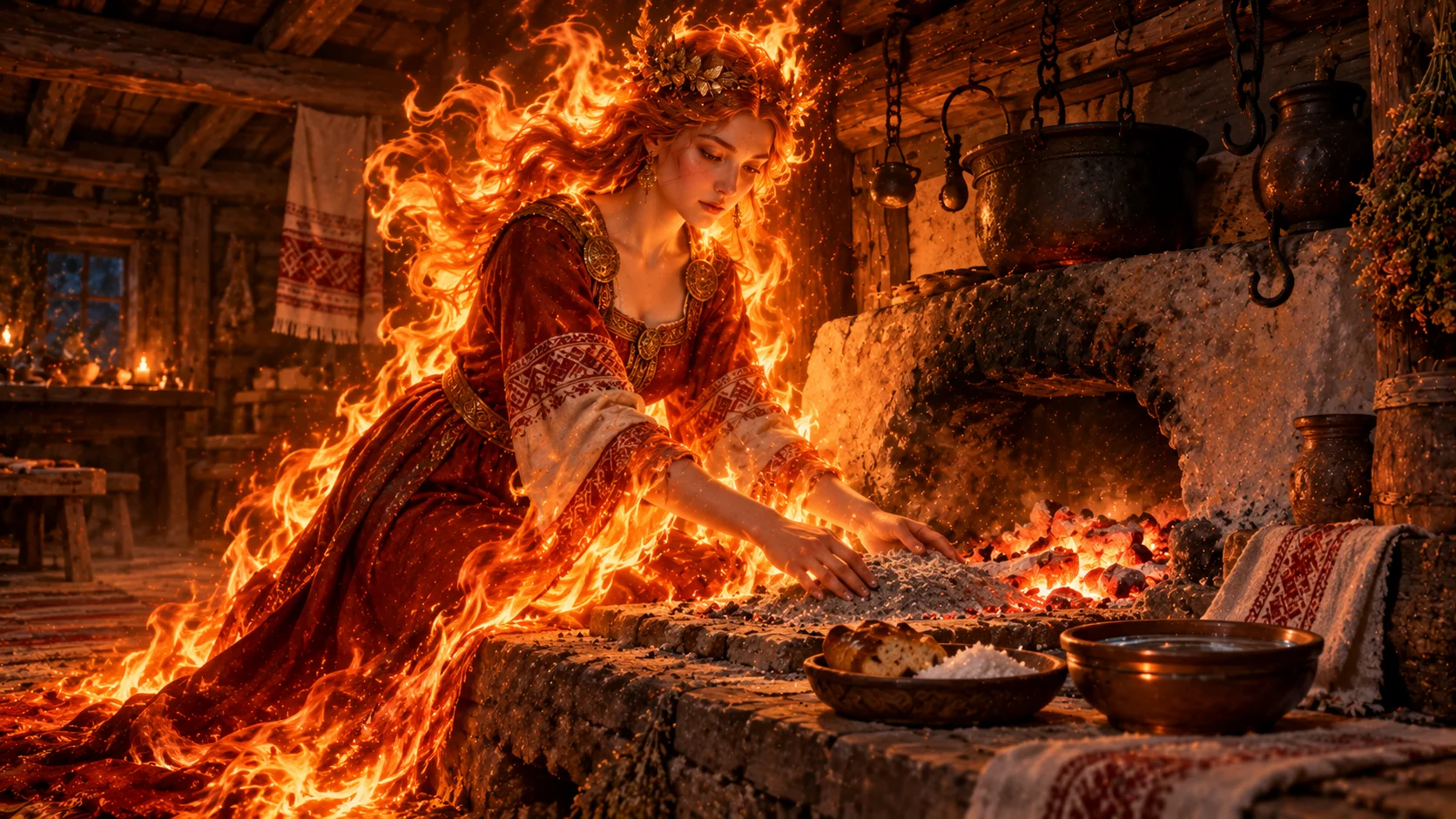
Gabija is the goddess of fire and the hearth in Lithuanian mythology, the quiet power kept alive in every household flame. She was not a distant sky deity invoked only at festivals; she was a daily, domestic presence, tended by hand morning and night in every farmstead, and her name was spoken with the same mixture of familiarity and caution that a family might use for a powerful relative living under the same roof.
The Goddess Who Lived in the Embers
Gabija was present literally in the coals of the hearth, treated as a living being with will and moods. She was not merely symbolized by the fire — she inhabited it, so that the difference between "the fire" and "the goddess" collapsed in everyday practice. To bank the coals carelessly, to let the flame gutter through neglect, or to feed it in anger was to mistreat a person, not to fail at a chore. Villagers spoke of her the way one speaks of an elder who sees everything that happens near her: attentive, easily offended by disrespect, and generous toward those who kept her comfortable.
This embodiment gave the hearth fire a moral weight that a purely practical view of cooking and warmth would not explain. A fire that leapt too high, smoked too much, or refused to catch was read as a message from Gabija herself, a signal that something in the household's conduct needed correcting. Because she lived where the family lived, she was also a witness to that family's private life — its quarrels, its hospitality, its cleanliness — and folk belief held that she carried her impressions of a household's character into how freely or grudgingly she gave her warmth.
Covering the Coals at Nightfall
Each evening the woman of the house raked ash over the embers, tucking the fire in and speaking a prayer. This was not a casual habit but a small rite performed with real seriousness, usually by the senior woman of the household, whose responsibility it was to maintain the relationship with Gabija on the family's behalf. The raking motion itself mattered: coals gathered gently to the center, smoothed level, and then covered so that they would smolder rather than die, preserving a living coal until morning rather than forcing the household to strike a fresh flame.
The accompanying words functioned as a nightly blessing and a request for protection — asking Gabija to rest peacefully through the night, to guard the sleeping household from harm, and to be ready to wake gently with the family rather than sullenly or destructively. This bedtime ritual mirrored the way a family might settle a child or an honored guest: softly, with care, and with an acknowledgment that the relationship needed maintaining rather than being taken for granted. Skipping the covering, or doing it carelessly, was thought to leave the goddess exposed and irritable, and by extension left the household vulnerable overnight.
The morning reversed the rite: the ash was gently swept back, the coals uncovered and coaxed with kindling, and the reappearance of flame greeted almost like a person waking up. A fire that caught quickly and cleanly in the morning was taken as a good sign for the day ahead, a small daily omen delivered by the goddess herself about her mood and, by extension, the household's fortune.
When the Fire Turns Vengeful
A disrespected fire could transform into a ragane, a destructive witch-fire. This transformation represented the dark inversion of Gabija's nurturing role: the same being who warmed the home and cooked its food could, if consistently mistreated, become an agent of ruin rather than of care. Where the tended hearth fire was orderly, contained, and productive, the ragane was chaotic and consuming — associated with runaway blazes, scorched fields, and fires that spread beyond any reasonable control.
The conditions believed to provoke this shift were the everyday sins against the hearth: spitting into the fire, dumping filth or impure water onto the coals, cursing near the flame, or letting the fire go out through laziness and then relighting it without the proper respect. Each of these was understood not as a minor housekeeping lapse but as a direct insult to a being who lived in that very space and who remembered how she was treated. A household with a history of such carelessness might be blamed, after a real fire had damaged a barn or a home, for having provoked Gabija into her vengeful aspect rather than having simply suffered an accident.
This belief gave the hearth-keeping rituals real practical teeth. Fear of the ragane reinforced fire safety long before any formal understanding of combustion risk: keep the hearth clean, keep water and fire separate except when intended, never leave flame untended, and never treat the fire as a dumping ground for household refuse. In that sense the mythology encoded a genuine survival lesson — uncontrolled fire was the single greatest threat to a wooden farmstead — inside a moral relationship with a goddess who could be angered.
A Goddess Among Goddesses
Gabija stood between Medeine of the forest and Giltine of death, presiding over the domestic hearth. This placement was not incidental but reflected how the Lithuanian pantheon divided the world into overlapping spheres of responsibility, each with its own goddess governing a domain of daily concern. Medeine held the wild, uncultivated world beyond the farmstead's fences — the forest that supplied timber, game, and danger in equal measure. Giltine held the furthest boundary of all, the passage out of life itself, and was approached with dread rather than the familiar affection shown to Gabija.
Between these two — the wild exterior and the final ending — sat Gabija's realm: the interior, the cultivated, the daily. She governed the space where raw materials from the forest and the field were transformed into livable warmth and edible food, the literal center of the home around which the family organized its life. This middle position meant she was approached far more often and far more casually than either Medeine or Giltine — not with the awe reserved for forces of wilderness or mortality, but with the ongoing, almost conversational attentiveness one gives to a co-resident of the house.
Seen together, the three goddesses trace a kind of map of Lithuanian rural experience: the dangerous unknown at the tree line, the sustaining and moody warmth at the center of the home, and the unavoidable end waiting at the far edge of life. Gabija's place in that arrangement helps explain why her worship was so intimate and so constant compared to more remote deities — she was not invoked at shrines or seasonal festivals alone, but negotiated with nightly, in the ordinary act of banking a fire before sleep.
Fire as Kinship, Not Just Utility
Because Gabija's fire supplied cooking, warmth, and light in a single flame, her presence touched nearly every activity that took place indoors. Bread was baked in her heat, meals were prepared over her coals, and the family gathered in the light and warmth she provided through the long dark months. This constant, multi-purpose usefulness is part of why she was treated less like an abstract force of nature and more like a member of the household in her own right — one whose comfort had to be considered the way a family considers the comfort of an elder relative who cannot easily be replaced.
That sense of kinship also meant that Gabija's favor was thought to be transferable in a limited way between households. Carrying a burning coal from an established hearth to light a new one — as when a daughter married and moved into her own home — was treated as more than a practical convenience; it was a way of bringing a portion of the family's relationship with Gabija along into the new household, rather than starting that relationship from nothing. A fire started this way was regarded as more trustworthy and better disposed than one struck cold and unfamiliar.
Enduring Traces of the Belief
Even as formal veneration of Gabija faded, the underlying etiquette of fire-tending persisted in rural households for generations: never spit in the hearth, never leave a fire unattended, cover the coals properly at night, and treat the act of relighting a fire in the morning as a small daily transaction rather than a meaningless chore. These habits outlived explicit belief in a fire goddess and survived instead as inherited good manners around the hearth, passed down as "the way it's done" long after the reason had faded from active memory.
Scholars of Baltic mythology have pointed to Gabija as one of the clearest surviving examples of a household deity whose worship was sustained almost entirely through domestic ritual rather than temple or priesthood — evidence for how much of the older Lithuanian religious world lived not in grand ceremony but in the small, repeated gestures of daily housekeeping. In that sense, every evening a coal was carefully banked under ash was itself an act of worship, however quietly it was performed, and however little the ritual's origin was consciously remembered by the person performing it.
Sources & traditions
- EncyclopediaWikipedia — Gabija
- TraditionLithuanian folk and village traditions
Myths change from area to area and from time to time. This chronicle follows the most widely told versions; tellings in other villages, regions and eras may differ.