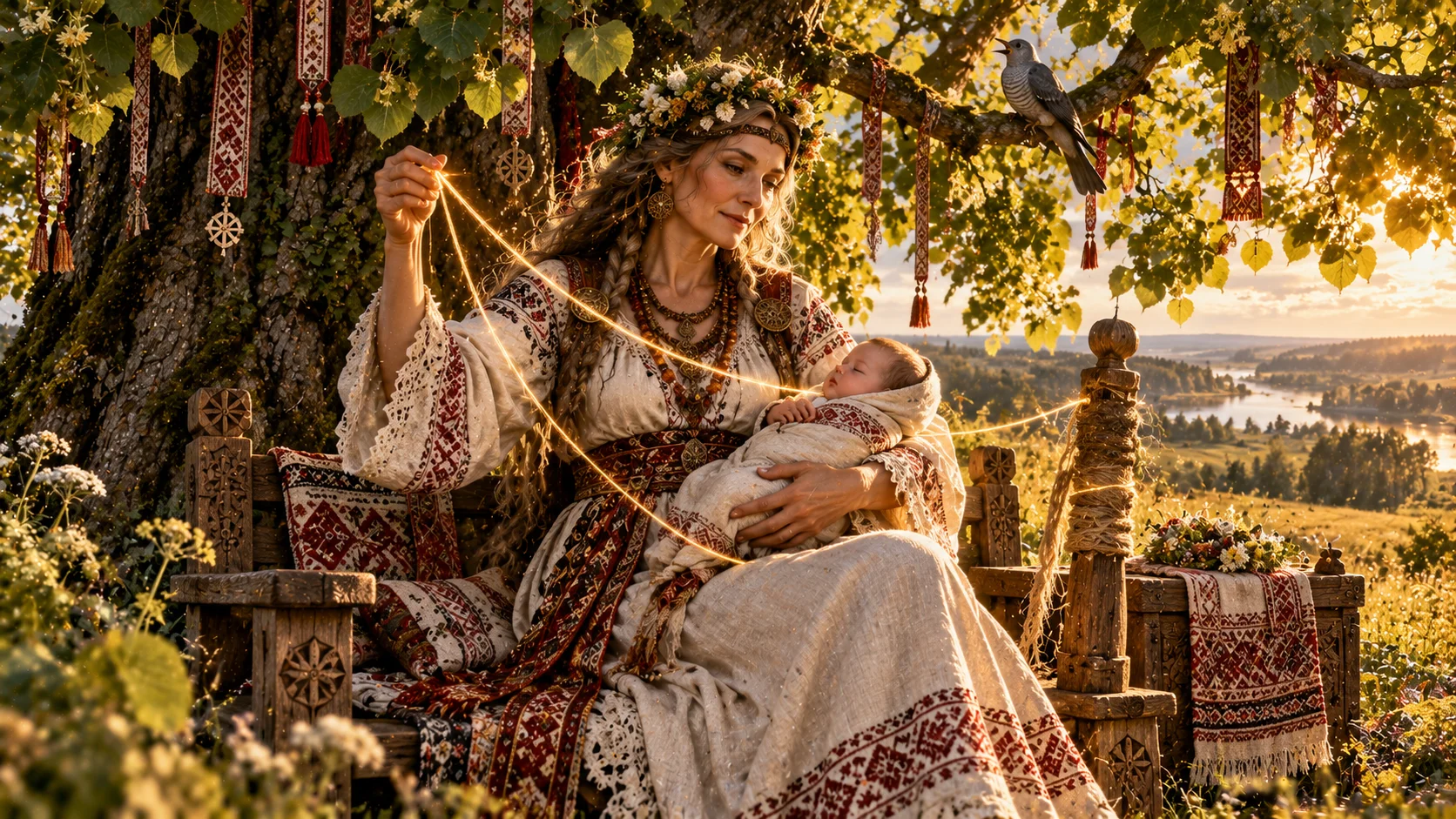
Laima is the great goddess of fate, fortune, and childbirth in Latvian Baltic mythology, one of the principal deities of the old Latvian pantheon alongside the sky god Dievs and the goddess Māra. Her name descends from the Latvian word laime, meaning "luck" or "happiness," and that etymology is not incidental — it names her entire domain. Where other deities govern sky, sun, or thunder, Laima governs the unseen thread that runs through a single human life: the moment it begins, the shape it takes, and the moment it ends. She survives today not through temples or carved images, but through an oral archive of extraordinary size — the dainas, the short folk songs of Latvia — in which she appears more often than almost any other figure in the pantheon.
The Decreer of Destiny
At the center of Laima's identity is a single, uncompromising act: she decides fate at the moment of birth. Latvian tradition holds that in the instant a child draws its first breath, Laima is present, and what she pronounces in that moment becomes the unalterable shape of that person's life — their fortune, their hardships, the length of their days. This is not fate as an abstract cosmic mechanism; it is fate delivered by a specific, personal goddess, standing at the bedside, speaking a verdict that cannot be appealed. The dainas describe this decree in intimate terms, as something spoken rather than merely willed, which is part of why the songs treat her less as a distant cosmic principle and more as a figure a mother might address directly, pleading or thanking her in the same breath.
Present at the First Cry
Latvian folk songs describe Laima as physically present at childbirth, an attendant deity standing alongside the labouring mother rather than observing from some remote seat of power. This is a crucial distinction in Baltic religious thought: fate is not dictated from a distance, it is administered in the room, at the bedside, in the same physical space as the human event it governs. The dainas that reference this moment often carry a tone of urgency and intimacy — invocations, requests, sometimes bargaining — treating Laima as a goddess who can be spoken to, even if her ultimate decision cannot be changed. This proximity to the most vulnerable and consequential moment of human life is likely the single largest reason for her enduring prominence in the oral tradition.
Guardian of the Life Cycle
Laima's authority does not end at birth. Latvian folklore ties her closely to the major thresholds of a woman's life in particular — birth, marriage, and death — positioning her as a guardian who oversees the entire arc of the life cycle rather than a single event within it. In this role she functions less like a goddess invoked for a single purpose and more like a constant companion to human existence, present at each of its hinge points. Marriage songs and death laments both carry her presence in Latvian tradition, reinforcing the idea that a single deity was understood to preside over the full continuity of a life, from its first moment to its last.
A Triad with Dievs and Māra
Latvian mythology is often described in terms of a functional triad: Dievs governing the sky and cosmic order, Māra governing the material and earthly world, and Laima governing fate and human destiny. The Latvian folklorist Haralds Biezais, working extensively with the daina corpus, identified this triadic structure as a recurring pattern in how the songs organize divine responsibility. Laima is sometimes depicted standing close beside Māra, the two goddesses forming a kind of complementary pairing — one attending to the physical world a person lives in, the other to the destiny that person is given — while Dievs oversees the wider order within which both operate. This is not a rigid theological system written down by priests; it is a pattern that emerges from thousands of independently composed songs converging on the same relationships.
Voice of the Dainas
The scale of Laima's presence in Latvian oral tradition is difficult to overstate. Thousands of dainas reference her, making her one of the most frequently invoked deities in the entire corpus collected by the Latvian folklorist Krišjānis Barons in his monumental compilation, Latvju dainas. Because Baltic paganism left few written theological texts before Christianization in the thirteenth century, it is this sung tradition — passed from voice to voice, generation to generation, largely by women — that preserved her character. The dainas are short, often only a few lines, and yet across thousands of them a consistent portrait accumulates: a goddess concerned with luck, fairness, and the practical fortunes of ordinary people, rather than with grand cosmic drama.
The Linden Tree
Laima is closely associated with the linden tree, known in Latvian as liepa, which stands as her most recognizable symbol in folk tradition. The linden held a special place in the ritual life of expectant mothers, and offerings connected to childbirth were sometimes made near these trees, treating them as a kind of living threshold between the human world and Laima's domain. The choice of the linden is not incidental to Latvian rural life — it is a tree associated with shade, shelter, and steady, patient growth, qualities that map naturally onto a goddess whose concern is the long unfolding of a human life rather than a single dramatic act. Even after the decline of organized pre-Christian worship, the symbolic linking of Laima to the linden persisted in folk memory and in the dainas themselves.
Threads of Fate
Laima's role carries an unmistakable echo of weaving and spinning symbolism, a motif shared broadly across Indo-European fate-goddess traditions. Comparative mythology has long noted the resemblance between figures like Laima and other fate-spinning deities such as the Greek Fates or the Norse Norns — goddesses whose determination of a life's course is imagined through the physical act of spinning or weaving thread. Whether or not this reflects a direct shared ancestry, the parallel illuminates something essential about how the Baltic peoples conceived of destiny: not as an abstract decree floating in the air, but as something with texture, something made, thread by thread, the way cloth is made. It reinforces the same intimacy found in the birth-attendance tradition — fate as something worked by hand, not merely spoken from afar.
A Shared Baltic Inheritance
Laima is not unique to Latvia. Lithuanian tradition preserves a closely related goddess of the same name and function, and scholars including Marija Gimbutas have treated the Latvian and Lithuanian Laima as expressions of a single, older Proto-Baltic goddess-of-fate concept. This shared inheritance matters because it situates Laima within a genuinely ancient layer of Baltic religious life, predating the political and linguistic divergence of the Latvian and Lithuanian peoples. The two traditions did not simply borrow from one another late in their history; they appear to be drawing from the same root, each preserving and reshaping it through their own separate bodies of oral literature.
An Unwritten Goddess
Like the other celestial and fate deities of the Latvian pantheon, Laima is known almost entirely through the dainas rather than through any extensive written mythological narrative. Baltic paganism was not set down in native scripture the way, for instance, Norse or Greek myth eventually was; it survived Christianization instead through the discipline of oral memory, carried forward specifically in song. This has consequences for how she is understood today: there is no single canonical story of Laima, no fixed sequence of myths, only the accumulated weight of thousands of short, independently transmitted songs that agree, with remarkable consistency, on her essential character and role. That consistency across so vast and decentralized a body of material is itself a kind of evidence for how deeply embedded she was in everyday Latvian life.
Fate Beside the Sky and the Stars
Laima's domain stands distinct from, though not entirely separate from, the celestial family of Latvian mythology — the sun goddess Saule, the moon god Mēness, and the morning star figure Auseklis. Comparative Baltic scholarship, including the work summarized by Marija Gimbutas, treats these celestial figures as belonging to an interconnected cycle of their own, one concerned with the sky's daily and seasonal drama — marriages, rivalries, and the passage of light and dark. Laima's concern is different in kind: not the movement of celestial bodies, but the movement of a single human life through birth, growth, and death. The two spheres coexist in the dainas without merging, a sky-mythology of light and time running alongside a human-mythology of fortune and fate, each preserved by the same singers, often in the very same songs.
An Enduring Presence
Centuries after the formal Christianization of Latvia, Laima's name and character persisted in folk memory precisely because the dainas kept singing her into existence, generation after generation. She was never dependent on temples, priesthoods, or written scripture to survive — she lived instead in the practical, recurring moments of ordinary life: a birth, a wedding, a death, a mother's private plea near a linden tree. That mode of survival, fragile in some respects and remarkably durable in others, is itself part of her story. Laima endures today as one of the clearest windows historians and folklorists have into how the pre-Christian Latvian world understood the shape of a human life — as something decreed once, at the very beginning, by a goddess who never entirely left the room.
Sources & traditions
- EncyclopediaWikipedia — Laima
- TraditionLatvian folk and village traditions
Myths change from area to area and from time to time. This chronicle follows the most widely told versions; tellings in other villages, regions and eras may differ.