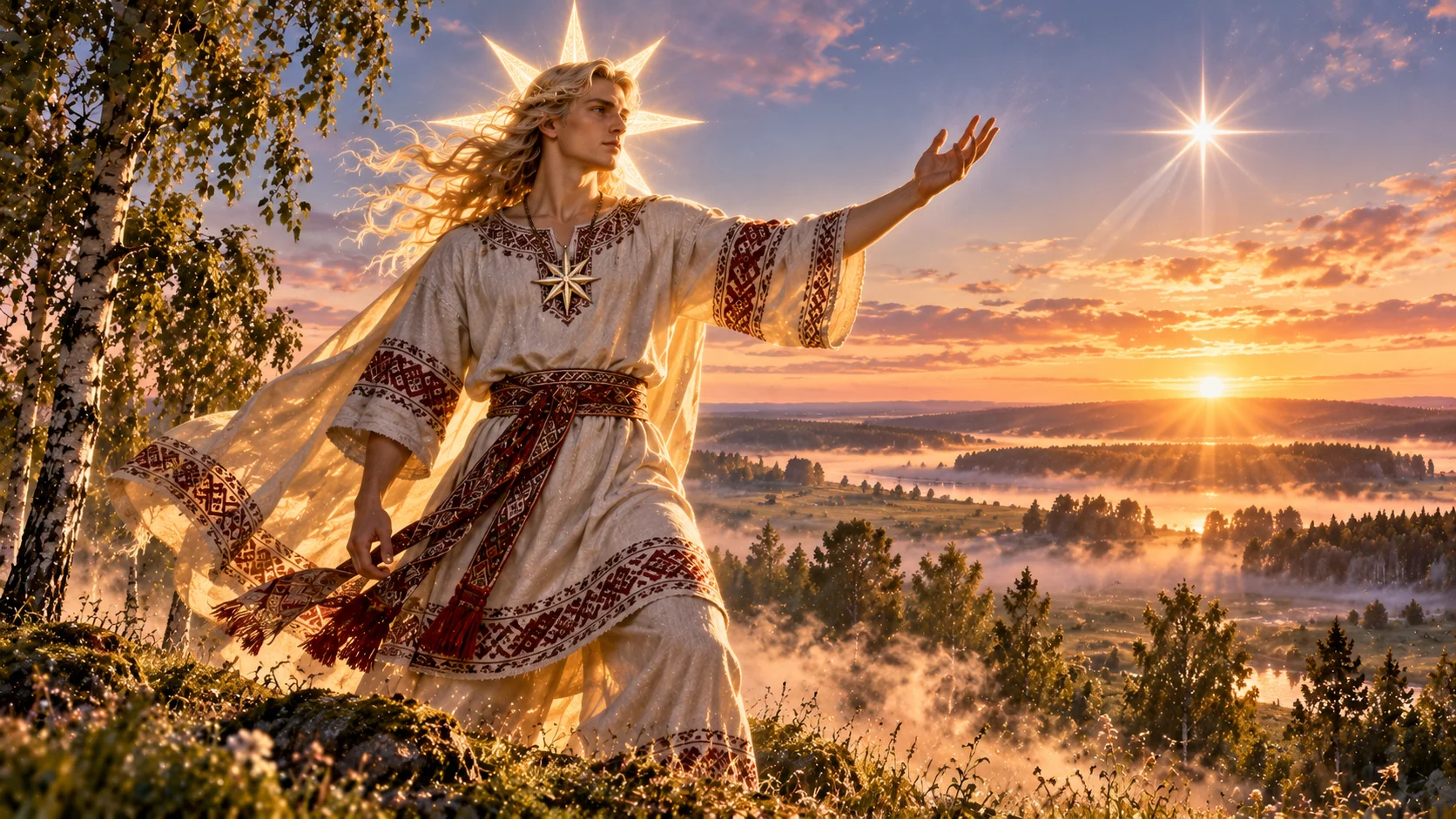
Auseklis is the morning-star god of Latvian Baltic mythology, the personification of Venus as it burns low on the eastern horizon in the hour before sunrise. His name comes directly from ausma and aust — "dawn" and "to break," as day breaks — so that to say his name in Latvian is already to describe what he does: he is the moment the sky begins to lighten. He belongs to a small, tightly interlinked family of sky beings recorded across thousands of the dainas, the short traditional folk songs collected in the nineteenth century, standing alongside the sun goddess Saule, the moon god Mēness, and the thunder god Pērkons.
The Star That Breaks the Night
Long before Latvian farmers rose to milk the cows or harness the horses, Auseklis was already awake in the sky, a single bright point above the treeline. He was not the day itself — that role belonged to Saule — but the promise of it, the sign that the long Baltic night was ending. In a culture where winter nights stretch brutally long and the agricultural calendar left no room for oversleeping, a god whose entire identity was "the light that tells you it is time to rise" was not an abstract poetic figure but a genuinely practical one. Auseklis carried a secondary reputation because of this: he was associated with diligence, with the beginning of labor, with waking not just people but animals for the work of the day. To be an "Auseklis" sort of person, in the folk imagination, was to be up before everyone else.
A Herald Between Two Kingdoms
Latvian mythology divides the sky into a night realm and a day realm, and these are not merely times but almost separate domains with their own ruler. Mēness governs the night, wandering across it as a guide for travelers and soldiers who move under darkness. Saule governs the day, her golden chariot crossing the sky each morning. Auseklis stands at the seam between the two. He is neither fully of the night nor fully of the day — he rises while it is still dark and fades once Saule herself appears, so his entire existence is transitional. Latvian folklorists who classify the dainas into thematic cycles place Auseklis, together with Mēness and Saule, inside the "mythological songs" grouping, precisely because his function is structural: he is the hinge the two halves of the sky turn on.
Suitor to the Daughters of the Sun
The best-loved cycle of songs concerning Auseklis casts him not as a herald but as a bridegroom. In these dainas he courts the Saules meitas — the daughters of Saule — beautiful celestial maidens who appear again and again throughout Baltic mythological song as objects of divine courtship, sometimes in rivalry with other celestial figures. Auseklis's pursuit of them fits a god associated with the soft light of early morning rather than the violence of storm or the coldness of night.
Rivalry With the Moon
Auseklis does not court the Saules meitas alone. Mēness appears in some of the same songs as a rival suitor for their affection. This rivalry sits inside a larger and more troubled pattern involving Mēness. In the most famous of the dainas concerning him, Mēness is said to have been unfaithful to Saule herself, or to have courted her daughter, and for this Pērkons, the thunder god, struck and scarred his face — an etiological myth told to explain why the moon's face looks marked and why it visibly changes shape as it waxes and wanes through the month. Mēness's dual and multiple "faces" in the sky were sometimes mythologized in the dainas as evidence of him having multiple wives or lovers among the daughters of Dievs and of Saule.
Son of the Sky
Some variants of the dainas place Auseklis as a son, or otherwise a close relative, of Dievs, the supreme sky god of Latvian mythology. This lineage matters because it sets Auseklis within the same generational tier as Mēness and as Saule's own children, binding the celestial family together as kin rather than as a loose assortment of independent powers. Latvian dievturība — the pre-Christian Baltic religious system that these songs preserve fragments of — understood the sky as a household of sorts, with Dievs as its patriarchal figure presiding at a distance while Saule, Mēness, and their children carried out the visible, daily work of governing light, dark, weather, and time.
The Eight-Pointed Sign
In Latvian folk symbolism, Auseklis is represented by the Auseklis star, or Ausekļa zīme, an eight-pointed star design still used today in Latvian folk art, jewelry, and national iconography. The symbol was historically used on gravestones and homestead markers across Latvia as a protective sign, and it remains a recognized element of modern Latvian cultural and national identity.
A Living National Symbol
That same eight-pointed star did not stay confined to old gravestones. It was adopted into modern Latvian folk art, into jewelry, and into the broader visual language of Latvian national identity, where it remains instantly recognizable today. The star's persistence says something about how central the idea of Auseklis — dawn as a returning promise — remained to Latvian self-understanding even centuries after the formal religious system that produced him had receded.
The Poet Who Took His Name
In the nineteenth century, during the Latvian national awakening, the poet Miķelis Krogzemis (1850–1879) chose the pen name "Auseklis" for himself. This was a deliberate act, not a coincidence of taste: the national awakening was a period in which Latvian intellectuals and writers turned back toward pre-Christian Baltic mythology as a wellspring of cultural identity distinct from the German and Russian influences that had long dominated the region. Taking the name of the morning-star god — the herald of a new day — for a poet writing at the dawn of a national cultural movement was a piece of symbolism nobody at the time would have missed. It cemented Auseklis's name in Latvian public memory in a way separate from, but reinforcing, his older religious identity.
Preserved in the Dainas of Krišjānis Barons
Nearly everything known about Auseklis today survives because of one extraordinary undertaking: the folklorist Krišjānis Barons's compilation of the dainas, the Latvju dainas, a monumental nineteenth-century collection of traditional folk songs gathered from oral tradition across the Latvian countryside. Without this compilation, the courtship cycles involving Auseklis, Mēness, and the Saules meitas — along with the story of Pērkons and the moon's scarred face — would likely have been lost, since Latvian pre-Christian religion left behind no priesthood, no temples, and no written scripture of its own. The dainas functioned instead as an oral scripture, and Barons's collection became, in the twentieth century, the primary source drawn upon by the Dievturi movement, a modern revival of Latvian folk religion that systematized figures like Auseklis and Mēness into a coherent pantheon for contemporary practice.
A Shared Baltic Inheritance
Auseklis is not unique to Latvia. Lithuanian mythology, which shares a common Proto-Baltic root with Latvian belief predating the Christianization of the region in the thirteenth century, preserves a close cognate figure named Ausrinė, who performs an almost identical role as morning-star herald and suitor figure. The parallel extends further: Lithuanian mythology's Mėnulis mirrors Mēness as moon god, performing the same nightly wandering role. These correspondences are treated by Baltic folklorists as strong evidence of a shared celestial religion that existed among Baltic peoples before Latvian and Lithuanian cultures diverged into their separate but closely related paths, making Auseklis and Ausrinė less like two different gods than two regional voices describing the same underlying figure.
Counting Time by the Sky
Auseklis's place in the sky was not merely poetic; it was practical astronomy woven into agrarian life. Latvian folk timekeeping relied heavily on watching the sky, and the lunar cycle governed by Mēness structured much of the agricultural and ritual calendar, with the "jaunais mēness," or new moon, considered an especially auspicious time to begin new undertakings. Auseklis's own rising, tied as it was to the specific pre-dawn appearance of Venus, gave farmers and travelers another fixed point by which to measure the approach of day, a role that placed him — like Mēness — not only among the gods of story but among the working instruments of everyday rural life.
The Dawn That Keeps Returning
What endures about Auseklis, across the dainas, the carved gravestones, the borrowed pen name of a national poet, and the star still worn today, is the constancy of what he represents: an ending that is also a beginning, arriving without fail after even the longest night. In a mythology where the moon can be wounded and scarred, and where the thunder god's justice falls hard on the unfaithful, Auseklis remains the one figure whose story is never one of punishment or loss. He simply rises every morning, courts the daughters of the sun, and yields the sky once Saule herself finally arrives. It is a small, quiet myth compared to the thunder and scars of the others in his family — and that quietness may be exactly why the symbol of his star was the one Latvians chose to keep close, on gravestones, on jewelry, and in the modern memory of who they are.
Sources & traditions
- EncyclopediaWikipedia — Auseklis
- TraditionLatvian folk and village traditions (Baltic)
Myths change from area to area and from time to time. This chronicle follows the most widely told versions; tellings in other villages, regions and eras may differ.