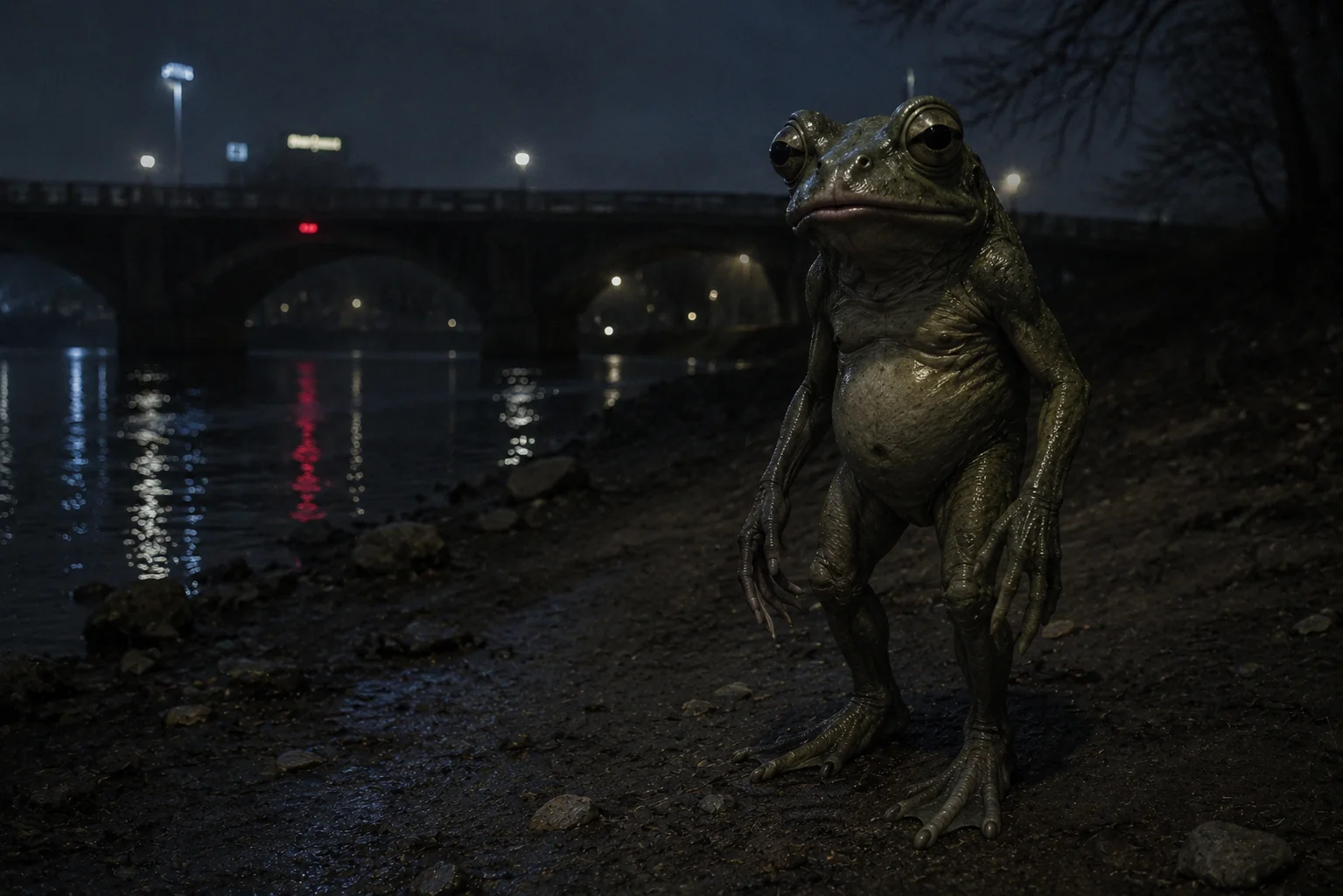
The Loveland Frog (also called the Loveland Frogman, or in the earliest telling, the Frogmen) is an American cryptid tied to one specific patch of ground: the town of Loveland, Ohio, and the winding stretch of the Little Miami River that passes through it. Described across decades of accounts as a bipedal, frog- or lizard-faced humanoid roughly three to four feet tall, greyish-green and leathery-skinned, it is unusual among American cryptids for resting its credibility not on a single blurry photograph or a lone hiker's story, but on multiple witnesses, two of them police officers on duty, reporting strikingly similar figures along the same short riverside road nearly two decades apart.
A Roadside Encounter in the Small Hours
The earliest account traces to the early morning of May 25, 1955. A businessman driving near Loveland reported three bipedal, greyish, roughly three-foot-tall creatures with reptilian or frog-like features standing at the roadside. In one telling of the story, one of the three held a wand-like device that emitted sparks as the car's headlights swept over them. Unlike the sightings that would follow it, this 1955 account has no solid civic record or contemporary press trail behind it; it survives mainly through later UFO-era and cryptozoology literature, which makes it the more loosely documented of the Loveland Frog's two founding episodes. Some researchers treat it as its own strand of local folklore, adjacent to but not quite continuous with what came later.
Officer Shockley on Riverside Drive
The legend hardened into something closer to a documented case on March 3, 1972, when Loveland police officer Ray Shockley reported seeing a creature roughly three to four feet tall, bipedal, with leathery, wrinkled skin, crouched at the roadside on Riverside Drive. As Shockley approached, the creature reportedly fled, vaulting a guardrail and disappearing down toward the Little Miami River below. The description matched the 1955 account closely enough, in size and bearing, that the two episodes were from then on read as chapters of the same story rather than two unrelated encounters.
A Second Officer, a Second Night, a Shot Fired
About two weeks after Shockley's report, a fellow Loveland officer, Mark Matthews, reported a near-identical sighting in the same stretch of road. Matthews's account went further than Shockley's: he reportedly fired a shot at the creature. The near-simultaneous, near-identical testimony of two officers on duty, in the same small town, along the same short corridor, is the detail that has done the most to keep the Loveland Frog out of the pile of forgettable roadside-monster stories and into serious cryptozoological discussion.
The Witness Who Explained His Own Sighting
Years later, as reported when a fresh 2016 sighting brought the old case back into the news, Officer Matthews offered his own explanation for what he had seen and shot at: a large iguana, missing its tail, that he later killed and identified. The theory attached to this admission is that an escaped or released exotic pet, caught reflecting wet pavement and headlight glare in the dark, was mistaken for something stranger by a startled officer on a quiet road. It is worth being plain about the sourcing here: this self-correction comes from Matthews himself, reported secondhand in news coverage, and has not been independently verified beyond his own account. It carries weight precisely because it is one of the original witnesses undercutting his own story, but it remains a single-source claim rather than a confirmed fact.
The Little Miami River Keeps Its Secrets
Whatever else is true of the case, no physical evidence has ever surfaced to settle it either way. No body, no clear photograph, no biological sample has been produced in the seventy-odd years since the earliest reported sighting. What exists is entirely testimonial: a businessman's roadside account in 1955, two police officers' independent reports in 1972, and a driver's renewed sighting decades later. That eyewitness record, thin as it is by scientific standards, is unusually strong by the standards of American cryptid lore precisely because of who some of the witnesses were — which is also exactly why Matthews's later walk-back matters so much to how the case is read today.
Names Attached to the Same Riverbank
Across cryptozoology sources and local media, three names recur for the same figure: Loveland Frog, Loveland Frogman, and, from the 1955 account specifically, the plural Frogmen, reflecting that the earliest report described three creatures rather than one. The plural form is a small but telling detail — it marks the 1955 sighting as describing a group, while the 1972 police reports each describe a single creature, and the naming has followed that thread ever since without ever resolving whether "Frogmen" and "Frogman" describe one kind of being or two different memories layered onto the same stretch of road.
A Renewed Sighting Brings the Legend Back
The story did not stay buried in 1972. A 2016 sighting report, made by a driver near the original Loveland site, brought a fresh wave of media and cryptozoological attention back to the case. It was this renewed interest that also surfaced Matthews's iguana explanation more widely, giving the public both a new reported encounter and a decades-old skeptical account of the original one in the same news cycle — a pairing that has shaped how the whole legend is discussed since.
Two Sightings, One Continuous Legend — Disputed
Researchers generally treat the 1955 and 1972 sightings as the two core episodes of a single continuous local legend, the "same" Loveland Frog appearing, vanishing, and reappearing across a generation. But that continuity is itself disputed. Some analysts separate the 1955 account, with its spark-emitting wand and its UFO-literature pedigree, as a distinct strand of folklore, while treating the two 1972 police reports as a more grounded and better-documented episode in their own right. The Loveland Frog, in other words, may be one creature remembered twice, or two different stories that folklore has since fused into one.
What the Witnesses Actually Described
Strip away the framing and the physical description across all the accounts is fairly consistent: a bipedal, frog- or lizard-like humanoid, greyish-green in color, standing roughly three to four feet tall, with skin described variously as leathery or wrinkled. No account claims any lineage or connection to another named cryptid; the Loveland Frog does not belong to a wider family of related creatures, it belongs to one riverbank. That narrowness is part of what makes it a distinctly regional figure rather than a variant of some larger, more widespread legend.
Ohio's Hometown Monster
Within the broader landscape of American folk cryptids, the Loveland Frog occupies a familiar role: the local river or lake monster, claimed by one town and one waterway, standing in the same general category as countless other regional cryptids across the country. What sets it apart is not the category but the specificity — it is not a monster of "the river" in the abstract but of the Little Miami River at Loveland, Ohio, and the legend has stayed tethered to that exact stretch of ground rather than drifting into a generic regional monster story.
The Skeptical Case
Outside cryptozoological circles, the standard explanation offered by science-communication treatments — Tetrapod Zoology among them — favors misidentification: an escaped or released large lizard such as an iguana, or in some tellings a large bullfrog or beaver glimpsed under poor lighting. This is, notably, the same conclusion Officer Matthews himself later reached about his own encounter, which gives the skeptical reading an unusual degree of support directly from inside the case rather than only from outside critics second-guessing it.
A Mascot as Much as a Mystery
Decades on, the Loveland Frog has settled into something closer to civic mascot than active cryptozoological investigation. The legend has been featured repeatedly in American cryptid television and paranormal programming, and shown up again and again in cryptid compendiums, while locally it has taken on a lighter, celebratory role — referenced in area festivals and local merchandise as a mascot-like emblem of the town rather than a menace to be feared. The frog that once sent a police officer reaching for his sidearm on Riverside Drive is now, just as often, a friendly logo.
Where the Case Rests Today
Taken together, the Loveland Frog occupies an unusual middle ground in American cryptid lore: better attested than most, thanks to two independent police reports in 1972, yet still resting entirely on testimony, with one of its own key witnesses eventually offering a mundane explanation for what he saw. Whether the story told in 1955 and the story told in 1972 are truly one legend or two loosely stitched together remains an open question among those who study it. What has not changed is the setting — a dark road above the Little Miami River, at Loveland, Ohio, where something was seen more than once, and never fully explained.
Sources & traditions
- EncyclopediaWikipedia — Loveland frog
- TraditionLocal sightings, press reports and regional folklore (North America)
Myths change from area to area and from time to time. This chronicle follows the most widely told versions; tellings in other villages, regions and eras may differ.