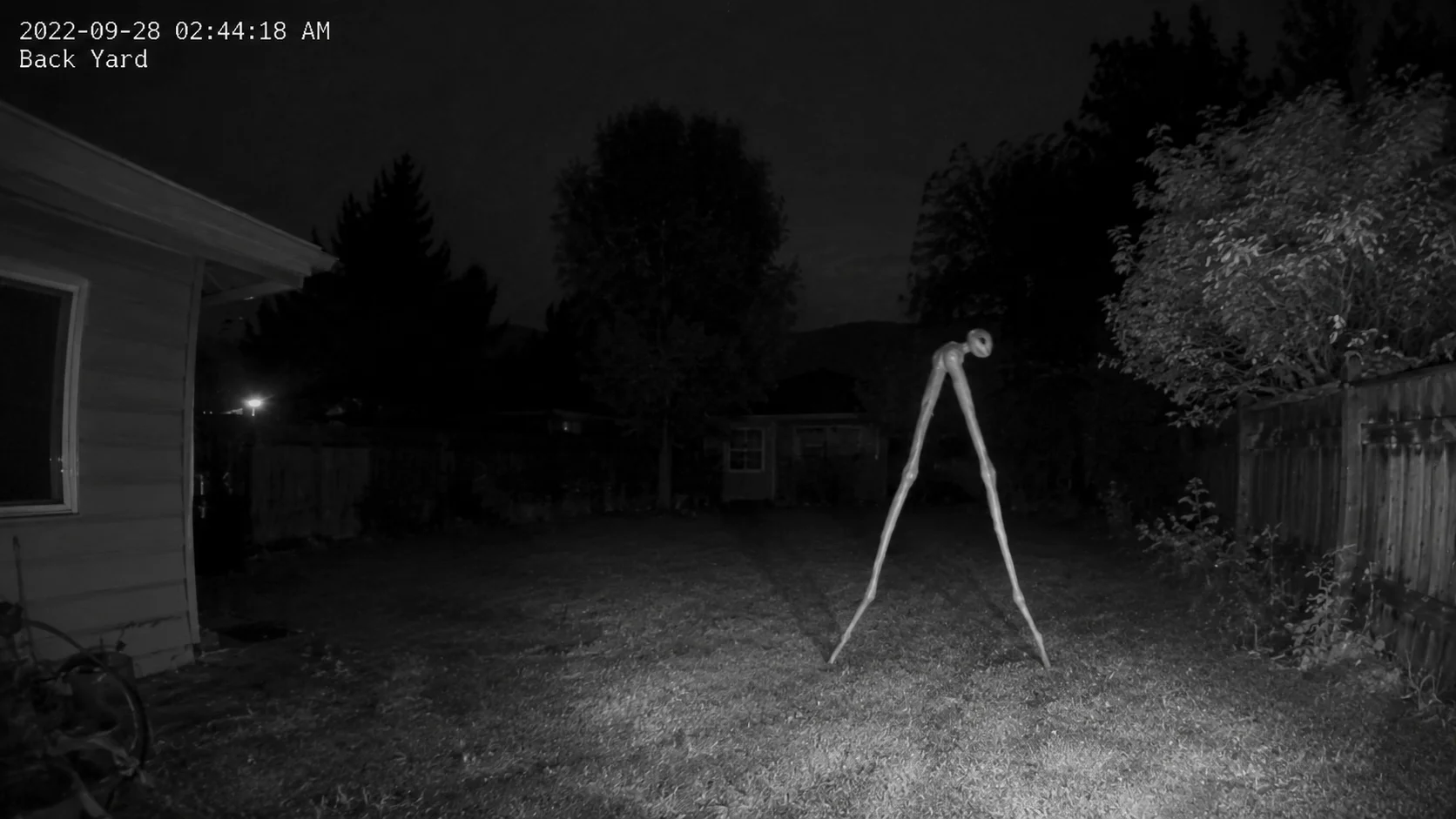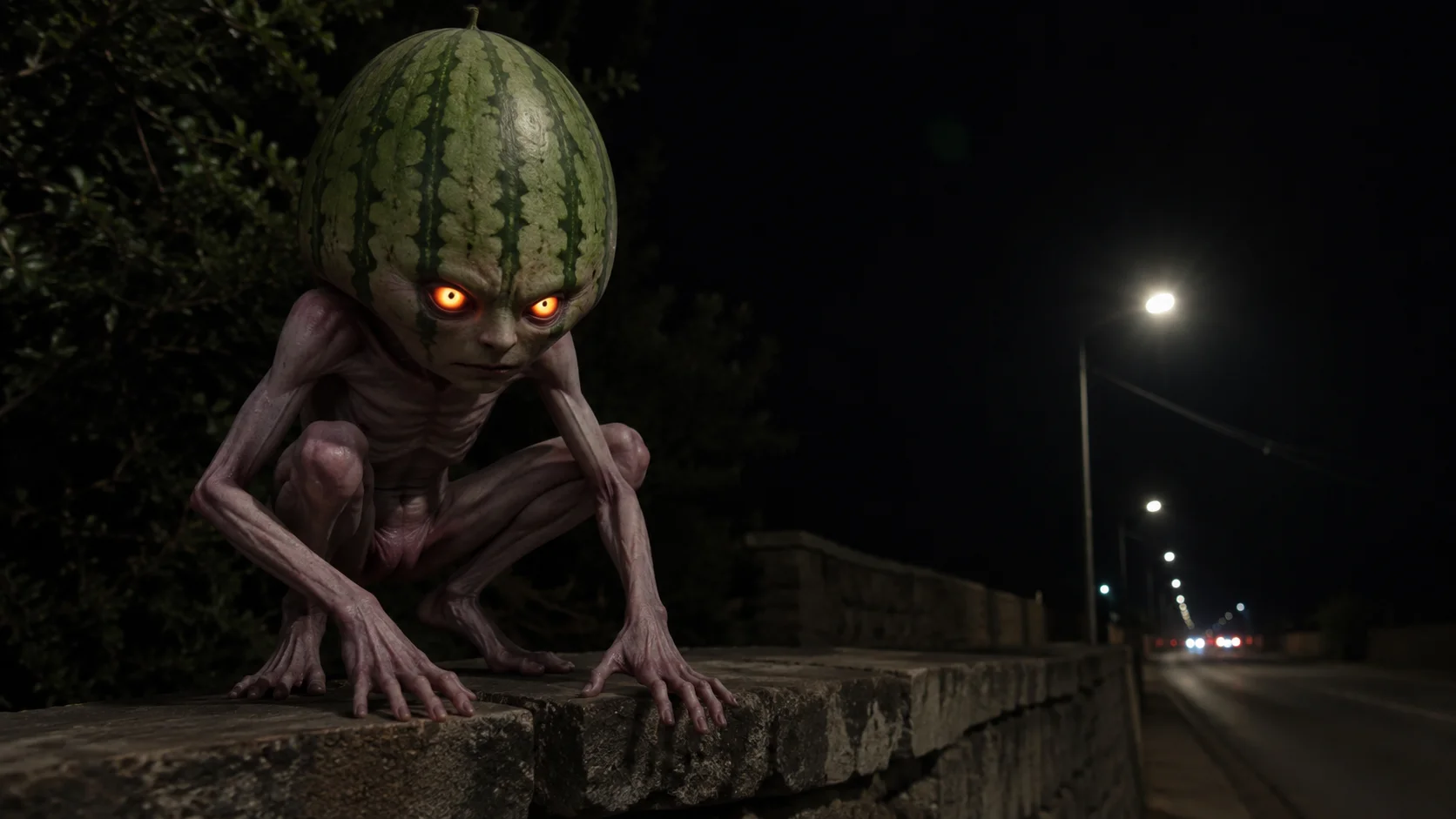
The Dover Demon is an American cryptid — a small, strange, hairless humanoid creature with a large, melon-shaped head and glowing eyes, said to have been sighted in the town of Dover, Massachusetts, over two consecutive nights in April 1977.
A Boston Suburb, Two Nights in April
Dover, Massachusetts sits among the quiet, wooded suburbs southwest of Boston, the kind of town where a strange figure glimpsed by headlights on a back road would be talked about for years. It was here, on the nights of April 21 and 22, 1977, that four teenagers, across three separate encounters, reported crossing paths with something none of them could identify. No sighting of the creature by the name it would come to bear is documented in Dover before that April, and none is documented after it. Whatever the Dover Demon was, it appears in the record only in that brief window, which sets it apart from cryptids whose sightings stretch back generations. This is a single-incident case, and its entire evidentiary weight rests on what four young people said they saw across those two nights — roughly a 24-hour span in total.
Farm Street: William Bartlett's Sketch
The first report came from 17-year-old William Bartlett, who on the night of April 21, 1977, was driving along Farm Street with friends when his headlights caught something crouched at the roadside. Bartlett was the witness whose account would go on to shape nearly every subsequent depiction of the creature, because he was also the one who put pencil to paper afterward and produced the sketch that has since become the Dover Demon's de facto portrait. He described a hairless, melon-headed figure with thin limbs like a monkey's, and skin the texture of wet sandpaper or a rough peach. Most striking of all were its eyes: large, glowing orange, and lidless, fixed on the car without blinking. The creature Bartlett described was roughly the size of a small child, an unsettling scale that made the encounter feel less like meeting an animal and more like meeting something that should not have been recognizable as anything at all.
Miller Hill Road: A Second Boy, the Same Night
Bartlett's sighting was not the only one that night. Later on April 21, 15-year-old John Baxter was walking home along Miller Hill Road when he came across a similar figure crouched on a pile of rocks, its eyes catching the light with the same glow Bartlett had described. Baxter's account differed from Bartlett's in one striking detail: he claimed he did not simply glimpse the creature and walk on, but approached it — closing to within a few feet before it broke and fled into the dark. That proximity, if taken at face value, makes Baxter's the most intimate of the four encounters, the only one in which a witness claims to have nearly stood beside the thing rather than viewed it from a passing car. The two accounts, given independently by boys who were not together at the time, described a creature consistent enough in shape and detail that investigators would later treat the overlap as significant.
Springdale Avenue: Headlights on the Second Night
The following night, April 22, brought a third and fourth witness. Abby Brabham and Will Traintor, driving along Springdale Avenue, reported seeing a similar creature crouched at the roadside, caught for a moment in their headlights before it moved off. Their account, like Bartlett's, came from behind a windshield rather than on foot, but it corroborated the same general description that had already emerged the night before: the same hairless build, the same oversized head, the same eyes. Between April 21 and 22, then, three separate encounters — Bartlett's, Baxter's, and Brabham and Traintor's together — had converged on a single, oddly consistent picture, reported by young people who did not know each other's accounts in advance. With Brabham and Traintor's sighting, the recorded case closes: four witnesses, two nights, and nothing more entered into the primary record.
The Name Coleman Gave It
The case might have stayed a piece of local gossip had it not reached Loren Coleman, a cryptozoologist who investigated shortly after the sightings and is credited with coining, or at least popularizing, the name by which the creature is now known everywhere: the Dover Demon. Coleman interviewed the teenage witnesses separately, a deliberate choice meant to test whether their accounts had been coordinated or contaminated by comparing notes. He came away describing the accounts as consistent with one another and the witnesses themselves as credible. That assessment carried the case into cryptozoological literature and beyond, but it is worth being precise about what it is: Coleman's professional judgment as an investigator, not an independent or forensic verification of what actually happened on those roads. No corroborating evidence — physical or otherwise — has ever surfaced to confirm it beyond the witnesses' word.
What Was Never Found
For all the consistency of the four accounts, the Dover Demon left nothing behind. No tracks were recovered. No hair, no photographs, no physical trace of any kind tied to the creature has ever been produced. Everything known about it exists because four teenagers described what they say they saw over the course of about twenty-four hours in April 1977 — and nothing more. This absence has never stopped the case from being told and retold, but it does mean that every physical detail of the creature's appearance, from the sandpaper skin to the lidless orange eyes, rests entirely on human memory and description, filtered through Bartlett's sketch, rather than on anything that could be examined independently.
The Skeptics' Case
Skeptical explanations have circulated for as long as the sightings themselves. One proposes that the witnesses encountered a young moose suffering from alopecia or mange, its patchy, hairless hide and unfamiliar silhouette misread in darkness and headlight glare as something altogether stranger. Others have suggested a foal, similarly disfigured by an animal none of the teenagers would have expected to meet on a suburban road at night. Still others point to an escaped exotic animal as a more mundane, if unproven, culprit. And running alongside every naturalistic explanation is the simplest one of all: that the whole episode was a prank, four teenagers spinning a story that took on a life none of them could have predicted. None of these explanations has been proven any more than the creature itself has been proven real — they remain competing readings of the same four uncorroborated accounts.
A Cryptid Without a Lineage
Unlike many cryptids that cryptozoologists trace back through decades or centuries of regional folklore, the Dover Demon has no attested mythological ancestry. It does not descend from an older local legend, an indigenous tradition, or a folk tale that predates 1977. Cryptozoologists instead file it under a broader, more modern category: North American reports of humanoid or alien-looking cryptids, figures that seem to emerge less from inherited story than from a particular late-twentieth-century cultural moment. Writers in that field have drawn comparisons between the Dover Demon and other single-cluster American humanoid cases, such as the Flatwoods Monster, or to the "grey alien" imagery that was becoming culturally pervasive by the late 1970s. These are comparative groupings made by researchers studying the shape of a phenomenon, not claims that any of these figures share an origin or an identity with one another. The Dover Demon stands on its own case file, tied to no other named cryptid in any documented, shared-sighting sense — any suggestion otherwise is speculation layered on afterward, not part of the primary record.
A Small Town's Enduring Curiosity
Nearly five decades on, the Dover Demon has settled into a modest but durable place in New England's regional identity. It shows up in local folklore tours through Dover and the surrounding towns, in books cataloguing New England's monsters — including Coleman's own writing on the subject — and in the steady stream of popular cryptid documentaries and media that return to it as one of the more restrained, well-documented entries in American cryptozoology. Its appeal lies partly in its brevity: unlike sprawling, decades-spanning cryptid legends, the Dover Demon is contained, almost forensically tidy — four witnesses, two nights, one town, and then nothing again. That compactness is part of what makes it such a frequently retold case; there is a beginning, a short middle, and an end, with no messy accumulation of later, harder-to-verify claims to sort through.
Four Voices, One Brief Window
Strip away everything built up around the Dover Demon since 1977 — the name, the comparisons to other cryptids, the tours and the documentaries — and what remains is exactly four eyewitness accounts, given by four teenagers, over roughly twenty-four hours. Bartlett's sketch. Baxter's claim of a close approach. Brabham and Traintor's headlight glimpse. That is the whole of the primary record. Everything else — the interpretation, the classification, the cultural afterlife — is built on top of that narrow foundation, and the case is best understood for what it plainly is: not a recurring haunting of a place, but a single, brief, unresolved cluster of reports that happened to be detailed and consistent enough to outlast the moment that produced them.
Sources & traditions
- EncyclopediaWikipedia — Dover Demon
- TraditionLocal sightings, press reports and regional folklore (North America)
Myths change from area to area and from time to time. This chronicle follows the most widely told versions; tellings in other villages, regions and eras may differ.