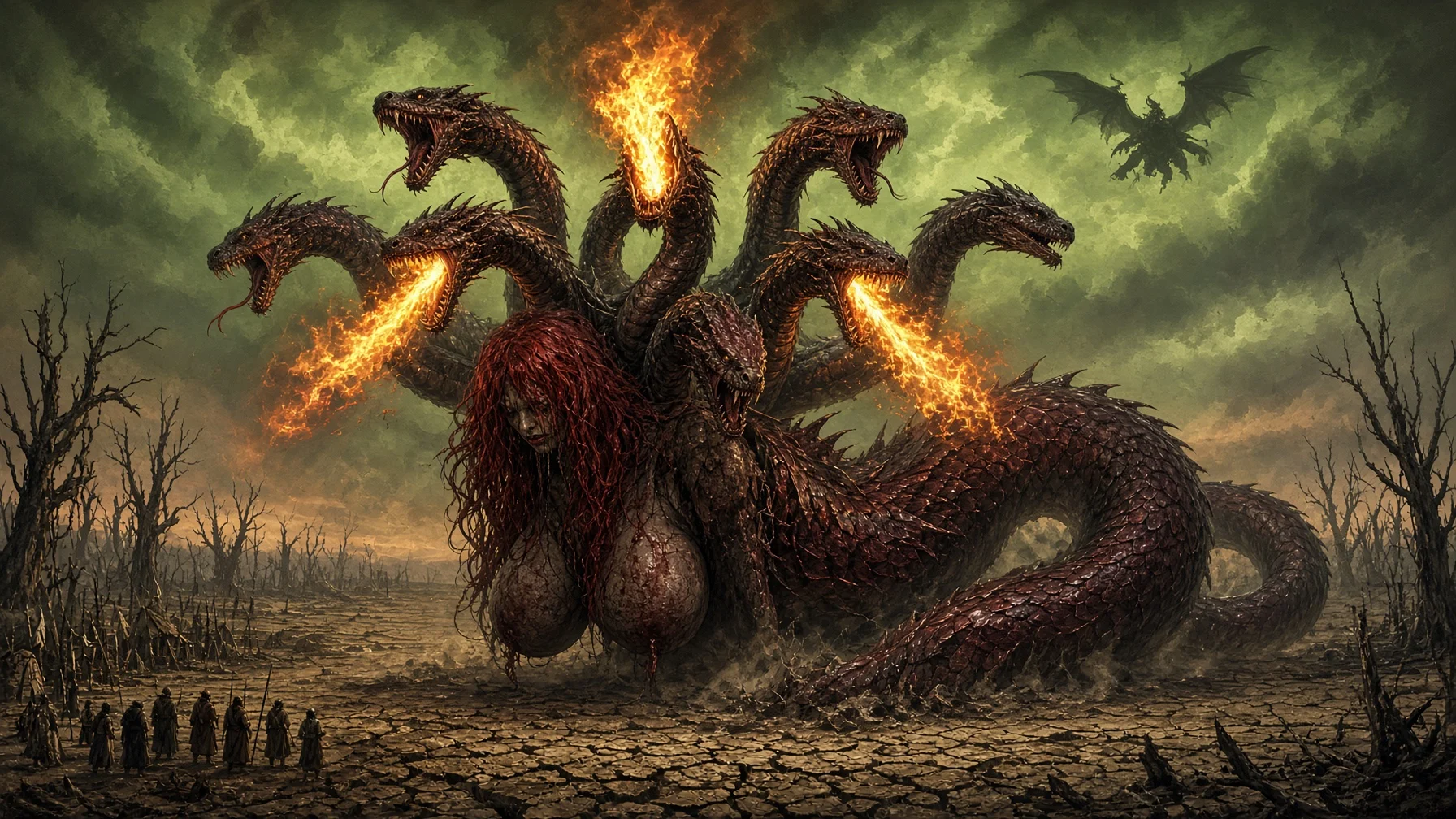
The Kulshedra, also called Kuçedra in many regions, is the great serpentine she-monster of Albanian folklore: an enormous, multi-headed, fire-breathing dragon-being whose name is bound up with drought, poisoned water, and the storms that break over the mountains. Depicted as a colossal scaled serpent with several heads — folk accounts differ on the exact number, most often citing seven or nine — and marked as female by her pendulous breasts, she is not a single fixed image so much as a shared regional understanding: that the land's worst weather and worst thirst have a shape, and that shape has a natural enemy. That enemy is the Drangue, and the story of their recurring battle is, in the fullest sense, how a great deal of Albanian oral tradition explained the sky.
A Serpent Grown Monstrous
Albanian folk cosmology draws a careful line between the Kulshedra and a smaller, humbler creature called the Bolla — a blind, serpent-like being that spends much of the year hidden away, dormant, out of the light. In the most widespread version of the transformation story, a Bolla that survives undetected by human eyes until Saint George's Day, or that endures for a set span of years — accounts vary between seven, nine, and twelve — does not simply live on as a serpent. It changes. Wings unfold from a body that had none. A single mouth becomes several. Breath that was harmless becomes fire. What emerges is the Kulshedra: no longer a blind thing hiding in the ground but an airborne, flame-breathing calamity capable of laying waste to a valley.
This is not incidental folklore color. It carries a moral logic that agrarian communities would have recognized instantly — a dormant, passive danger, left unwatched and unchecked for too long, does not stay small. It grows into something that can no longer be managed by caution alone, only confronted.
The Shape of the Beast
Where the Bolla is described plainly, the Kulshedra is described at length, and with dread. She is rendered as serpentine or lizard-like, her body sheeted in scales, multiple heads rising from one great trunk, breathing fire or venom depending on the telling. In many accounts she has taken flight by the time she is fully grown, wings carrying her into the storm-clouds where her battles with the Drangue are fought. She is almost never given a human face or human bearing — unlike some neighboring Slavic dragon-figures, who slide toward the anthropomorphic, the Kulshedra stays resolutely monstrous, a creature of scale and claw and multiplied mouths, built to be feared rather than reasoned with.
Mistress of Drought and Flood
Her defining power is over water, though the tradition is not of one mind about how she wields it. In some tellings she is a hoarder: she drinks rivers dry or plants her bulk across a spring, and the land around her withers for want of what she has taken. In others she is a destroyer working the opposite way: she vomits floods, unleashes hailstorms, and drowns what drought would otherwise have merely starved. The two pictures do not agree on mechanism, and the tradition does not resolve them into one — she is, depending on the valley telling the story, either the thing that steals the water away or the thing that lets it loose all at once, catastrophically. What both versions share is the same underlying claim: that she is the force behind weather that turns hostile, whichever direction that hostility runs.
The Price of a Village's Spring
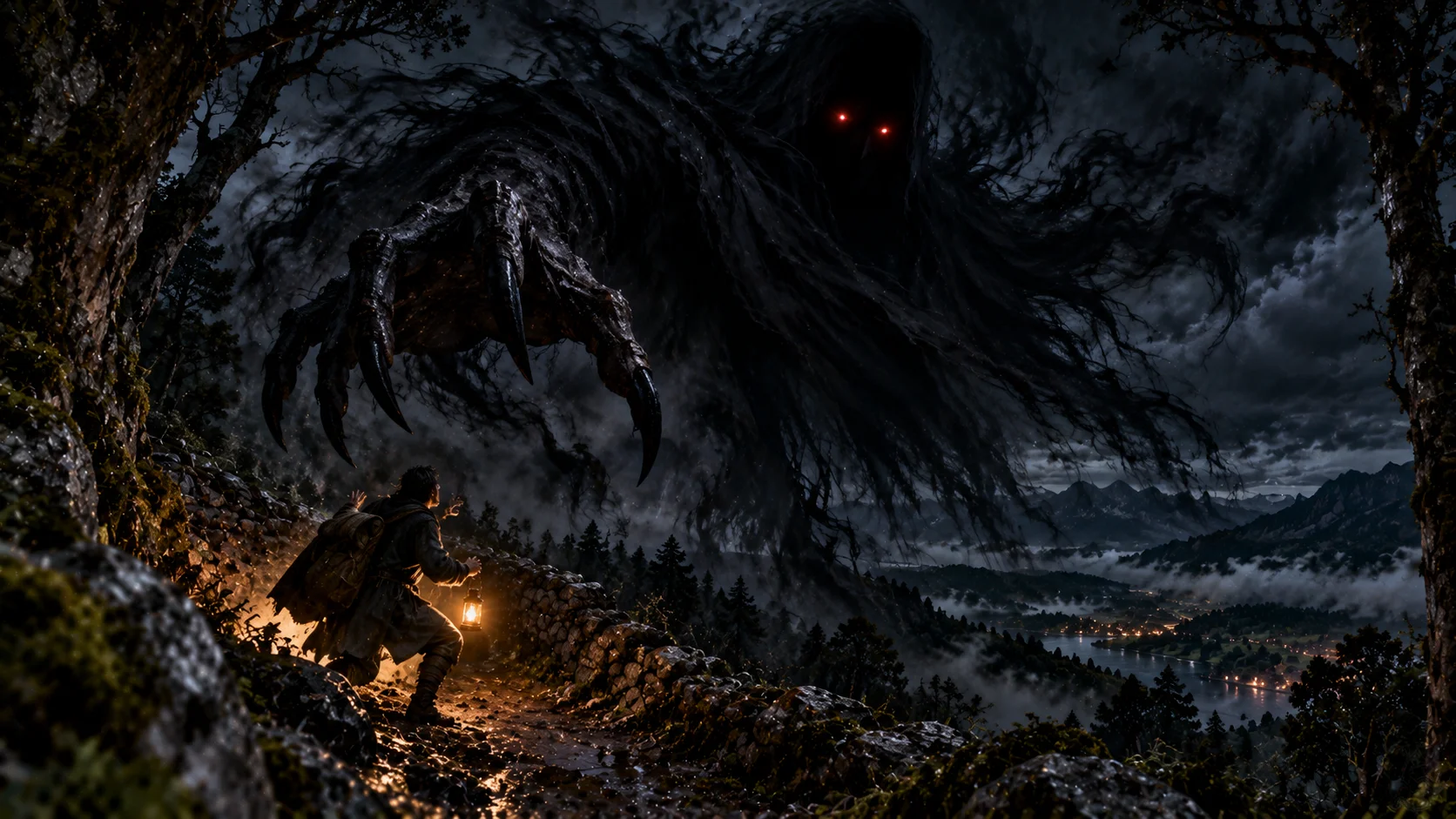
In many of the most enduring tale-variants, the Kulshedra does not merely control water in the abstract — she guards one particular source that a community cannot live without. A spring, a well, the single river a village depends on: she settles upon it and will not let it flow. The price she sets for releasing it is human, and it is almost always a young woman, offered up so the water may run again. The community does not defeat her through the offering; it merely survives another season by it. The offering buys time, not victory — and it is that unresolved debt, paid over and over, that the wider mythic tradition eventually answers with a hero rather than another sacrifice.
The Drangue in the Storm-Clouds
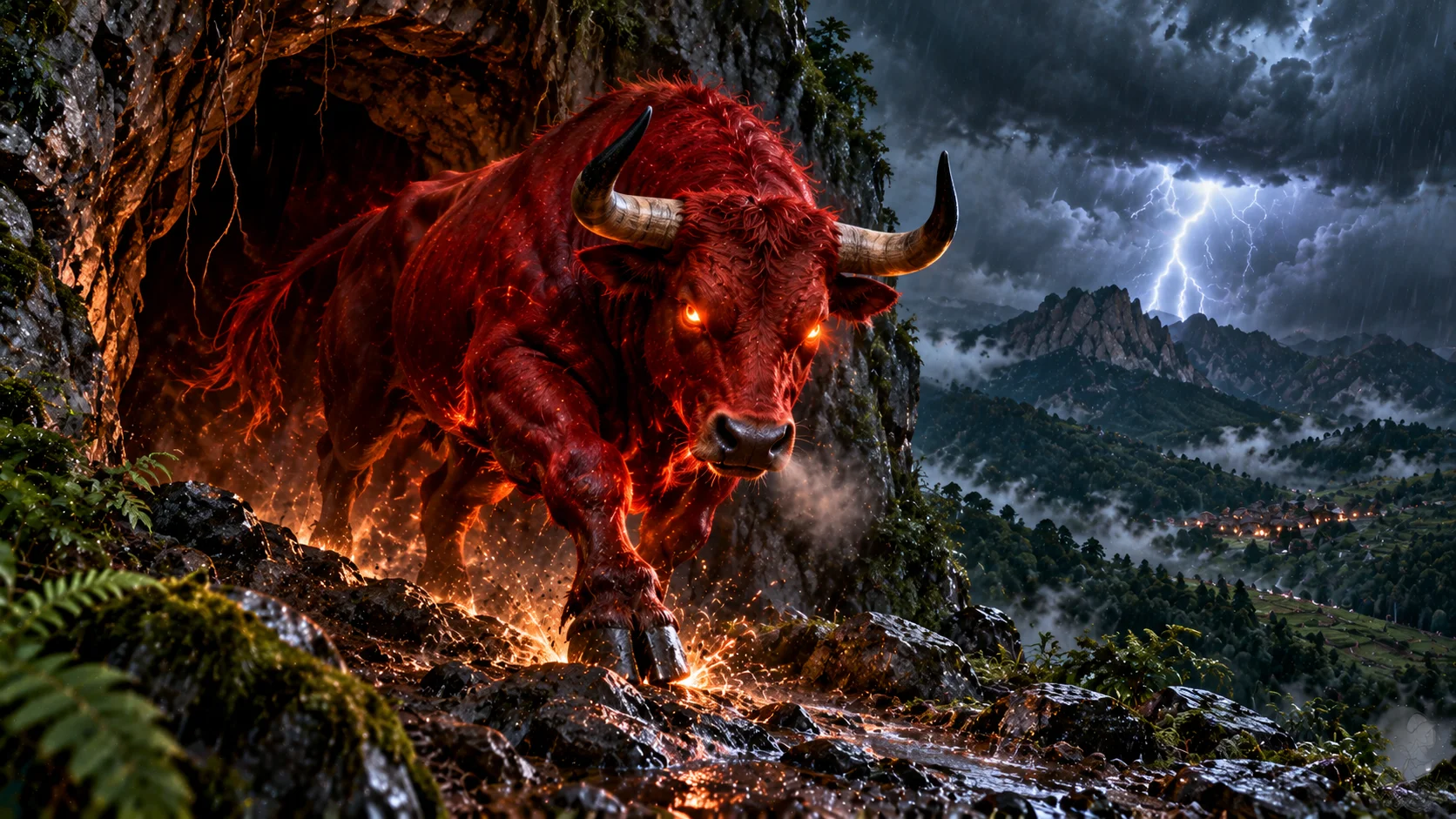
That hero is the Drangue, sometimes rendered Dragua: a winged demigod of Albanian folk belief, born already marked as extraordinary — with wings beneath the arms in some accounts, or extra fingers in others, signs read from birth as proof of a destiny to fight on the community's behalf. Where the Kulshedra hoards and devastates, the Drangue defends. He strikes at her with thunderbolts, with boulders torn from the mountainside, with whole uprooted trees swung like weapons. The confrontation between them is not framed as a single decisive myth but as an ongoing, cyclical war, recurring again and again, often placed at the turning of the seasons or in the heart of a storm.
Thunder as the Sound of a War
It is this cyclical combat that folk belief used to make sense of an otherwise unexplainable sky. Thunder and lightning were understood, in this tradition, as the audible and visible trace of the Drangue and the Kulshedra fighting overhead — the crack of thunder was the strike of a hurled stone or bolt, the flash of lightning was the weapon itself. A violent storm was not simply weather; it was a battle being fought for the community's benefit, with the Drangue's success or struggle written into the intensity of what fell from the sky that night.
Men Born to Answer Her
The myth did not stay confined to the sky. Certain communities held that particular men — born with a caul, a birth-membrane taken as a mark of destiny — were themselves Drangue-born, understood to carry the same protective calling into adulthood. In folk belief, such a man's spirit was thought to leave his body during a storm and join the fight against the Kulshedra directly, defending his village in a form no neighbor could see. The cosmic battle, in other words, was not only something that happened far overhead; it was a role a real, named man in a real village might be believed to hold, tying the grand mythic opposition into the texture of lived life.
Explaining Drought Without a Weather Report
Beyond its drama, the Kulshedra myth did practical work. It gave a farming community a framework for the things that actually threatened it — a dry season that would not break, a flash flood that tore through a field, a hailstorm that flattened a harvest overnight. None of these needed to be arbitrary or meaningless within this cosmology; each could be read as a moment in an ongoing struggle between a destructive chthonic force and the protector who existed to hold her back. The myth turned unpredictable, frightening weather into something with a cause, a combatant on humanity's side, and — crucially — an outcome that was never final, so the next storm could always still be read as another round of the same fight.
Names That Shift From Valley to Valley
The creature does not carry one fixed name across Albanian-speaking regions. Kuçedra and Kulshedra both appear as the base form, and in parts of Kosovo and the north additional descriptive epithets attach themselves to her — Kucedra e Bardhë, "the white Kulshedra," among them — tied to color or to the count of heads a particular local telling gives her. Scholarship has never settled on one standardized spelling or one canonical description, and that is itself part of what the tradition is: a set of related regional pictures of the same underlying danger, rather than a single fixed text.
A Shared Balkan Inheritance
Comparative folklorists place the Drangue–Kulshedra pairing inside a much broader regional pattern: the storm-hero-versus-dragon complex found across South Slavic and wider Balkan tradition, echoed in figures such as the zmey and the zduhać of neighboring cultures. Read this way, the Kulshedra is not an isolated Albanian invention but Albania's own expression of a mythological structure shared across the region — a chthonic, water-hoarding or flood-bringing monster set against a storm-wielding protector, worked out independently in valley after valley but recognizably kin from one tradition to the next.
Where the Tradition Disagrees With Itself
Several points about the Kulshedra remain genuinely unsettled across the oral record, and are best held as variant traditions rather than fixed fact. The exact number of her heads shifts from account to account. The number of years — or the exact condition — required for a Bolla to complete its transformation into a Kulshedra is given differently from source to source. And whether she is purely malevolent, or in some tellings a more ambivalent guardian spirit rather than an outright monster, is not something the wider tradition resolves in one direction. These disagreements are not gaps to be smoothed over; they are the ordinary texture of a myth that lived, for a very long time, in spoken tellings rather than in a single written canon.
What Remains of Her
Across all its regional variation, the Kulshedra endures as one of the defining monstrous figures of Albanian folk tradition: a many-headed serpent-dragon bound to drought and flood, opposed across a cyclical, storm-borne war by the winged Drangue, and understood by generations of listeners as the reason the sky itself sometimes turned violent. In her, a community's oldest fears about water — too little of it, or catastrophically too much — were given a body large enough to be fought, and a story large enough to explain why the fight was never quite finished.
Sources & traditions
- EncyclopediaWikipedia — Kulshedra
- TraditionAlbanian folk and village traditions
Myths change from area to area and from time to time. This chronicle follows the most widely told versions; tellings in other villages, regions and eras may differ.