Zojz — also written Zoj or Zojzi — is the name Albanian philology has recovered for a sky-and-thunder god standing at the very root of the Indo-European family of religions. He is not, strictly, a figure of continuous living worship in the way a saint or a well-attested local spirit might be; he is a reconstruction, built by comparative linguists and folklorists out of a name preserved in place-names, dialect calendar terms, and scattered fragments, and set beside his unmistakable cousins Zeus, Jupiter, Dyaus, and Dievas. To speak of Zojz is to speak of the oldest layer anyone has been able to reach in Albanian belief — a layer of trace and etymology rather than of story, and one that deserves to be handled with the same care a philologist gives a worn inscription: certain in outline, humble about its details.
A Name Carried on the Wind of *Dyeus
The linguistic case for Zojz begins with the reconstructed Proto-Indo-European root *Dyēus, "sky, day, the shining one," the same root that gives the Greeks Zeus, the Romans Jupiter (from Diespiter, "sky-father"), the Vedic hymns their Dyaus, and the Baltic peoples their Dievas. Albanologists, foremost among them Eqrem Çabej, identified Zojz as the Albanian reflex of this same ancient word — meaning that when an Albanian speaker of past centuries invoked Zojz, they were, however unknowingly, continuing to pronounce a name that had already been ancient when Homer's Greek and Vedic Sanskrit went their separate ways. This is one of the more secure findings in Balkan comparative philology, even as scholars continue to debate how much of a living cult, as opposed to a linguistic fossil, the name Zojz actually represents by the time it was recorded.
Traces Instead of Tales
What makes Zojz unusual among sky-gods of the ancient world is the shape of what survives him. There is no Albanian epic in which Zojz contends with rival powers, fathers a divine lineage, or is given the kind of extended narrative that Greek poetry gives Zeus — no succession myth, no catalogue of unions, no court of subordinate gods described in sequence. What remains instead is a name: in toponyms scattered across the landscape, in the name attached to a month or seasonal period in some northern Gheg dialect traditions, and in scattered references gathered by nineteenth- and twentieth-century folklorists, later summarized by scholars such as Robert Elsie. Zojz survives, in other words, the way a very old river survives in the names of the villages along its banks, long after anyone remembers what the river itself looked like in flood.
Storm-Father of the High Country
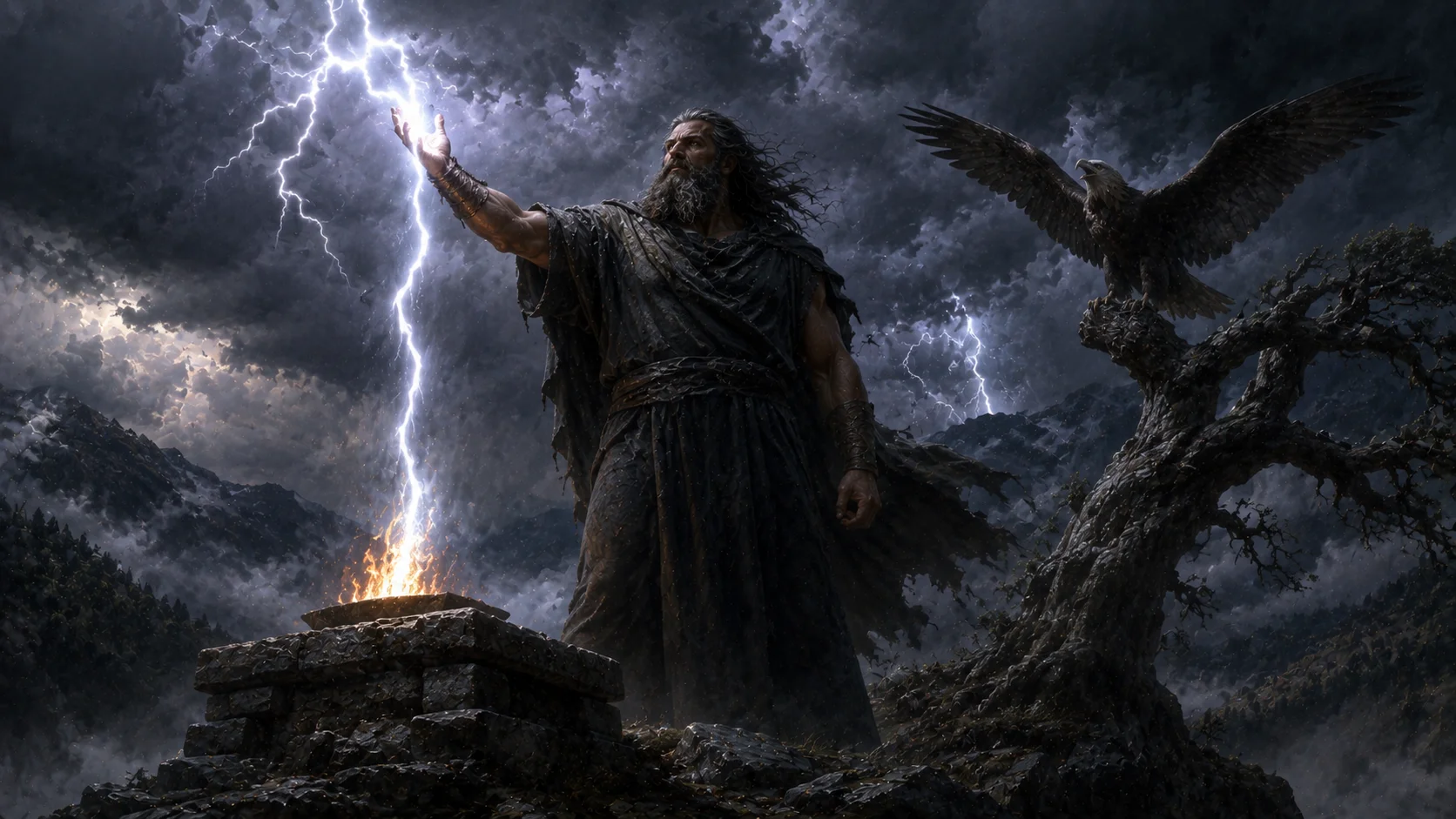
Where the record does speak with some consistency, it speaks of weather. Thunder rolling through the mountains, lightning splitting the sky, storm and rain governing the fortunes of herders and farmers alike — these are the phenomena the ethnographic record attaches most steadily to Zojz, placing him squarely within the recognizable Indo-European type of the thunder-god, the same type that produced Perun among the Slavs, Perkūnas among the Balts, and Thor among the Norse. This is not a matter of poetic guesswork; it is the pattern that repeats wherever a reflex of *Dyeus is found, and Albanian tradition, however thin its surviving detail, falls faithfully into that pattern.
The Eagle's God
Ethnographic and philological sources link Zojz to the eagle, shqiponja, the very bird that Albania has taken as its national emblem. Scholars often point to this as evidence of how central a sky-god's imagery once was to the beliefs of the region — a bird of the heights standing for a god of the heights. Others urge caution, noting that the eagle's symbolic weight may have been reinforced, and perhaps partly reshaped, by the demands of later national iconography rather than transmitted untouched from antiquity. Both readings can be held at once: the association is real and recorded, and its full depth in the pre-Christian imagination is something the sources cannot settle beyond doubt.
Peaks Where His Name Still Clings
The mountains of northern Albania — above all the Bjeshkët e Nemuna, the Accursed Mountains of the Albanian Alps — are the region folklorists most often cite when tracing place-name evidence connected to Zojz: peaks and sites locally associated with storms, where his name or its traces are said to linger in local speech. The precise identification of these sites varies from source to source, and no single inventory commands universal agreement among scholars. What is consistent is the geography of the claim itself — a sky-and-storm god rooted, appropriately, in the highest and stormiest ground the country has to offer.
A Sky Paired with an Earth, by Inference
Comparative mythology has long noted that sky-fathers of the *Dyeus type tend to be paired, in the wider Indo-European imagination, with a chthonic or earth-associated female counterpart. Following this pattern, some scholars have discussed Zojz alongside E Bukura e Dheut, "The Beauty of the Earth," as a plausible sky-and-earth polarity within Albanian folklore. It bears repeating plainly that this pairing is a scholarly inference drawn by analogy, not a union recorded in any single surviving tale — there is no Albanian narrative that names the two together as consort figures. The comparison illuminates a possible shape behind the fragments; it does not itself constitute evidence of a documented myth, and it is best understood as an open question rather than a settled fact.
The Word Beneath the Word for God
Perhaps the most striking thread in the scholarship concerns language itself. Several Albanological etymological studies trace the modern Albanian words zot, "lord" or "master," and zoti, "God" in both Christian and Islamic Albanian usage, back to the same *dyeu- root that produced Zojz's own name. If this etymology holds — and it is discussed seriously, though not unanimously accepted, among specialists — then every time an Albanian speaker today says zoti in a mosque, a church, or an everyday blessing, the syllables carry, several thousand years removed from their origin, an echo of the old sky-god's name. It is a quiet kind of survival: not a temple or a festival, but a word worn smooth by daily use, still doing its ancient work of naming the highest power without anyone needing to remember why.
Weather in the Mouth: Curses, Blessings, and Proverbs
Comparative mythologists studying the wider Balkan and Indo-European survival of sky-father worship have also pointed to Albanian folk speech itself — curses, blessings, and proverbs that invoke thunder, lightning, and the sky. Some of these turns of phrase are tentatively connected by scholars to a residual memory of Zojz's cult, weather-language outliving the god who once explained the weather. This connection remains carefully qualified rather than firmly proven: the written record of pre-Christian, Illyrian-era Albanian religion is sparse enough that a fully unbroken line from antiquity to modern folk speech cannot be verified with certainty. The resemblance is suggestive, not conclusive, and honest scholarship leaves it exactly there.
No Statue, No Fixed Image
Unlike Zeus with his thunderbolt and eagle rendered in bronze and marble across the ancient Mediterranean, Zojz has no securely attested archaeological iconography — no statue, no fixed attribute-object, no image that can be traced with confidence back to an ancient cult. Any depiction of Zojz found in modern Albanian art, illustration, or media is necessarily a reconstruction or an interpretation, built from the comparative evidence rather than continuing an unbroken visual tradition. This absence is itself informative: it marks the difference between a god known through monuments and a god known through the quieter evidence of names, dialect, and etymology.
Crowned Retrospectively: A Modern Reconstruction
In the nineteenth and twentieth centuries, a number of Albanian folklorists and writers working in the currents of Romantic nationalism sought to place Zojz at the head of a reconstructed "pre-Christian Albanian pantheon," offering him as a direct parallel to Zeus's or Jupiter's position atop the Greek and Roman pantheons. This elevation should be understood clearly for what it is: a modern synthesis shaped by the nation-building instincts of its era, not a hierarchy directly inherited from ancient practice. The underlying etymological identity of Zojz as a *Dyeus-reflex is sound scholarship; the picture of him presiding over an organized pantheon of subordinate deities is a later construction laid on top of it, and the two should not be mistaken for one another.
A Symbol of Deep Time
In present-day Albanian cultural discourse, Zojz functions chiefly as a symbol — a marker of the antiquity and the Indo-European pedigree of pre-Christian Albanian religion, invoked in narratives of Illyrian and Albanian continuity and in the broader project of heritage-building. This is, importantly, a modern cultural-symbolic role, and it should be kept distinct from any claim of continuous ancient cultic practice, which the surviving record does not document. Zojz's power in contemporary imagination lies less in what is known about him than in what his name proves about how old Albanian language and belief truly are: proof carried in a handful of syllables that reach back before Zeus had a name to be compared to.
What the Fragments Ask of Us
To hold Zojz rightly is to hold a paradox with grace: a god whose kinship with Zeus, Jupiter, and Dyaus is about as certain as comparative linguistics gets, and whose personal story is almost entirely unrecoverable. There is no cycle of deeds to retell, no quarrel or triumph to narrate, because none was written down in a form that survived. What remains is rarer and, in its way, more moving — a name embedded in mountains, in a dialect month, in the word for God itself, waiting in the structure of a language for someone to notice it was there all along. That is the honest shape of Zojz: not a story finished, but a trace still being read.
Sources & traditions
- EncyclopediaWikipedia — Zojz (deity)
- TraditionAlbanian folk and village traditions
Myths change from area to area and from time to time. This chronicle follows the most widely told versions; tellings in other villages, regions and eras may differ.