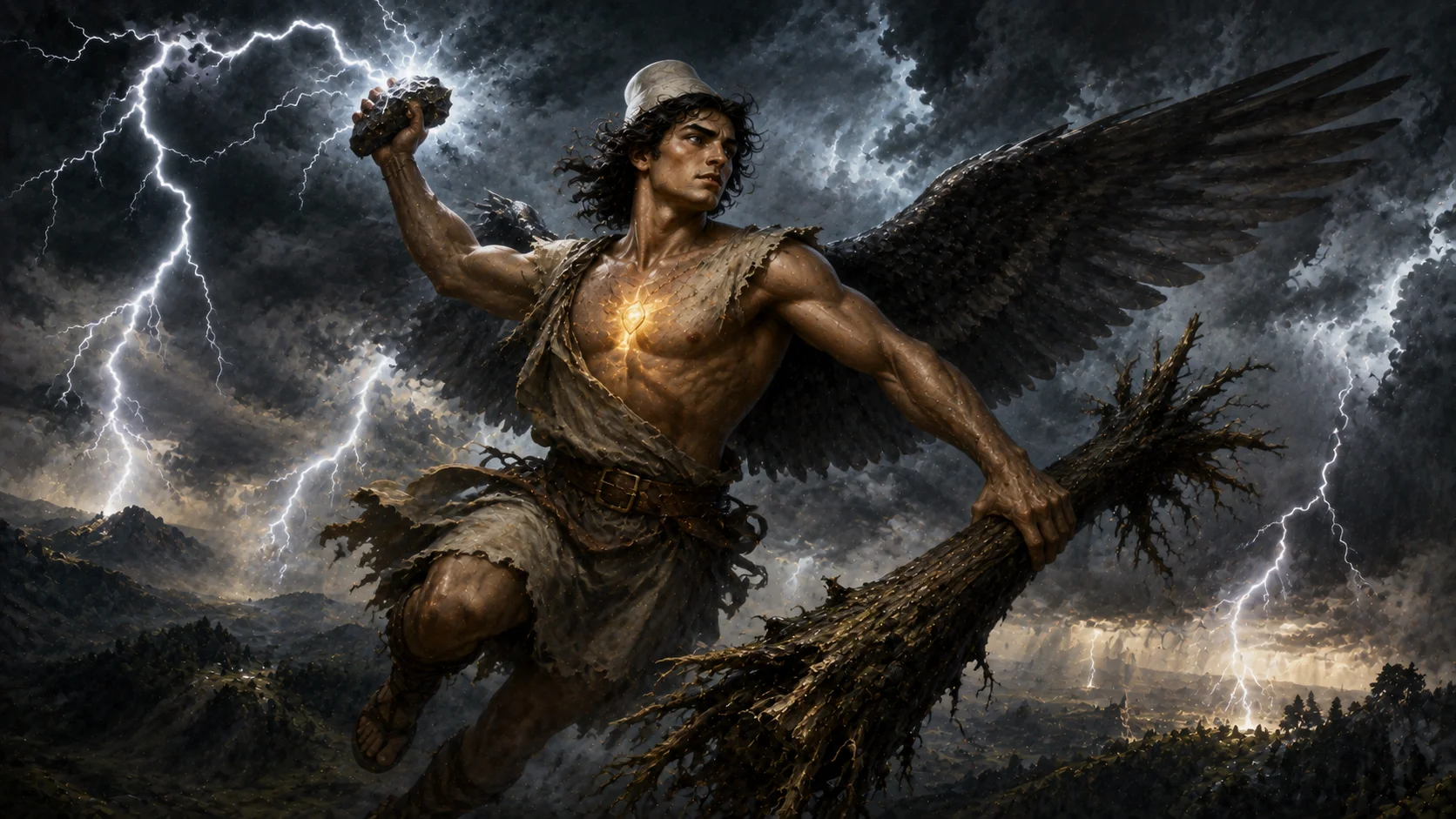
The Drangue, plural drangue, is the great winged hero-protector of Albanian mythology, a semi-divine, immensely powerful being, born with supernatural marks upon his body, whose sacred charge is to defend humankind and the fields against the monstrous drought-dragon, the kulshedra. Wielding uprooted trees, meteoric stones, and the broken timbers of watermills, doing battle across the storm-clouds, the drangue is the champion of order against chaos, and his eternal war with the kulshedra is remembered across the northern Albanian highlands as the great recurring drama that explains why the sky thunders and why the fields, in the end, are spared.
A Child Marked Before He Is Named
A drangue is born, the old tellings insist, not made. From the first hour of his life he carries the signs of what he will become: he comes into the world wrapped in the caul, the amniotic membrane still clinging to his head and shoulders, and, most tellingly, with small wings, or the ghost of wings, folded beneath his arms or across his shoulder blades. Some accounts add that he is born already with teeth, a further omen read by the women attending the birth as proof that this was no ordinary child. In northern Albanian belief, and above all in the highland regions of Malësia e Madhe and Dukagjin, such a birth was understood as the mark of a supernatural agency touching the mother, setting the child apart from his brothers and sisters from his very first cry. He was not chosen later, in youth or in battle. He was chosen in the womb.
The Wings Beneath the Arms
Of all the signs said to accompany a drangue's birth, the wings are the one the oral tradition returns to again and again as the definitive proof. Hidden beneath the armpits, sometimes described as a single small pair, sometimes as two pairs, these wings are not decorative. They are the means by which the grown drangue rises from the earth into the clouds where his true battles are fought. A man might live an ordinary life among his neighbors, plow his fields, tend his flocks, and give no outward sign of what he is, until the sky darkens and the wings beneath his arms answer a call that ordinary men cannot hear.
The Kulshedra Rising
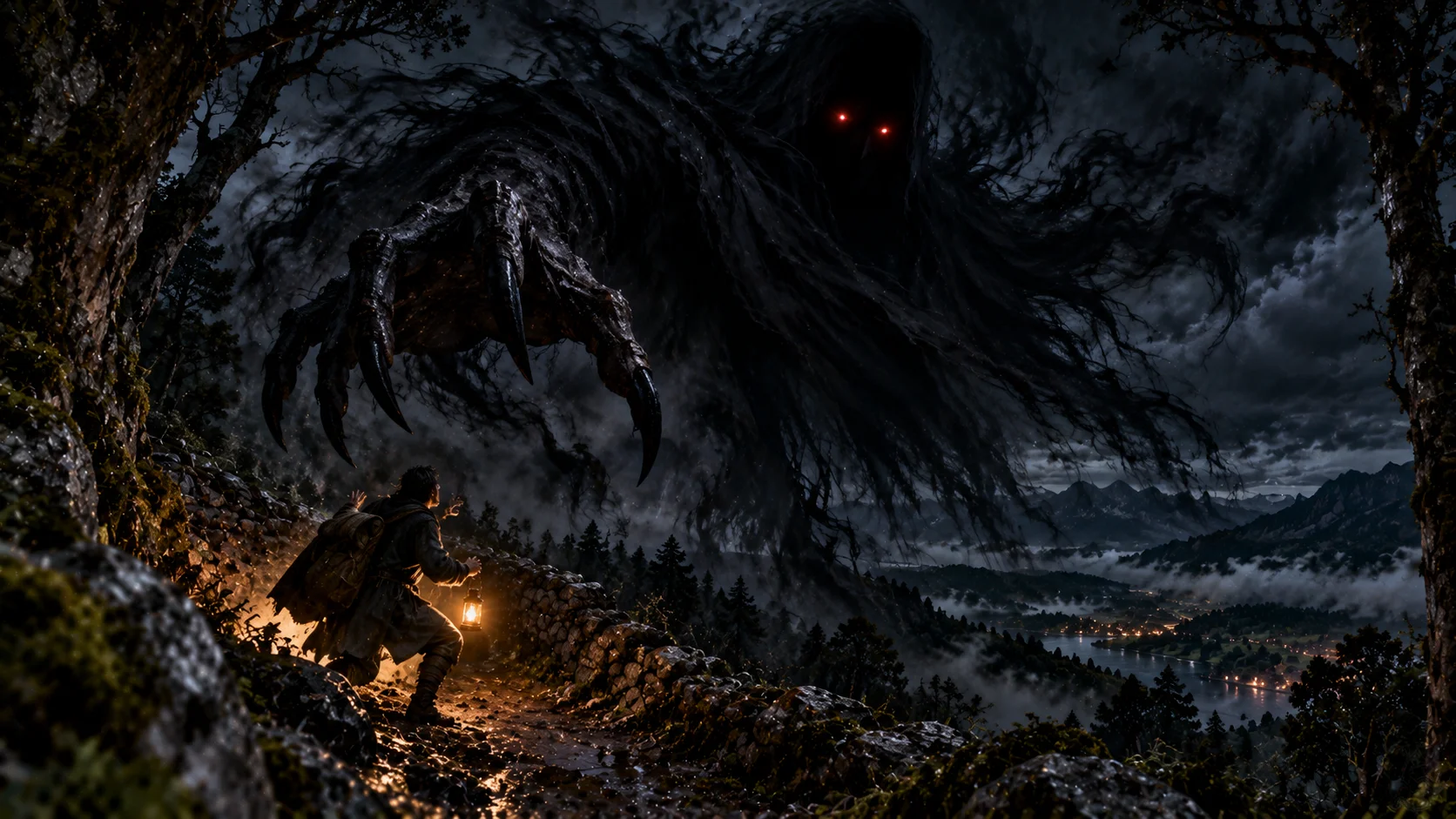
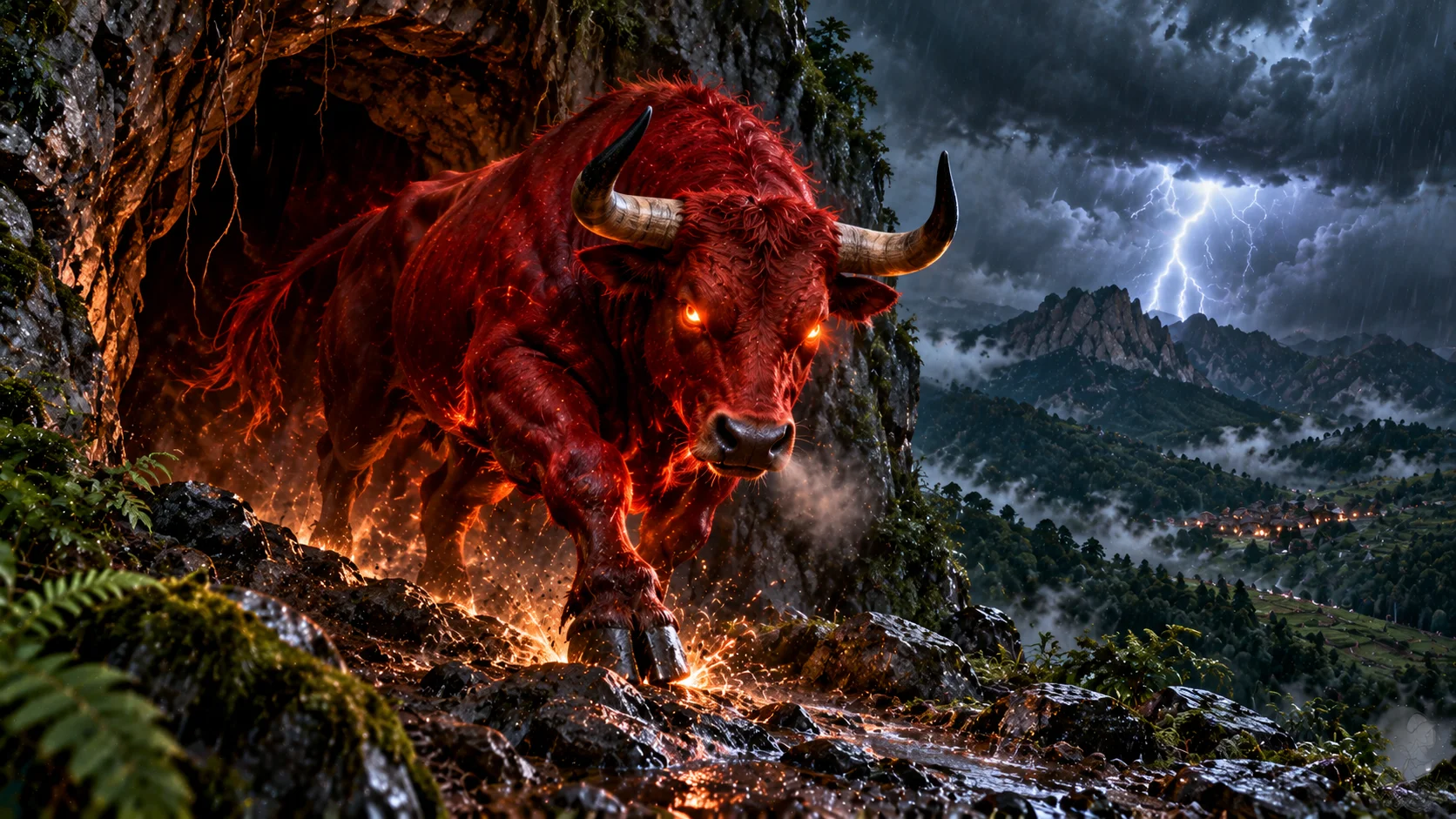
The drangue's enemy, and the reason for his existence, is the kulshedra, a monstrous serpent-dragon of many heads, the bringer of drought and devouring flood in equal measure. In some tellings the kulshedra does not begin as the terror she becomes: she is said to start life as a lesser dragon-serpent, a bolla, coiled and hidden, and only after passing a set span of years unseen by any human eye does she transform into the full kulshedra, swollen with power and menace. This slow escalation raises the stakes of the drangue's watch. He is not merely fighting a fixed monster; he is standing guard against a danger that grows more terrible the longer it goes unchallenged, a threat that punishes a community's inattention as surely as it punishes drought itself.
War Fought in the Storm-Clouds
When the kulshedra rises to bring ruin upon the land, the drangue meets her not on open ground but in the sky itself, amid the gathering thunderheads. There, in the heart of the storm, he takes up whatever weapon comes to hand: an uprooted tree torn free by its roots, a boulder wrenched from a mountainside, the broken beams and stones of a watermill. These he hurls against the serpent with a strength no mortal frame could match. The Albanian highlander looking up at a thunderstorm was, in this belief, watching that very battle unfold above the fields: the crack of thunder was read as the sound of the drangue's blows landing, and the flash of lightning as the weapons themselves, meteoric and blinding, crossing the dark sky between hero and monster.
Stones Flung and Left Behind
The battle was said to leave its evidence on the land long after the storm had passed. Unusual boulders, oddly placed rocks, and strange formations scattered across the highland terrain were pointed to as the very stones and missiles the drangue had hurled at the kulshedra, fallen short of their mark or flung wide in the chaos of the fight. In this way, the myth did double service: it explained the violence of the thunderstorm overhead and, in the quieter light of morning, it explained the landscape itself, giving the ordinary stones underfoot a place in a cosmic story of guardianship and combat.
Not One Hero but a Kind of Man
It would be a mistake to picture the drangue as a single, solitary figure, the way a saint or a named epic king might stand alone in memory. The tradition speaks as often of drangues in the plural, of a village or a whole region said to have several such men born among its people in a given generation, a class of beings scattered through the population rather than concentrated in one hero. In this understanding, "drangue" names a category of person as much as it names an individual: any child born with the caul and the hidden wings might grow to be one, and a community might reckon itself fortunate to count more than one drangue among its sons in a single age. Elsewhere, particularly within the epic ballad cycles of the highland tradition, individual drangue are named and given the stature of singular heroes. Both pictures exist side by side in the record, and which one a given telling favors seems to depend on where, and by whom, the story was kept.
Kin to the Mountain Nymphs
In some regional tellings the drangue does not stand entirely alone even within his own kind. He is said, in certain areas, to be aided or accompanied by the Zana, the mountain nymph or fairy figures who move through the same highland cosmology as protective spirits. This pairing of drangue and Zana is looser than his opposition to the kulshedra, and far less fixed across the tradition as a whole; it should be understood as a variant found in particular districts rather than a bond every teller of the story would recognize. Where it does appear, it deepens the sense of the drangue as one figure among a wider company of supernatural guardians watching over the highland world, rather than as a hero operating in complete isolation.
Guardian of the Fields and the Rain
Beneath the thunder and the flung stones lies a plainer, more urgent stake: the harvest itself. The kulshedra's power is bound up with drought and with devastating flood, the two extremes that could ruin a highland community's year in a single season. The drangue's war against her is therefore never fought for its own sake or for glory alone; it is fought so that rain will fall in its season and not in its fury, so that the crops in the field will neither wither nor drown. Every crack of thunder that rolled over the fields carried, in this belief, the sound of a hero laboring on behalf of people who could only watch the sky and wait for the outcome.
Names the Storm Has Answered To
The figure is not recorded under a single fixed spelling. Drangue, Dragua, and Drangoni all appear across the tradition as variant forms of the same being, and certain descriptive epithets tying him to fire and storm imagery are attested as well. Scholars remain divided on where the name itself comes from. Some propose a link to the Latin draco, arriving through contact with Balkan Romance speech; others argue for a native Illyrian-Albanian substrate origin, independent of any borrowing. No consensus has settled the question, and Albanian folklorists working in the tradition surveyed by Robert Elsie have generally preferred to treat the drangue as a distinct native figure in his own right, rather than as a simple local equivalent of the wider Balkan and South Slavic dragon-word family, whatever the deeper roots of the name may eventually prove to be.
A Figure of the Old Highland Sky
The drangue does not stand alone in the cosmology recorded from the northern Albanian highlands. He belongs beside the Zana, the Ora, the Shtriga, and E Bukura e Dheut among the beings collected by nineteenth- and twentieth-century folklorists working the Malësi districts, part of a pre-Christian substratum of belief that persisted, often quietly, alongside Albanian Christian and Muslim practice rather than being erased by it. This world was most densely remembered and elaborated in the north, in Malësia e Madhe and Dukagjin, where the long epic-ballad tradition known as the kângë kreshnikësh gave heroes like the drangue room to grow into named, individual figures. Further south, among Tosk-speaking communities, the same figure is attested far more thinly, a difference that seems to follow the strength of the epic tradition itself rather than any absence of belief.
What the Record Leaves Unsettled
Honest telling requires admitting what remains uncertain. Whether the drangue is best understood as a fully individualized epic hero, the way certain highland ballad cycles present him, or as a general type of supernaturally born defender that could be embodied by many men across many villages, is presented inconsistently from source to source, and the surviving material does not resolve the question cleanly. There is also a real possibility, raised by those who have studied how these folklore collections were assembled, that twentieth-century compilers harmonized what were once regionally distinct storm-hero figures under the single convenient label of drangue, which would mean the true degree of local variation in the belief is understated in the secondary summaries most readers now rely upon. These are not small footnotes; they shape how confidently any single portrait of the drangue can be drawn.
The Bright Champion at the Heart of the Storm
Across all its variation, the drangue endures as Albanian tradition's answer to a question every farming community under a highland sky has had to ask: what stands between us and the storm that could destroy everything we have grown. The tellers of this tradition gave that answer a winged, thunder-wielding shape, born marked from the womb, fighting an enemy that grows more dangerous the longer it goes unwatched, sometimes standing as one hero and sometimes as many, sometimes aided by the mountain nymphs and sometimes fighting entirely alone. Albanian folklorists have long pointed to the drangue-kulshedra combat as a native elaboration of the storm-versus-chaos pattern found across Indo-European dragon-slayer traditions, and the drangue continues to be invoked in modern Albanian cultural memory as an emblem of heroic defense of the homeland, a guardian whose war in the clouds still explains, for those who listen to the old telling, why the thunder rolls the way it does.
Sources & traditions
- EncyclopediaWikipedia — Drangue
- TraditionAlbanian folk and village traditions
Myths change from area to area and from time to time. This chronicle follows the most widely told versions; tellings in other villages, regions and eras may differ.