The Zana, plural Zanat, are the mountain spirits of Albanian folk belief — beautiful, fierce, semi-divine women who dwell among the high peaks, the deep forests, and the cold mountain springs of the Albanian highlands. Warlike where other fairy-traditions are gentle, generous to the worthy and merciless to the trespasser, the Zana occupy a singular place in Albanian oral culture: part huntress, part guardian of wild nature, part patroness of the frontier heroes whose songs carried her name down through centuries of unwritten tradition.
Daughters of the High Rock
The Zana belong first and foremost to the mountains. Albanian highland communities named specific peaks, cliffs, and rock formations as haunts of the Zana — places where a Zana was said to have been seen, or to still dwell, or to have left some mark on the stone. This was not vague poetic association but a working feature of local geography: a given crag or ridge carried the Zana's name and reputation in the same way a village might carry the name of a saint or a battle. To live in the highlands was to live within a landscape already populated by these beings, whose presence was assumed rather than debated.
Springs Where the Water Remembers
Alongside the peaks, mountain springs held a special charge as Zana-dwellings. A spring believed to belong to a Zana was treated with a wary respect that shaded into outright taboo observance — not fouled, not disturbed carelessly, sometimes approached with a kind of ritual caution appropriate to entering a space that was not fully human territory. This connects the Zana to a very old and very widespread instinct: that flowing, spring-fed water is a threshold, and the beings who guard such thresholds are owed courtesy. In the Albanian highlands, that courtesy was owed specifically to the Zana.
The Huntress Armed
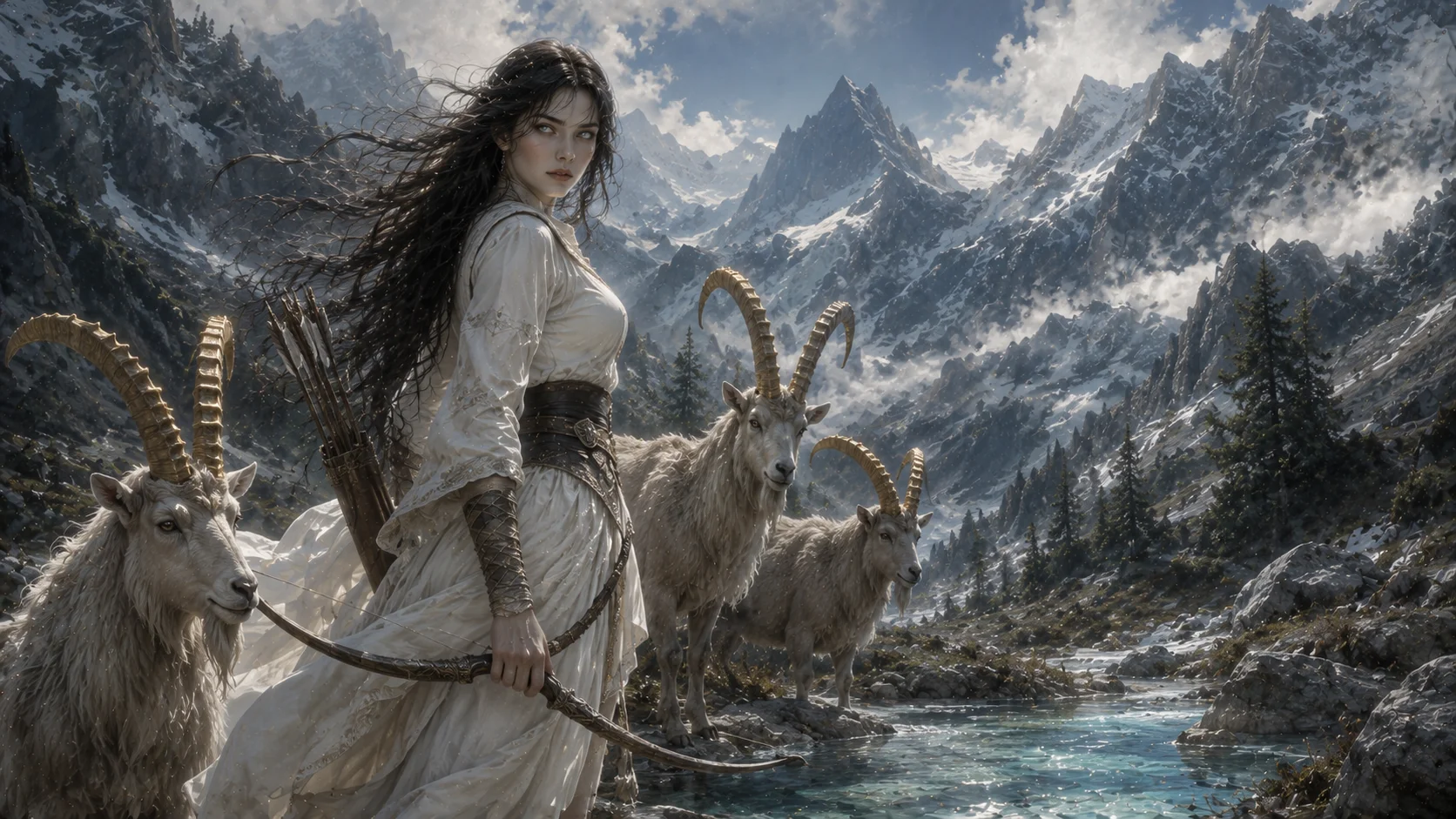
Where many nymph-like beings in European folklore are imagined as delicate or passive, the Zana were remembered as armed and martial. Folk description gave them bows and spears, wild and untamed hair, a huntress's bearing rather than a courtly one. They were not decorative spirits of the woods but active forces within it — capable of granting extraordinary strength and battle-prowess to mortals they favored, and equally capable of turning that same ferocity against anyone who wronged them. This dual capacity, to bless with might or to punish with ruin, is the defining tension of everything told about the Zana.
The Milk That Made a Hero Mighty
The most celebrated Zana narrative belongs to the great Albanian oral epic cycle known as the kângë kreshnikësh, the Songs of the Frontier Warriors. Within this cycle, the hero Mujo (Muji) is described as having been nursed — given milk — by a Zana in his youth, and it is this nursing that grants him his exceptional, larger-than-life strength. The motif recurs across the wider tradition: a Zana's milk, or a Zana's direct intervention, marking out certain heroes as more than ordinary men. It is a striking image, tender and supernatural at once, and it sits at the very center of how the Albanian highlands imagined the origin of heroic power — not earned by training alone, but granted by a spirit of the mountains themselves.
Patronesses of the Frontier Songs
Beyond Mujo, the Zana appear throughout the kângë kreshnikësh as recurring supernatural figures bound up with the highland warrior-heroes more broadly. Sometimes they act as combat allies, lending aid in the heat of battle; sometimes they appear instead as tempters or tricksters, figures the hero must appease, outwit, or satisfy according to some unspoken code before their favor can be won. This double register — helper and hazard within the same figure — kept the Zana from ever becoming a simple, one-note blessing. A hero's relationship with a Zana was always a live negotiation, not a guarantee.
A Name No Single Word Holds
Even the question of what to call the Zana in English resists a clean answer. Translators and scholars have rendered them as "fairies," as "nymphs," and as minor "goddesses," and each choice captures something real while leaving something out. "Fairy" carries the right sense of a being tied to a specific wild place and treated with folk caution, but risks the diminutive, whimsical connotations that English has attached to fairies through centuries of children's literature — connotations that sit badly on a figure armed with a bow and capable of nursing a hero into a warrior of legendary strength. "Nymph" better conveys the Zana's deep attachment to a particular spring, peak, or grove, echoing the classical association with Diana that linguists trace in the name itself, but it can understate the Zana's moral seriousness — her role as an active guardian of fate, not merely a decorative genius loci. "Goddess" gestures at her power to bless or to punish and her possible pre-Christian, syncretized-with-Diana origins, but overstates a cult status the Zana never had: no temple, no priesthood, no formal worship survives in the record. No single English term captures the category precisely, and the honest response is to hold all three in mind at once rather than force the Zana into whichever word happens to translate most smoothly.
A Question the Old Songs Leave Open
Scholars of Albanian folklore have long debated the relationship between the Zana and the Ora, another class of female spirit tied to fate, destiny, and the guardianship of particular natural sites or particular individuals. Some regional traditions appear to treat Ora and Zana as the same class of being under different local names; others hold them apart as genuinely distinct spirit-types with overlapping but not identical roles. Robert Elsie's dictionary of Albanian mythology addresses this uncertainty directly, and it remains, honestly, unsettled — a case where the oral tradition itself was never uniform enough to yield one tidy answer, and where forcing one would misrepresent the material.
The Name That Crossed from Diana
Linguists widely connect the name "Zana" to the Latin Diana, goddess of the wild, the moon, and the hunt, by way of a Vulgar Latin or Balkan Romance intermediate form. The comparison is strengthened by the Romanian word zână, meaning fairy, drawn from the very same root — a parallel development on the other side of the Balkans that points to a shared Roman-era layer beneath both traditions. This derivation reflects the long centuries of contact between Roman civilization and the peoples of what is now Albania, and it is broadly accepted among Balkan folklorists, even where the precise path of transmission from Latin cult to highland fairy-belief remains a matter of scholarly reconstruction rather than settled fact.
Guardians of More Than the Wild
The Zana's role was never purely ecological. Alongside their function as personifications of untamed mountain nature, they carried a second, overlapping duty as guardians of fate and destiny for particular families or individuals — a responsibility that shades directly into the Ora's own domain. This is part of why the two figures are so difficult to fully separate: a Zana watching over a household's fortune and an Ora doing the same work look, from the outside, very much alike. What stayed constant was the expectation that their domain — certain springs, certain rocks, certain groves — be left undisturbed, a folk taboo observed as a practical matter of highland life rather than an abstract belief.
Kin Beauties of Earth and Sea
The broader Albanian supernatural landscape includes other fairy-like female figures sometimes grouped loosely alongside the Zana in the popular imagination — most notably E Bukura e Dheut, the Beauty of the Earth, and E Bukura e Detit, the Beauty of the Sea. These are distinct, separately named figures in their own right, not alternate names for the Zana, and the tradition is careful to keep them apart even as it recognizes a family resemblance among Albania's supernatural women. Treating them as interchangeable would flatten a folklore that in fact preserved fairly specific distinctions between its different classes of spirit.
A Belief Without a Statue
Unlike the Roman Diana she is linguistically descended from, the Zana never received a fixed cult image or a formal iconographic tradition. Albanian mountain-spirit belief remained oral and non-institutional throughout its recorded history — no temple, no carved likeness, no priesthood. What survives instead is a consistent verbal picture, repeated across tellings: extraordinary female beauty paired with martial equipment and wild, unbound hair and dress, the huntress archetype rendered entirely in words and memory rather than in stone.
What the Field Collectors Found, and What Came After
Albanian ethnographers point to the Zana as evidence of a nature-spirit belief system that predates Christianity, likely rooted in a pre-Roman, Illyrian-substrate tradition that later syncretized with Roman religious influence carried in through the figure of Diana. This belief persisted in highland oral culture into the nineteenth and twentieth centuries, when folklorists first began systematically recording it. It is worth being precise about layering here: the older, earlier-collected field material is not always identical to later literary or touristic retellings, which have sometimes romanticized or embellished the Zana well beyond what the earliest ethnographic collections actually record. Distinguishing the two requires care, and the caution is worth stating plainly rather than smoothing over.
Living On in a Name
The clearest sign that the Zana never became a merely historical curiosity is that her name is still given to Albanian girls today, a small but telling continuity between the old belief and present-day culture. A figure who was once invoked to explain the strength of epic heroes and the danger of certain springs now also lives quietly as a common given name — a reminder that the positive resonance of the Zana, her beauty and her fierce protectiveness, outlasted the world of taboo springs and hidden mountain cradles that first gave her shape. Fierce, generous, dangerous, and enduring, the Zana remains one of the most distinctive figures the Albanian highlands ever gave to the wider store of European fairy tradition.
Sources & traditions
- EncyclopediaWikipedia — Zana (mythology)
- TraditionAlbanian folk and village traditions
Myths change from area to area and from time to time. This chronicle follows the most widely told versions; tellings in other villages, regions and eras may differ.