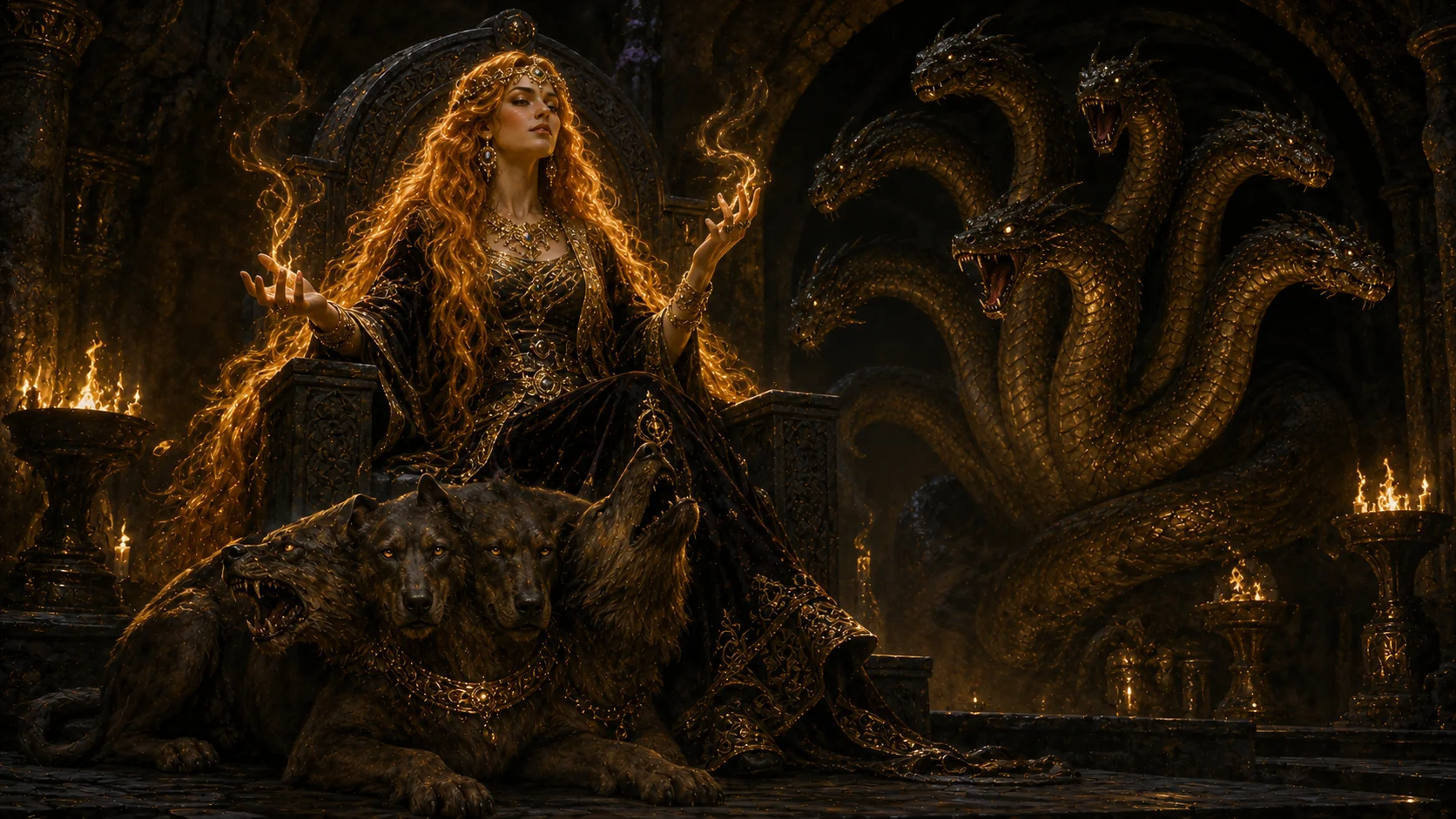
E Bukura e Dheut, "the Beauty of the Earth," is one of the most cherished otherworldly maidens of Albanian oral folklore, a figure who belongs to a set of personified "Beauties" — alongside E Bukura e Detit, the Beauty of the Sea, and E Bukura e Qiellit, the Beauty of the Sky — who together populate the përralla, the fairy-tales, collected across northern and central Albania and Kosovo. She is not a figure of cultic ritual or of any fixed religious text; she lives instead in the oral tradition itself, carried mouth to mouth for generations before nineteenth- and twentieth-century folklorists began writing her stories down, which means the exact age of her character cannot be pinned to a date — only that the tales are older than their earliest transcriptions.
A Name That Is Also a Destiny
In Albanian storytelling convention, a name often is the character's whole nature, and Bukuria e Dheut carries hers plainly: she is beauty itself, and she is of the earth. Where her sister figure of the sky commands radiance and her sister of the sea commands the water's danger and allure, E Bukura e Dheut's domain is the ground beneath the world — hidden, chthonic, subterranean. Her epithet marks her as fundamentally different from a simple mortal heroine; she belongs to a realm that a person cannot merely walk into, but must earn passage to, often through trial, riddle, or descent into a place beneath the visible earth.
The Hidden Realm Beneath
Across the tales in which she appears, E Bukura e Dheut is consistently located somewhere hard to reach: an underworld, a remote enchanted country, a hidden land beneath the earth's surface, sealed off from the ordinary world by distance, danger, or magic. This placement is not incidental description but the very engine of her stories — she cannot be encountered by accident. A hero must go looking, must cross into a world that does not behave like his own, before he can so much as lay eyes on her. In this she stands in contrast to her sky- and sea-associated sisters, whose realms are at least visible from the world above; hers must be sought out and uncovered.
The Quest That Defines Her
The great majority of her surviving narratives take the shape of a quest. A young hero — very often a prince, and, in keeping with a structural pattern common across Albanian and wider Balkan folk-tale tradition, frequently the youngest of three brothers — sets out to find her, to win her hand, or to free her from captivity. The trials he must pass along the way are the substance of the tale: journeys into darkness, tests of cunning or courage, encounters with beings who could destroy him. This narrative shape is not unique to her alone; it echoes the wider Balkan and European motif of the quest for the otherworldly bride, familiar from tale-types recorded across South Slavic and Greek folk traditions as well. What distinguishes E Bukura e Dheut's version of the story is the specifically earthly, buried character of the realm the hero must penetrate to reach her.
A Beauty Beyond the Measure of Mortals
The tales describe her loveliness in the hyperbolic register that Balkan oral narrative reserves for otherworldly heroines — beauty so complete that it is said to outshine any mortal woman, beauty vivid enough, in some tellings, to light up dark places. This is a stock convention of the storytelling tradition rather than a claim unique to her alone, shared with other supernatural heroines of the region's folk imagination, but it is applied to her with particular intensity: she is not merely admired, she is sought at the cost of great danger precisely because her beauty is understood to be beyond the ordinary world's power to produce.
Kinship With the Zana and the Wider Supernatural World
E Bukura e Dheut does not stand alone in her stories. In a number of recorded variants she is accompanied, guarded, or assisted by magical helpers and obstacles, and she is sometimes associated with or numbered among the zana, the fairy-women of the Albanian mountains and wild places. Her world is the same populated supernatural landscape that gives Albanian hero-tales their texture more broadly — a landscape shared with the ora, the spirits said to preside over fate and the length of a person's life, and with the dragon-beings of the tradition, the kulshedra and the dragoi, who appear elsewhere in the corpus as monstrous adversaries. She belongs, in other words, not to an isolated legend but to an entire living ecosystem of Albanian folk belief in which fairies, fate-spirits, and dragons all have their place alongside her.
Neither Only Prize Nor Only Peril
It would be a simplification to describe her purely as a passive goal awaiting rescue. Across the variant tellings that folklorists have gathered, she is also entangled with magic in her own right — attended by supernatural helpers, protected by obstacles that are themselves marvels, situated at the center of a world where enchantment is the ordinary condition rather than the exception. The hero does not simply walk in and claim her; the realm itself tests him, and she is inseparable from the dangers and wonders that guard the approach to her.
One Story Among Many, Never a Single Canon
It is important to hold clearly in mind that there is no single, authoritative version of E Bukura e Dheut's story. As with oral folklore generally, different regions and different collectors recorded different variants — the identity of the hero changes, the trials he faces change, the resolution changes from telling to telling. Any specific plot summary of her tale should be understood as one attested variant selected from several, not a canonical or definitive narrative that supersedes the others. This variability is not a flaw in the record; it is the ordinary condition of a story that lived for centuries in spoken retelling before anyone wrote it down.
The Triad of Earth, Sea, and Sky
Considered together, E Bukura e Dheut, E Bukura e Detit, and E Bukura e Qiellit form a recognized structuring device within Albanian folk-narrative scholarship: a triadic set of elemental female beauties, each governing a different register of the world and a different symbolic charge. E Bukura e Dheut, as the earth's own beauty, has been read by folklorists as a personification of the ground's abundance and fertility in the folk imagination — set against E Bukura e Detit's association with the sea's danger and allure, and E Bukura e Qiellit's association with celestial radiance. This threefold division is a pattern folklorists have identified by comparing the surviving tales against one another, a structuring device recognized in the scholarship on Albanian oral narrative rather than a doctrine stated outright within any single tale.
A Disputed Echo of an Older Cosmology
Some comparative folklorists have gone further and proposed, as a scholarly hypothesis rather than an established fact, that this triad of Earth, Sea, and Sky beauties might echo a much older tripartite division of the cosmos in pre-Christian Balkan or Illyrian thought — comparable to other tripartite divisions of realms or goddesses found elsewhere in Indo-European tradition. This idea belongs squarely to the domain of interpretive comparative mythology. It is explicitly disputed and unproven, offered as a possibility for how an ancient cosmological structure might survive, transformed, inside a much later body of fairy-tale material — not as a claim that the tales themselves preserve a doctrine their tellers consciously knew.
An Unproven Pairing With the Sky-God
A further point of caution belongs here. No surviving tale attests a direct mythic union between E Bukura e Dheut and Zojz, the sky-god figure of Albanian tradition, as a single documented narrative episode. Where modern comparative mythology has suggested a pairing between a sky-god and an earth-beauty on thematic grounds — sky answering to earth — that suggestion is an inference drawn from the shared domains the two figures occupy, not a story that has actually been recorded. It should be understood plainly as speculative, a modern scholarly proposal rather than an inherited piece of the tradition itself.
Carried Into International Memory
The tales in which E Bukura e Dheut appears form part of a broader Albanian oral epic and fairy-tale tradition, preserved through collections made by Albanian folklorists in the late Ottoman period and into the early twentieth century. Later scholars, most notably Robert Elsie, compiled and translated a significant portion of this material into English, becoming a primary conduit through which the wider Balkan-studies world encountered these stories. Through this work, the Beauty of the Earth — once known only to the oral tradition of specific villages and regions — has become legible to readers far outside the language and landscape that first told her stories.
The Unattainable Bride of a Wider Region
Set against the broader canvas of Balkan and southeastern European folk narrative, E Bukura e Dheut's role — a hidden, supremely beautiful bride figure reachable only through hardship — situates her within a motif shared well beyond Albania: the unattainable earthly paradise or bride, found in comparable form in South Slavic and Greek folk tales alike. This kinship points to a shared regional substrate of storytelling rather than to any single point of origin, and it is part of what makes her figure recognizable as belonging to a living, connected tradition rather than a wholly isolated invention. She endures in that tradition as the earth's own beauty, sought after and never simply given, the hidden heart of a story still told in more than one voice.
Sources & traditions
- EncyclopediaWikipedia — E Bukura e Dheut
- TraditionAlbanian folk and village traditions
Myths change from area to area and from time to time. This chronicle follows the most widely told versions; tellings in other villages, regions and eras may differ.