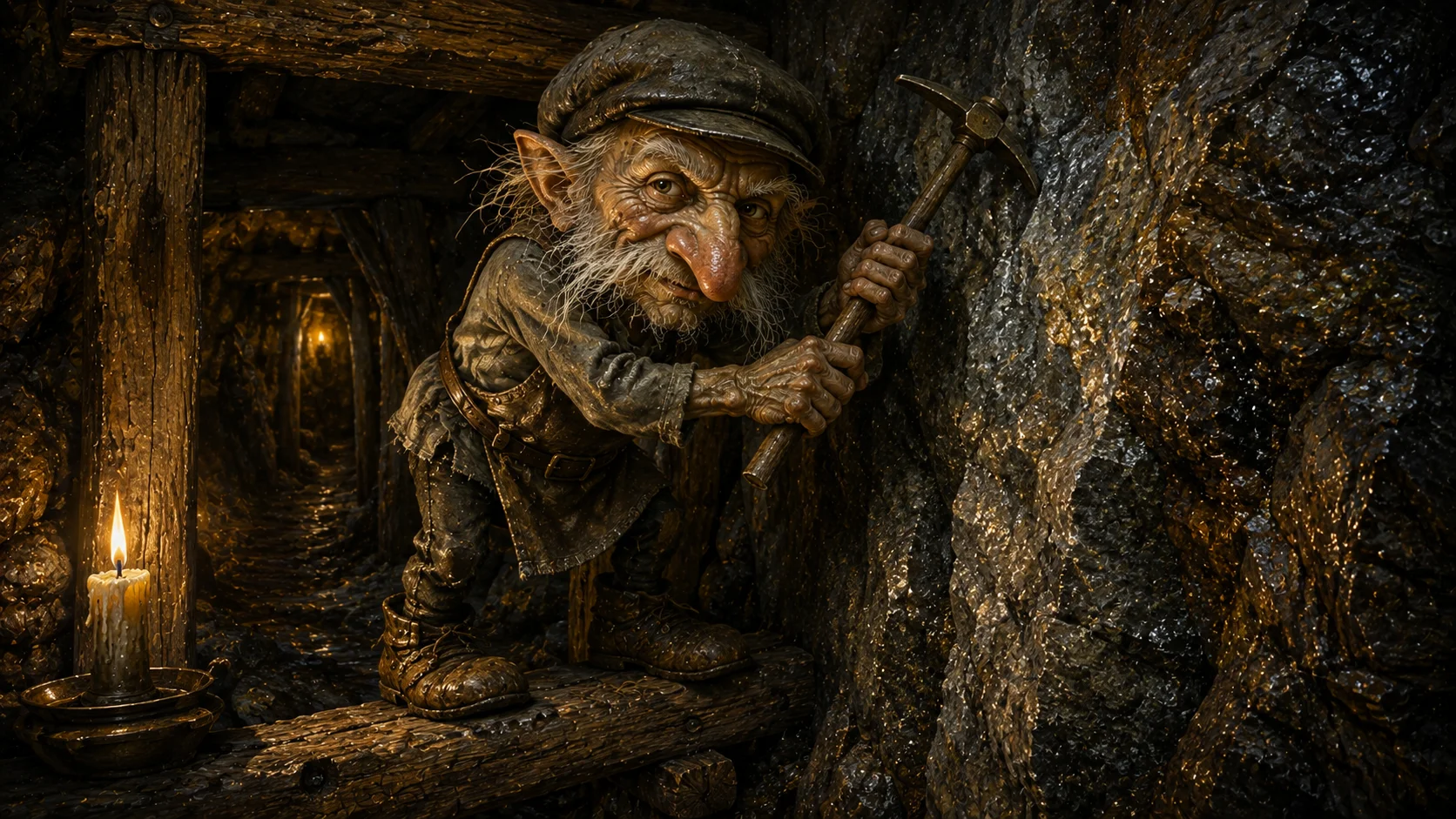
The Knocker (knacker, bucca) is the mine-spirit of Cornish folklore — the small, ugly fairy-being who dwells deep in the tin and copper mines of Cornwall, whose knocking sounds in the rock warned (or guided) the miners, and who could bring fortune or doom to those who labored in the dark beneath the earth. A spirit of the perilous depths, both feared and befriended by the Cornish tin-miners, the Knocker is the fairy of the mine.
The Little People of the Mine
The Knockers (so called from the knocking sounds heard in the mines) are small, gnome-like beings, often described as ugly, with large heads and wizened faces, the size of a small child, dwelling in the deep workings of the Cornish mines. They were heard, in the dark and dangerous tunnels, by their knocking — tapping and rapping sounds in the rock. The miners’ relationship with the Knockers was a careful one: the knocking was widely understood as a warning, for the Knockers knocked loudest where the richest lodes of tin and copper lay (leading miners to good ore), but also where the rock was about to collapse (warning of cave-ins). To heed the Knockers was to be safe and prosperous; to anger or mock them was to court disaster.
Friends or Foes Beneath the Earth
The Cornish miners treated the Knockers with respect and even affection. They were believed to be helpful to those who honored them — leading them to ore, warning them of danger — and the miners would leave a portion of their food (a bit of their pasty) for the Knockers as an offering, and were careful never to whistle, swear, or make the sign of the cross in the mine (which offended the spirits). But the Knockers could be malicious to the disrespectful, leading them astray, hiding their tools, or worse. Whether they were the ghosts of dead miners, ancient fairy-folk, or the spirits of the earth itself, the Knockers were a real and present part of the dangerous world of the Cornish mine, the unseen companions of the men who toiled in the dark.
The Spirits Who Crossed the Sea
The belief in the Knockers traveled with the Cornish miners across the world — especially to the mines of America (where they became the “Tommyknockers”), carried by the great Cornish mining diaspora. Wherever Cornish miners went, the Knockers went with them, and the tradition of the helpful, warning, food-offered mine-spirit spread to the mining communities of the New World. The Knockers belong to the worldwide family of mine- and earth-spirits (kin to the German Kobold, from which “cobalt” takes its name), the supernatural denizens of the perilous underground that miners everywhere have sensed at their side.
Legacy
The Knocker endures as the mine-spirit of Cornish folklore — the small, ugly fairy of the tin-mines whose knocking warned of cave-ins and guided miners to ore, both feared and befriended by the men of the Cornish deeps. In it the mining communities of Cornwall gave form to the dangers and the mysteries of the underground, and to the unseen companions of their perilous trade. Carried across the sea to become the Tommyknockers of America, the Knocker remains a vivid figure of mining folklore, the fairy of the dark beneath the earth.
Origins in the Written Record
Very little of the Knocker belief reached print before the nineteenth century, and by the time collectors arrived it was already old enough that miners could not say where it began — only that their fathers and grandfathers had heard the same tapping in the same seams. Two men preserved most of what survives. Robert Hunt, whose Popular Romances of the West of England appeared in 1865, and William Bottrell, whose Traditions and Hearthside Stories of West Cornwall came out in 1870 and 1873, took their accounts from working miners and their families — men who spoke of the Knockers not as quaint fireside colour but as a working fact of the pit, on a level with bad air and falling ground and the price of tin. Bottrell’s second series carries a tale titled simply The Knockers of Ballowal, set at a real and famously ancient working near St Just. What both men wrote down was already, by their own telling, in decline: the old hands were dying, the trade was contracting, and the belief that had guided generations of Cornishmen underground survived chiefly because two Victorian collectors thought it worth recording before it went silent.
Bucca and the Wider Cornish Spirit-World
A Cornish fisherman, setting out before dawn, would once leave a portion of his catch on the sand for a power he did not name lightly. The Knocker was never an invention of the tin lodes alone — it belongs to a much older Cornish habit of striking bargains with the unseen, chief among them Bucca, the spirit to whom that fish was owed. At Newlyn and Mousehole the practice was to leave fish on the sand at night; elsewhere a few crumbs, or a drop of beer thrown back over the shoulder, served the same purpose. Some accounts distinguish a Bucca Gwidden, the white or good Bucca, from a Bucca Dhu, the black one — a benevolent and a malicious face of the same power, propitiated so that the sea would give rather than take. The logic is identical to the miner leaving a corner of his pasty in the dark: a Cornishman at the edge of a hostile element, whether the tide or the tunnel, kept faith with something that could either provide for him or destroy him, and the price of provision was always the same — a portion given up freely, and proper respect shown to what could not be seen.
The Legend of the Jews of the Tin Mines
Ask a nineteenth-century Cornish miner what the Knockers actually were, and some would give an answer stranger than the haunting itself. Hunt recorded a legend, current among the miners of his day, that the Knockers were the spirits of Jews condemned for their part in the Crucifixion and sent by the Romans to labour in the Cornish tin mines. Miners who held to it said the Knockers were never heard on a Saturday, nor during the Jewish holy days. A second strand of the same belief made them the ghosts of Jews who had worked the mines in the eleventh and twelfth centuries. The legend attached itself to real features of the landscape: ancient smelting remains, far older than any working then in memory, were locally called “Jews’ houses,” and blocks of tin recovered from them “Jews’ tin,” taken as physical proof that the story was true.
There is no historical foundation for it. Jews were expelled from England in 1290, and the structures in question are now understood as the remains of medieval blowing houses — the small stone furnaces in which Devon and Cornish tin was smelted — whose real builders had simply been forgotten by the time anyone thought to name them. What the legend actually preserves is an aetiology: an origin story fitted, after the fact, to a belief that already existed and needed accounting for. It is worth recording plainly, and with the distance it deserves, because it shaped what miners believed they knew about the beings sharing their dark, and because folklore that explains itself wrongly is still folklore, and still tells you what a community was afraid of. Notably, this was one part of the tradition that did not survive emigration: the Jewish attribution had no purchase in the American West and was left behind in Cornwall.
The Coblynau of the Welsh Mines
Cross the Bristol Channel into the mining country of Wales and the tapping in the rock has a different name and a gentler temper. The Coblynau, described by the American writer Wirt Sikes in his 1880 survey British Goblins, are gnome-like mine-dwellers about half a yard high, in Sikes’s account very ugly to look upon but extremely good-natured, and warm friends of the miner. They point out rich veins of ore by a peculiar knocking or rapping; their dress is a grotesque imitation of the miner’s own working clothes, and they carry tiny hammers, picks and lamps. Sikes’s most striking detail is their industry: they load ore into buckets, flit about the shafts, turn miniature windlasses and pound away like madmen while accomplishing nothing whatever. Where the Cornish Knocker could turn genuinely dangerous to the disrespectful, the Coblynau were held to be essentially harmless. The two traditions are close enough kin that a stranger might mistake one for the other — both gnomic, both fond of the same knock, both said to mark good ore — and different enough that a Cornish miner and a Welsh one, meeting at the same face, would have sworn they served two different masters underground.
Cousin Jacks and the Tommyknockers of America
When the Cornish copper and tin lodes began to fail in the second half of the nineteenth century, the men who had worked them did not simply lose their trade — they exported it. An estimated quarter of a million Cornish people emigrated between 1841 and 1901, and so many of them turned up in the world’s hard-rock mining districts asking after work for “my cousin Jack” that the nickname stuck to them as a people: Cousin Jacks, their wives and daughters known as Cousin Jennys. They went to the copper country of Michigan’s Keweenaw Peninsula, to California’s goldfields and Nevada’s Comstock Lode, to the silver camps of Colorado and the copper pits of Butte, Montana. Because Cornishmen had spent generations perfecting deep hard-rock work — underground extraction, timbering, steam pumping — they were frequently the men put in charge of sinking the deepest and most dangerous shafts on the continent.
They brought their tools, their vocabulary and their Knockers, renamed Tommyknockers in the American diggings. The old bargain travelled with them largely intact, and it outgrew them: the belief spread to miners who had never set foot in Cornwall, and shifted in the crossing, absorbing an American conviction that men killed underground could themselves become Tommyknockers. Not every ghost was a Tommyknocker and not every Tommyknocker was a ghost, but in the western camps the two ideas were never again cleanly separated.
Why the Knocking Persists
Mining is among the oldest and most consistently lethal of human trades, and for most of its history a man went down into it with no way of knowing which of the ordinary sounds of a working mine — timber settling, water finding a new course, another gang working an adjoining seam, rock itself groaning under new pressure as a face is cut into it — might be the one that meant the roof above him was about to come down. The Knocker gave that unbearable uncertainty a mind and a code. A collapse was no longer pure chance; it was something that could, in principle, be averted by decent conduct. That is a more survivable belief to carry into a mile of dark tunnel than the true one, which is that the rock does not know or care who is respectful.
The belief has outlasted the industry that produced it. Geevor closed in 1990 and is now a museum; South Crofty, the last working tin mine in Cornwall, stopped in 1998, and the Knockers have gone on being talked about in a county with no tin coming out of the ground. In 1987 Stephen King took the American name for the title of his novel The Tommyknockers, building it on a rhyme he said he had heard as a child — “Late last night and the night before, Tommyknockers, Tommyknockers, knocking at the door” — to which he added a verse of his own. The mines that made the Knockers are worked out. The habit of listening for something in the dark that means to warn you, or worse, was never really about tin at all.
Sources & traditions
- EncyclopediaWikipedia — Knocker (folklore)
- TraditionCornish folk and village traditions (England)
Myths change from area to area and from time to time. This chronicle follows the most widely told versions; tellings in other villages, regions and eras may differ.