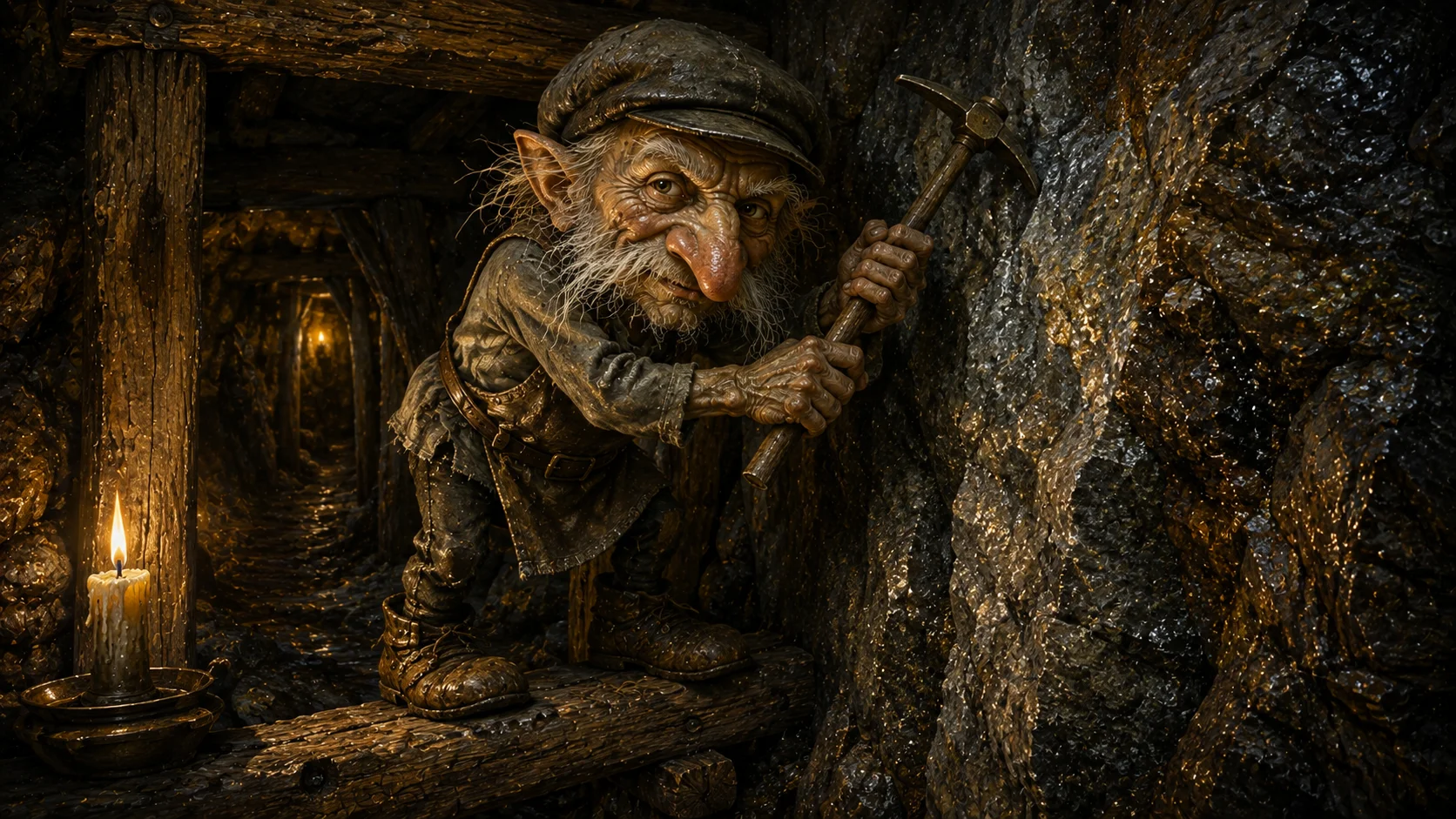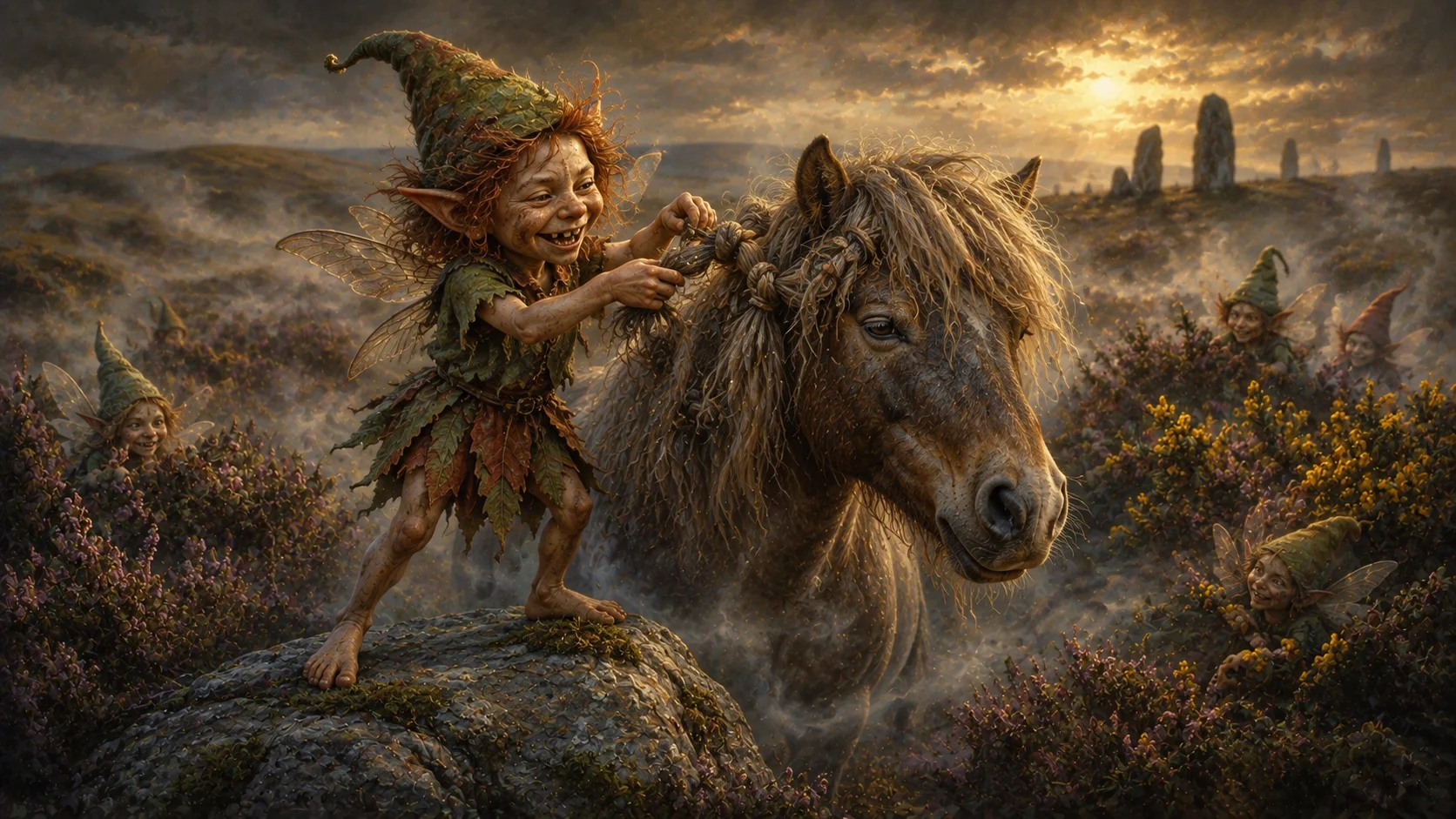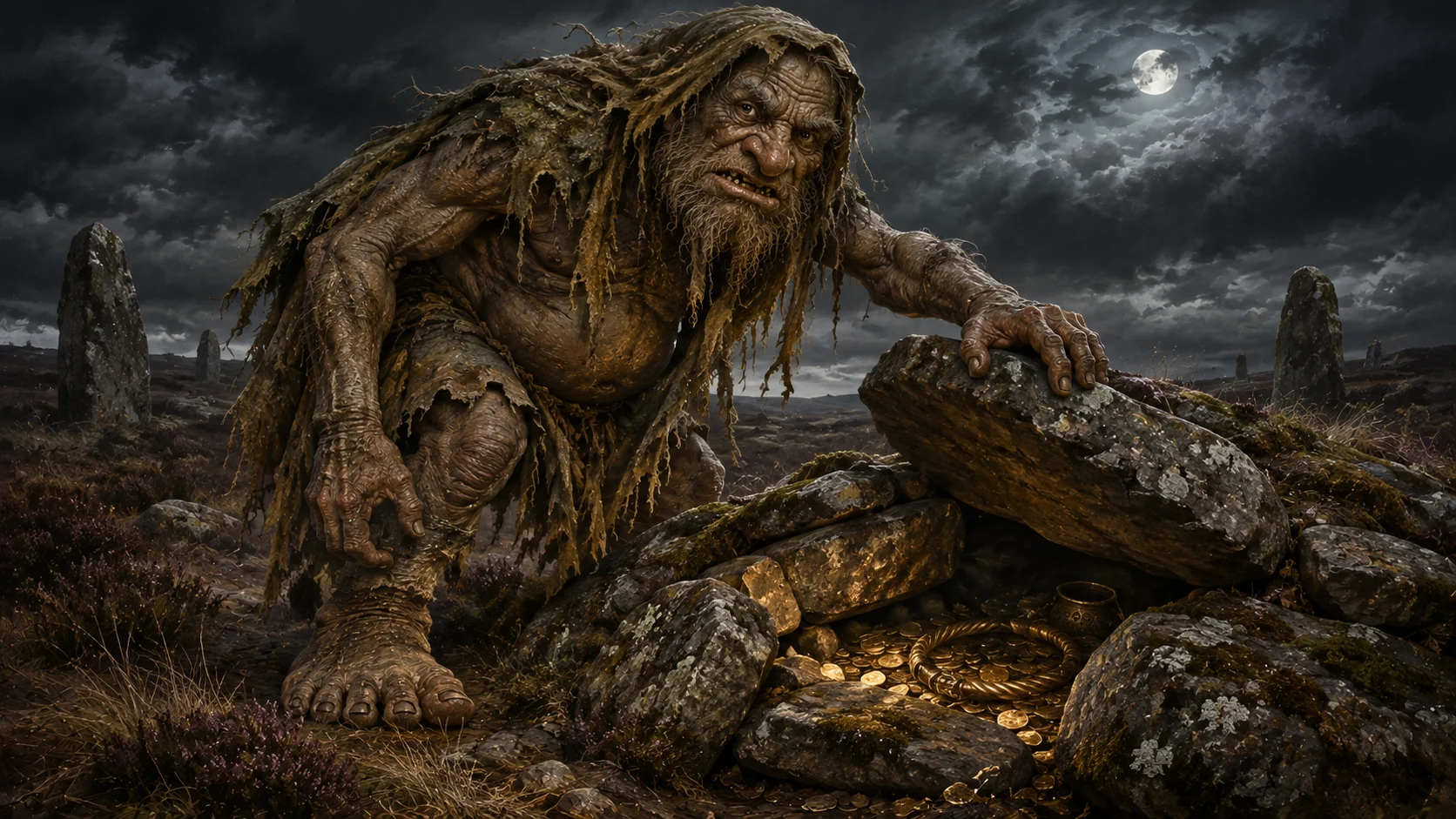
The Spriggan is the ugly, dangerous guardian-fairy of Cornish folklore — a grotesque, sour-faced sprite, the guardian of treasure, ancient barrows, and standing stones, a bringer of storms and misfortune, and a thief of children. Able to swell from a small size to a monstrous, giant bulk, the Spriggan is among the most feared of the Cornish fairy-folk, and among the most distinctly tied to a single stretch of ground: the wind-scoured moors and coastline of West Cornwall.
A Name Recorded in West Cornwall
What is known of the Spriggan comes to us chiefly through two nineteenth-century collectors of Cornish oral tradition: Robert Hunt, whose Popular Romances of the West of England (1865) preserves several of the most detailed accounts, and William Bottrell, whose Traditions and Hearthside Stories of West Cornwall, gathered in the 1870s, records the beliefs of Penwith and the Land's End district in the voices of the people who held them. Without these two collections, much of what is remembered of the Spriggan today would likely have been lost entirely, carried only in the fading memory of a handful of parishes.
The name itself is Cornish dialect, and its origin is not settled with certainty. Some trace it to sprys or spyrys, meaning "spirit" — a plausible root, given the creature's association with ghostly and supernatural danger, but one that should be treated as a reasonable proposal rather than a confirmed etymology. The uncertainty is itself worth preserving: folklore of this kind was carried by speech long before it was carried by print, and a name's deepest roots do not always survive that journey intact.
The Wizened Watchers of the Barrows
Spriggans are traditionally described as small, wizened, grotesquely ugly figures with the aspect of aged men — sour, grim, unlovely to look at, and unmistakably other. Cornish tradition offered its own explanation for this uncanny appearance: some accounts held that Spriggans were the ghosts of the ancient giants once said to have walked the Cornish landscape, diminished in form but not in menace. This lineage, if it may be called that, is offered in the sources as an explanation for a stranger fact still — that a creature so small could, when provoked, become something very large indeed.
The Swelling Terror
The single most striking power attributed to the Spriggan is its ability to change size at will. A creature that might pass, at first glance, for nothing more than a shrivelled old man could, when angered or threatened, swell monstrously — growing to an enormous, looming bulk capable of overpowering or simply terrifying any human intruder foolish enough to provoke it. This transformation was understood in the old tellings as bound up with the Spriggan's supposed giant ancestry: the swelling was not a random magic but a kind of return, however briefly, to a larger and older shape. It made the Spriggan a genuinely unpredictable figure in the landscape — small and easily overlooked one moment, vast and unanswerable the next.
Trencrom Hill and the Giants' Gold
Among the named episodes Hunt records, none is more vivid than the treasure said to lie beneath Trencrom Hill — Trecrobben, in the parish country of West Penwith — reputedly buried there by the giants of Cornish legend. The hill's Spriggans were its appointed guardians, and those who came seeking the gold were not merely warned off but actively driven from the ground: storms rose without warning, and swarms of Spriggans converged on the intruders until they abandoned the attempt or fled outright. The tale functioned, in its own time and place, as a description of a specific hill with a specific reputation — not a general warning attached loosely to any old stone, but a named site with a named danger, remembered by name for generations of tellers.
Sudden Weather Out of a Clear Sky
Closely tied to the Trencrom Hill account, and recurring across the wider body of Spriggan lore, is the belief that these creatures could summon storms, whirlwinds, or sudden mists to punish anyone who trespassed on their guarded ground or attempted to make off with what they protected. This was not incidental menace but one of the Spriggan's most distinctive and consistently attributed powers — the weapon reached for first when intruders needed driving away. A traveller caught in an unexpected squall on the moor, or a digger who found the sky closing in the moment his spade struck stone, had a ready explanation close at hand in the communities that told these stories.
Guardians of What Should Not Be Disturbed
The core of the Spriggan's reputation rests on this guardianship: of ancient sites — cairns, barrows, standing stones, the quoits and old workings that mark the Cornish landscape with the presence of a much older past — and of treasure believed to be buried within or beneath them. To dig in such a place, in the world these stories describe, was to invite retribution, and the Spriggans were the agents of that retribution, punishing intruders with terror, with storm, with whatever force the situation required. In this role the Spriggan served a function beyond simple entertainment: it gave a community a way of explaining, and of discouraging, the disturbance of graves and monuments whose builders and true purposes were already lost to memory. A story that made grave-robbing dangerous, in a landscape full of unexplained ancient stonework, was doing real cultural work.
The Same Fear, Turned to the Sky
The weather-raising attributed to the Spriggan carried a second, complementary function. Cornwall's exposed moorland and coastline are no strangers to sudden, unseasonable storms, and a belief that placed the blame for such weather on offended guardian-spirits offered a way of accounting for the sky's unpredictability without leaving it wholly unexplained. Two anxieties — the disturbance of sacred old ground, and the violence of unpredictable weather — were folded into a single figure, so that the Spriggan stood watch, in the popular imagination, over both the earth and the air above it.
Stolen Children and Sickly Substitutes
Alongside their guardianship of stone and treasure, both Bottrell and Hunt record the Spriggans as figures blamed for the theft of human children, who were said to be spirited away and replaced with sickly, ill-favoured fairy offspring left in their place — the changeling belief found across much of the British Isles, here attached specifically to the Spriggan, though sometimes the same accusation was laid instead at the door of the piskies. This conflation between the two, in the matter of child-theft particularly, appears in the source material itself rather than being a later confusion, and it is worth noting honestly rather than smoothing over: even within Hunt's and Bottrell's own records, the boundary between "Spriggan" and "pisky" was not always drawn with a firm hand when it came to this particular fear.
Kin to the Giants, Unlike the Piskies
Where that boundary is drawn firmly and consistently, however, is in lineage. The source material repeatedly describes Spriggans as the offspring, or in some tellings the diminished descendants, of the Cornish giants — a claimed ancestry that sets them apart from the piskies, who carry no such association with the giant-legends of the region. This distinction mattered to the tradition itself: it explains the Spriggan's capacity to swell to giant size, and it marks the Spriggan as belonging to an older, grimmer lineage than the more familiar mischief-makers of Cornish fairy lore.
Two Kinds of Small People
Cornwall's folklore recognised more than one class of diminutive supernatural being, and the Spriggan and the pisky were understood, in Hunt and Bottrell alike, as distinct types within that wider taxonomy rather than interchangeable names for the same thing. The piskies come down to us as more playful and mischievous — tricksters more than threats. The Spriggans, by contrast, are consistently the darker company: territorial, ill-tempered, and willing to bring real harm to those who cross them. It is a division worth holding onto, because later retellings have not always respected it.
Shadows Beneath the Mine Workings
West Cornwall's long mining history added another layer to Spriggan tradition. In the folklore of the district's derelict shafts and old workings — the country around Ding Dong Mine among them — Spriggans were said to haunt the abandoned tunnels, their presence overlapping in places with a separate and better-known tradition of the underground: the knockers, mine-spirits associated with warning sounds and hidden ore. The sources generally treat knockers as a related but distinct class from the Spriggan, sharing the underground darkness but not the same name, the same nature, or quite the same reputation.
Where Later Tellings Blur the Lines
It is worth being plain about a point on which the record itself is not uniform. Some twentieth-century popular retellings collapse the distinctions preserved by Hunt and Bottrell, treating Spriggans, knockers, and piskies as more or less interchangeable labels for the same generic "Cornish fairy." The earlier primary sources do not support that flattening — they keep these as separate, named categories, each with its own character and its own stories attached. Where a later account blurs Spriggan into knocker, or Spriggan into pisky, without qualification, that blurring is a simplification introduced well after the fact, not a feature of the original attestation. Holding onto that distinction is not pedantry; it is the difference between remembering a tradition as it was actually told and flattening several distinct beliefs into one convenient shorthand.
A Belief Bound to Its Ground
Unlike some fairy traditions attested with reasonable uniformity across a wider region, the Spriggan belongs, in the surviving record, quite specifically to West Cornwall — Penwith, the Land's End peninsula, and named locations within it such as Trencrom Hill and the Ding Dong Mine district. This is not a belief recorded evenly across the whole of Cornwall, still less further afield; it is a local tradition, rooted in particular hills, particular ruins, and particular communities who told these stories about the ground beneath their own feet. That specificity is part of what makes the surviving accounts valuable — they describe not a vague folkloric type but a belief once alive in a real and identifiable stretch of country, attached to stones and shafts a person could actually walk to and see.
Sources & traditions
- EncyclopediaWikipedia — Spriggan
- TraditionCornish folk and village traditions (England)
Myths change from area to area and from time to time. This chronicle follows the most widely told versions; tellings in other villages, regions and eras may differ.