
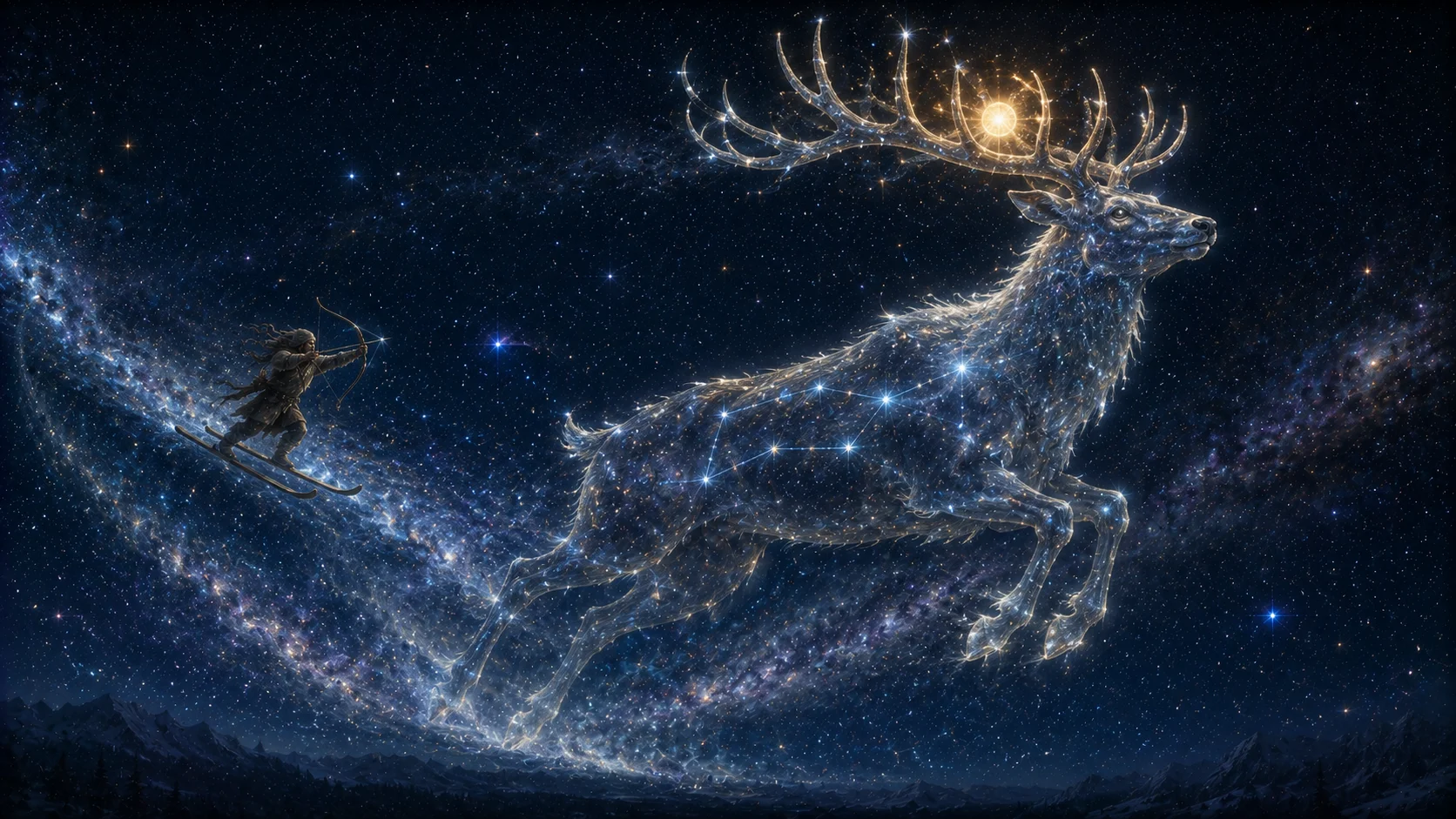
Kheglen — also recorded as Kheglun or Kheglan — is the celestial elk of Evenki cosmology, the great quarry whose form the Evenki people traced in the stars of the constellation known in the West as Ursa Major, the Great Bear. She stands at the center of the cosmic hunt, a myth complex carried across the taiga and tundra by Tungusic-speaking peoples — the Evenki foremost among them, but also the Even and their neighbors — and echoed, in cognate shapes, among the Nanai, the Selkup, and the Ket. What survives of her today survives because Russian and Soviet ethnographers of the nineteenth and twentieth centuries — among them Glafira Vasilevich and Arkady Anisimov, whose fieldwork among Evenki shamans and hunters preserved cosmology otherwise passed only by voice — sat with Evenki storytellers and shamans and wrote down what had, until then, lived only in telling. There is no older manuscript to consult, no carved inscription to check against. Kheglen belongs entirely to oral tradition, and that fact is not a gap in the record but the record's very shape.
A Beast Written Into the Turning Sky
For peoples whose lives moved with the reindeer and the seasons of the taiga, the night sky was not a static backdrop but a working landscape, populated with figures whose motion meant something. The bright stars that European tradition binds into a bear and a plough, Evenki tradition bound into an elk — vast, celestial, and pursued. Night after night, and across the turning year, this shape wheels around the pole, and it was that visible, repeated motion that the myth of Kheglen was built to explain. The elk does not simply exist in the sky; she runs, and the running is the story.
Last updated .
The Hunter Who Never Stops Following
At the heart of the cosmic hunt stands a pursuit: a hunter — in the tellings ethnographers recorded, sometimes a mythic ancestor-hunter, sometimes a figure bound to the name Mangi, sometimes a shaman-hero acting in that same role — takes up the chase after Kheglen across the vault of heaven. The hunt explains the sky's motion, whether read as the wheel of day following night or the slower wheel of the year. In some of the tellings gathered by ethnographers this hunter does not travel alone; he is followed by dogs, and in certain variants those dogs, too, are written into the stars, running the chase forever beside him. That detail places Kheglen's myth alongside the wider pattern of Siberian shamanic story, where a spirit-helper — often in animal form — accompanies the traveler between worlds.
Two Endings the Elders Did Not Agree On
Ethnographers recording the myth across different communities and different tellers did not find one fixed ending, and that divergence is itself part of the honest record rather than a flaw in it. In some variants the chase is perpetual and unresolved — the hunter never quite closes the distance, and that endlessness is precisely what explains why the constellation never sets below the northern horizon, circling the pole instead of rising and falling like the rest of the sky. In other recorded variants, the hunter does catch Kheglen, but only once a year, binding the myth instead to the turning of the seasons rather than to the endless wheel of the pole star's circuit. Scholars who have compared these variants read the disagreement not as confusion in the tradition but as evidence of a living myth doing more than one kind of explanatory work — sometimes accounting for the night, sometimes for the year — depending on which community, which teller, and which need for explanation shaped the telling that night.
Blood, Dusk, and the Reddening Sky
A further variant, attested in some of the recorded tellings but not universal across Evenki or the wider Tungusic-speaking world, ties the myth to the visible reddening of the sky at dawn and dusk. In these versions, when the hunter finally overtakes Kheglen and the chase ends in death, it is her blood — or, in some tellings, her body itself — that colors the horizon red, or that is bound to the origin of fire and light among people. This should be understood as one attested strand of the tradition rather than the single canonical close of the story; other communities, as noted, kept the chase unresolved and never brought Kheglen to that end at all. Holding both possibilities together, rather than collapsing them into one, is closer to what the ethnographic record actually shows.
The Elk as the Animal Peoples Actually Knew
Kheglen's shape in the sky is not an arbitrary choice of creature. The elk and the wild reindeer were, for Evenki hunters, the animals around which real subsistence turned — tracked through snow, depended upon for meat and hide, central to the rhythm of taiga life in a way few other creatures could match. Scholars who have studied the cosmic hunt across Siberia, Åke Hultkrantz among them, have read this celestial elk as the hunting economy itself projected onto the heavens: the same animal a hunter pursued on skis through the forest is pursued, eternally and on a cosmic scale, by a hunter through the stars. The sky does not invent a new drama; it repeats, at its own scale, the oldest and most necessary one on the ground.
Where the Reindeer Wears the Elk's Name
The figure is not identical from one Tungusic-speaking community to the next, and the variation is genuine rather than an error to be smoothed away. Among some groups — the Even, and neighboring Siberian peoples who share pieces of the same myth complex, including the Ket and the Selkup — the celestial animal is a reindeer rather than an elk, and the names attached to both hunter and quarry shift accordingly. What holds constant across these tellings is the underlying structure: a celestial ungulate, an eternal chase, and that chase read as the explanation for the visible motion of certain stars around the pole. The specific names and the specific episodes of the story were never uniform across the Tungusic-speaking world, and the ethnographic record treats that as documented regional divergence, not as a corrupted or incomplete version of a single "correct" myth.
Where the Shaman Meets the Elk
Kheglen's presence in Evenki life was not confined to storytelling around a fire. Ethnographers recorded shamans ritually re-enacting or narrating the cosmic elk hunt during séance, using the chase as the shape of the shaman's own journey between the levels of the tripartite Evenki cosmos — the Lower, Middle, and Upper worlds through which a shaman's spirit was understood to travel. In this setting the hunt is not only an explanation of the sky; it becomes a map, a narrative structure the shaman's own passage between worlds could follow and be understood through. Kheglen, in other words, was not myth alone but working cosmology, load-bearing in actual ritual practice.
An Animal-Spirit, Not a God to Be Petitioned
It is worth being precise about what kind of figure Kheglen is. The ethnographic sources do not present her as an anthropomorphic deity who receives a cult or a sacrifice offered in her own name. She belongs instead to the category of animal-spirit or celestial-animal, a figure who does her work within myth-narrative and within shamanic cosmological explanation rather than through worship directed at her. That distinction matters for how the figure should be understood: not as an object of devotion but as a presence in the sky whose story explains, teaches, and gives shape to a shaman's own path between worlds.
A Chase Told Far Beyond the Taiga
Kheglen is not an isolated figure even within the broader field of comparative mythology. She belongs to a documented and widespread type that folklorists call the cosmic hunt — a term used in comparative motif scholarship, including the large-scale comparative work associated with Yuri Berezkin, that links the Evenki elk-chase typologically to other reindeer-and-elk sky myths recorded across Siberia, and, more distantly, to parallel star-chase myths recorded among Native American and Finno-Ugric traditions. Whether these far-flung parallels trace back to genuine historical diffusion or arose independently in separate hunting cultures facing the same night sky remains an open question among scholars. What is not in question is that the pattern itself — a hunted celestial animal whose flight explains the motion of the stars — recurs across an enormous span of the circumpolar and North Eurasian world, with Kheglen standing as one of its most fully documented instances.
What the Record Keeps and What It Cannot
Because Kheglen survives only through the fieldwork of outside recorders working across the nineteenth and twentieth centuries, what remains is necessarily partial — a set of tellings captured at particular moments from particular voices, rather than a single fixed scripture. That should be read honestly rather than as a deficiency: an oral cosmology, faithfully transmitted across generations of Evenki life and only later set down by ethnographers, naturally carries the variation of many tellers and many communities rather than the uniformity of a text copied from a single original. The value of the record lies precisely in what it preserves of that living variation — the disagreement over the ending, the shift between elk and reindeer, the presence or absence of the hunter's dogs — rather than in flattening it into one tidy account. Kheglen's sky is still there, still turning, and the story that explains her flight remains one of the clearest surviving windows onto how the Evenki once read their own working lives written across the stars.