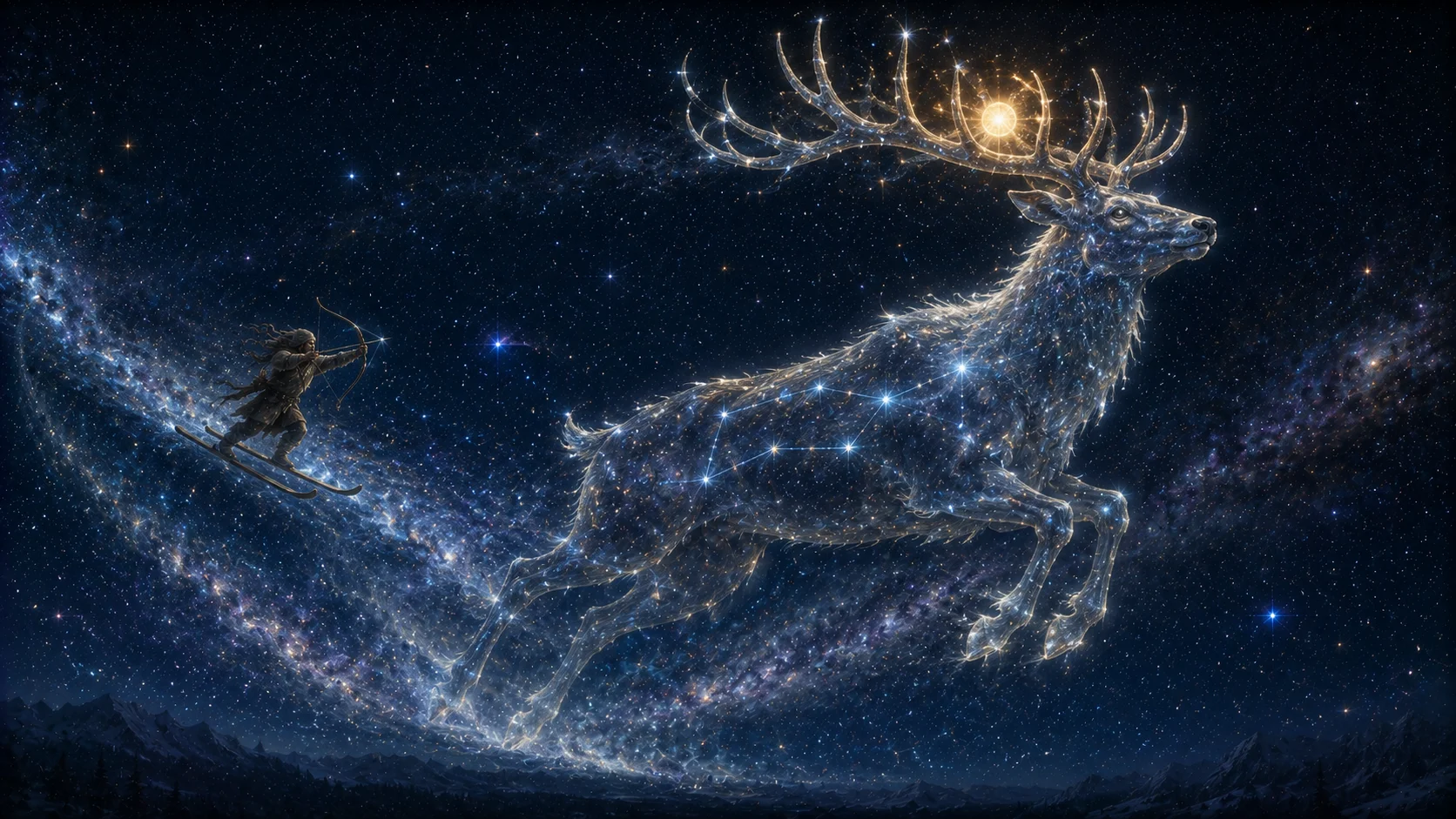
Ulu Toyon — the "Great Lord" — stands among the most formidable and morally ambiguous figures in Yakut (Sakha) mythology, a supreme spirit whose dominion touches the highest tier of the Ýokary, or Upper World, and whose shadow falls, by some accounts, into the underworld below. He is not the gentle, distant sky-father of other traditions. He is fire, forge, and fate bound into a single towering presence — a being who gave humanity flame and shamans their power, and who is remembered, in the same breath, as the wellspring of sickness and the evil abaahy spirits that trouble the Middle World.
The Great Lord of the Upper World
In the layered cosmology of the Sakha people, the universe unfolds in three tiers: the Upper World of sky and light, home to the benevolent Aiyy spirits; the Middle World of earth, where humans live out their fated lives; and the Lower World, domain of the abaahy, the malevolent spirits who bring misfortune. Ulu Toyon's place within this structure is famously unsettled. Some tellings seat him on the highest rung of the Upper World itself, ruling as its supreme lord. Others describe him as an intermediary figure, a being who bridges Upper and Lower realms rather than belonging cleanly to either. This ambiguity is not a flaw in the tradition — it is the tradition. Ulu Toyon is not meant to sit comfortably in a single moral category the way the purely luminous Aiyy deities do.
A Name That Means Command
"Ulu Toyon" — rendered in various transliterations as Ulu-Tojon — translates roughly to "Great Lord," a title of raw authority rather than a description of temperament. Where the supreme sky god of the purely benevolent creator class carries an epithet of radiant whiteness, Ulu Toyon's name carries only weight and rank. It is the name of a ruler, and rulers, in Sakha storytelling as in so much oral tradition worldwide, are rarely simple.
Shaper of the First Humans
Among the most striking threads in Ulu Toyon's mythology is his role in the creation of humankind. In some Yakut traditions, it is Ulu Toyon — not the purely benevolent creator spirits — who first shaped human beings. But his craftsmanship was imperfect. The bodies he formed lacked something essential: a living soul. It fell to Ürüŋ Aiyy Toyon, the White Lord Creator of the Upper World's Aiyy class, to complete what Ulu Toyon had begun, breathing animating spirit into the imperfect beings his fellow god had made. This division of labor — one god who builds, another who animates — is a quietly profound piece of theology. It suggests a world in which even the divine is capable of getting it half right, and in which completion, wholeness, and true life require more than one kind of power.
The Fire-Bringer
Among the most human-facing of Ulu Toyon's roles is that of teacher and provider: the being who brought fire to the Yakut people. Nineteenth-century ethnographic accounts, most notably those recorded by the Polish scholar Wacław Sieroszewski during his years of Siberian exile among the Yakuts, describe Ulu Toyon as the one who taught humans the art of making fire — in some versions stealing it from the sky and delivering it down to the Middle World. The parallel to fire-bringer figures found across world mythology is unmistakable, yet the Yakut telling is its own: fire here is not simply stolen for humanity's sake in defiance of higher powers, but granted, or wrested, by a figure who himself straddles the line between benefactor and trickster. This gift of fire sits alongside the broader Yakut veneration of flame at every scale, from the cosmic figure of Ulu Toyon down to the household hearth, itself watched over by its own guardian spirit, Ot Ich'ite.
Lord of the Forge
Ulu Toyon's association with fire extends into forging as well — the fact-pack traditions link him with fire and with the craft of the forge, without spelling out the specific things made there. This forge-association is part of what marks him as an active, intermediary deity rather than a remote, untouchable sky-father — a being who works with his hands, who deals in heat and craft, in contrast to loftier creator spirits who simply will things into being from a distance.
Father of the Abaahy
Darker still is Ulu Toyon's connection to the abaahy, the malevolent spirits of the Lower World. Some accounts describe him as the origin point of evil spirits and disease altogether; others go further, naming him as the literal progenitor of a lineage of abaahy — sons and offspring among the very forces that torment the Middle World's human inhabitants. This lineage sets him distinctly apart from the "white," purely benevolent Aiyy deities, whose nature admits no such shadow. Ulu Toyon is instead something closer to a trickster-adjacent power, morally ambiguous in a way that resists easy translation into simple hero or villain. He is neither fully aligned with the forces of harm nor cleanly separated from them.
Patron and Ancestor of Shamans
Perhaps Ulu Toyon's most enduring role in living Sakha spiritual memory is as the ancestral patron of the oyuun, the shaman. Tradition holds that the very first shaman received his powers and spirit-helpers directly from Ulu Toyon, establishing a sacred lineage that every shaman who followed was understood to inherit from. This is a role of immense weight: the shaman in Yakut society was healer, seer, and intermediary between worlds, and to trace that office back to Ulu Toyon is to place him at the very foundation of Sakha spiritual practice.
Dismemberment and the Making of a Shaman
Shamanic initiation narratives among the Yakuts describe a harrowing process: the future shaman's soul is said to be raised up to Ulu Toyon's own abode, there to undergo a kind of dismemberment and reassembly under his supervision, before descending back to the Middle World transformed and empowered. This motif is not unique to the Sakha — dismemberment-initiation appears across Siberian shamanism broadly, among Tungusic and Buryat traditions alike — but its association with Ulu Toyon specifically underscores his role as a being who deals in thresholds: between life and death, wholeness and fragmentation, the ordinary person and the initiated seer. Shamans did not receive their calling lightly, and the tradition remembers that cost honestly, without softening it into comfort.
An Ambivalent Power, Not a Simple One
It would be a disservice to Sakha tradition to flatten Ulu Toyon into either a benevolent culture-hero or a straightforward demon. He is neither. He is fire-bringer and disease-bringer, craftsman and destroyer, shaman's ancestor and abaahy's father, sometimes ruler of the Upper World and sometimes a bridge into the Lower one. This is a pattern that recurs across Turkic and Mongolic Siberian belief more broadly: a distant, withdrawn high creator paired with a closer, more active, morally complicated intermediary deity who actually deals with humanity's needs and dangers. Ulu Toyon is that working god — approachable, dangerous, necessary.
Ajysyt, Giver of Children
Where Ulu Toyon governs fire and the shaman's difficult calling, a very different kind of power watches over the beginning of every human life. Ajysyt — also spelled Aiyyhyt or Ayyysyt, meaning roughly "Mother" or "Giver of Children" — is the Yakut goddess of childbirth, fertility, and the fate of newborns. She belongs to the Aiyy, the benevolent creator-class spirits of the Upper World, and her intervention was sought at the single most vulnerable threshold of life: the moment of birth itself. Tradition holds that Ajysyt descends personally to a mother's home when labor begins, remaining present to assist the delivery and, crucially, to determine or record the child's destiny — the shape of the life that is just beginning.
Offerings at the Threshold of Life
Yakut women traditionally made ritual offerings to Ajysyt both before and after childbirth: food, dairy products such as kumis, ribbons tied in her honor — small, careful acts meant to secure a safe delivery and a healthy child. She is closely bound to the horse, an animal of deep sacred significance throughout Sakha culture, and horse-themed imagery and horsehair items recur in the birth rituals connected to her worship. In some accounts she does not work entirely alone; a spirit or deity of the hearth stands beside her in protecting the newborn, echoing the broader Yakut reverence for the hearth fire embodied in Ot Ich'ite — the same sacred flame tradition that runs, in a very different key, through Ulu Toyon's own mythology.
A Wider Turkic Kinship
Ajysyt is not an isolated figure within the wider Turkic world. She shares clear functional parallels with Umay, the widespread Turkic goddess of childbirth and guardian of children found among the Altai, Tuvan, and other Central Asian Turkic peoples — a kinship that reflects the deep roots the Sakha share with their Turkic relatives, carried north into Siberia and reshaped by the shamanistic traditions native to that land. Folklorists studying Siberian belief have also drawn a structural comparison, though never a claim of direct historical connection, between birth-fate goddesses like Ajysyt and the fate-recording figures of other mythologies, such as the Moirai of Greek tradition or the Norns of Norse belief — different peoples, arriving independently at the same profound intuition that a life's shape is set, in some measure, at its very start.
Living Memory in the Olonkho
These figures are not confined to ethnographic footnotes. They live on in the Olonkho, the Sakha heroic epic tradition recognized by UNESCO as Intangible Cultural Heritage, where deities such as Ürüŋ Aiyy Toyon and birth-goddesses like Ajysyt appear directly, intervening in the fates of heroic protagonists. The primary early written record of much of this cosmology comes from Sieroszewski's ethnography, born of years spent living among the Yakuts in Siberian exile — an outsider's careful record of a belief system that predates and outlasts any single account of it. Yakut mythology itself is the product of a long blending: Turkic sky-worship, or Tengrism, carried east and north by the ancestors of the Sakha, fused over centuries with the shamanistic traditions native to the peoples of Siberia. Ulu Toyon and Ajysyt, fire-giver and birth-giver, stand as two of its most enduring and most human faces — one governing fire, craft, and the shaman's difficult calling, the other watching tenderly over the moment life begins.