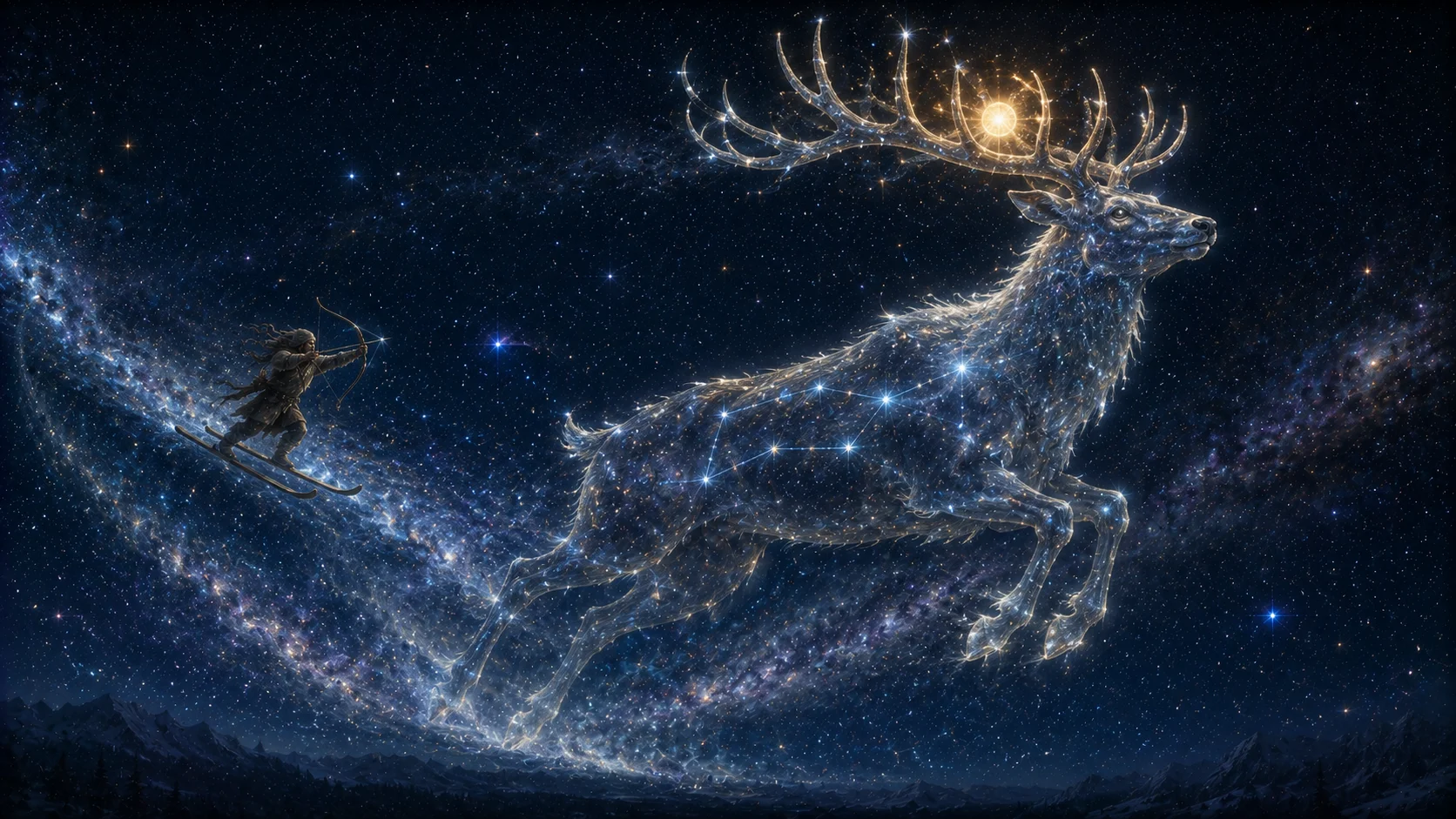
Yryn-Ay-Toyon — rendered in various transliterations as Ürüŋ Aar Toyon, the "White Creator Lord" — is the supreme sky deity of the Sakha (Yakut) pantheon, a Turkic-speaking people of the Sakha Republic (Yakutia) in northeastern Siberia. He dwells in the ninth and highest tier of the Sakha multi-layered heavens, remote above the affairs of the middle world, yet honored each year as the source from which light, order, and life itself are believed to descend.
The Ninth Heaven and the White Lord
Sakha cosmology imagines the universe as a stack of worlds: an Upper World of sky-dwelling aiyy spirits, a Middle World of humans, animals, and rivers, and a Lower World inhabited by the abaahy, hostile spirits of darkness and misfortune. Yryn-Ay-Toyon occupies the topmost, ninth heaven of this structure — a position that places him above every other spirit named in Sakha tradition, aiyy or otherwise. His name carries the color white at its center, and whiteness in Sakha belief is never a neutral shade. It marks purity, benevolence, and the sacred, standing in direct contrast to the darker, lower-lying forces associated with misfortune and the underworld. To call him the White Creator Lord is to place him, linguistically and cosmologically, as far as possible from anything abaahy.
A Creator Who Withdrew
What distinguishes Yryn-Ay-Toyon from many sky-fathers in other pantheons is not power but distance. Sakha tradition remembers him as largely passive after the work of creation was done. Having shaped the world and set its order in motion, he is understood to have delegated the active governance of the middle world to the lesser aiyy spirits beneath him, rather than continuing to intervene directly in human affairs. This is not a mark of weakness in Sakha thought but a structural feature of how the cosmos is imagined to run: the highest authority establishes the framework and then steps back, leaving day-to-day stewardship — the weather, the herds, the fates of individual families — to spirits closer to the ground. Yryn-Ay-Toyon remains the horizon against which those closer powers operate, invoked at the great communal rites even though he is not expected to answer in the way a nearer spirit might.
Father of the Aiyy and the First Sakha
Some strands of the Sakha epic tradition known as olonkho describe Yryn-Ay-Toyon as more than a distant sovereign — as the progenitor of the entire aiyy race of sky spirits, and through them, the figure behind the creation of the first Sakha ancestors. In these tellings he stands at the root of the genealogy that connects heaven to the Sakha people themselves, and is credited with establishing the cattle-and-horse herding culture that has defined Sakha life for centuries. The horse in particular carries enormous weight in Sakha cosmology, appearing again and again as a bridge between the human and spirit realms, and tracing that gift back to the supreme sky deity gives the whole pastoral way of life a sacred origin story.
Olonkho: The Living Memory of the Sky
The olonkho epic tradition — recognized by UNESCO as a form of Intangible Cultural Heritage — is the primary oral-literature vessel through which stories of Yryn-Ay-Toyon and his relationship to the aiyy and to humanity have survived. These are not fixed texts but living performances, carried by singers and storytellers across generations, and it is within them that the sky lord's role as father-figure to the upper-world spirits is most fully preserved. Because olonkho is performed rather than merely read, the tradition keeps Yryn-Ay-Toyon present in Sakha cultural life in a way that a static myth could not — each retelling is itself an act of maintaining the connection between the ninth heaven and the people who trace their origin to it.
Ysyakh: Offerings Poured Toward the Sky
The clearest surviving expression of devotion to Yryn-Ay-Toyon is the Ysyakh festival, the major Sakha summer solstice thanksgiving rite. At Ysyakh, kumys — fermented mare's milk, itself inseparable from the horse culture attributed to the sky lord's gift — is ritually offered skyward to the upper-world aiyy deities, Yryn-Ay-Toyon among them. The gesture is simple and direct: milk lifted toward the sky in thanks for the light, warmth, and order the upper world provides. Even in a cosmology where the supreme deity is understood to be remote, the community still turns outward and upward at the year's most important communal gathering, treating the offering itself as the meaningful act rather than expecting an answering intervention.
A Post-Soviet Return to the Ninth Heaven
Modern Sakha revivalist religious practice, often described under the banner of the Aiyy faith movement, has re-emphasized worship of Yryn-Ay-Toyon since the late twentieth century as part of a broader post-Soviet cultural and religious revitalization in the Sakha Republic. Decades of suppression under Soviet religious policy had pushed much of this practice into private or informal spaces; the revival has brought Ysyakh and its offerings back into public, communal life, with Yryn-Ay-Toyon and the goddess Ajysyt both returning as central figures invoked at the festival. This is a living tradition undergoing active renewal, not a closed chapter of folklore, and it deserves to be understood on those terms.
Ulu Toyon: The Great Lord of the Middle World
Where Yryn-Ay-Toyon presides from the furthest heaven, Ulu Toyon, the "Great Lord," operates much closer to the ground. He is a major figure associated with the middle world and, depending on the telling, functions as a lord of the forest, a master of wild animals, or a powerful and ambivalent figure with ties to the underworld. Sakha spirit classification is notably fluid, and Ulu Toyon sits at one of its more unstable points: some tellings place his domain among the abaahy, the hostile spirits of the lower world, even though he is not simply evil in the way other abaahy figures are understood to be. He is better described as morally ambiguous — a trickster-like presence set deliberately against the purely "white" aiyy spirits of the upper world, including Yryn-Ay-Toyon himself.
Master of Shamans and the Raven's Call
In certain traditions, Ulu Toyon holds a role of particular importance to Sakha spiritual practitioners: he is regarded as the master of shamans, the spirit who grants or oversees the shamanic power known as kut, and the figure shamans are said to invoke or descend to during initiation and trance journeys. This association places him at the very center of how Sakha shamanism understood the transmission of spiritual authority — not a background deity but the specific source shamans looked to when their calling took shape. Ethnographic records compiled by researchers such as Wacław Sieroszewski and G.V. Ksenofontov, who documented Sakha shamanism in the nineteenth and early twentieth centuries, connect Ulu Toyon to the raven, a bird treated in Sakha belief as a powerful and often ominous spirit-animal. The pairing of a morally ambiguous middle-world lord with a bird long read as an omen fits the broader pattern of Ulu Toyon's character: potent, necessary to shamanic practice, and never fully safe.
Two Lords, One Duality
Some cosmogonic accounts place Aiyy Toyon and Ulu Toyon together as a deliberate duality, a way of expressing the Sakha tripartite universe in the relationship between two great lords rather than through abstract description alone. One belongs to the white, benevolent, distant order of the ninth heaven; the other belongs to the forested, animal-thronged, morally mixed territory of the middle world, with roots reaching toward the abaahy below. Read side by side, Yryn-Ay-Toyon and Ulu Toyon sketch the entire vertical structure of Sakha belief — Upper World, Middle World, and Lower World — in the contrast between a creator who withdrew and a great lord who never left.
Ajysyt: The Mother Who Descends for Every Birth
Ajysyt, also rendered Ayyysyt or Aiyyhyt and meaning "Mother" or "Giver of Birth," stands among the most important female deities of the aiyy pantheon and among the figures most directly involved in human life. Sakha belief holds that she descends invisibly from the upper world to attend every childbirth, determining at that moment the child's future lot — its kut-siur, or soul and fate. Where Yryn-Ay-Toyon governs from a remove so great that lesser spirits handle the middle world on his behalf, Ajysyt represents the opposite pole of the aiyy pantheon: an upper-world deity who comes down in person, at the most intimate and vulnerable moment a family experiences.
Rites, the Mother-Soul, and the World Tree
Sakha women traditionally performed birth rites associated with Ajysyt — sometimes referred to as the Ajysyt ojuuta — involving offerings of food and milk products and ritual objects hung near the place of birth to invoke her favor and protection. She is closely tied to the concept of ijeh kut, the "mother-soul," one of the three souls a person is believed to possess in Sakha spiritual thought, which she is said to help bestow at the moment of birth. Some ethnographic sources describe her traveling on a spirit-horse or accompanied by helper spirits — another point at which the horse, central to nearly every layer of Sakha cosmology, appears as the vehicle connecting sky and earth. Other accounts link her to the aal luuk mas, the "world tree" motif shared across Sakha and broader Siberian Turkic mythology, tying the giving of new life to the same cosmic tree that anchors the layered universe itself.
A Pantheon Still Spoken and Sung
Taken together, Yryn-Ay-Toyon, Ulu Toyon, and Ajysyt occupy distinct and carefully differentiated niches within — or, in Ulu Toyon's case, at the fluid edge of — the aiyy and abaahy system that structures Sakha traditional religion. G.V. Ksenofontov's early twentieth-century fieldwork remains a primary documented source for reconstructing how these three figures relate to one another and to the rites performed in their names. None of this belongs only to the past: olonkho is still performed, Ysyakh is still held each summer solstice, kumys is still lifted toward the sky, and the Aiyy faith's post-Soviet revival has brought Yryn-Ay-Toyon and Ajysyt back into public devotion in the Sakha Republic today. The white light of the ninth heaven, in Sakha tradition, has never stopped being offered to.