
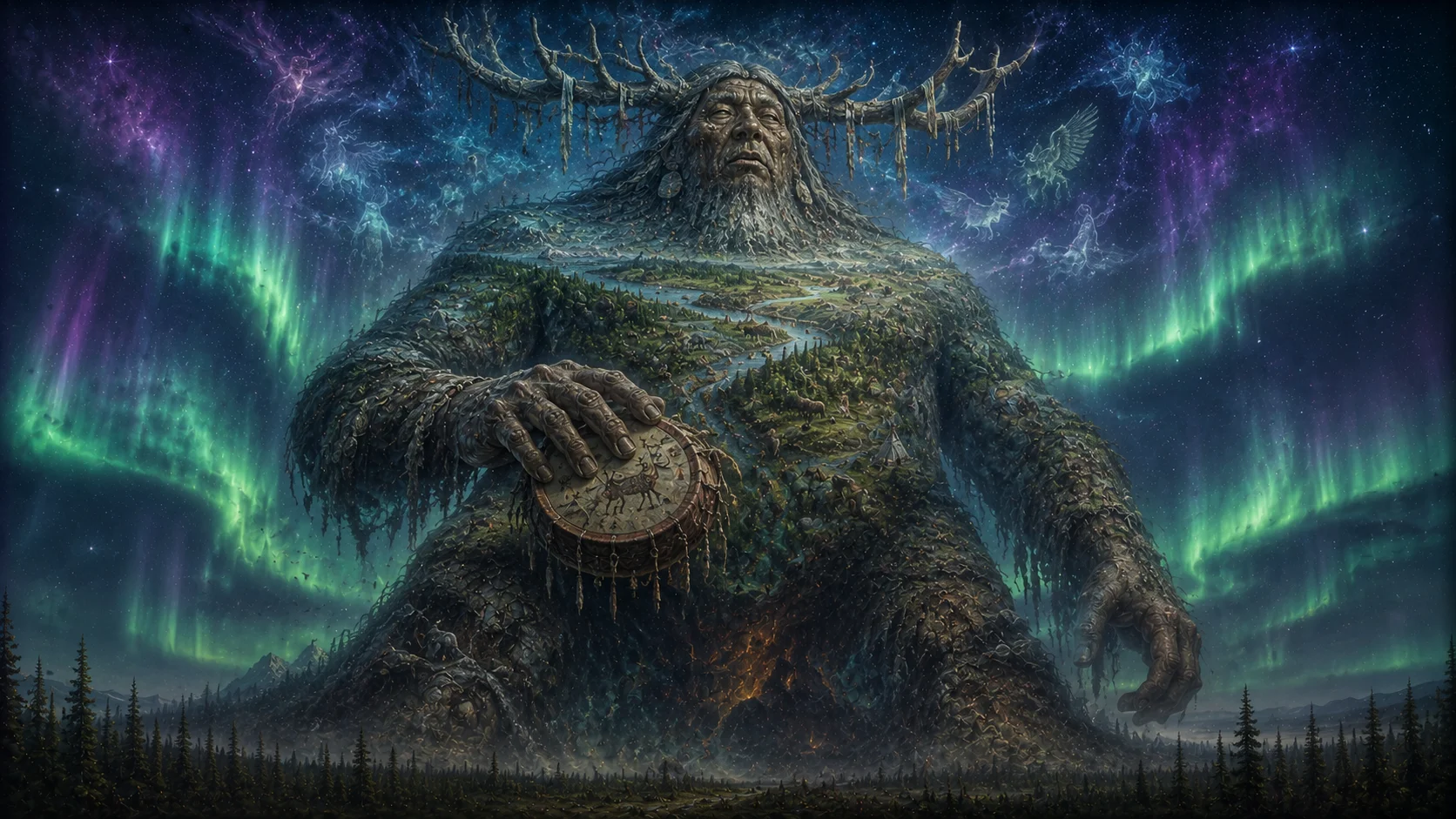
Buga is the supreme being of the Evenki — the Tungusic reindeer-herders and hunters of the Siberian taiga. He is at once the high god of the sky and the very universe itself, for his name means "sky," "world," "universe," and "weather" all at once: the all-encompassing divine cosmos, the creator and master of the world, the source of life and the order of the three-tiered Evenki universe.
The God Who Is the Universe
Buga is among the most striking of supreme beings recorded anywhere in Siberian religion, for he is not merely a god dwelling in the world but, in a real sense, the world and the universe themselves made divine. The Evenki word buga names the sky, the cosmos, the inhabited world, weather and climate, and the divine power that pervades and rules over all of it at once — so that to speak of Buga is to speak simultaneously of the high god and of the living universe over which he presides. This polysemy is not a fluke of translation or a puzzle to be resolved into a single "real" meaning; Evenki ethnographers, above all G. M. Vasilevich, whose mid-twentieth-century fieldwork among Evenki communities of Eastern Siberia remains the primary scholarly foundation for what is known of Buga, recorded it as a deliberate and structural feature of Evenki religious vocabulary. When an Evenki speaker of the old generation said the weather had turned, or that the world was vast, or that Buga watched over the hunt, the same word carried all of those senses together, each shading into the others depending on context.
Last updated .
A Presence Without a Face
Unlike many supreme sky-gods of world mythology who accumulate biographies, spouses, children, and dramatic episodes, Buga as recorded in the Evenki ethnographic corpus resists exactly that kind of storytelling. Across the accounts gathered by Vasilevich and later scholars, Buga appears far more often as a governing principle — a master of the universe, an animating and ordering force — than as a personalized figure with a developed narrative arc. This is not a gap in the record to be filled in or an omission awaiting discovery; it is itself a documented and notable feature of how the Evenki conceived their highest sacred power. Where other traditions might picture a sky-father striding through the heavens, Evenki testimony more often speaks of Buga as something closer to the condition of the cosmos itself — impersonal in the way that gravity or weather is impersonal, and yet still addressed, propitiated, and held responsible for fortune and misfortune alike. Scholars working from Vasilevich's material and from later syntheses by figures such as Anisimov, Siikala, and Hultkrantz have consistently preserved this ambiguity rather than smoothing it into a more familiar, anthropomorphic deity, and any faithful account of Buga must do the same.
Dweller in the Upper World
Evenki cosmology, like that of many Siberian peoples, pictures the universe as built in three tiers: an Upper World of sky and celestial beings, a Middle World of the living — the taiga, its rivers, its animals, and its human and spirit inhabitants — and a Lower World associated with the dead. The three are joined by a great cosmic river or a world tree that runs like a spine through the whole structure, and it is along this axis that movement between the tiers becomes possible. Buga is closely associated with the Upper World, and in some recorded accounts is described as residing there, or even as being identical with the sky dome that arches over the Middle World. This placement is consistent with his character as a sky and universe deity: the Upper World is not merely where he lives but is, in the more abstract accounts, continuous with what he is. To look up at the vault of the sky, in this understanding, was in some sense to look toward Buga himself, rather than merely toward his dwelling place.
Creation Told in Many Voices
Various recorded accounts credit Buga with creating the earth, the animals, and humankind, and with maintaining the order of the cosmos once it was made. Yet the specific narratives attached to this creative role differ from informant to informant and from community to community, and no single version should be treated as the canonical Evenki creation myth. This variability is itself well documented in the ethnographic record rather than a sign of incomplete collection — Evenki religious knowledge, like that of many oral traditions spread across a vast and only loosely connected territory of taiga and tundra, was never centralized into one fixed scripture, and different bands and lineages carried different tellings of how the world under Buga's authority came to be. What remains constant across the variations is the underlying conviction that the world's shape and its living order trace back to Buga's creative and sustaining power, even where the details of how that power acted diverge.
Weather, Luck, and the Turning of Fortune
Because the very word buga denotes weather and climate as well as the deity and the cosmos, the god's influence over the skies was inseparable from Evenki daily concern with survival in one of the harshest inhabited environments on earth. In recorded belief, Buga was in some accounts appealed to, and in others blamed, for the turns of weather that could make or break a hunting season or a reindeer migration. This same association extended to the broader idea of fate and personal fortune: the luck of an individual hunter, or the fortunes of an entire band, could be understood as flowing from Buga's favor or displeasure. To have good luck in the hunt, or to be struck by an unaccountable string of misfortune, was in this framework not simply chance but a reflection of one's standing before the highest power governing both sky and destiny.
Sovereign Above the Many Masters
Everyday Evenki religious life was populated not primarily by Buga but by a dense population of eseki, or "master spirits" — the guardian and governing spirits of particular places and particular kinds of being: masters of the taiga, of individual mountains and rivers, and of the animal species that sustained the hunt. These were the spirits an Evenki hunter or herder dealt with most directly, propitiating the master of the elk before a hunt or the master of a river before a crossing. Buga's place in this system was not as one master among many but as the overarching authority standing above them all — the universe-principle within whose domain the entire web of place-spirits and species-spirits existed and operated. The masters governed their particular corners of the Middle World; Buga governed the whole of which those corners were parts. This layered structure, with a supreme but relatively abstract sky power presiding over a crowded landscape of more immediate, more approachable spirits, is a recurring pattern in Siberian indigenous religion and is attested clearly in the Evenki material.
The Shaman's Road to the Sky
Contact between the human community and Buga, or more broadly the Upper World he inhabits, was mediated above all through the Evenki shaman — and it is worth noting that the very word "shaman," now used worldwide, derives from the Tungusic šaman, making Evenki and related Tungusic practice the historical wellspring of the term itself. Both men and women were recorded serving as shamans, though the prestige and specific gendered contours of the role varied between groups and across different periods. In ritual, the shaman's drum and the trance-journey it induced served as the vehicle of contact with the sky-realm, the shaman figured as traveling along the cosmic river or ascending the world tree that joins the tiers of the universe. This structure — drum, trance, and cosmic journey along a world-axis toward the Upper World — is one of the best-documented and most central features of Evenki religion as a whole, recorded consistently from Vasilevich's foundational fieldwork through later syntheses of Siberian shamanism, and it is through this practice that ordinary Evenki communities maintained their living relationship with Buga.
The Measure of Right Conduct
A number of ethnographic sources record a moral and quasi-judicial dimension to Buga's authority: an oversight of the correctness of human conduct, particularly around hunting ethics, the proper treatment of killed game, and the observance of taboo. In this framing, misfortune in the hunt or in daily life could be read as a sign of Buga's displeasure, or as displeasure channeled through one of the subordinate masters acting within his domain. Scholars are careful to flag, however, that the extent to which this moral-overseer role reflects pre-contact Evenki belief, as opposed to a dimension shaped or sharpened by later contact — including encounters with Russian Orthodox Christianity, which in nineteenth- and twentieth-century missionary and ethnographic records prompted explicit comparisons between Buga and the Christian God — remains genuinely uncertain and actively disputed. This is not a case where scholarship has quietly settled on an answer; it is presented honestly in the record as an open question, and any account of Buga's moral dimension should carry that same caution rather than presenting it as settled fact in either direction.
Sun and Moon in an Unsettled Sky
The relationship between Buga and the sun and moon — both of great significance in Evenki cosmology in their own right — is recorded inconsistently across the available sources. In some accounts the sun and moon appear as separate spirit-beings, existing under Buga's overarching domain as distinct powers rather than as extensions or aspects of Buga himself. Other tellings draw them closer into Buga's own identity. Rather than attempting to reconcile these differing accounts into one tidy cosmological chart, the honest position — and the one scholarship itself takes — is to treat this as a genuinely unsettled point in the ethnographic record. The Evenki cosmos as recorded was rich enough, and gathered from a wide enough range of individual informants over a wide enough territory, that not every relationship between its celestial powers was fixed the same way twice.
A Name Not Shared Lightly
Cognate concepts of a high sky-deity appear among other Tungusic peoples under different names and with different emphases — among some Manchu-Tungusic-related traditions further to the south and east, for instance, distinct high-god or sky-cult figures are attested in their own right. Scholars caution strongly against collapsing all of these Tungusic sky-deity concepts into a single, unified "Buga cult" spanning the whole Tungusic-speaking world. Buga specifically, as named and described in the sources discussed here, is most solidly and richly attested among the Evenki proper. The degree of genuine continuity between this Evenki Buga and analogous figures among related peoples — the Even, Negidal, Nanai, Udege, and Oroqen among them — remains a live question of comparative scholarship, not a settled genealogy, and the distinctiveness of the Evenki tradition deserves to be respected on its own terms rather than flattened into a generic "Tungusic sky god" template.
A Tradition Still Spoken
Buga does not belong solely to a closed or vanished past. Post-Soviet-era ethnography and Evenki cultural revival efforts from the late twentieth century into the twenty-first have brought renewed documentation, and in places renewed reinterpretation, of Buga within contemporary Evenki cultural and religious self-description. Communities that endured decades of Soviet-era suppression of indigenous religious practice have, in the years since, worked to recover, record, and in some cases reconstruct threads of belief and ritual that had been driven underground. Buga's presence in that ongoing work — as universe, as sky, as the highest power a hunter might still quietly acknowledge before setting out into the taiga — is a living dimension of Evenki identity, not merely a subject preserved in archival transcripts. Any respectful account of Buga should hold both truths together: a figure documented with unusual care by twentieth-century ethnography, and a name that Evenki people continue to carry, reinterpret, and speak for themselves today.