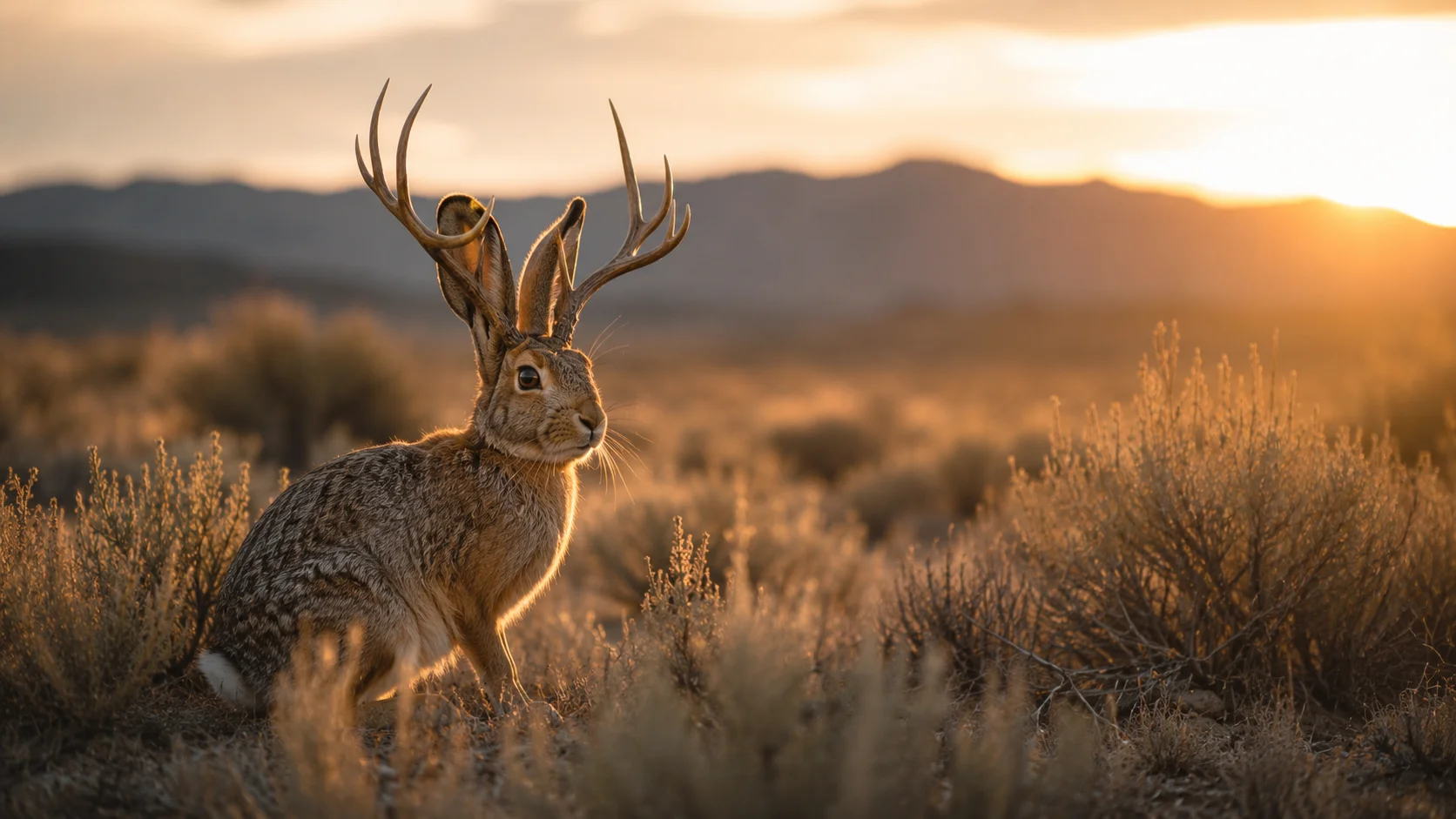
The Jackalope is an American folkloric creature and cryptid: a horned rabbit, said to be a jackrabbit crowned with the antlers of an antelope or deer. It is not a species anyone claims to have captured or studied, but a tall tale given a body — the most durable and beloved of the American West's "fearsome critters," a comic invention of loggers, cowboys, and settlers passed down and, eventually, nailed together and hung on a wall.
A Name Stitched From Two Animals
The word jackalope is a portmanteau, jackrabbit fused with antelope, and both halves of the name are themselves slightly misleading. The jackrabbit is not a true rabbit at all but a hare, of the genus Lepus, named for its long, mule-like ears rather than for any taxonomic kinship with rabbits proper. Onto that animal's silhouette the legend grafts branching antlers, borrowing the antelope's name for the second half of the compound even though the horns in question, in the taxidermy tradition that made the creature famous, more often came from deer or pronghorn antelope stock. The jackalope's very name, then, is a small joke about mismatched parts, which turns out to be the whole point of the creature.
The Herrick Brothers and the First Mount
The specific, datable origin of the jackalope as an object rather than a rumor traces to Douglas, Wyoming, in 1932. Brothers Douglas and Ralph Herrick are credited with creating and popularizing the first taxidermy jackalope mount, grafting deer or antelope antlers onto the carcass of a jackrabbit until the two halves read, at a glance, as one impossible animal. Douglas Herrick reportedly learned the taxidermist's craft from mail-order courses, the kind of correspondence-school skill that was common currency on the rural plains, and it was that trade knowledge, turned toward a joke rather than a trophy, that gave the legend its enduring physical form. What had likely existed before as scattered talk of horned rabbits became, in the Herricks' hands, a thing you could hang above a bar and point to.
The La Bonte Hotel and a Stolen Trophy
The Herrick family's original mounted jackalope did not stay in the family's own hands for long. It was reportedly sold to a man named Roy Ball and put on display in the La Bonte Hotel in Douglas, Wyoming, where it became a genuine tourist attraction, the kind of local curiosity that travelers detoured to see and photograph. Decades later, the original mount was stolen, an episode commonly dated to the 1970s though the exact date and the mount's current whereabouts remain disputed and unclear. The disappearance of the founding specimen has become its own small footnote to the legend: the first jackalope, the one that started an entire regional industry of imitation and merchandise, is itself now a piece of folklore rather than an object anyone can point to.
Wyoming Claims Its Own
Douglas, Wyoming did not let the association fade. The town officially declared itself the "Home of the Jackalope" and erected an eight-foot jackalope statue in a downtown park, a permanent civic monument to a creature that, by any strict accounting, does not exist. The statue functions as both landmark and punchline, a town's willingness to build something enormous and lasting out of a joke it clearly loves telling.
A License Valid on No Calendar
Douglas also issues novelty jackalope hunting licenses, a tradition documented since at least the mid-twentieth century, and the joke is built directly into the paperwork: the licenses are valid only from June 31 to December 31, a date that does not and cannot exist on any calendar, since June has only thirty days. The nonexistent start date is not a printing error but the entire point, a wink built into an official-looking document that quietly tells you, if you read closely enough, that the hunt it authorizes was never meant to happen.
Distant Cousins, Not the Same Animal
Antlered-rabbit folklore did not begin with the Herricks in 1932; it predates their specific taxidermy creation by generations. Related but distinct regional legends exist within their own separate folk traditions: the German and Bavarian Wolpertinger, and the Swedish Skvader, a hare fitted with the wings of a grouse. These figures share the jackalope's basic gesture, an ordinary creature made strange by an impossible graft, but they belong to their own cultures and their own tellings, and are not the same named entity as the jackalope. The American creature is a twentieth-century invention of the western United States, related to these older motifs only in spirit, not in lineage.
A Virus That Grows Real Horns
Unusually for a tall-tale creature, the jackalope legend has a documented biological seed. The Shope papillomavirus, known also as the cottontail rabbit papillomavirus, was first described by the researcher Richard Shope in 1933, a year after the Herricks' first mount. The virus causes keratin-based, horn-like tumors to grow on the heads and bodies of infected rabbits, producing animals that, at a distance or in a hunter's retelling, genuinely resemble a horned rabbit. Many historians and cryptozoology writers cite this real, documented condition as a plausible natural seed for antlered-rabbit sightings both before and after the Herricks gave the story its taxidermy form, a rare case of a folk legend and a genuine pathology growing up almost side by side.
A Creature That Sings and Runs and Drinks
Around the taxidermy object, American frontier storytellers built the usual embellishments of a tall tale. The jackalope was said to mimic human voices, including, in some tellings, the cowboy songs sung around a campfire, to run at extraordinary speed across the plains, and to be catchable only by one method: luring it with whiskey left out as bait. These claims were never presented as documented natural history. They belong squarely to the folkloric tall-tale tradition, exaggerations traded for the entertainment of listeners and, often, for the specific entertainment of testing how much a newcomer to the West would believe.
Kin Among the Fearsome Critters
Folklorists classify the jackalope as a "fearsome critter," a recognized category of tall-tale creature invented by North American loggers, cowboys, and settlers to entertain one another and, pointedly, to test the credulity of greenhorns and newcomers. It shares that category and that purpose with other invented animals of the same regional tradition, including the hodag, the hoop snake, and the squonk. This categorization is well attested in American folklore scholarship, in works that compile and cross-reference the fearsome critter tradition as a distinct genre of frontier storytelling, one built less on belief than on performance, delivered with a straight face to whoever was willing to listen.
An Older Motif, Borrowed Rather Than Inherited
Folklorists also point to a broader antecedent for the horned-hare image: sixteenth-century European natural history and cartography, where illustrations attributed to a general "horned hare" motif appear well before Wyoming existed as a territory. American frontier tall-tale tradition drew on that older well of imagery the way it drew on many things, but the jackalope as it is known today remains a twentieth-century American West invention, distinct from those earlier illustrated motifs rather than a direct continuation of them.
A Trademark on a Folk Tale
The jackalope's afterlife has been thoroughly commercial. It has been trademarked and merchandised extensively out of Wyoming and South Dakota, nowhere more visibly than at Wall Drug in South Dakota, where large jackalope statues and photo props have made the creature a fixture of the classic American road trip. What began as one taxidermist's grafted joke became a regional tourism icon in its own right, printed on postcards, mounted in gift shops, and photographed by generations of travelers who understood perfectly well that the animal in front of them was not real.
Postcards, Milk, and a Cowboy's Saddle
The jackalope's cultural life has taken particularly playful forms. A traveling roadside-attraction postcard fad through the 1970s and 1980s produced images of "jackalope milk" and of cowboys improbably riding jackalopes like undersized horses, souvenirs mailed home as much for the joke as for the memory. Later pop-culture references kept the creature circulating well beyond Wyoming's borders. Throughout, mainstream folklorists have treated the jackalope consistently as a comedic hoax and folk-art tradition, never as a cryptid seriously believed to be biologically real, which is precisely what has let it be embraced so openly and so fondly rather than debated.
No Sightings, Only Performances
Because the jackalope is explicitly a hoax and tall-tale tradition rather than an eyewitness cryptid in the usual sense, it lacks the documented "reports" or "cases" that genuine cryptozoological creatures accumulate over time. Its sightings, such as they are, exist within its own tradition as taxidermy displays, postcards, and folklore performances, told and retold with a wink rather than claimed as real encounters. That absence of eyewitness testimony is not a gap in the record to be filled; it is the honest shape of a legend that was always, from its first grafted antler onward, in on its own joke.
Sources & traditions
- EncyclopediaWikipedia — Jackalope
- TraditionLocal sightings, press reports and regional folklore (North America)
Myths change from area to area and from time to time. This chronicle follows the most widely told versions; tellings in other villages, regions and eras may differ.