Endovellicus is the best documented native god of Roman Lusitania, and he is documented almost entirely from one place. On a hill called São Miguel da Mota, near Terena in the municipality of Alandroal in the Portuguese Alentejo, ninety-odd Latin inscriptions have been found that name him, written by Roman citizens, their slaves and at least one man of equestrian rank, over a period of roughly three centuries. What they say is consistent: thanks for health, answers to questions, orders obeyed. That is why he is called a god of healing and oracle. How far he was a god of the underworld, how much of him was native and how much a Roman creation around a Celtic-sounding name, are questions the scholars have not settled. This is a god from a dead tradition, known through the offerings of his worshippers and not through any story told about him.
The Name
The god’s name appears in many spellings. In the corpus studied by Catarina Gaspar in 2019, the form Endovellicus is used in forty-nine inscriptions and is clearly the regular one; the others are Endovelicus, Endovollicus, Endovolicus, Indovellicus, Idovelicus, Enobolicus, Ennovolicus and Endovelecus. She argues that these variants show the ordinary habits of spoken Latin of the area — vowels shifting, a nasal dropping out, v and b swapping — and are not evidence of a second language. One text from the sanctuary even calls him Deus dominus, “lord god”, and others Deus sanctus, “holy god”.
José Leite de Vasconcelos, the archaeologist who did most to bring the sanctuary to scholarly notice, read the name as Celtic, Andevellicos, “very good”. Other proposals exist, among them a derivation of the second element from a Celtic word for “wolf” and a more recent suggestion, mentioned in the literature without general acceptance, of a loan from a Basque-like root said to mean “most black”, which would fit an underworld reading. None has won general acceptance. Gaspar speaks of a theonym with a Celtic root, while arguing that its spellings show it had become part of the Latin of the district and was not merely a loan from the substratum. Some related names occur elsewhere in the peninsula — Vellicus at Postoloboso in Ávila and Andobellicus at Cerro del Andévalo in Huelva — but she excludes them for method’s sake, and whether they name the same god is debated.
The Sanctuary of São Miguel da Mota
The site is a hilltop, now occupied by the ruins of a chapel of Saint Michael, standing at a crossing of routes, including the road known as the Silver Route, not far from the River Guadiana. The people who went there came mainly from the local region, from Lusitania and western Baetica. The monuments themselves were carved locally, in marble from the quarries of Vila Viçosa, Trigaches and Pardais, which is consistent with workshops operating at or near the sanctuary. Gaspar notes that a sanctuary with so many inscriptions to a single indigenous god, over so long a period, is unusual in Hispania; the nearest parallel she cites is the sanctuary of the god Lar Berus Breus at Monte do Facho in Galicia, with more than a hundred inscriptions, though the texts there are shorter and more repetitive.
A survey of the district in the 1990s found that the sanctuary began to flourish as activity at a nearby site, the Rocha da Mina, declined, from about the beginning of the first century AD. The inscriptions date from the first century to the third or fourth; many belong to the second and third. The sanctuary was not the discovery of an excavator. Local scholars and antiquarians had copied inscriptions from it since the Renaissance, and he appears in works by André de Resende (1593), Bernardo de Brito (1597), Thomas Reinesius (1637), and the eighteenth-century writers Quesada, Pérez Pastor and Cornide. In the nineteenth century J. J. Espanca and Gabriel Pereira worked there. In 1890 Leite de Vasconcelos visited, obtained permission to dig in the chapel, and took back to Lisbon a large group of inscriptions reused in the walls; further finds followed in 1905–1907. Because of his efforts, the National Archaeological Museum in Lisbon holds the largest collection of Endovellicus inscriptions in the world. According to the epigrapher José d’Encarnação, many monuments had earlier been carried from Terena to Vila Viçosa by Teodósio, fifth duke of Braganza, a keen collector of antiquities who died in 1563, and one account places them in the church of the Augustinian convent of the Graça there.
Systematic excavation is more recent. A campaign in 2002 by Guerra, Schattner, Fabião and colleagues found further inscriptions, sculpture, decorative elements, coins, ceramics and small votive objects, among them a little silver figure. The team called its publication a progress report, and no complete plan of the sanctuary has been established. Some later accounts speak of a terraced sanctuary on the hill, but that reading could not be confirmed from the sources checked here and should be treated as provisional.
What the Worshippers Wrote
The monuments are altars (about thirty large ones and twenty-five small), plaques, statue bases and a few sculptural pieces, in a corpus Gaspar counts at ninety-two texts; the printed introduction to her article gives 921, evidently a misprint for that figure. The texts are generally short and formulaic, in the Roman votive style: Deo Endovellico sacrum, then the name of the dedicant, then the formula of the fulfilled vow, votum solvit libens animo. A few examples show the range of people.
- A Roman knight, Sextus Cocceius Craterus Honorinus, set up an altar to the god of “most excellent and most present divinity” (praestantissimi et praesentissimi numinis), an unusual phrase that uses a genitive of quality, rare in votive texts.
- Quintus Saevius Firmanus, enrolled in the Papirian voting tribe and identified as a citizen of Emerita, paid a vow.
- Hermes, a slave who was a marble-worker (servus marmorarius) of a woman named Aurelia Vibia Sabina, dedicated an altar of his own, a reminder that the people carving the stones were also among the worshippers.
- Blandus, slave of Caelia Rufina, and a Vitalis, described as both son and slave of one Messius Sympaeron, appear in separate dedications.
- A man named Marcus Licinius, with a cognomen read as Nigellio, fulfilled a vow for the health (pro salute) of his daughter, whose name is partly restored as Licinia Marciana.
Gaspar notes that the family names are those of Roman families of Lusitania and western Baetica, and that the indigenous population is almost absent: only a handful of probable native names occur, among them Antubellicus Priscus, Dobetianus, Mogolius and Paesicus; Conicodius, also usually listed, has been read differently by Marques. Several scholars have linked the families to the marble industry of the district. It is therefore a cult attended by the Romanised society of the region, not by a vanishing tribal folk. Among the texts discussed by Gaspar no senator appears; the highest rank recorded is the equestrian one. Claims that the cult attracted the circle of an emperor are not supported by those texts, and none was found in the sources checked.
Health, Answers and Orders
The vocabulary is what tells us what he did. Several texts speak of a response or an order: ex responsu and the ungrammatical ex responsum, “by an answer”; ex iussu numinis and iussu ipsius numinis, “by order of the divinity”; ex relegione iussu numinis; and the phrase ex imperato Averno, whose sense is uncertain, since Avernus is a word for the underworld. A man called Marcus Fannius Augurinus says that he made his dedication because he had found this god favourable to himself, merito hunc deum sibi propitiatum. A woman named Iulia Anus records an offering “left by the ancestors” (relictum a maioribus), which implies a cult handed down within families. Another text, with ad relicticium, was interpreted in a 2017 study as a propitiatory act ordered by the god and not a thank-offering.
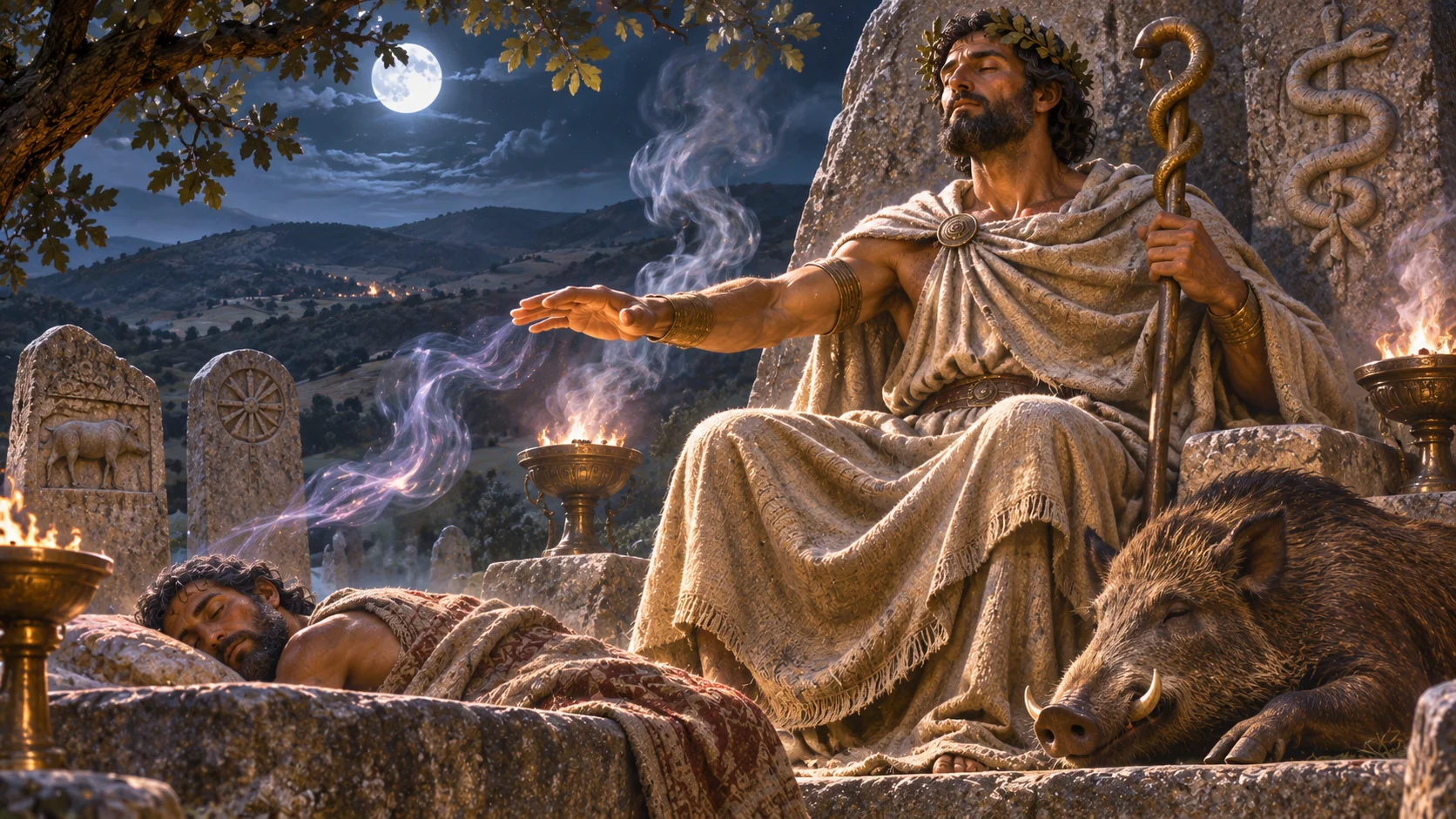
On this evidence Vasconcelos suggested that the sanctuary was an oracle in which the sick or troubled slept and were answered by dream, the practice called incubation, as in the cult of Asclepius. That is a reasonable inference and also an inference: the words responsum and iussus show that gods were thought to answer and command, but none of the texts discussed here describes sleeping in the sanctuary, and the buildings that might have served for it have not been securely identified. The healing function rests on the “for the health of” dedications, which are only a part of the corpus; many texts simply record a vow without saying what it was for.
An Underworld God?
The reading of Endovellicus as a chthonic god of the dead is old and widely repeated, and it rests on slender evidence: the word Averno, the Celtic-looking name, and the comparison with other healing gods who dwell below. It is also the point on which specialists disagree most. The encyclopaedia entry by Jonathan Edmondson in 2013 observes that the view of Endovellicus as a Romanised Lusitanian divinity has been challenged recently, notably because no pre-Roman activity has been shown on the site and because the iconography and ritual actions attested are distinctly Graeco-Roman. This does not make him an invention; the name is native, and the families who worshipped him honoured a god handed down “from the ancestors”. It does mean that the picture we can document is the picture of a god in a Roman province, and that anything said about him in the Iron Age is a reconstruction.
The same caution applies to the claim that he was equated with Roman gods. Modern handbooks speak of an assimilation to Pluto or Serapis, and the museum in Lisbon likewise associates him with Serapis, but the inscriptions at the site do not use a double name; they call him plainly Endovellicus, sometimes with deus or sanctus. A comparison with Asclepius is a modern one, made from the function, and the Pluto and Serapis equations are likewise modern inferences and not statements on the stones.
Images
A marble head of the first century AD, collected by Vasconcelos in 1890 from the reused material of the ruined chapel together with inscriptions and architectural fragments, and now in Lisbon, is catalogued as a head of the god. The identification is probable, not certain, and the museum’s own publications present it with some caution. Beyond that, the evidence for his appearance is thin: a few sculptural elements are recorded in the corpus and nothing in the inscriptions gives him a sacred animal. Edmondson’s remark about Graeco-Roman iconography is the best guide; the god was shown in the manner of the Mediterranean gods around him.
Decline
Dated texts run to the third or fourth century, and a group of late fragments, the so-called hymn to Endovellicus, may belong to the fourth or fifth; notably, the fragments do not actually mention his name. A chapel of Saint Michael later stood on the hill, and one hypothesis, advanced in 1962 by F. de Almeida, holds that the pagan cult changed gradually into a Christian one on the same hill. There is as yet no early Christian inscription from the site to support it. Many inscriptions survived only because they had been reused in the walls of the chapel that Vasconcelos entered in 1890.
Kindred Deities
Ataecina is the other Lusitanian deity with a sanctuary of comparable size, at Santa Lucía del Trampal in Cáceres, and the same variation in spelling occurs in her name. Nabia is a goddess of the north-west whose dedications are spread over a large area, in contrast to the single hill of Endovellicus. The three are often named together as the “great gods of Lusitania”, but that is a modern habit; they belonged to different places and were not linked by any ancient text.
Closing Reflection
Endovellicus is the rare ancient god who can be studied through the people who prayed to him: a knight, a citizen, a slave who carved marble, a father with a sick daughter, a woman who kept her family’s custom. The hill gives their words and their material, and holds back the god himself. What we have is a Latin-writing society that honoured a native name for three centuries, trusted that he answered, and put its thanks in marble.
Sources & traditions
- EncyclopediaWikipedia — Endovelicus
- TraditionLusitanian texts, inscriptions and later retellings (Iberia)
Myths change from area to area and from time to time. This chronicle follows the most widely told versions; tellings in other villages, regions and eras may differ.