Nabia (also written Navia) is the goddess whose name turns up on more altars in the north-west of the Iberian Peninsula than that of any other native goddess, and the only indigenous female deity there whose cult reaches beyond a single village. Melena’s 1984 catalogue listed fifteen dedications, and a recent count puts the whole series at about twenty-eight, depending on how doubtful readings are treated. That is a small number, and almost nothing else is known: no myth, no ancient description, no statue that can be named. What we have are Latin altars, a handful of local epithets, a Lusitanian-language inscription at a spring, and a name that is built into the river names of Galicia and Asturias. The common description of her as a “goddess of rivers” is the oldest guess about her and probably too narrow; the scholarship of the last half-century has been moving away from it.
The Name
The name appears as Nabia, Nabiae, Navia, Naviae and a few other forms, the alternation of b and v being a sound-change of the languages of the west, the “betacism” of the title of Blanca Prósper’s 1997 article on the goddess. On the meaning, there is now a main line of argument. Prósper, following the work of the German scholar W. P. Schmid on the old European hydronymy, relates the name to an Indo-European root giving words for “valley”, “river-bed” or watercourse, which also underlies the Spanish common noun nava, a flat basin between hills, and a wide scatter of place-names across Europe. She argues that Navia is an adjective-like derivative of that word, which later became an ordinary synonym for “valley” in the north-west, and concluded that the goddess’s name originally meant “valley”. Older alternatives include a link with Sanskrit navya and Latin navis, a ship (“navigable”), which Leite de Vasconcelos favoured and which is ill suited to many of the river names, and a comparison with a Greek word for a wooded glen, which J. L. Melena defended and which Prósper found unsupported by the sound-changes.
The rivers matter, and the direction needs care. The river Navia, in Lugo and Asturias, the Neiva near Braga, a Fuente Navia near Luarca and a scatter of names of the type Novio or Navio all belong to the same family. On Prósper’s analysis it is not that the rivers were named after the goddess; goddess and rivers go back to the same word for the watercourse and its valley, and the deity is the divinised form of a landscape term. That is a different claim from the older one, in which a water-goddess lent her name to the streams.
The Inscriptions
The goddess’s epigraphic record has been studied by Melena (1984, after the discovery of an altar at El Gaitán in Cáceres), by Blanca García Fernández-Albalat (1988), by Prósper (1997) and by Juan Carlos Olivares Pedreño (1998–1999). Melena’s dossier of fifteen texts made her, at that date, the pre-Roman goddess with the most inscriptions, ahead of Ataecina’s thirteen and behind only Endovellicus. Olivares, working with stricter criteria, counted roughly a dozen secure inscriptions north of the Douro, leaving aside doubtful ones that other editors have assigned to her. They are spread through the region around Braga (the Roman Bracara Augusta), the province of Ourense, and the province of Lugo. South of the Tagus, in Extremadura, she is attested at El Gaitán, Alcántara and Trujillo, and possibly at Villa del Rey on a reading proposed by Prósper. Farther east, an altar at Pedrogão Pequeno in the municipality of Sertã belongs to the Portuguese interior.
The El Gaitán altar was found among the ruins called El Castillo in the Sierra de San Pedro, in the territory of the Roman colony of Norba Caesarina (modern Cáceres), and it is the stone that gives her the title Augusta: A(ugustae) Nabiae, set up by a man named Victor, whom the catalogue reads as the slave of a Sempronius. It is a single stone; it does not count twice under the name of the colony and the name of the find-spot. At Trujillo, an altar names her together with a god read as Salama, whom Melena called a water god.
What makes her unusual, Olivares observed, is her range. In the north-west there are several supra-local male gods — Cosus, Bandua and Reve among them — but Nabia is the only goddess to be honoured over a wide area, the other female names being local and attested once, some of doubtful reading. He considered whether this reflected only missing evidence and concluded that it did not. His explanation was that one goddess had absorbed a range of roles which elsewhere were divided among several.
Epithets and Places
Most of her local altars carry an epithet that attaches her to a community.
- Nabia Sesmaca, reported from Puebla de Trives in Ourense (the findspot is given with some doubt), is linked by a second altar, dedicated by an Ancetolus of Aurium, to a community or hillfort whose name begins Sesm-, of which she seems to be the protector.
- Nabia Elaesurraeca, at San Juan de Camba in Castro Caldelas (Ourense), is another local title, of uncertain meaning.
- Naviae Arconunieca is the dedication of a man called Maximus, read in some editions as Sulpicius Maximus, from San Mamed de Lousada in Guntín (Lugo). The epithet is read as naming a local group, and the altar carries a carved crescent.
- Nabia Corona is the epithet of the Marecos altar, discussed below. Melena, following earlier Portuguese work, took Corona to mark her as the consort of a god Corono, a reading that has not been generally adopted.
Several scholars took such epithets to mean that she was the tutelary goddess of a particular settlement or group, in the way Roman tutelary gods protected a community. Olivares saw the same pattern in the places where the altars stand.
The Altar of Marecos
The key inscription comes from Marecos, in Penafiel (district of Porto), where a granite altar with three inscribed faces is reported from a chapel of Our Lady of Desterro, possibly from an ancient villa nearby. It is a tariff of sacrifices: it lists the victims offered to named divinities, among them a cow and a bull for Nabia, lambs for Jupiter, and offerings to a god Danigus (read with the epithet Nimbifer in the current catalogue) and to Ida. It is dated by its consuls to 9 April 147 AD, with two men named Lucretius as the officiants. It names Nabia twice, once with the epithet Corona and again simply as Nabia, and it also opens with a string of abbreviations that Le Roux and Tranoy read as epithets followed by Nim(phae) Danigo(rum), “the nymph of the Danigi”, taking the Danigi to be a local community. Melena, who summarised their reading, called the supplements speculative while holding that its conclusion could be retained with some confidence. Other editors read the lines differently, and a 2023 study in Sagvntvm has argued that the altar also honours the sky god Reve and was set up to ask the sky deities to end a drought.
From this one stone grew two distinct theories. For Tranoy, the nymph-titles made her a goddess of nature and waters, protector of the Danigi and giver of harvests and flocks. Le Roux and Tranoy together, as Melena reports them, saw in the naming of Nabia right before Jupiter a “cosmic role including not only the waters but also the sky and the earth”. Olivares, reading the same stone, saw one divinity with two faces: a particular patroness of a people, and a great sovereign figure standing beside the Roman supreme god, as the great goddesses of other Indo-European peoples are sometimes shown. It is a persuasive reading, but it rests on one inscription whose text is not settled.
The Spring at Braga and the Lusitanian Language
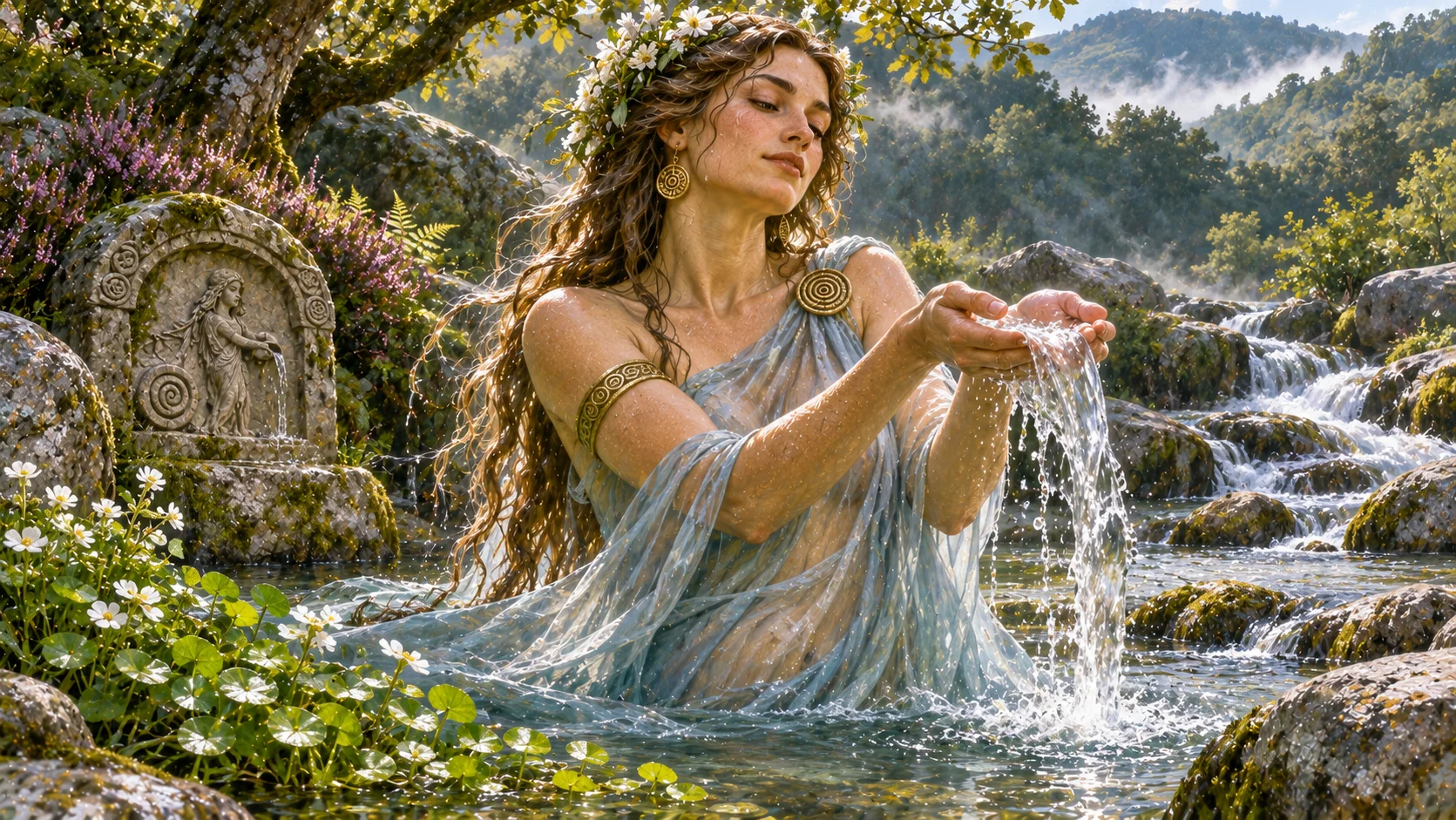
Nabia’s name also appears in the one inscription where the local language itself can be seen. At Braga, beside the rock-cut sanctuary known as the Fonte do Ídolo, an inscription in the Latin alphabet but not in Latin names a divinity as Tongoe Nabiagoi. Scholars read this as a dative phrase in the Lusitanian language, the Indo-European language of the western peninsula known from only a handful of texts, among them those of Lamas de Moledo, Cabeço das Fráguas and Arroyo de la Luz. The second word looks like an adjective built on the same stem as the name of the goddess; the first is a divine name on which no etymology has won agreement. Leite de Vasconcelos linked it to an Irish verb “to swear”, which would make the god one by whom oaths were sworn; a more recent article in Veleia rejects that link and proposes an Indo-European root “to wet”, so that the phrase would mean something like “to the lake of the valley”. If that is right, the inscription names a place or water, not a personal goddess. An altar to Nabia herself, Nabiae Rufina v.s.l.m., was found close to the same fountain, tying her again to water, and Melena saw in the relief of a bearded figure with a cornucopia the genius of the spring, Tongus, with Nabia as his consort.
The Lamas de Moledo stone, one of the main Lusitanian texts, names several local gods; the sources consulted do not show Nabia among them, and her presence there should not be assumed.
What Kind of Goddess?
The water-goddess reading is the oldest and has real support: the names of rivers, the nymph-title at Marecos, the altar beside a fountain at Braga, and the general fact that springs were places of cult. Melena, who set out the case in 1984, put the emphasis elsewhere: he saw a goddess of wooded valleys, woods and hills, comparable with the Latin Diana, noting that the crescent on the Lousada altar fits the moon-and-woodland Diana. The comparison with Diana is a modern one: Le Roux and Tranoy assimilated the nymph of Marecos to Diana, but no inscription equates her with Diana, and nothing in the sources reviewed here connects her to Neptune or Minerva. The Roman identification the stones do show is the juxtaposition with Jupiter at Marecos, and the possible nymph.
Olivares’s contribution was to look at the places. The altars come from hilltops away from villages (Marecos is a hill chapel; at Pedrogão Pequeno an altar naming a man called Cicero, son of Mancus, was found reused in a house at Roqueiro and probably came from a hillfort above it; at El Gaitán in the Sierra de San Pedro the altar was among the ruins called El Castillo), from inside or beside hillforts (as at Monte Baltar in Paredes), and beside a sacred spring (Braga). Melena himself noticed that the dry mountain terrain of El Gaitán sits badly with an exclusively aquatic goddess. A deity found in all three settings, tied to peaks, to communities and to waters, could not simply be a river goddess. Olivares concluded that the peoples of the north-west gave one goddess a very wide range of functions, as other Indo-European peoples did with goddesses of wide competence, each seen as one and also as several. This reading is a hypothesis built on comparison; the inscriptions never describe her functions.
Where Did the Cult Begin?
Melena held that Nabia was in origin a goddess of the Bracara region and that her cult spread along the Roman roads, which explained the outlying altars in Cáceres. Olivares found this unproven and held that the whole northern area looks like a native region of the cult. Prósper used the spelling as a further argument: the Lugo altars write Navia with a v, those of Ourense hesitate, and those of the Braga region and further south write Nabia with a b. These are technical arguments, and the question remains open.
After the Romans, and Study
No ancient writer mentions her, and no source tells how her worship ended. The Marecos altar was reported from a chapel of Our Lady, and it is tempting to see the chapel as built over an older shrine, as happened in many places, but that is a guess. Her name lasted, as Prósper’s catalogue of place-names shows, in the rivers, fountains and hills of the north-west, and modern scholarship has not stopped revising her. A recent count of about twenty-eight inscriptions is still a small basis for any picture.
Kindred Deities
In Extremadura she appears at Trujillo beside the god Salama, and in the same region as Ataecina; in the north she stands alone among goddesses. Among the male gods of the north are Cosus, Bandua and Reve. Her closest analogues are not in Iberia but in the river goddesses of other Indo-European traditions, a comparison that tells more of method than of Lusitanian belief.
Closing Reflection
Nabia is a goddess seen in outline. We know her name and how it was written, her epithets, the places where altars were set, the rivers that share her word, and one spring where a prayer was cut in her people’s own language. We do not know a story about her. The picture of a river goddess is a simplification of something broader: a valley, its water and its hills, a community’s patron and, beside Jupiter on one altar, perhaps something greater. The honest conclusion is a limit. The goddess whom the north-west of Iberia honoured most widely is known only through the plainest of Latin formulae and the shape of a place-name.
Sources & traditions
- EncyclopediaWikipedia — Nabia
- TraditionLusitanian texts, inscriptions and later retellings (Iberia)
Myths change from area to area and from time to time. This chronicle follows the most widely told versions; tellings in other villages, regions and eras may differ.