Ataecina is the name of a goddess who lived, as far as anyone can now tell, almost entirely in the stone of central Extremadura and the Alentejo. She left no myth, no hymn and no description by an ancient author. What survives is a scatter of altars, a few inscribed plaques, some small bronze goats and a restless spelling of her name — a few dozen dedications, with counts running from the high twenties to the forties depending on how strictly a scholar counts — carved in Latin, under Roman rule, by people who still called on a native power. From these stones a figure emerges: a “holy goddess” (dea sancta), a “lady” (domina) attached to a place called Turibriga, whom the Romans sometimes equated with Proserpina, queen of the dead. Almost everything beyond that is argument. The tradition she belonged to is dead, and an honest account has to be written as history, with the thinness of the evidence stated plainly.
The Name and Its Many Spellings
No two scholars have agreed on what her name meant, and the stones do not help, because the ancients themselves did not agree on how to spell it. It is written Ataecina, Ataegina, Adaecina, Adaegina, Attaegina and in other ways, with doubled consonants, simplified diphthongs and swapped voiced and unvoiced stops, and it is often abbreviated on the stones. Juan Manuel Abascal Palazón, in his 2002 entry on her in the Lisbon catalogue Religiões da Lusitânia, drew attention to that frequent abbreviation, which may have helped to make the name familiar. The usual explanation of the instability is the difficulty of writing a native, imperfectly understood word in a Latin script. Catarina Gaspar, discussing the spellings of Endovellicus, has argued that native names were more open to this kind of variation than Roman ones, and she notes that the same wavering is seen in the name of Ataecina.
Where the name came from has been disputed for over a century.
- A Celtic reading, taken up in the nineteenth century by H. d’Arbois de Jubainville and set out by José Leite de Vasconcelos in 1905, analyses the name as a prefix of repetition plus a root meaning “born”, giving “the reborn one”. This is the source of her popular description as a goddess of rebirth.
- A reading from “night” compares Old Irish adaig. Gabriel Sopeña tentatively saw such a link, which would suggest an underworld character. Eugenio Luján (1998) took Adaecina as the original spelling and related it to the Irish word through a Proto-Celtic form, while declining to give a definitive etymology. Patrizia de Bernardo Stempel derived the name from a Celtic word for “night”, “the one of the night”. Against this, Wolfgang Meid suggested that the Irish word may itself be borrowed from Welsh, which would make the connection unlikely, and Abascal is reported to have noted that the Irish word is attested only from about the eighth century, far outside the pre-Roman and Roman period.
- Some scholars would assign the name to a non-Celtic native layer of the peninsula, since the goddess is also attested in regions where Celtic speech is doubtful.
José María Blázquez, whose handbooks on the pre-Roman religions of Hispania long shaped the field, judged the “reborn” reading unworkable and the “night” link difficult. The safest summary is that the meaning of the name is not known, and that her description as a goddess “of rebirth” is a modern reading and not ancient testimony.
What the Stones Say
She first reached scholarship through inscriptions from Mérida, the Roman Augusta Emerita and capital of Lusitania, published in the Corpus Inscriptionum Latinarum (volume II, 1869). Since then the corpus has grown, and the total depends on how it is counted. Recent summaries give figures from the high twenties to the forties, and the spread exists because many dedications to an unnamed dea sancta cannot safely be given to her. Every count agrees on the geography: Ataecina is attested almost entirely in one region, above all around Emerita and in the province of Cáceres, and the single site of Santa Lucía del Trampal supplies, on Rafael Sabio’s reckoning, almost half of all her known inscriptions on the peninsula.
The formulae are simple. A typical altar reads Deae Sanctae Ataecinae Turibrigensi, “to the holy goddess Ataecina of Turibriga”, sometimes adding Proserpinae; others say Dea domina sancta Turibrigensis Adaecina, or only Domina. Many omit the name and say simply “holy goddess”; at the main sanctuary the worshippers knew whom they meant. The dedicants are mostly private people paying a vow. The epithet is usually spelled with -i-: of the texts that give it in full or nearly so, fifteen read Turibri- and only four Turobri- or Turubri-, a point that matters below.
Santa Lucía del Trampal
The richest site is a small early medieval church, Santa Lucía del Trampal, near Alcuéscar in the province of Cáceres. It was identified by the historian Juan Rosco Madruga in 1980. Its well-preserved apse was first dated to the Visigothic period and is now often considered a building of the first years of Islamic rule, and its fabric proved full of reused Roman inscribed stones; an iron-rich spring lies a few hundred metres to the west. Abascal’s study records thirty-one Roman inscriptions from the site, fifteen of them altars to Ataecina (Sabio counts fourteen votive altars to her), plus many uninscribed fragments, and concludes that this was the largest known sanctuary of the goddess, comparable in the Lusitanian world only to that of Endovellicus far to the south-west.
His most interesting argument, developed in a 1996 study of a manuscript report on a survey made in 1900, is that the altars did not necessarily stand on the church’s site. He argued that they probably came from a Roman site nearby called Las Torrecillas, which he thought might be the Turibriga of the goddess’s epithet. Sabio, who has reviewed the competing positions, would instead place the lost town in the immediate surroundings of the church. Both views read the sanctuary as the centre of a real community and not an isolated shrine.
Malpartida de Cáceres and the Bronze Goats
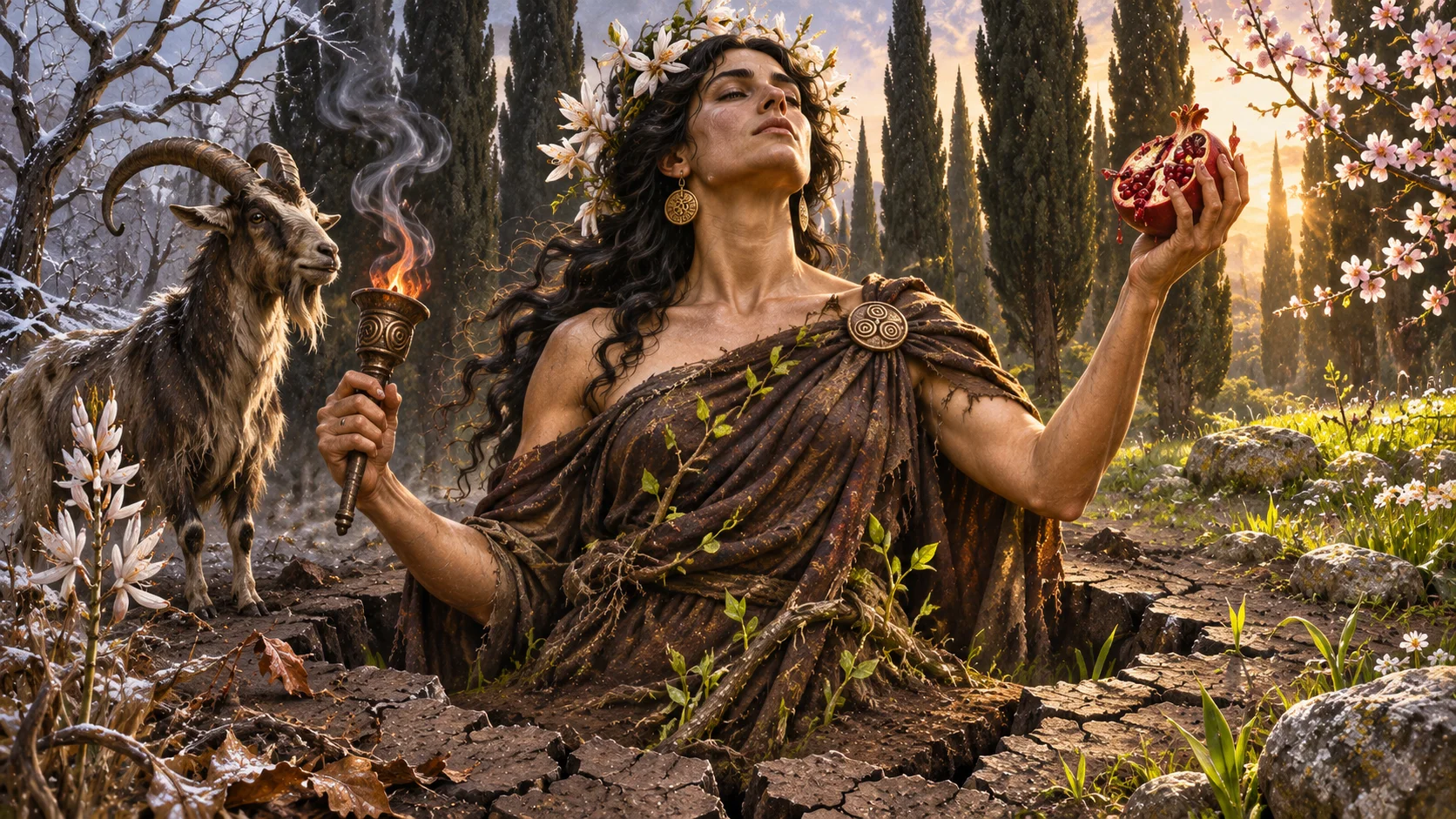
At La Zafrilla near Malpartida de Cáceres, small bronze goats were found whose inscriptions name the goddess; the epigrapher Fidel Fita read them in 1885, and one carries a little inscribed plaque attached to the legs of the animal. These are among the few objects that tie a particular animal to her, and the goat has accordingly been taken as her sacred animal. A modern study by Martín Almagro-Gorbea (2018), “Las cabritas de bronce de la diosa Ataecina”, treats about thirty such figurines. It reports that their distribution overlaps with that of the Ataecina inscriptions and, since their archaeological context is unknown, dates them on stylistic grounds from the third century BC into the second or third century AD. He reads them as evidence of a popular rite lasting more than five centuries and has suggested an ancestral mother goddess behind the cult. That dating and that thesis are his own and rest on style, not on a dated context. Small bronze animals were offered to many cults, so only goats attached to a text are certain.
Turibriga: a Place That Cannot Be Found
Her commonest epithet, Turibrigensis, points to a town called Turibriga. For a long time the name was confused with Turobriga, a town that Pliny the Elder names among the places of the “Celtic” part of Baeturia and that is generally placed at Aroche in Huelva, the Roman Arucci. That equation still stands in the Tabula Imperii Romani, but most specialists have given it up since the 1990s: of the texts that give the epithet in full or nearly so, fifteen read Turibri- and only four Turobri- or Turubri-, which can be explained as slips of vowel assimilation or confusion with the better-known town. Turibriga is therefore a different place, known only from inscriptions, and nobody has found it. Abascal and Sabio both look for it in central Extremadura, close to Santa Lucía, and the altars cluster in the country around Emerita and Cáceres.
One text is a rare case of a worshipper naming his home. At Caleruela, in the province of Toledo, an altar to Ataecina was set up by a man called Bassus, whom the inscription calls Turobri(gensis), a native of the goddess’s town. María Pilar González-Conde Puente studied the stone as “Bassus Turobrigensis” and noted that he is the only dedicant who states his origin; elsewhere the word is merely the goddess’s epithet. It is a small human document: a man a long way from the core of her cult who still carried her name and the name of her town with him.
What Kind of Goddess?
The standard picture, put forward in Blázquez’s handbooks, makes her a chthonic or “infernal” goddess, a power of the earth and underworld, and so a natural partner of Proserpina. Other accounts stress agrarian and fertility aspects, and Sabio has recently added possible healing powers, pointing to the iron-rich spring beside Trampal. The views are no longer treated as exclusive. Neither rests on a native text; both are inferences from Latin evidence and from the one equation the Romans made.
A third strand concerns the moon. A lunar reading is sometimes offered on the strength of the “night” etymology and of crescent motifs reported on some altars. A crescent is a common decorative motif, so it is a hint and not a proof of lunar attributes. The same caution applies to the title sancta: it is an ordinary Roman honorific, used also of Endovellicus in the Alentejo, so the epithet is not a fingerprint, and it has been argued since the 1990s that reading every nameless dea sancta in Extremadura as Ataecina goes beyond the evidence.
One property is reasonably clear: she was a tutelary divinity, tied to a place and its people, the lady of Turibriga. Whether her care extended to the dead, the seasons, herds or justice has to be read from associations, not from any statement.
Proserpina
Every account says that the Romans identified her with Proserpina, and the epigraphy bears it out in a few places. At Mérida there are dedications naming her in full as Dea Ataecina Turibrigensis Proserpina, and shorter formulae with the same elements. Two further Mérida pieces published by Méndez Grande came from excavations in 2004–2005 and 2007 and share a close connection with water. The identification is real but narrower than usually presented: Proserpina also appears alone in Mérida dedications, and not every one of those need concern Ataecina. The equation is a Roman-period one, made by people already writing Latin on altars of Roman shape, and it is this equation that gave her the underworld character most modern accounts emphasise. Some recent writers prefer to see the pairing as local elites negotiating a place in a new Roman sphere of power, rather than as syncretism in the strict sense; that is an interpretation, not a fact.
Justice from Below: the Thief Text
A frequent claim is that she was invoked in lead curse tablets. The sources checked for this article give no securely identified lead tablet addressed to her. The best-known text of this kind is carved on stone: a marble slab from Mérida, said to have been found at the bottom of a reservoir, dedicated to the goddess in her full style as Ataecina Turibrigensis Proserpina and catalogued in Hispania Epigraphica (HEp 21481). It is an execratio, a curse, and its subject is stolen clothing. Popular summaries report that it lists six tunics, two linen cloaks and an undergarment and asks that the thief be brought before the goddess herself; that detail comes from secondary accounts and should be checked against the edition. R. S. O. Tomlin discussed the text in 2013 in a study of cursing thieves in Iberia and Britain.
It is not a spell in the usual sense but a plain petition: the person robbed hands the thief over to the goddess, who is expected to find him. It shows that for someone in Mérida she was a power of retribution, which fits a chthonic nature without establishing it.
After Rome and Rediscovery
When the cult ended is not known; the sanctuary’s decline appears to fall in the third century. The Trampal altars were broken up and built into an early medieval church, as though the pagan sanctuary had been quarried and its site Christianised. Some scholars have proposed that the cult of Saint Eulalia of Mérida replaced or continued the older devotion to Ataecina, and Sabio argued in 2020 that the church of Santa Lucía may have been founded by a monastic community from Mérida, with the martyr gradually displacing the goddess there. The idea is attractive and untestable, and no ancient text equates the goddess with a saint.
The modern study of Ataecina begins with the 1869 Corpus. Leite de Vasconcelos gave her a long chapter in his Religiões da Lusitânia, favouring a Celtic goddess and the “reborn” etymology; Blázquez set the “infernal” interpretation in the later twentieth century; Abascal’s work on Trampal redrew the map of the cult and questioned doubtful testimonies; and Almagro-Gorbea has argued that her roots lie before Rome. The picture can still shift with a single stone. In 2016 Marta Fernández Corral published a tiny marble altar, about nineteen centimetres high, kept in the monastery of San Salvador de Oña in Burgos, naming Ataecina with the epithets of Turibriga and Proserpina. She thought it came from the Mérida area and travelled perhaps with a migrant or in the hands of a later collector, although the Spanish epigraphic yearbook ascribes it to Trampal. How it reached Burgos is unknown.
Kindred Deities
She is often paired with Endovellicus, but the pairing is modern. He belonged to a sanctuary in the Alentejo near Alandroal, she to the country around Mérida and Cáceres, and the stones do not link them; what they share is the way they are known, through Latin altars, and sanctuaries large enough to compare. The third Lusitanian name usually grouped with them is Nabia, a goddess found mostly north of the Douro. Each is a local god whose cult was strong enough to be written down in the Roman period, and none represents a single “Lusitanian religion”.
Closing Reflection
Ataecina is a goddess seen entirely from the outside. We have her name in many spellings, her title, a town we cannot place, a few animals in bronze, a possible crescent on a pediment and the worship of people who dealt with the Romans in Roman terms. We do not have her story. The popular description, a goddess of death and spring, comes largely from the equation with Proserpina and from an etymology that experts have been unable to confirm. What the evidence will bear is more modest and, in its way, more moving: a lady of a place, honoured by farmers and soldiers and the robbed, by people who set up a stone, or a goat in bronze, and went home.
Sources & traditions
- EncyclopediaWikipedia — Ataegina
- TraditionLusitanian texts, inscriptions and later retellings (Iberia)
Myths change from area to area and from time to time. This chronicle follows the most widely told versions; tellings in other villages, regions and eras may differ.