Bathin — also Mathim or Bathym — is the eighteenth demon of the Ars Goetia: a mighty duke who commands thirty legions of spirits, a demon of herbs and precious stones and, most strikingly, of instantaneous travel — able to carry men swiftly from one country to another.
The Duke on the Pale Horse
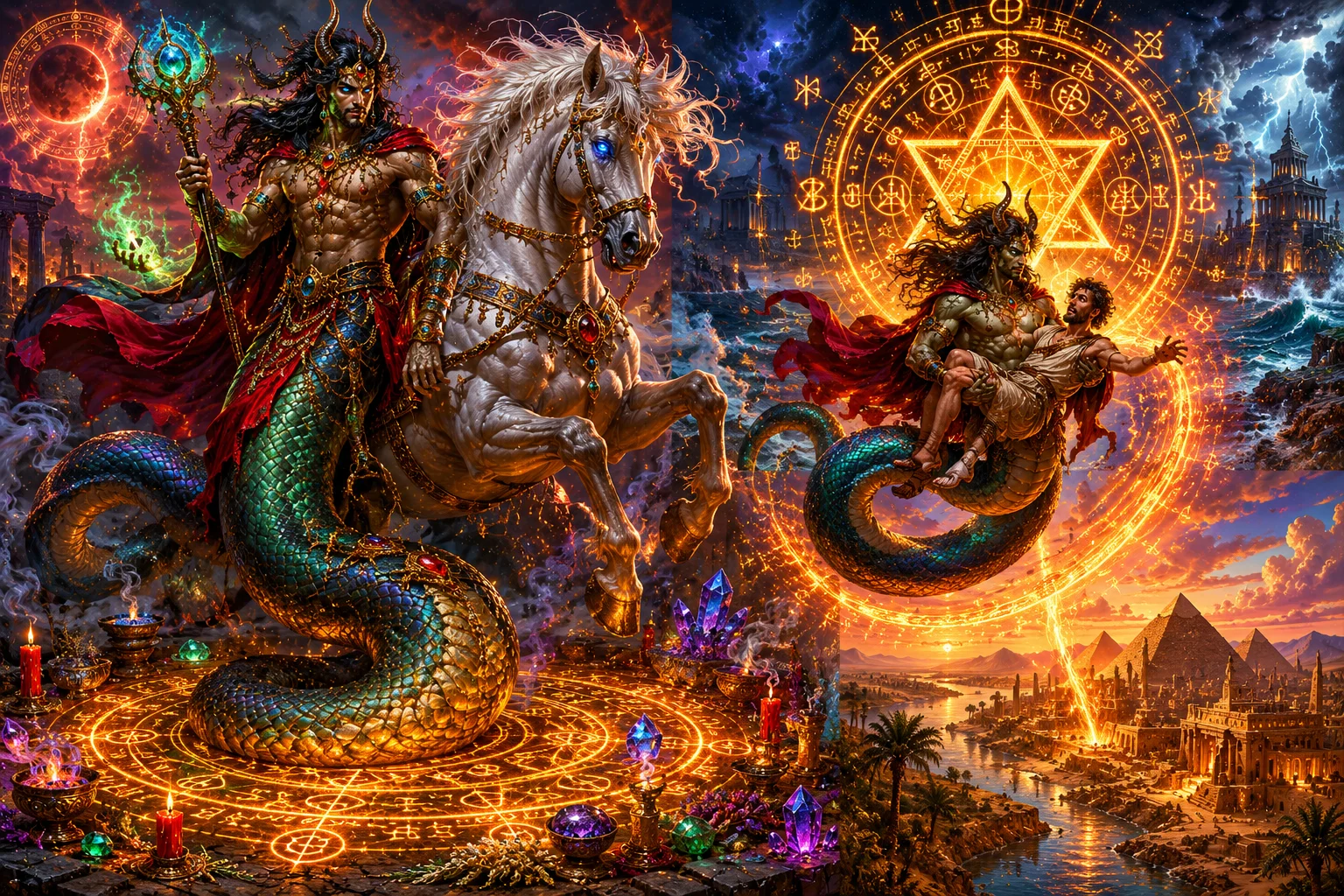
Bathin is a great and strong duke, the eighteenth-named of the seventy-two Goetic demons, commanding thirty legions of spirits. He appears as a strong man with the tail of a serpent, riding upon a pale (or pale-coloured) horse. The image of the serpent-tailed man mounted on the pale horse is his characteristic form.
Knower of Herbs and Stones
Bathin’s first power is knowledge of the natural world: he knows the virtues (powers) of herbs and of precious stones — the magical and medicinal properties of plants and gems — making him a demon of natural magic, alchemy, and the lore of the earth’s treasures. The magician seeking the secret powers of herbs and stones might call upon him.
The Carrier Between Lands
Bathin’s most remarkable power is transportation. He can carry or transport men swiftly from one country to another — conveying a person instantly across great distances, from land to land. This power of magical travel — teleportation, in effect — made him one of the most practically desirable of the Goetic demons for any magician who wished to journey far in an instant. Compelled by his seal and conjuration, the serpent-tailed duke on the pale horse, Bathin is the demon of natural lore and swift travel — who knows the virtues of herbs and stones and carries men instantly between distant lands.
Bathin Before the Goetia
The Ars Goetia did not invent Bathin. By the time a seventeenth-century compiler slotted him in at number eighteen, the serpent-tailed duke had already been in print for the better part of a century — and, stranger still, he had been printed by a man who did not believe in him.
The oldest surviving catalogue in which he appears is the Pseudomonarchia Daemonum, the “false monarchy of demons”, appended in 1577 to a much larger Latin work by the Dutch physician Johann Weyer — a former pupil of Cornelius Agrippa, and one of the earliest and bravest opponents of the witch trials. Weyer’s great book argued that the women being burned across Europe were ill, elderly, deluded or slandered, not conspirators with hell. The demon list was part of that argument. He set out the whole absurd bureaucracy — the ranks, the legions, the pompous titles — precisely so that readers could see how ridiculous the conjurors’ claims were. It is one of the great ironies of Western occultism that the most influential demon catalogue in the tradition was assembled by a sceptic as an exhibit for the prosecution, and was then read for four hundred years as a manual.
Weyer withheld the operative parts. His entries describe what each spirit looks like and what it claims to do, but he supplies no seals — the sigils that later readers treat as the heart of the system are a later addition, supplied by the Lemegeton tradition. Bathin’s famous seal, in other words, is younger than Bathin’s description.
Seven years later the English gentleman Reginald Scot carried the list into English in The Discoverie of Witchcraft (1584), a book written with the same sceptical purpose and rather more sarcasm. Scot’s rendering of this particular duke is compact and complete: a great and strong duke who appears like a strong man with the tail of a serpent, sitting on a pale-coloured horse, who knows the virtues of herbs and precious stones, can carry a man suddenly from one country to another, and rules thirty legions. Every element of the Goetic entry is already there. What the Ars Goetia adds is not lore but apparatus.
Scot’s scepticism did not go unanswered. King James VI of Scotland named him in the preface to Daemonologie (1597), writing expressly against those who denied that witchcraft existed at all. The demon lists survived the argument by outliving both sides of it.
A name that will not hold still
Bathin, Bathym, Mathim, Marthim — the spelling wanders from manuscript to manuscript, and the wandering is itself informative. These catalogues were copied by hand, one exemplar at a time, and every recopying introduced fresh damage that no one could correct against a spoken original, because there was none. No secure etymology has ever been established for the name, and honest treatments say so. What we have is not a word with a meaning but a shape that survived transmission — which is a fair description of most of the seventy-two.
Duke, Legion, Number: Where Bathin Sits in the Machine
The Goetic hierarchy is a feudal court transposed onto hell. Its spirits are kings, princes, dukes, marquises, earls, presidents and — in exactly one case — a knight. Duke is the commonest title in the list, and the ranks are not decorative: the grimoire treats them as jurisdictional, so that a duke is approached as one would approach a duke, with the correct address, at the hour the book assigns his rank, by a magician who has established his own authority first.
The thirty legions deserve a moment. Christian demonology took the word from the possessed man of Gerasa, who told Christ his name was Legion, for they were many — and a Roman legion, at full paper strength, was around six thousand men. Do the arithmetic the tradition invites and Bathin’s command comes to something near a hundred and eighty thousand spirits. The grimoire never performs that sum, and it would be wrong to insist it means to; but the choice of a military unit of account is deliberate. Hell in these texts is not chaos. It is an army with a payroll, and the magician’s claim is that he can requisition a division of it.
His number — eighteenth — belongs to one particular list rather than to Bathin. Weyer’s catalogue and the Ars Goetia are not the same roll: Weyer carries spirits the later book drops, Pruflas among them, and lacks several the later book includes, such as Vassago, so the two sequences cannot line up and Bathin does not stand at the same place in both. Rank in this hierarchy is stated inside the entry — duke, thirty legions. The number in front of it is a fact about the manuscript, not a measure of standing, and reading importance into it is reading the index instead of the text.
The Doctrine of Virtues
To a modern reader, “knows the virtues of herbs and precious stones” sounds vague, even quaint. To the period that produced Bathin it was one of the most valuable things a spirit could offer, because it named a specific and enormous body of contested knowledge.
A virtue, in medieval and early modern natural philosophy, is a power seated in a substance: the property by which a stone stanches blood, or a root breaks a fever, or a gem protects its wearer from poison. Two whole literary genres existed to catalogue them — the herbal and the lapidary. Dioscorides’ pharmacological survey stood behind the first for a millennium and a half; the second ran from Pliny’s book on gemstones down through Marbode of Rennes’ verse lapidary, which was copied, translated and mined across Europe for centuries. These books agreed on a great deal and contradicted one another constantly. Which virtues were real? Which had been garbled in copying, like Bathin’s own name? A spirit who simply knew would settle a question that no amount of reading could.
He is not alone in the offer — the tenth spirit, Buer, likewise teaches the virtues of herbs and plants and heals the sick — which tells us something about demand. The magicians who commissioned these manuscripts were not, for the most part, seeking apocalypse. They wanted what their neighbours wanted: remedies that worked, stones worth buying, and an edge over the apothecary.
There is a quieter logic in pairing that knowledge with Bathin’s other gift. Herbs and stones are the fixed treasures of the earth, rooted in the exact places where they grow and are dug; the same duke who knows what the ground contains is the one who can put you instantly on top of it. Knowledge of place, and freedom from distance, in a single spirit.
Can a Demon Really Move a Body?
Bathin’s power of carrying men from one country to another lands squarely in the middle of the most bitterly argued question in European demonology, and the grimoires state it so flatly that it is easy to miss how loaded it was.
The problem had scriptural precedent on the good side of the ledger. Philip is caught away by the Spirit and found at Azotus. In the story of Bel and the Dragon, an angel seizes the prophet Habakkuk by the hair and sets him down in Babylon with a meal for Daniel. Ezekiel is lifted by a lock of his hair between earth and heaven. Miraculous transport was an established divine prerogative — so the question was whether a fallen spirit retained it.
Canon law had said no. The text known as the Canon Episcopi, circulating from the early tenth century and later embedded in the standard body of church law, held that women who believed they rode out at night in the company of a pagan goddess were deluded — that the journey happened in the imagination, planted there by the devil, and that to believe otherwise was itself an error. For centuries that was the official position: no real flight, only a dream with an author.
The witch-hunting literature of the late fifteenth century reversed it. The Malleus Maleficarum (1486) argued at length that witches are genuinely, bodily transported — a doctrinal shift with a body count, because a woman who merely dreamed she flew was sick, while a woman who actually flew had gone somewhere and done something. Bathin’s entry, transmitted through Weyer and Scot, sits inside that quarrel like a fossil. It asserts real transport, of real men, over real geography, as a service on offer. And it is worth noticing which side of the argument each writer was on: the men who preserved the claim in print were the ones trying to stop the burnings.
The Pale Horse
No reader in the sixteenth century could meet a pale horse in a religious text innocently. The fourth horseman of Revelation rides one — the Greek word is the sickly yellow-green of illness and vegetation, not the white of purity — and his rider is named Death, with Hades coming on behind him. Whether the original compiler intended the echo cannot be recovered, but the association was unavoidable for anyone who heard the phrase, and it does real work: it tells you the register of the encounter before a single power is listed.
The serpent’s tail does comparable work. Demonic iconography in this period is built by grammar rather than by portraiture — a human above, an animal below, means a mind you can bargain with attached to a nature you cannot trust. The upper half negotiates; the lower half is the reason you stay inside the circle. Bathin’s figure is therefore legible at a glance to an audience trained on church carving and woodcut: a courtly form, a serpent’s ending, mounted on the horse of the last rider. Nothing in that image is accidental, and nothing in it is reassuring.
The Circle, the Triangle and the Brass Vessel
The apparatus the Ars Goetia builds around these older descriptions is worth understanding, because it sets the terms on which Bathin is met: he is bound and compelled, never invited.
The operator stands in a drawn circle inscribed with divine names; the spirit is required to manifest in a triangle set outside it, at a fixed distance. The seal is engraved and worn on the breast as a lamen — a badge of authority, exactly as a herald wears the arms of the lord whose word he carries. The whole procedure is legal in temper rather than devotional. The magician does not worship, he serves notice, and every conjuration in the book is essentially a summons backed by an escalating threat of penalty.
Behind that stands the frame story the grimoire inherits: Solomon shut the spirits into a vessel of brass and sank it, and the vessel was later broken open by people who assumed anything hidden that carefully must be treasure. The spirits went free; the seals remained. It is a beautifully economical piece of mythmaking, because it explains at once why demons are loose in the world, why the seals still work, and why the book you are holding is worth what the scribe charged for it.
From Manuscript to Mass Culture
The Lemegeton circulated in handwritten copies for two and a half centuries, several of which survive in British collections, before S. L. MacGregor Mathers edited the first book of it and Aleister Crowley published it in 1904 as The Book of the Goetia of Solomon the King. That single edition did more than any manuscript ever had: it made the seventy-two names, seals and descriptions widely available in English, and everything downstream — the ceremonial revival, the mid-century occult publishing boom, the roster of demons that fantasy novels, role-playing games, comics and heavy metal have been drawing on ever since — runs through it. When a modern game hands you a demon with a hierarchical rank, a fixed number of legions and a sigil, it is quoting this book, usually without knowing it.
The tradition is also still practised. Contemporary occultists of several currents work with the Goetic spirits in earnest, some understanding them as autonomous entities to be treated with the caution the grimoire demands, others as structures of the practitioner’s own mind given names and faces so they can be addressed. Both readings take the text seriously; neither treats it as a curiosity.
Why the Duke of Distances Endures
Strip away the brass vessel and the legions and Bathin is a promise about two very ordinary kinds of powerlessness.
The first is not knowing what things are for. Before pharmacology there was an entire world of leaves and roots and stones whose properties were rumoured, disputed, and occasionally fatal to test. Someone who knew — really knew, not merely repeated what the last copyist wrote — would have been worth almost any risk.
The second is distance. To the people who copied and read these manuscripts, another country was a matter of weeks: bandits, tolls, sea passage, plague orders, letters that arrived after the person who wrote them had died. To be somewhere else, now, is one of the oldest wishes there is, and it has never gone away — we have merely industrialised it, and are still not satisfied. Every teleporter in science fiction, every fantasy of stepping through a door onto another continent, is Bathin’s offer restated for a readership that no longer needs to name a demon to make it.
What the myth records, then, is not a belief in a serpent-tailed nobleman on a sallow horse. It is a very precise account of what a frightened, curious, slow-moving civilisation would have paid for — and a warning, in the shape of the horse it chose, about the price.
Sources & traditions
- EncyclopediaWikipedia — Bathin
- TraditionGoetic texts, grimoires and later commentary
Myths change from area to area and from time to time. This chronicle follows the most widely told versions; tellings in other villages, regions and eras may differ.