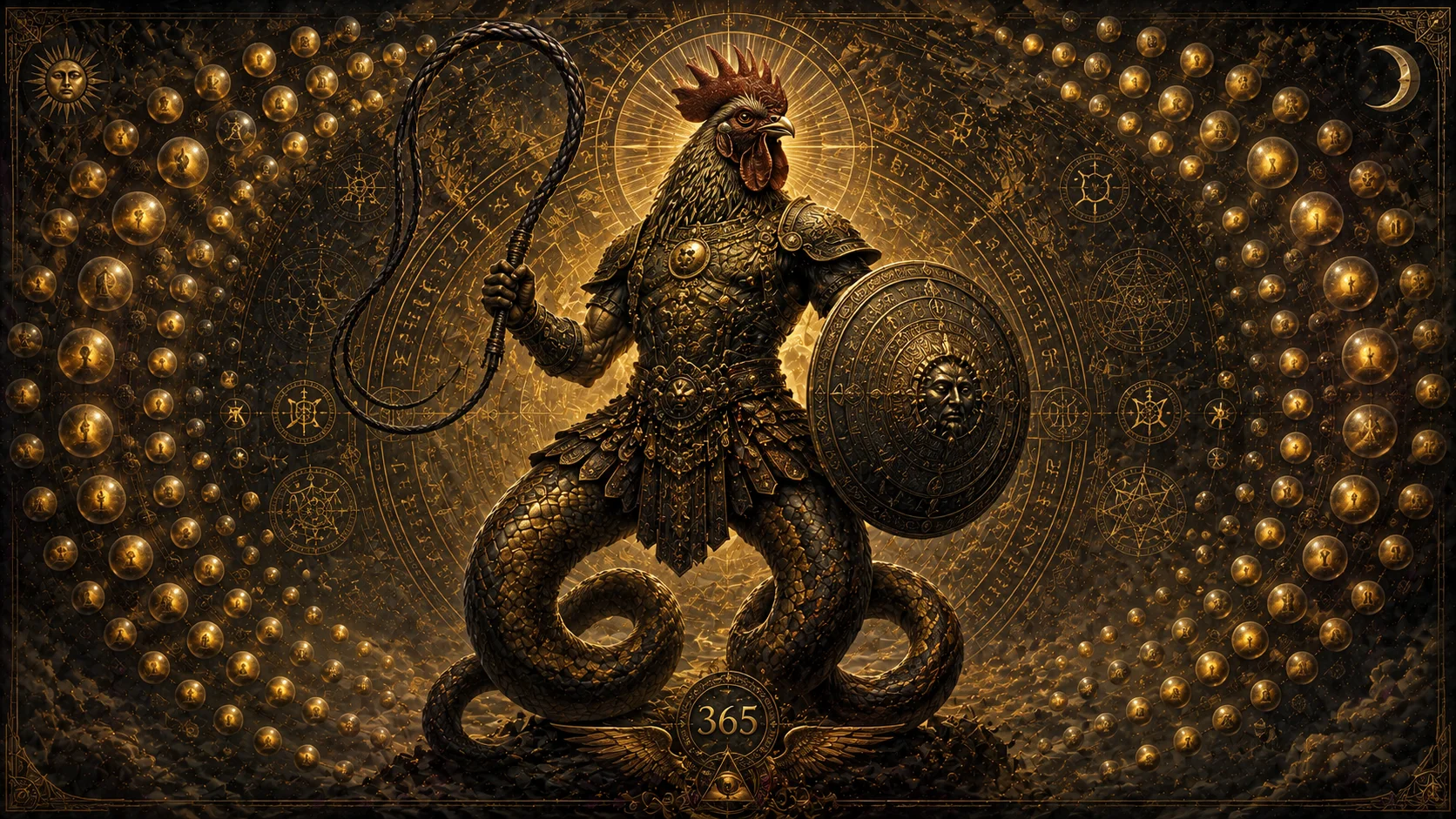
Abraxas (Abrasax) is one of the most enigmatic and powerful names of Gnosticism — a great cosmic being, often depicted as a rooster-headed warrior with serpent legs, whose name was held to contain a sacred numerical mystery and who in some Gnostic systems was the supreme ruler over the 365 heavens. A figure of magic, mystery, and cosmic power, Abraxas appears on countless ancient amulets and gems, and has fascinated mystics, magicians, and thinkers from antiquity to the modern age.
The Name of the 365 Heavens
Abraxas is associated above all with the number 365 — for the seven Greek letters of his name (Α-Β-Ρ-Α-Σ-Α-Ξ), taken as numerals, add up to 365, the number of the days of the year and, in the Gnostic system of the teacher Basilides of Alexandria, the number of the heavens or emanations of the cosmos. In Basilides’ teaching, Abraxas was the great ruler (archon) presiding over these 365 heavens, the head of the vast hierarchy of cosmic powers, a being of supreme rank in the unfolding of the divine into the world. His name itself was thus a sacred cipher, a word of power encoding the structure of the cosmos.
The Rooster-Headed Warrior
Abraxas is best known from the “Abraxas stones” or “Abrasax gems” — ancient carved amulets, used in magic and as talismans, that survive in great numbers. Upon them he is depicted in a distinctive composite form: the head of a rooster (or cock, symbol of vigilance and the dawn), the body of a man, often in armour, and two serpents for legs, wielding a whip or flail and a round shield. This striking image — bird, man, and serpent combined — made Abraxas a potent magical figure, his form a synthesis of cosmic powers, and his image was carried for protection and invoked in spells across the ancient Mediterranean world.
Beyond Good and Evil
The ambiguous nature of Abraxas — at once a name of supreme cosmic power and a figure of magic, neither simply a good Aeon nor simply an evil Archon — gave him an enduring fascination. In the modern age he was famously taken up by the psychologist Carl Jung, who in his esoteric work the Seven Sermons to the Dead presented Abraxas as a deity uniting and transcending the opposites of God and Devil, good and evil, light and dark — a symbol of the totality beyond all dualities. Through Jung and through Hermann Hesse’s novel Demian, in which Abraxas is the god who unites the divine and the diabolical, the ancient Gnostic name gained a powerful new life as a symbol of wholeness and the union of opposites.
Legacy
Abraxas endures as one of the most mysterious and resonant names of the Gnostic and magical tradition — the rooster-headed, serpent-legged cosmic ruler of the 365 heavens, the sacred cipher of the year, the figure of the protective gems. From the teaching of Basilides to the countless ancient amulets to the modern reimagining as the god beyond good and evil, Abraxas has had one of the longest and richest afterlives of any Gnostic figure. As the name of cosmic power and the union of opposites, Abraxas remains a potent and enigmatic emblem of the esoteric imagination.
Alexandria, and the Teacher Nobody Can Quote
Everything we know about the man who first taught Abraxas comes from people who wanted him refuted. Basilides taught in Roman Alexandria in the second century, in a city where an Egyptian priest, a Greek philosopher, a Jewish scribe and a Christian catechist could argue in the same colonnade and understand one another. He wrote at length — a commentary on the gospel running to twenty-four books — and not one page of it survives intact. What we have are quotations preserved by his enemies, and summaries written by men who found his teaching monstrous.
That leaves us with two Basilides, and they do not fit together. Irenaeus, writing in Gaul, describes a teeming cosmos: an ungenerated Father, a descending chain of powers, and finally three hundred and sixty-five heavens, each with its own angelic rulers, the whole hierarchy crowned by the ruler whose name is Abrasax. Hippolytus, writing in Rome, describes something almost unrecognisable — an austere and difficult philosophy of a God who is not, a cosmic seed containing everything that will ever exist, and a threefold Sonship straining upward toward a light it half-remembers. In Hippolytus’ version Abrasax barely appears at all.
Scholars have argued for well over a century about which account is closer to the man himself, and the honest answer is that we do not know. Clement of Alexandria, who at least lived in the same city a generation or two later, quotes Basilides and his son and pupil Isidore on quite different matters — on suffering, on martyrdom, on the discipline of desire — and never mentions the rooster-headed god at all. Abraxas may have been the summit of Basilides’ system. He may equally have been one technical term among hundreds that a hostile summariser seized on because it sounded absurd.
How a Name Becomes a Number
The arithmetic is worth doing rather than merely being told. Greek used its alphabet for counting, so every word in the language was also, silently, a sum. Take the letters one at a time: alpha is 1, beta 2, rho 100, alpha 1, sigma 200, alpha 1, xi 60. The total is 365, and nothing about it is a coincidence discovered later — the name was almost certainly built to reach it.
This practice, isopsephy, was not an occult speciality. Lovers scratched it on walls in Pompeii, boasting of a girl whose number they gave without her name. The author of Revelation used it when he set the number of the beast. What made it powerful was not secrecy but the conviction, deeply held across the ancient Mediterranean, that language and number were the same substance seen from two angles — that if a name added up to the year, the name and the year were somehow the same thing.
Abraxas was not even the only such name. Jerome, writing around the year 400, remarked that the pagans reached the identical number under other letters and called it Mithras — a claim that works for the spelling ΜΕΙΘΡΑΣ, which does indeed total exactly 365. Whether Jerome was reporting history or scoring a polemical point, the remark tells us what mattered: in a world that had recently settled on a 365-day year, a divine name that was that year claimed authority over time itself.
The spelling deserves a note, because the modern world has settled on the wrong one. The ancient gems and papyri overwhelmingly write Abrasax, with the sigma before the xi. Abraxas, the form that conquered the modern imagination, reaches us largely through the Latin transmission of the heresy-hunters. The sum survives the swap untouched — addition does not care in what order the letters come, and both spellings total 365 — but it is the older form that the cutters actually put on the stones.
Passwords for Three Hundred and Sixty-Five Doors
Why would anyone need to know the names of the powers? Because, in the Gnostic account of things, the soul has to get past them. The cosmos of Basilides is not a cathedral but a customs post repeated three hundred and sixty-five times, each level administered by rulers who have no particular interest in letting anyone through. Knowledge — gnosis — was in large part the possession of the right names to speak at the right gate.
Irenaeus reports that the Basilidians guarded these names closely, and passed on the maxim that one should know everyone while being known by no one. He complains that they would deny their own beliefs under questioning rather than suffer for a mere name, and so moved unnoticed among ordinary Christians. He also attributes to them the teaching that scandalised him most: that Christ, who could not suffer, exchanged forms with Simon of Cyrene on the road to Golgotha, so that Simon was crucified in his place while Jesus stood by and laughed at the mistake. Whether Basilides truly taught this or whether it is a rival’s caricature has never been settled — but it shows the logic these systems ran on. A being of pure spirit cannot be nailed to anything. If the crucifixion happened, someone else must have been on the cross.
The Abrasax the Heresiologists Missed
For eighteen centuries Abraxas was known only through the men who denounced him and through anonymous carved stones. Then, in 1945, a jar of Coptic codices came out of the ground near Nag Hammadi in Upper Egypt, and Gnostic writers were finally allowed to speak in their own voices.
Abrasax is in them — and he is not a monster. In the treatise usually called the Gospel of the Egyptians he is one of four ministering powers attending the great luminaries of the heavenly world, serving the light named Eleleth as Gamaliel, Gabriel and Samblo serve the other three. In the Apocalypse of Adam he appears again in the same calm register, descending with Sablo and Gamaliel to carry the saved out of the fire. He surfaces elsewhere in the collection too, always as an aeon or a helper — part of the furniture of the upper world rather than a tyrant lording it over the lower one.
This is the single most useful correction the Nag Hammadi library made to the popular picture. The terrifying archon of the 365 heavens and the frightening cock-headed figure on the amulets are largely a construction of outsiders — the heresiologists who wanted an absurdity to mock, and the antiquarians who wanted a demon to collect. The Gnostics who actually wrote the name down wrote it calmly.
The Gems: What They Actually Were
Several thousand engraved stones of this type survive in museum cabinets, and they are one of the largest surviving bodies of evidence for how ordinary people in the Roman Empire handled the invisible. They are small — usually between one and three centimetres — cut in green or red jasper, haematite, carnelian, chalcedony, sometimes magnetite, and drilled or set so they could be worn against the skin. They were not read. They were carried.
Calling them “Gnostic gems” is a habit inherited from early modern collectors, and modern catalogues have largely dropped it in favour of magical gems, for a plain reason: almost nothing on them is specifically Gnostic. They belong to a common professional repertoire that any competent gem-cutter in Alexandria or Antioch could supply, and their customers wanted results, not doctrine. A gem cut with the lion-headed serpent Chnoubis, his mane radiating like the sun, was worn for the stomach — a Roman remedy for indigestion and worse. Another class shows a womb rendered as a cupping-vessel closed with a key, worn by women against haemorrhage and the dangers of childbirth. Abrasax sits in this company: not the emblem of a sect, but a name on the shelf, reached for when a name of power was needed.
Recognising the anguipede
The composite figure has a proper art-historical name — the anguipede, the snake-footed one — and what is striking about the type is how little it varies. Hundreds of stones repeat the same formula almost without deviation, down to the profile of the comb and the outward turn of the serpents’ heads. The revealing detail is the shield: on that round or oval face the cutter very often incised not the name Abrasax but ΙΑΩ.
IAO is the Greek way of vocalising the Hebrew divine name that pious Jews would not pronounce, and it is among the commonest words on the whole class of gems. The figure is therefore not straightforwardly “a portrait of Abraxas” at all — the name ABRASAX is usually on the reverse, and the same body carries other names on other stones. What we are looking at is closer to a solar warrior: the cock that announces the sunrise, the whip of the charioteer who drives the sun across the sky, the serpents that root him in the earth. Where the reverse is not blank it carries the rest of the working vocabulary — Sabaoth, Adonai, the archangels, and the great formula ABLANATHANALBA, which reads the same in both directions. Several of the most-used words on these stones are palindromes, and it is hard not to read that as deliberate: a word that cannot be turned around.
Abracadabra, and an Honest Uncertainty
Sooner or later everyone asks whether abracadabra comes from Abraxas. It is one of the most frequently repeated claims in the whole subject, and it cannot be demonstrated. What is solid is that abracadabra is genuinely ancient: Serenus Sammonicus, in a Latin medical poem of the early third century, prescribes writing it in a shrinking triangle, dropping one letter each line until the word wastes away to nothing, and hanging it round the neck of a fever patient so that the fever wastes with it. That is exactly contemporary with the gems, and it comes from exactly the same instinct — that a name of no known language, handled with the right procedure, does work in the world.
Whether the two words share a root, or merely share an era and a purpose, no one can say. It is a reasonable guess and nothing more, and it belongs here as a guess.
The Long Detour Through the Cabinet
The gems never quite went underground. They were ploughed up, traded, reset in medieval rings, and by the seventeenth century they were being collected in earnest by antiquarians who filed them under the heading of Basilides on the strength of a sentence in Irenaeus. That misattribution stuck for three hundred years, and it did something curious: it kept Abraxas alive in the European imagination as a specifically heretical god, an emblem of forbidden knowledge, at precisely the moment when forbidden knowledge was becoming fashionable.
By the time the psychologists and novelists of the twentieth century reached for the name, they were inheriting that centuries-old framing rather than anything a second-century Alexandrian would have recognised. The rock band Santana titled an album Abraxas in 1970 and printed a passage from Hesse on the sleeve, which is a fair measure of how the name now travelled: from a heresiologist’s summary, through a collector’s drawer, into a novel, onto a record cover. Very little of the original doctrine survived the journey. The charge in the word survived all of it.
Why the Name Refuses to Die
Abraxas answers a need that orthodoxy has never been able to meet, and it is not a need for evil. It is a need for a god who is not embarrassed by the world.
Any system that insists the divine is wholly good has to explain what the rest of existence is doing here — the disease, the accident, the cruelty that arrives without cause. Abraxas is what happens when someone refuses to split the answer in two. Sun and serpent, bird and man, the number of the year that contains every kind of day: the figure is deliberately built out of things that should not belong together, and the ancient customer who tied it round his neck against fever was not asking for goodness. He was asking for something big enough to cover everything that might happen to him.
That is why the name outlived the sect, the language, the empire and the misspelling. We still have no better answer than Basilides did, and we still reach, in the small hours, for a word that promises the whole of it at once.
Sources & traditions
- EncyclopediaWikipedia — Abraxas
- TraditionGnostic texts, grimoires and later commentary
Myths change from area to area and from time to time. This chronicle follows the most widely told versions; tellings in other villages, regions and eras may differ.