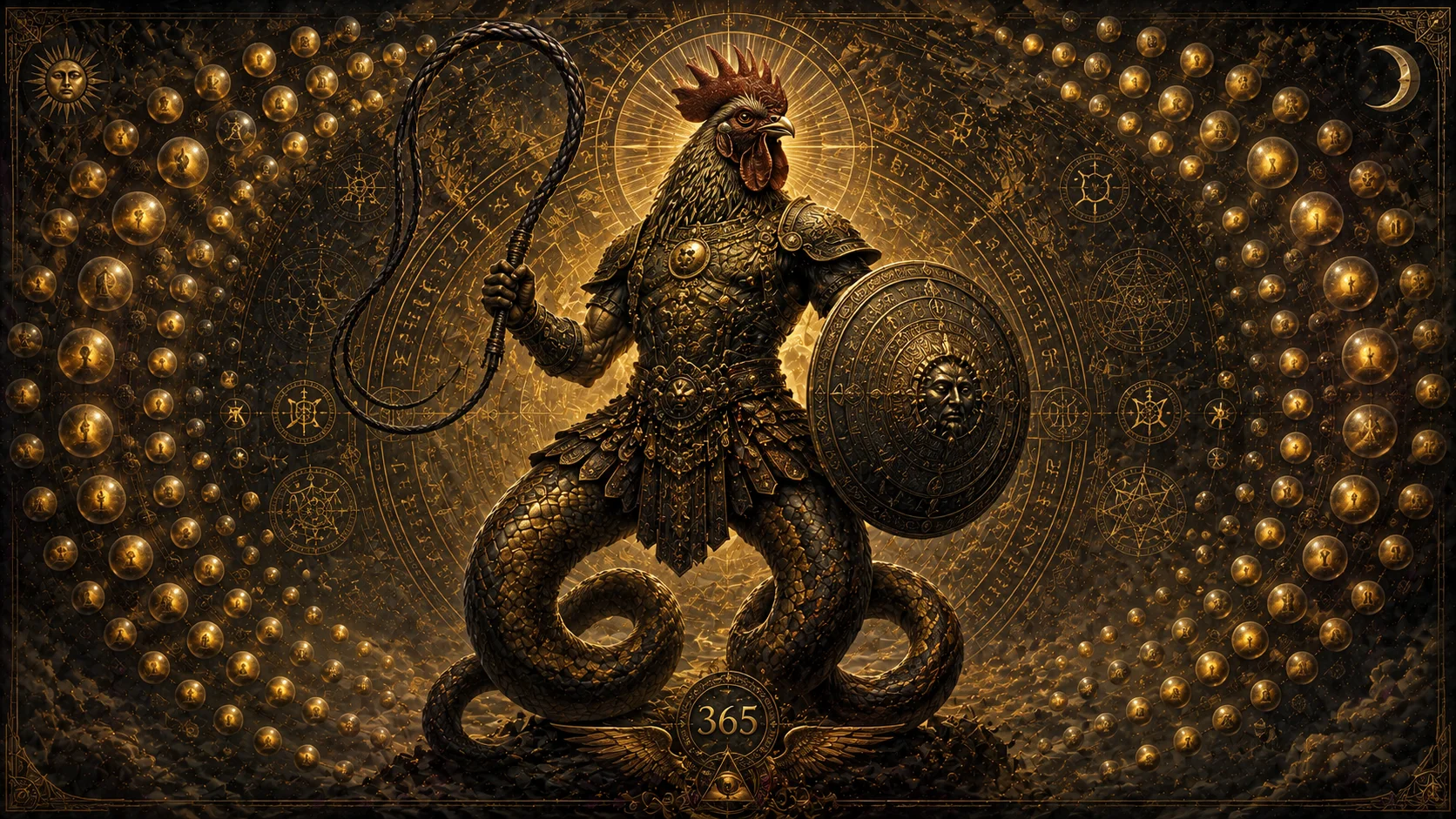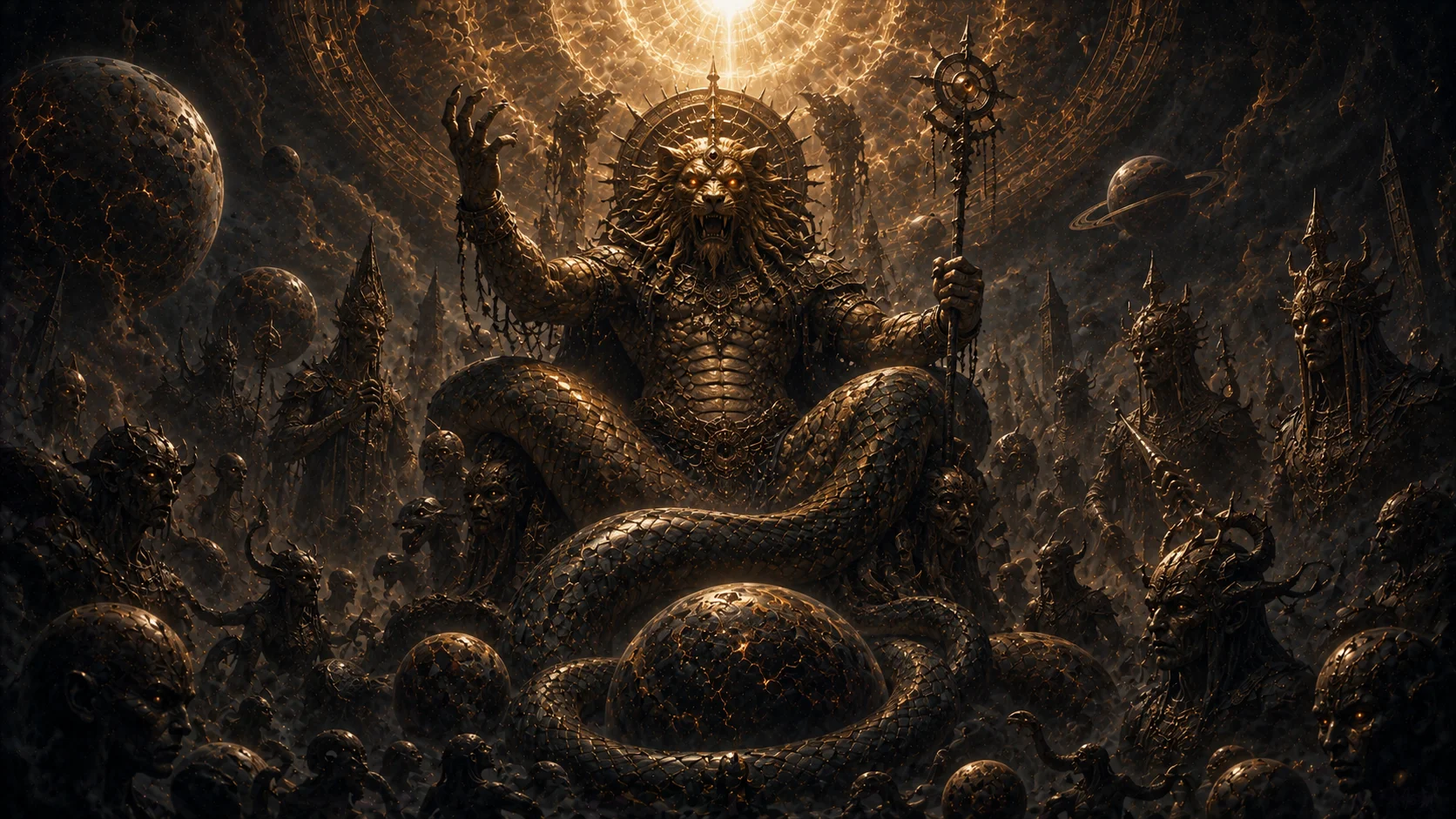
Yaldabaoth is the proper name of the Gnostic demiurge in the Sethian and many other Gnostic traditions — the blind, arrogant, lion-faced serpent-god who, born of the fallen Sophia, created the material world and its Archons and proclaimed himself the only god. Also called Saklas (“the fool”) and Samael (“the blind god”), Yaldabaoth is the vivid, monstrous personification of the false creator, the chief antagonist whose ignorance and pride are the source of the world’s flaw.
The Lion-Faced Serpent
Yaldabaoth’s very form expresses his nature. He is described in the Gnostic texts — above all the Apocryphon (Secret Book) of John — as a hideous and terrifying being: a serpent with the head of a lion, his eyes flashing fire, a monstrous fusion of beast and reptile. This grotesque form, the opposite of the luminous beauty of the true Aeons, marks him as a malformed and lower being, the misbegotten product of Sophia’s error. His three names carry his character: Yaldabaoth (perhaps “child of chaos” or “begetter of the hosts”), Saklas the fool, and Samael, “the blind god” — for his blindness to the true God above is his defining flaw.
The Birth and Boast of the False God
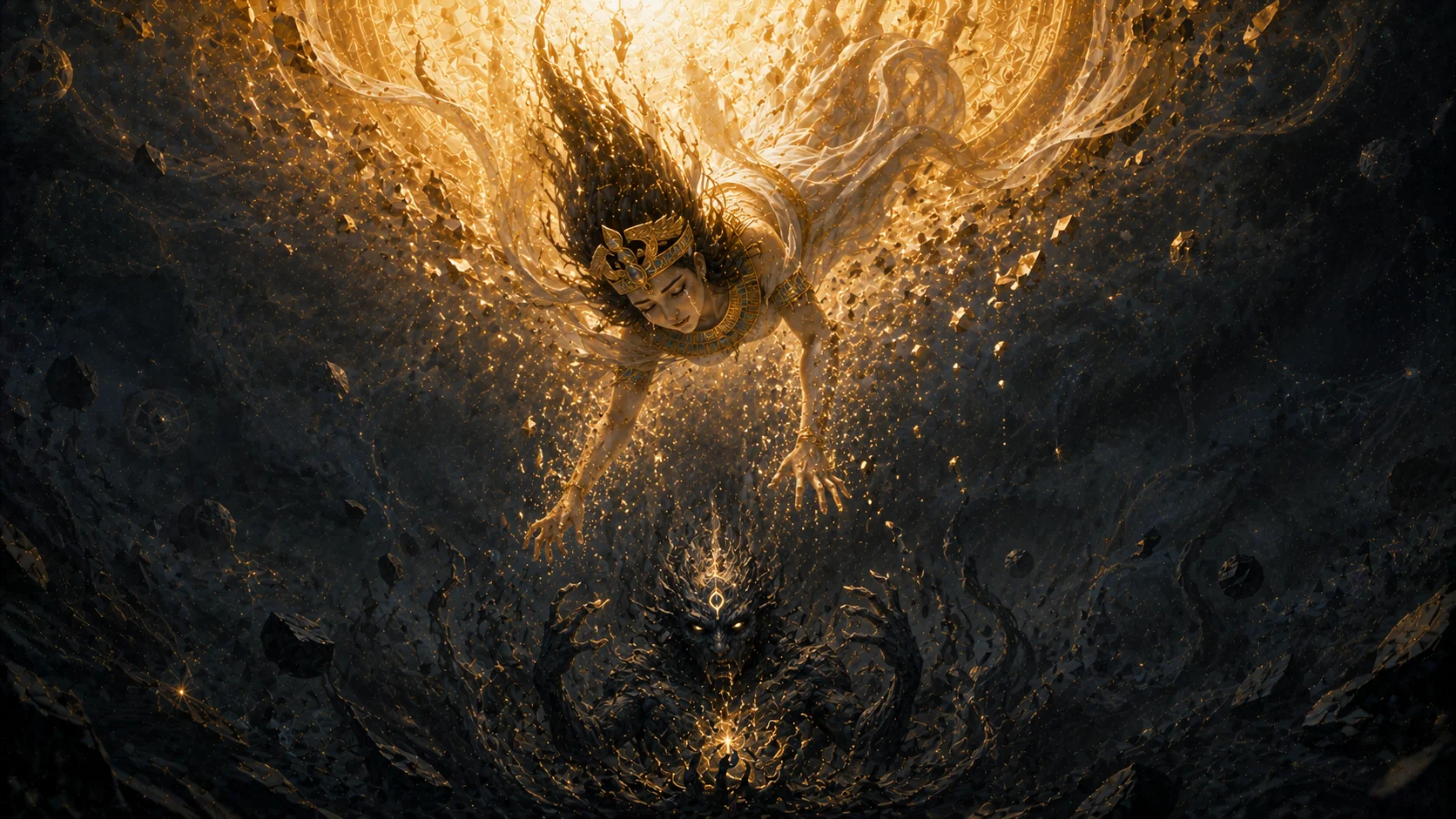
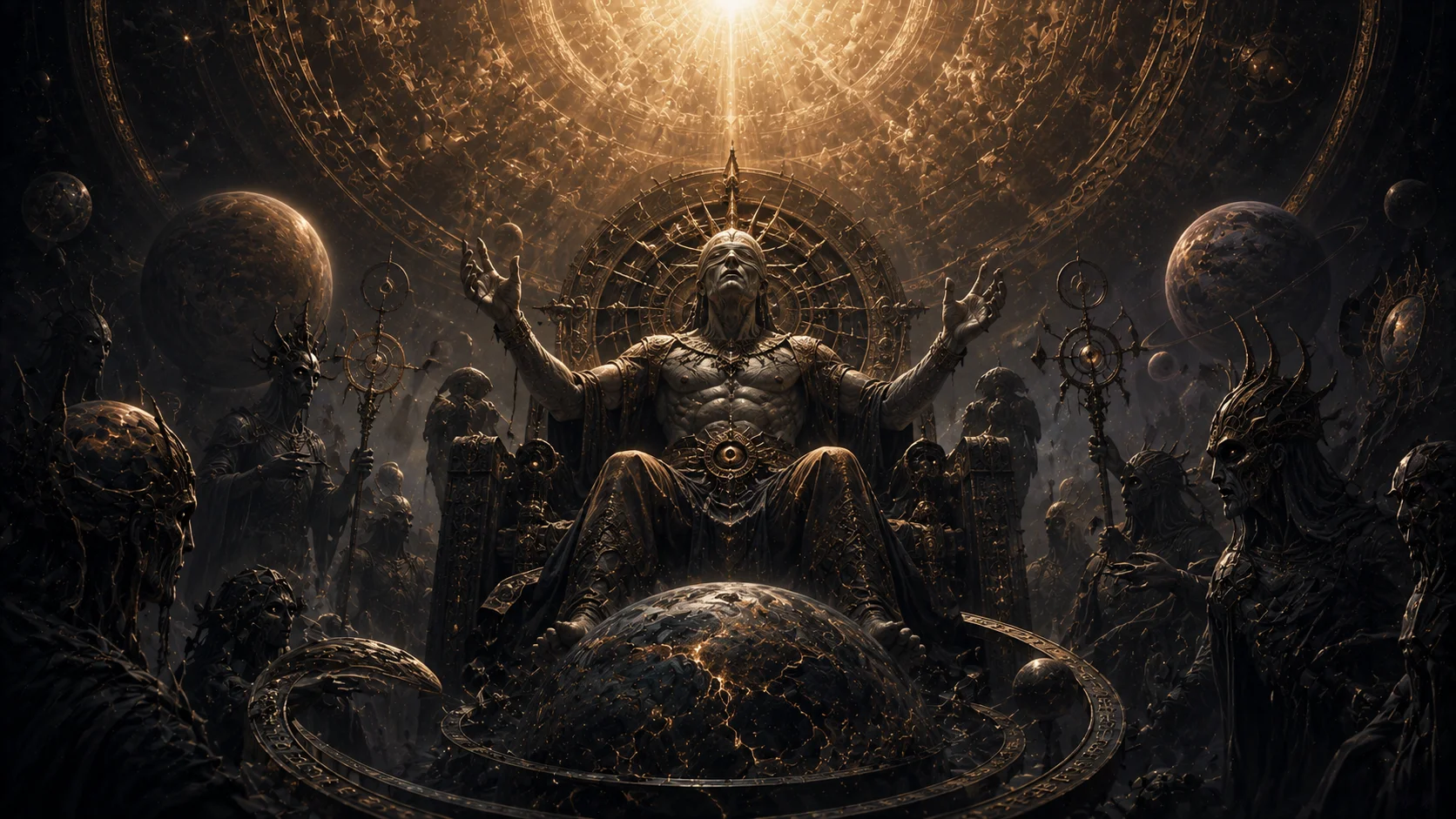
The myth tells that the Aeon Sophia, acting alone in her passion to create, brought forth Yaldabaoth without her divine consort — an imperfect, ignorant being, whom she hid away in shame, cast out of the divine Pleroma. Not knowing his origin or the spiritual world above, Yaldabaoth drew upon the power he had stolen from his mother and created the material cosmos, the Archons (the planetary rulers, often numbered as seven or twelve, whom he generated as his servants and the powers of the heavens), and ultimately the material body of humankind. Then, in his blind arrogance, he proclaimed the great boast of the false god: “I am God, and there is no other God beside me” — whereupon a voice from above (or his mother Sophia) rebuked him, declaring that the true Invisible God and the immortal Man existed before him, revealing his ignorance.
The Tyrant of the Cosmos
Yaldabaoth, with his Archons, rules the material world as a tyrant and a jailer, keeping the divine sparks — the fragments of the higher world trapped in human souls — bound in ignorance and matter. He and his powers oppose the awakening of humankind to the saving gnosis, for that knowledge reveals his falseness and frees the soul from his dominion. In many Gnostic systems he is identified with the jealous, law-giving creator-god of the Old Testament — a deliberate and radical reinterpretation. Yet his power is not ultimate: the descent of the redeemer and the awakening of gnosis undo his deception, and the divine sparks ascend past him and his Archons to the true God, leaving the blind god’s prison behind.
Legacy
Yaldabaoth endures as the most vivid and fully realized form of the Gnostic demiurge — the blind, lion-faced serpent-god, born of Sophia’s fall, the arrogant false creator who fashioned the flawed world and falsely claimed to be the only God. From the Sethian texts of Nag Hammadi to the writings of the Church Fathers who recorded (and condemned) Gnostic belief, his figure profoundly shaped esoteric and heretical thought, and he has been taken up anew in modern esotericism, philosophy, and fiction as the great symbol of the counterfeit god. As the blind god Samael, the fool Saklas, the lion-faced Yaldabaoth, he remains the dark heart of the Gnostic cosmos.
A Heresy Already Old When the Jar Was Opened
In December 1945, Egyptian farmers digging for fertiliser near the cliffs at Nag Hammadi in Upper Egypt struck a buried jar and found inside it thirteen leather-bound papyrus codices. Among them was the fullest surviving account of Yaldabaoth: the Apocryphon of John, a text so central to Sethian Gnosticism that the find preserved three separate copies of it — more than of any other work in the library — with a fourth surviving in the Berlin Gnostic Codex, a manuscript bought in Cairo half a century before Nag Hammadi was ever disturbed. But the myth did not begin with any of these books. Writing around 180 CE in Against Heresies, the bishop Irenaeus of Lyon already described, and denounced, a system in which a blind world-maker born of a fallen Wisdom declares himself the only god and is rebuked from above — and he gives the creature its name, Ialdabaoth. Close to eighteen centuries separate that hostile summary from the recovery of the texts it was attacking. Yaldabaoth was a live controversy inside the early Church long before he became a curiosity of modern scholarship.
A Name No One Has Fully Solved
Scholars have never reached agreement on what Yaldabaoth actually means, and the honest treatments say so rather than picking a winner. The first element is usually traced to the Aramaic yalda, “child”; the second is the contested one, read variously as a word for chaos, as a form of “hosts” — the Sabaoth of Hebrew scripture — and in other proposals besides. The uncertainty is itself part of the effect. Whatever it was assembled from, the name was built to sound at once foreign and faintly familiar: scripture heard through a wall.
Sabaoth, the Son Who Turned on His Father
Yaldabaoth does not rule unopposed, and the sharpest opposition comes from inside his own house. In On the Origin of the World and the Hypostasis of the Archons he fathers a son named Sabaoth — until Sabaoth glimpses the light of the realm above and is overcome with revulsion at his father’s ignorance. He condemns Yaldabaoth and the powers beneath him, and for that repentance he is lifted clear of his father’s dominion: raised to the seventh heaven, enthroned on a four-faced chariot of cherubim, attended by armies of angels, with Sophia’s daughter Zoe (“Life”) seated at his right hand to teach him what lies above. On the Origin of the World adds a detail worthy of the myth: Yaldabaoth, watching his son ascend into a splendour he cannot reach, is seized by envy, and out of that envy Death is born. Scholars have long read the enthronement as a deliberate splitting of the biblical creator in two, leaving the God worshipped in the Temple recognisable as the one Archon who woke up, while the blindness stays behind with his father.
The Theft That Made Humanity Possible
The making of Adam, in the Apocryphon of John, is not an act of generosity but of anxious imitation. The Archons see, reflected in the waters below, the image of the true and luminous Human above, and resolve to build a copy of it inside their own domain. They shape a body from the elements, and it lies inert, unable to rise, until Yaldabaoth is manoeuvred into breathing his own breath into its face — advised to do so by emissaries from above who let him believe the idea is his. In that single exhalation he empties himself of the light he had carried since Sophia’s fall and passes it into the first human being, who stands up more intelligent than the beings who assembled him. Humanity’s divine spark, on this telling, is not a gift from the true God at all. It is a mistake the false one made while trying to take something for himself.
The Instructor in the Garden
What follows is the Eden story read against the grain. Fearful of what Adam has become, Yaldabaoth and his Archons set him in a garden and forbid him one tree, hoping the spark inside him stays dormant. He is roused instead by the spiritual woman, the Eve called mother of the living — and in the Hypostasis of the Archons and On the Origin of the World the rulers answer her with desire and force, moving to seize her. She laughs at them, and what they lay hold of is only a shadow of her likeness; her true self has already passed into the tree, beyond their reach. In these texts the serpent that urges the eating of forbidden knowledge is no tempter but the Instructor, an agent of awakening working against a jailer with a genuine interest in keeping his prisoners uninformed. The prohibition is the crime, and the disobedience is the first free act.
The reversal is not universal, which is worth saying plainly. The Apocryphon of John interrupts itself again and again to insist that things did not happen as Moses wrote them, yet it gives the awakening not to the serpent but to the luminous Epinoia, with the revealer declaring that it was he who appeared upon the tree of knowledge in the form of an eagle. Even within a single buried library, the myth argues with itself.
A Bureaucracy of Ignorance
Yaldabaoth does not administer the cosmos alone. He generates a court of Archons out of the power he took from his mother, sets them over the seven heavens, and gives each — as he is himself — a composite, animal-headed form: faces of sheep and donkey, hyena and serpent, ape and shining fire. They are named individually in the Apocryphon of John, but the lists disagree between the surviving recensions, which reveals what the finished-looking manuscripts otherwise conceal: this was a mythology still being reworked by the communities telling it, not a canon fixed by a single hand. Sabaoth is counted among them here, before the other texts promote him out. Together they are less a pantheon than a bureaucracy — ranks of officials who take themselves for the whole of creation because none has ever seen past the ceiling of his own heaven.
Not Every Demiurge Wears a Lion’s Face
The serpent-bodied Yaldabaoth of the Sethian texts is the most vivid Gnostic world-maker, but not the only shape the idea took. Irenaeus also records the Valentinian version: a craftsman born of the lower Wisdom, Achamoth, who works in ignorance of the fullness above him and mistakes his own handiwork for the whole of divinity. He too announces that there is no god beside him — but he is given no bestial body and no real malice, and reads less as a tyrant than as an over-confident artisan flattered by his own results. Set the two side by side and Gnostic thought stops looking like one system and starts looking like a family of competing answers to a single question: how can a flawed, suffering world come from a perfect source? Yaldabaoth is that family’s most extreme and most theatrical answer.
Lion and Serpent on the Amulet
The lion-headed serpent was not invented for Yaldabaoth. Carved magical gems from Roman Egypt, worn as protective amulets in roughly the centuries when the Sethian texts were being written and copied, carry a strikingly similar figure known as Chnoubis: a serpent with a lion’s head, crowned with rays, cut with protective names and prescribed above all against complaints of the stomach. Chnoubis belongs to a separate, largely non-Gnostic current of Greco-Egyptian magical practice, and specialists are careful not to declare the two figures the same. But the visual kinship is real, and it suggests that a lion-faced serpent was already circulating in the region’s religious imagination as a potent, ambiguous hybrid — a thing that could be worn at the throat as a guardian or cast in a myth as a tyrant, depending on who was doing the telling.
From Condemned Heresy to the Analyst’s Couch
Yaldabaoth’s modern afterlife runs through some unexpected rooms. In 1952 the Jung Institute in Zurich bought one of the Nag Hammadi codices; it was presented to Carl Jung the following year and has been called the Jung Codex ever since. Jung read Gnostic cosmology psychologically, treating a creator who mistakes his own narrow horizon for the whole of reality as a portrait of something in the psyche rather than a report about the universe. Hans Jonas, in The Gnostic Religion (1958), took the material somewhere else entirely, arguing that the Gnostic sense of being thrown into a cosmos governed by an alien and indifferent power anticipated the twentieth century’s own experience of a universe without built-in meaning. Philip K. Dick’s VALIS (1981) drew on the same cosmology for a paranoid, technological age, casting the world as a prison — the Black Iron Prison — whose management is deranged and does not know it. Each borrowing keeps one complaint alive in a new vocabulary.
Why Blame a Lesser God
Underneath the lion’s face and the borrowed names is a single practical piece of theology. If the highest God is good, why is the world so plainly not? Most traditions answer by softening one of the terms — the goodness, the power, or the badness of the world. The Gnostic answer refuses all three and does something more drastic: it removes the true God from the scene entirely and installs an ignorant impostor in his place. That does not so much solve the problem of suffering as relocate it — but relocation was the point. For communities who already felt themselves strangers in a hostile cosmos, Yaldabaoth let the world be genuinely, structurally wrong without that wrongness being the last word on the God who mattered. He endures for the same reason he was invented: the suspicion that the powers actually running things are not the powers we were promised has never once gone out of date.
Sources & traditions
- EncyclopediaWikipedia — Yaldabaoth
- TraditionGnostic texts, grimoires and later commentary
Myths change from area to area and from time to time. This chronicle follows the most widely told versions; tellings in other villages, regions and eras may differ.