Sophia — “Wisdom” — is the central tragic figure of the Gnostic myth, the divine Aeon whose fall from the fullness of the spiritual world set in motion the creation of the flawed material cosmos and the entrapment of divine sparks within it. At once the cause of the world’s brokenness and the agent of its redemption, Sophia is the fallen and restored Wisdom of God, whose story is the very heart of the Gnostic vision of cosmic tragedy and salvation.
The Aeon of the Pleroma
In the Gnostic cosmology, the true God — the unknowable, transcendent Source — emanates a series of divine beings called Aeons, who together constitute the Pleroma, the “Fullness” of the spiritual realm. These Aeons exist in harmonious pairs, expressions of the divine nature. Sophia, Wisdom, is the youngest or outermost of the Aeons — a being of the Pleroma, yet the one through whom the fatal disruption enters the perfect spiritual order.
The Fall of Wisdom
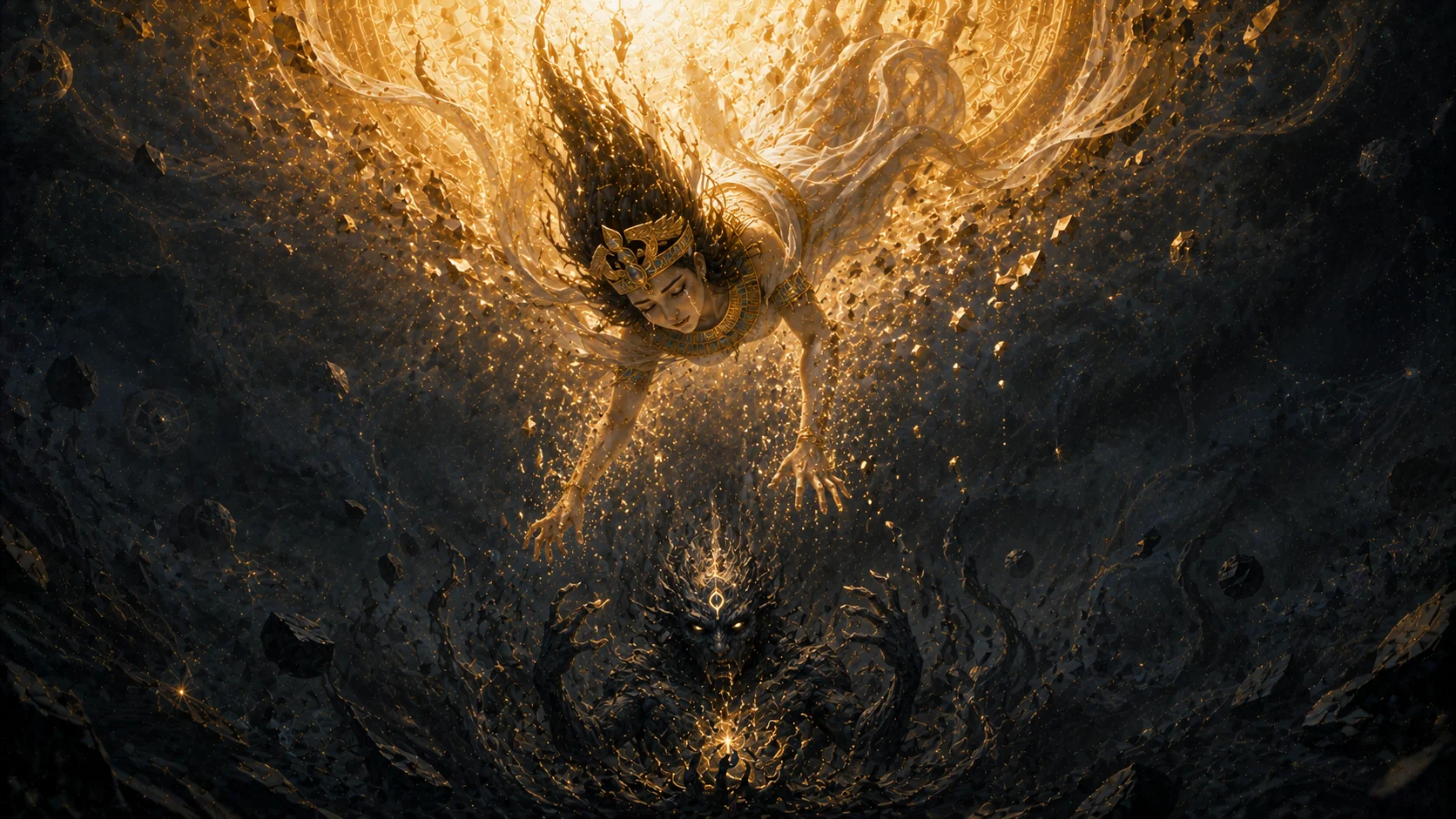
The great catastrophe of the Gnostic myth is the fall of Sophia. Seized by a passion to know the unknowable God directly, or to create on her own without her divine partner, Sophia acts in error and presumption beyond her bounds. The result is disastrous: she brings forth, alone and imperfectly, a malformed and ignorant offspring — the Demiurge (Yaldabaoth) — whom in shame she casts out of the Pleroma. This blind, arrogant being then creates the material world and sets himself up as its god, not knowing the true God above. Sophia’s passion and error thus become the origin of the flawed cosmos, and her own divine essence becomes scattered — the divine sparks trapped in matter and in human souls.
Wisdom Fallen and Restored
Yet Sophia is not merely the cause of the fall; she is also bound up with its remedy. In her fallen aspect — sometimes called the lower Sophia, or Achamoth — she suffers, repents, and longs to return to the Pleroma, and her divine substance, scattered in the world, yearns for redemption. The Gnostic drama of salvation is in large part the gathering-up and restoration of Sophia and the divine sparks: the descent of a redeemer (Christ, or the Logos) to bring the saving gnosis (knowledge) that awakens the trapped sparks and guides them, and Sophia, home to the Fullness. She is thus both the fallen Wisdom whose error made the world and the redeemed Wisdom whose restoration is the goal of all salvation.
Legacy
Sophia endures as the great tragic and redemptive figure of Gnosticism — the divine Wisdom whose fall created the flawed world and trapped the divine within it, and whose restoration is the aim of cosmic salvation. Her myth, preserved in the Nag Hammadi texts and the accounts of the Church Fathers, profoundly shaped Gnostic thought and has echoed through later mysticism, Kabbalah (in the figure of the Shekhinah), and modern esoteric and psychological thought. As the fallen and rising Wisdom of God, Sophia remains one of the most profound and influential figures of Western esoteric tradition.
Wisdom Before the Fall: The Biblical Ancestress
Centuries before any Gnostic teacher put pen to papyrus, Wisdom already had a voice, and it was serene rather than tragic. In the book of Proverbs she speaks in the first person, present at creation itself, daily God’s delight and rejoicing before him as he set a compass upon the face of the deep. The Wisdom of Solomon calls her “a pure influence flowing from the glory of the Almighty” — radiant, spotless, an image of divine goodness, passing through all things by reason of her pureness. Ben Sira has her pitch her tent in Jacob and take root in an honoured people, a wisdom that settles happily in Jerusalem among God’s own. This is Hokhmah, unfallen Wisdom, an attribute of God personified and beloved — and it is precisely this serene figure that the Gnostic mythographers seized upon and broke. They kept her name, her femininity, her cosmic scale, and gave her a biography of catastrophe. The shock of the Gnostic Sophia only lands fully once her ancestress has been heard first: the descent from delighted co-creator to erring exile is not a myth built from nothing, but a deliberate and unsettling inversion of scripture that Jewish and Christian readers already knew by heart.
Simon Magus, Helen, and Wisdom’s Earliest Fall
The oldest surviving version of a fallen divine Woman is not even called Sophia, and it survives only because her enemies wrote it down. Justin Martyr, Irenaeus, and Hippolytus all record the career of Simon Magus — the same Simon the sorcerer glimpsed briefly in the Acts of the Apostles — who according to Justin came to Rome in the reign of Claudius, and who travelled with a woman named Helen. Justin says she had formerly lived in a brothel; Irenaeus places the brothel at Tyre, in Phoenicia, and has Simon buy her out of it. Simon proclaimed Helen to be the earthly vessel of his own Ennoia, the “First Thought” that had proceeded from him as the highest God, and who, having generated the angels who made the world, was seized, degraded and imprisoned by her own ignorant offspring — passing thereafter, the account claims, from body to body down through history, including the body of Helen of Troy, until Simon found her and redeemed her.
Whatever Simon himself actually taught — and the heresiologists are hostile witnesses reporting at second hand — their account preserves the exact shape the Sophia myth would later take: a supreme feminine principle who falls or is cast out among the powers she unknowingly generates, is trapped and degraded in matter, and waits for recognition and rescue by a saviour who already knows what she is. Irenaeus named Simon the source from which every later heresy took its origin, and on this narrow point he was not wrong, though not in the way he meant. The pattern was already complete, long before the Nag Hammadi codices were copied in the fourth century, in the story of a woman found in a Phoenician brothel.
The Valentinian Elaboration: A Wisdom Twice Fallen
The school of Valentinus, the most intellectually ambitious of the second-century Gnostic teachers, did not leave Sophia’s fall as a single event, and Irenaeus, determined to refute it, preserved its architecture in exhausting detail. In the Valentinian Pleroma thirty Aeons stand in fifteen conjugal pairs, beginning with Bythos (“Depth”) and Sige (“Silence”); Sophia, paired with Theletos, is the youngest and last of them. Her transgression is the familiar one — the passion to comprehend the unknowable Father directly, without her partner — but what it produces, in this telling, is not the Demiurge. It is a shapeless, formless conception, which the Pleroma separates out from her and expels beyond its own boundary, the Horos, into the void.
That expelled portion becomes a second and lower figure, whom the Valentinians named Achamoth — and it is Achamoth, not the Sophia who remains safely within the Pleroma, who gives birth to the Demiurge and lives out the whole drama of exile. The distinction matters: it splits the myth’s protagonist in two, leaving Wisdom both intact above and suffering below. The account Irenaeus preserves goes further still, holding that the material world itself condensed out of Achamoth’s successive emotional states in the void — from her tears the waters, from her grief and terror and perplexity the corporeal elements, from the light she had glimpsed and lost the impulse that turns her back toward it. It is a strange and striking claim even by Gnostic standards: that matter was not built but wept into being, the sediment of a divine being’s despair.
Lion-Faced and Nameless: The Sethian Sophia
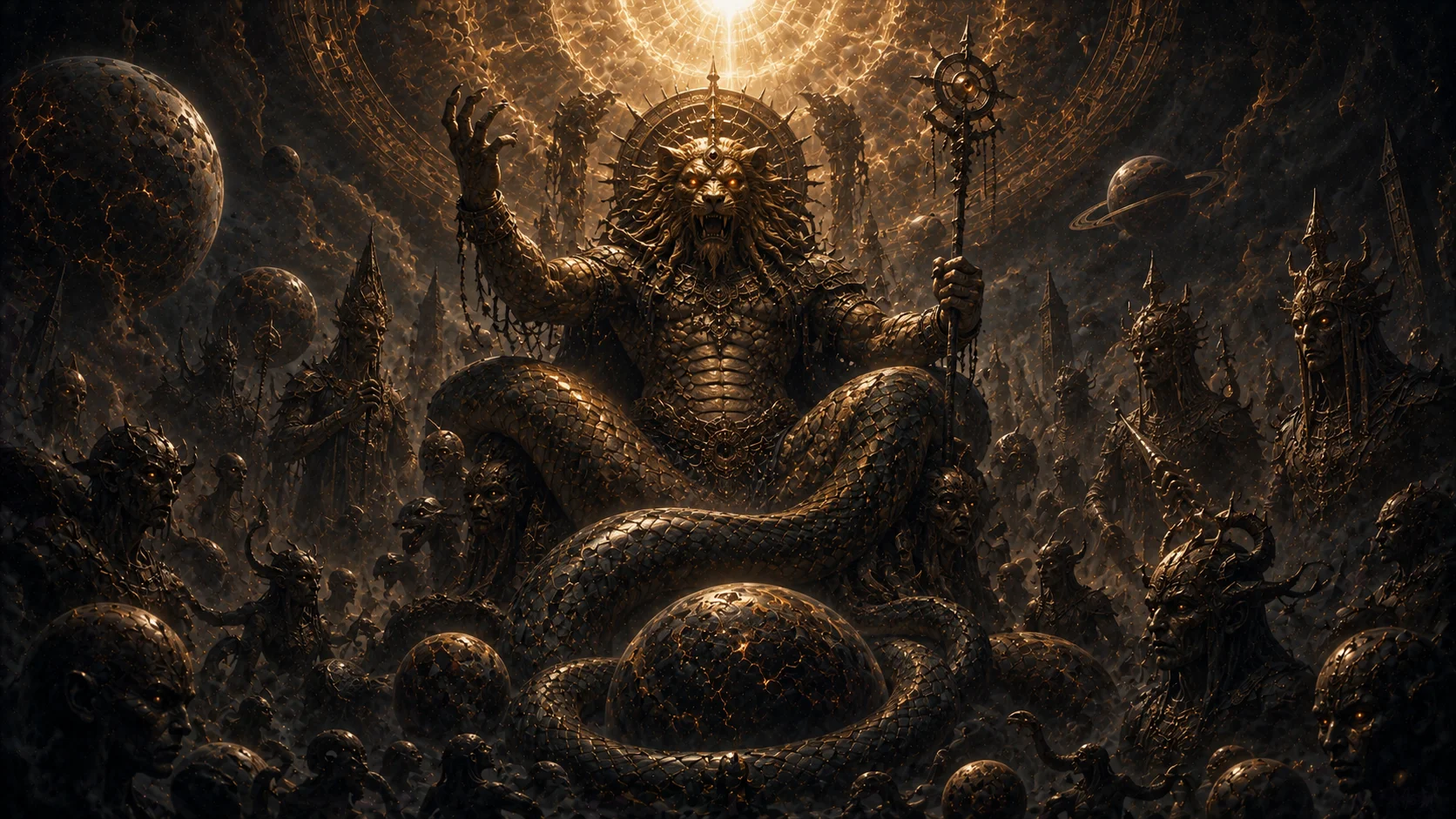
The Sethian current preserved in the Apocryphon of John tells a related but distinct version, and it supplies a detail the broad outline of the fall usually leaves out: what the Demiurge actually looked like. Sophia, wishing to bring forth a likeness out of herself alone — without her consort and without the consent of the invisible Spirit — produces a being with the body of a serpent and the face of a lion, its eyes flashing like fire. It is monstrous, and it is entirely ignorant of the luminous Pleroma above it, because Sophia hides it in a cloud the instant it is born so that none of the immortals will see what she has made.
Other Sethian and Ophite sources attach to Sophia the epithet Prounikos — roughly “the wanton” or “the lustful one” — a name Irenaeus and, later, Epiphanius both repeat with evident disapproval. Origen, answering the pagan critic Celsus, describes a ritual diagram used by the Ophites: concentric circles charting the soul’s ascent past a ring of hostile planetary rulers, each of whom had to be named and answered with the correct formula before the soul could pass. The schools disagreed about a great deal, but not about the shape of the problem — a light above, a barrier of jealous powers below, and a wisdom stranded on the wrong side of it. These variations are not contradictions so much as evidence of how alive the myth was: different teachers, working from the same core image of a wisdom who errs and falls, drew the resulting cosmos in different and equally vivid detail.
Pistis Sophia and the Songs of a Fallen Aeon
The longest surviving Gnostic treatment of the myth is not primarily about the cosmic Fall at all, but about what comes after it. The Coptic text known as Pistis Sophia — “Faith-Wisdom”, preserved in the Askew Codex — opens with a Sophia already fallen into the lower aeons and deceived by a rival power called Authades, the “Self-Willed”, into chasing a false light. Stripped of her own light-power by the emanations sent against her, she plunges toward chaos, and in her isolation breaks into a long sequence of laments: thirteen repentances, many of them close paraphrases of the biblical Psalms and of the Odes of Solomon, reworked into the voice of a cosmic being begging to be seen and remembered.
What makes the text peculiar is its frame. The risen Christ spends years teaching his disciples in secret, and it is they — Mary Magdalene most often, and most acutely — who interpret each lament in turn, matching it to the psalm it echoes, while Jesus confirms or corrects them. Only afterwards is he sent down to lead Sophia out of chaos, restore the light that was stolen from her, and set her in the place appointed for her in the thirteenth aeon. It is Gnostic literature at its most emotionally exposed — less a cosmological treatise than the record of a goddess grieving in a language borrowed from Israel’s own psalter, with her rescuers arguing over what she meant.
Sophia’s Christian Afterlife: Sophiology
The Gnostic schools of the second century did not outlive late antiquity, but Sophia was not buried with them. In late nineteenth-century Russia the philosopher Vladimir Solovyov described, in frankly visionary terms, three encounters with a luminous feminine Wisdom — as a child in a Moscow church, as a young scholar in the reading room of the British Museum, and finally in the Egyptian desert — and set them down in his poem Three Meetings. The experience seeded a theological current that came to be called Sophiology. Sergei Bulgakov and Pavel Florensky, both Orthodox priests as well as philosophers, developed it into a systematic theology treating Sophia as a real mediating principle between the uncreated God and creation — a project controversial enough that in the 1930s the Moscow Patriarchate moved to condemn Bulgakov’s teaching, uneasy at how nearly it echoed the heresy the early Church had spent centuries burying.
Independently, the psychologist Carl Jung took Sophia up in Answer to Job, reading her not as literal cosmology but as the figure through which wisdom, and the feminine, force their way back into an otherwise starkly masculine image of God. Across two thousand years, and in every register from heresy trial to psychoanalysis, the pattern the earliest Gnostic teachers set keeps resurfacing: wisdom exiled, wisdom grieving, wisdom recognised and brought home.
Sources & traditions
- EncyclopediaWikipedia — Sophia (wisdom)
- TraditionGnostic texts, grimoires and later commentary
Myths change from area to area and from time to time. This chronicle follows the most widely told versions; tellings in other villages, regions and eras may differ.