The Archons — "rulers" — are the powers of the Gnostic cosmos: the offspring and servants of a flawed creator, set over the material world and the planetary spheres, and cast in the surviving texts as the jailers of the divine spark trapped within human flesh. Their name, from the Greek archōn, "ruler" or "magistrate," names a class of being rather than a single figure — a graded hierarchy standing between the imprisoned soul and the true God of the spiritual Fullness, the Pleroma, that lies beyond and above the visible heavens.
A Word Recovered from Buried Books
What is known of the Archons comes from two very different kinds of witness. The first is secondhand and hostile: the heresiologists Irenaeus, in his Against Heresies, and Hippolytus, in his Refutation of All Heresies, described Archon doctrine while working to refute it, preserving fragments of Valentinian teaching through the distorting lens of controversy. The second witness is the Archons' own scripture, lost for some sixteen centuries and recovered only in 1945 with the discovery of the Nag Hammadi codices — a cache of Coptic manuscripts that includes the Apocryphon of John, the Hypostasis of the Archons, and On the Origin of the World, texts in which the Archons are not an enemy's caricature but a mythology speaking in its own voice. Reading the two witnesses side by side is how the modern picture of the Archons has been reconstructed at all.
The Fracture Above the World
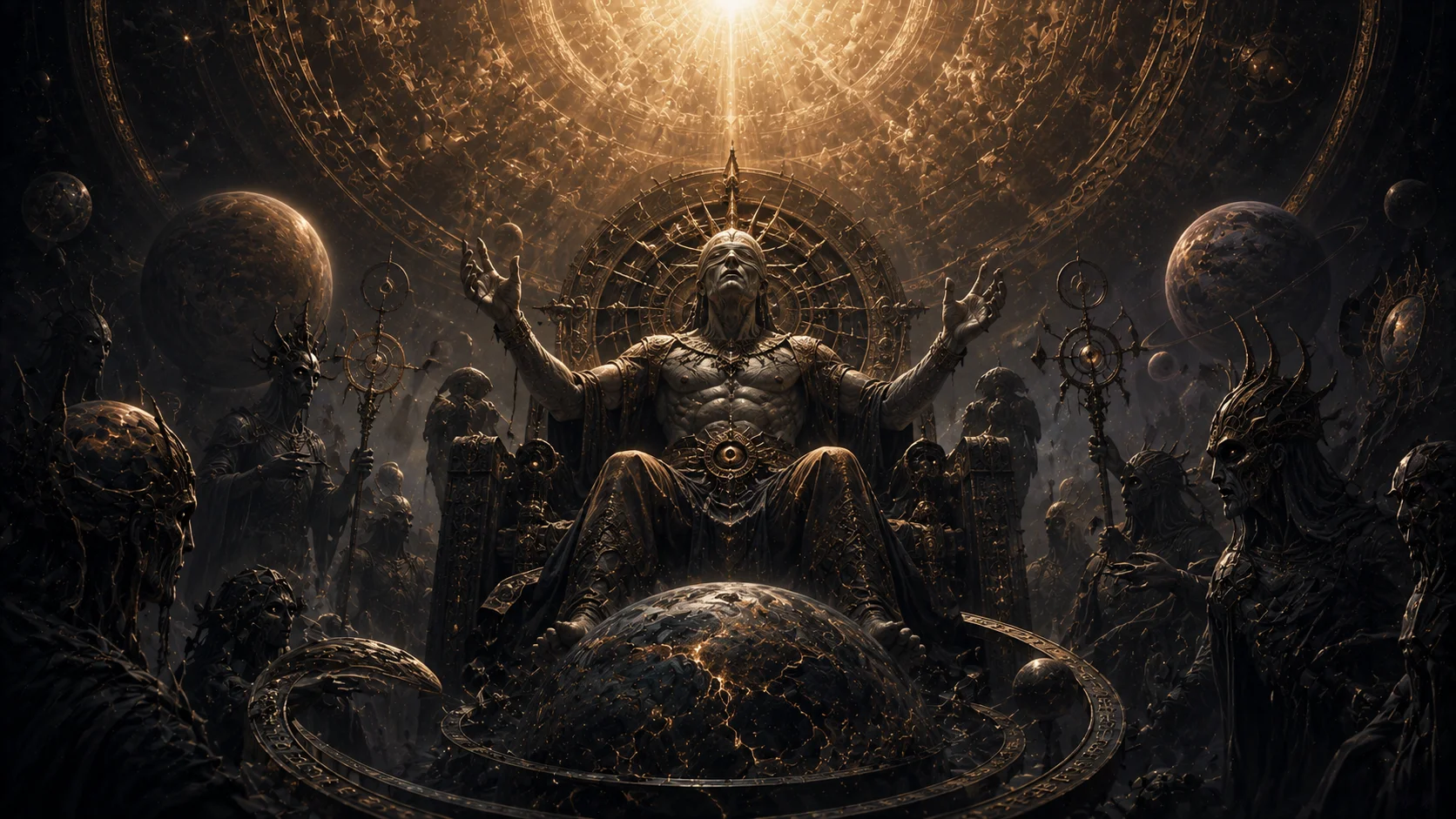
The Archons begin, in Sethian cosmology, not as first principles but as a mistake's consequence. Sophia, one of the aeons of the Pleroma, acted alone — creating without her syzygy, her consort, a rupture in the harmony of the divine Fullness. What emerged from that solitary act was Ialdabaoth, also called Yaldabaoth, Saklas, or Samael: a being formed outside the Pleroma, ignorant of it, and flawed by the very manner of his making. Everything the Archons are and do descends from this single fracture — a creator who does not know what created him, building a world in the image of his own ignorance.
The Lion-Faced Pretender
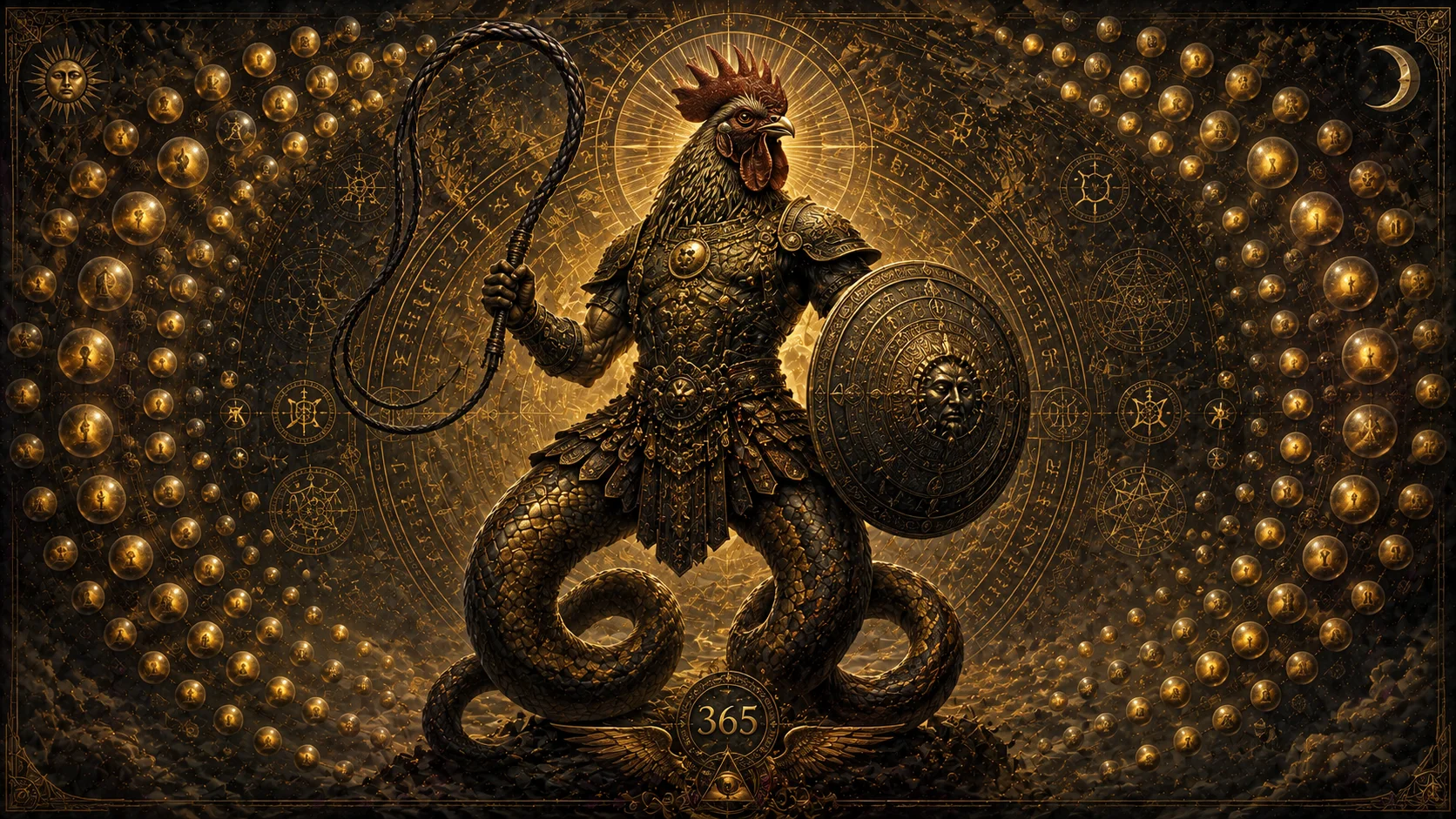
The Apocryphon of John gives Ialdabaoth a body suited to his origin: lion-faced, serpent-bodied, a hybrid form fit for something born outside the proper order of generation. From this position he makes the claim that recurs, almost verbatim, from the Book of Isaiah — "I am God, and there is no other god beside me." In its scriptural source the line is the true God's own declaration of singularity; in the Archon's mouth it becomes something else entirely, a boast the text frames as delusion rather than sovereignty, spoken by a ruler who cannot see the vast Pleroma stretching above the ceiling of his own creation. The line is the clearest statement of what makes an Archon an Archon — not malice alone, but power exercised in total ignorance of what stands over it.
The Begetting of the Seven
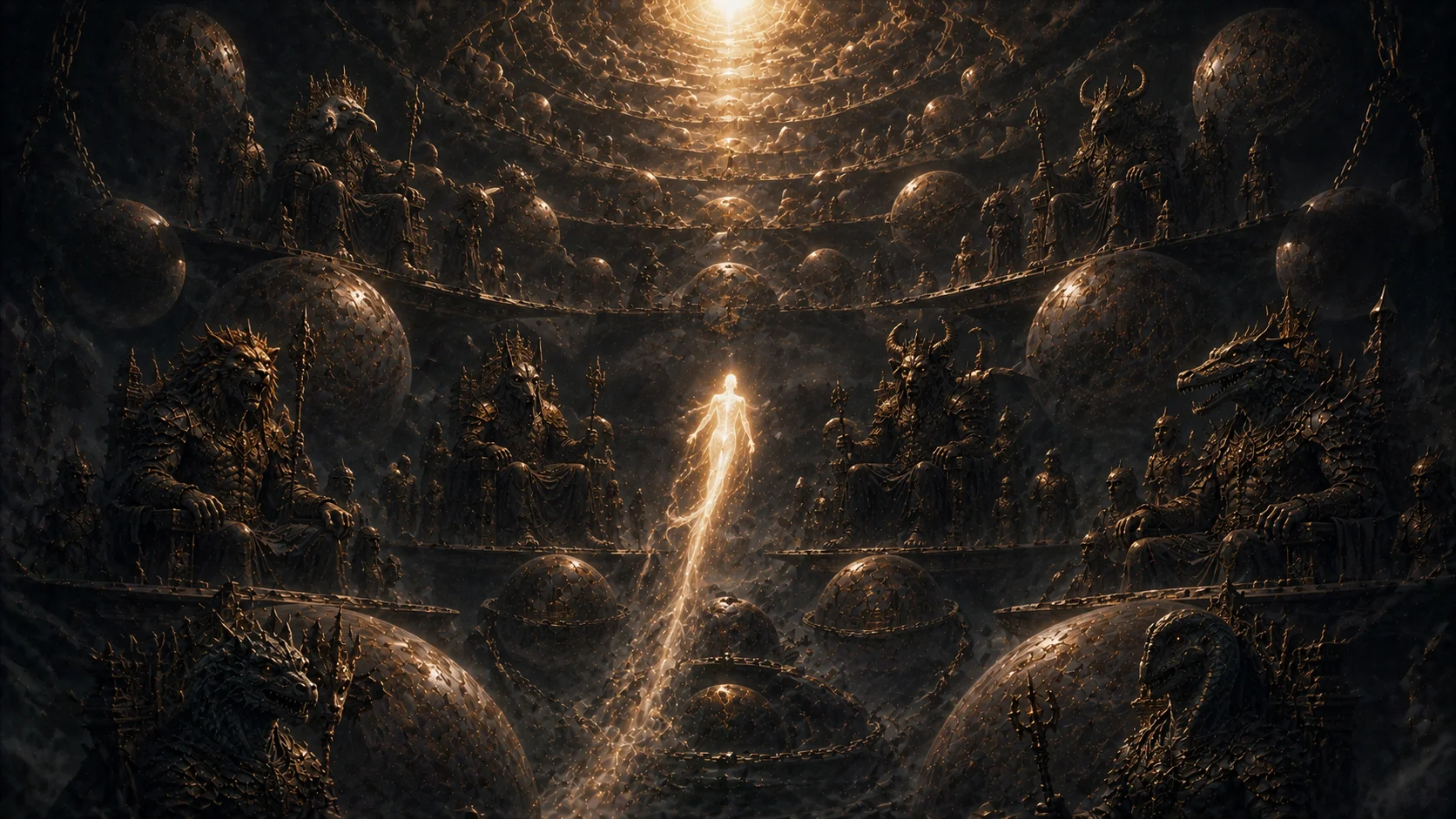
From Ialdabaoth come the Archons proper, generated as his offspring and ministers and set to rule the seven planetary spheres — a structure echoing older Mesopotamian and Hellenistic ideas of planetary rulership, remade here as a spiritual architecture of confinement. The Sethian recensions name individual Archons — Yao, Sabaoth, Adonaios among them — and give each a beast-like face in the manner of their father, though the exact roster shifts from manuscript to manuscript, a genuine point of variation rather than a single fixed list. What stays constant across the recensions is the number seven and the function: each Archon holds a sphere, and together the seven spheres form the concentric shell a soul must cross, in life and after death, to reach anything beyond the world Ialdabaoth built.
Architects of the Prison
The Archons' defining work is the construction of the cosmos itself, and within it, the human body — built not as gift but as containment. Sparks of divine light, pneuma, fell from the Pleroma in the aftermath of Sophia's error, and it is these sparks the material world exists to hold. The Archons keep that prison through several linked mechanisms: the sheer weight of matter, the fixed courses of fate — heimarmene, the astrological determinism the Gnostic texts treat not as guidance but as bondage — and the Law, imposed as a further layer of constraint. Distraction, ignorance, and the appearance of necessity are the Archons' instruments; a soul kept busy with the world's concerns is a soul that never asks what lies above it.
The Body That Would Not Rise
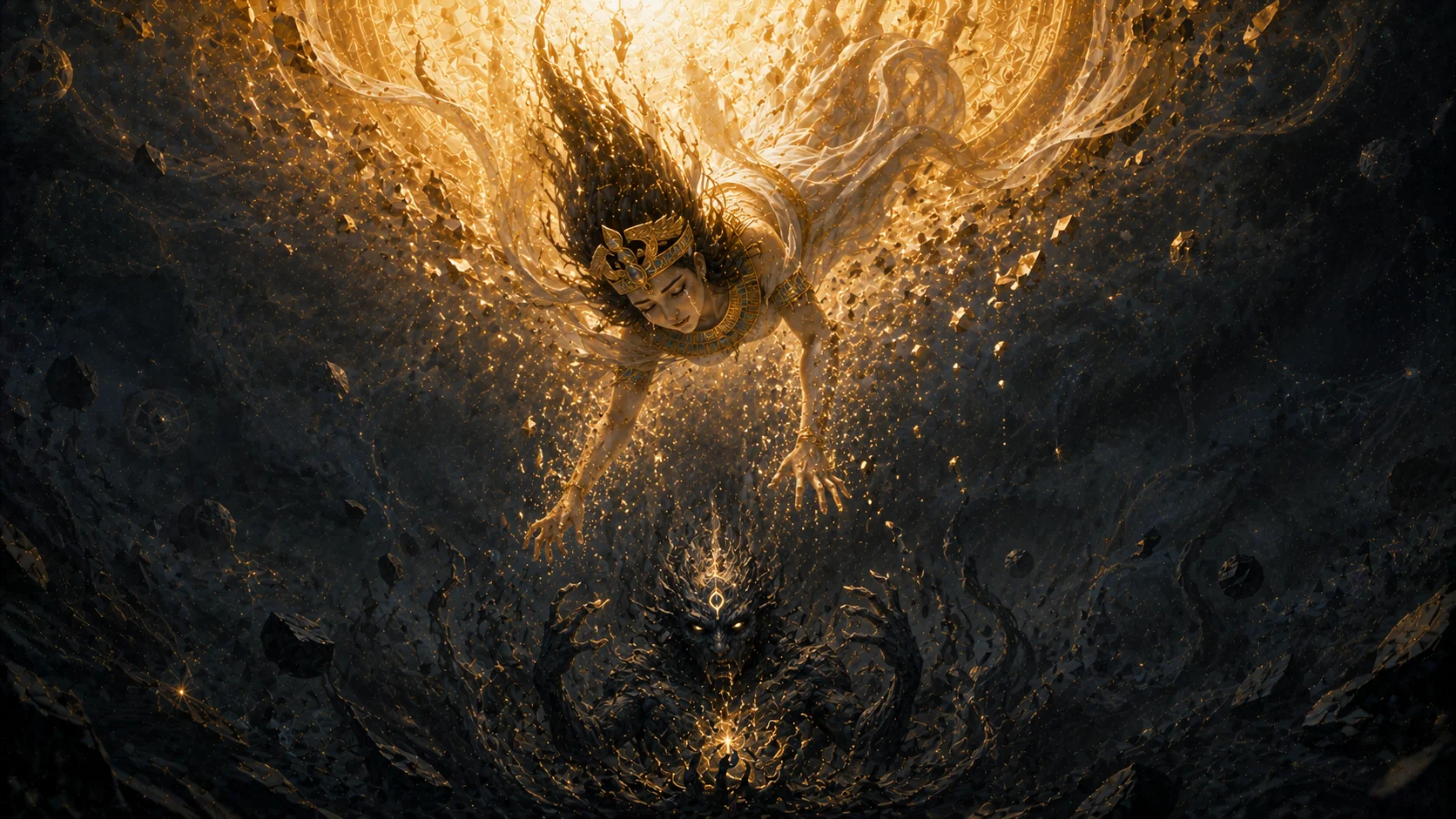
Both the Hypostasis of the Archons and On the Origin of the World preserve an episode of striking irony: the Archons, having decided to make a body in imitation of a higher image they glimpsed, mold Adam from the substance of the lower world — and find that what they have built will not stand. It has no life in it. Only when Sophia, or the divine Spirit acting through her, tricks the Archons into breathing pneuma into their own creation does the body rise. The deception succeeds completely and backfires completely: in the act meant to complete their prisoner, the Archons unknowingly seed humanity with exactly the divine spark they exist to contain. The jailers become, by their own hand, the ones who smuggled the light in.
The Pursuit of Norea
A second episode in the Hypostasis of the Archons turns on pursuit rather than construction. The Archons attempt to defile the spiritual principle represented by Eve, or in a related telling by her daughter Norea — an assault aimed at the very thing in humanity that stands outside their power, the spiritual element they cannot truly possess even as they try to claim it. The attempt fails; Norea is rescued by the angel Eleleth, who does more than intervene physically — he reveals to her the truth of the Archons' illegitimate rule, naming their authority for what it is. The episode functions as both a rescue narrative and a small apocalypse: a moment where the Archons' claim to govern is exposed to the very figure they tried to seize.
Two Faces of the Same Dominion
Not every branch of this mythology paints the Archons in the same ink. The Sethian texts are the more hostile in tone, casting the Archons and their chief as adversaries in something close to open war against the light. Valentinian teaching, as reported by Irenaeus, strikes a more ambivalent note: there the Archons and the Demiurge appear less as malevolent enemies than as ignorant intermediaries, beings who serve a higher plan without knowing it, their rule real but their opposition to the light incidental rather than deliberate. This is not a contradiction to be resolved but a genuine internal diversity — different communities working out the same basic structure toward different emotional and theological ends, a point sharpened by modern scholarship's own caution, following critics like Michael Williams and Karen King, against treating "Gnosticism" as one unified religion with one settled doctrine rather than a family of related, distinct textual traditions.
The God of Genesis, Recast
Many Sethian and Valentinian texts take a further, deliberately provocative step: identifying Ialdabaoth, the chief Archon, with the God of the Old Testament. Genesis, read through this lens, becomes an account not of creation's goodness but of the Archons' deception — the garden, the commandment, the jealous claim to sole divinity, all recast as the ignorant ruler's attempt to keep his creation from the knowledge that would free it. This is best understood as a deliberate polemical inversion of Jewish and Christian scripture, a rewriting aimed at unsettling an inherited authority rather than any claim of shared lineage or continuity with the traditions it reworks.
What the Rupture Owes to Sophia
Because the Archons exist only as consequence — Ialdabaoth born from Sophia's solitary error, the Archons born from him in turn — much of the wider Gnostic myth is occupied with undoing what that first fracture caused. The light trapped by the Archons is not meant to stay trapped forever; its return to the Pleroma, an apokatastasis or restoration, runs as a current beneath the whole system, often mediated by Christ or the Logos descending into the lower world, or by Sophia's own eventual repentance reaching back to mend what her isolated act first broke. The Archons, in this frame, are less a final enemy than a problem with a built-in resolution — powerful, but temporary by the very logic of the myth that produced them.
The Toll Paid in Passwords
Where the myth becomes practice is in the ascent. Because the Archons hold the planetary spheres, the soul's journey back to the Pleroma — after death, or in mystical ascent during life — means passing through each ruler's domain in turn. Texts such as the First Apocalypse of James and the Pistis Sophia describe this passage in terms close to ritual: the ascending soul recites names, seals, or passwords proper to each Archon and sphere, credentials that prove its true origin lies above the world these rulers govern. The Archons, in this picture, function as checkpoints as much as jailers — challenging the rising soul, seeking to detain it, turned back only by the gnosis it carries. It is this mechanism that gives the Archons their deepest symbolic charge: they are ignorance and fate given a face and a name, and the knowledge that defeats them at each gate is the same knowledge — gnosis, direct experiential awareness of the soul's divine origin — that Gnostic initiates sought in life, long before any final ascent.
A Kinship Not to Be Drawn
The word "archon" survives into later Manichaean literature as well, where it names the generals of the Prince of Darkness — a related but distinct development, built on its own narrative logic rather than a direct continuation of the Sethian material found at Nag Hammadi. The shared vocabulary reflects a common inheritance of late-antique religious language more than a single unbroken doctrine, and the two usages are best kept apart rather than merged into one figure or one system. The Archons of the Apocryphon of John and the Hypostasis of the Archons belong to their own textual world — a mythology of rupture, imprisonment, failed creation, and the long return of scattered light, told across manuscripts that do not always agree with each other and were never meant to be flattened into a single, tidy account.
Sources & traditions
- EncyclopediaWikipedia — Archon (Gnosticism)
- TraditionGnostic texts, grimoires and later commentary
Myths change from area to area and from time to time. This chronicle follows the most widely told versions; tellings in other villages, regions and eras may differ.