The Demiurge is the false creator-god of Gnosticism — the lower, ignorant, and often malevolent being who fashioned the material world and rules over it, mistaking himself for the supreme God while remaining wholly ignorant of the true, transcendent God above him. The fashioner of the flawed cosmos and the jailer of the divine sparks trapped within it, the Demiurge is the great antagonist of the Gnostic myth, the counterfeit god whose dominion the Gnostic seeks to transcend.
The Craftsman of Matter
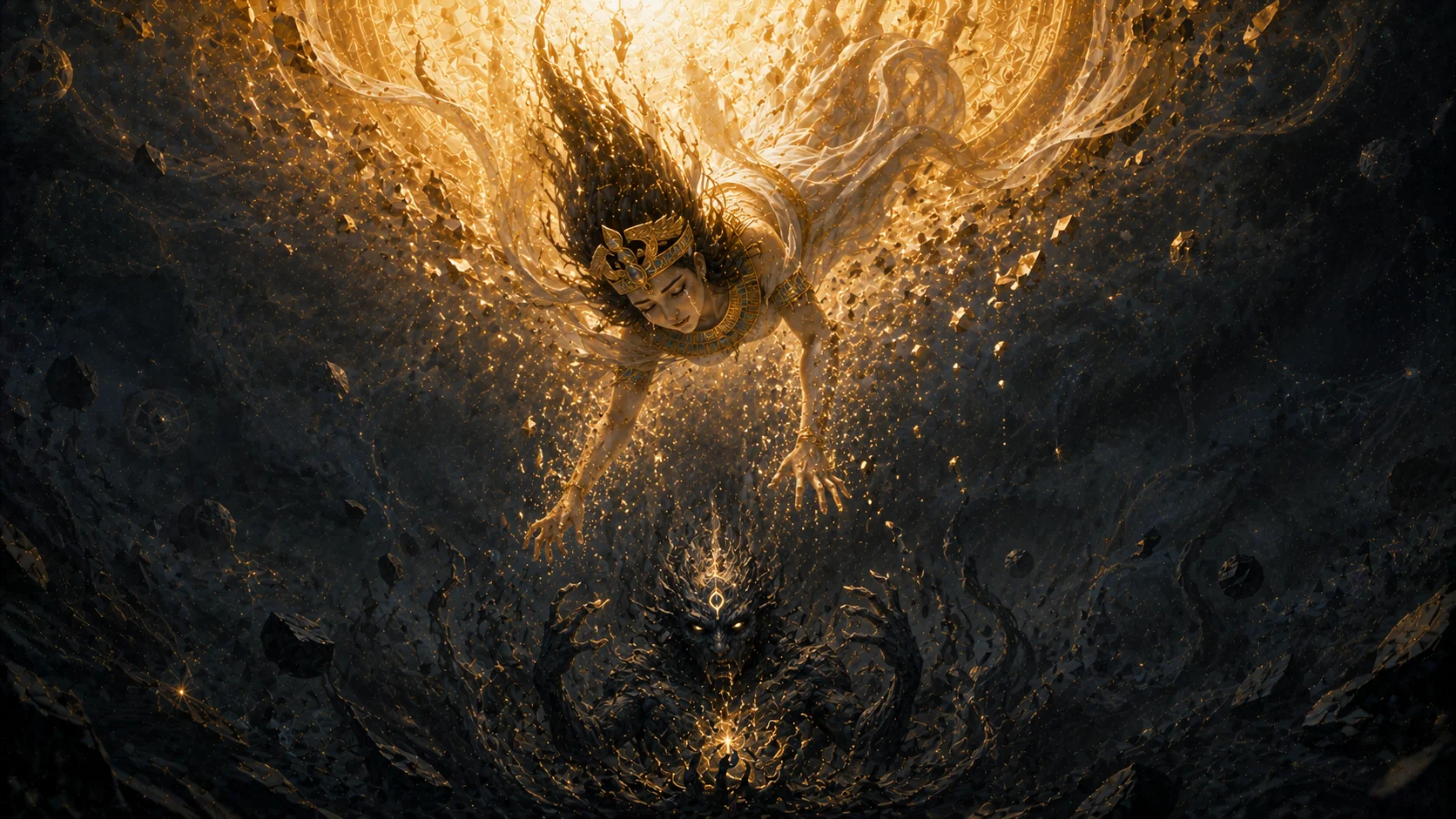
The word demiurge (Greek dēmiourgos, “craftsman” or “artisan”) was borrowed from Plato, who in the Timaeus used it for the benevolent divine craftsman who shapes the cosmos according to the eternal Forms. But the Gnostics radically transformed the figure: in their myth the Demiurge is not benevolent but ignorant and often evil, a lower being who fashions the material world — itself a prison and a flawed copy — and who, not knowing the true God of the spiritual Fullness above, arrogantly declares himself the one and only God. He is born of the fall of the Aeon Sophia (Wisdom), brought forth by her alone and in error, a malformed offspring cast out of the divine Pleroma.
The Ignorant God Who Claims to Be Supreme
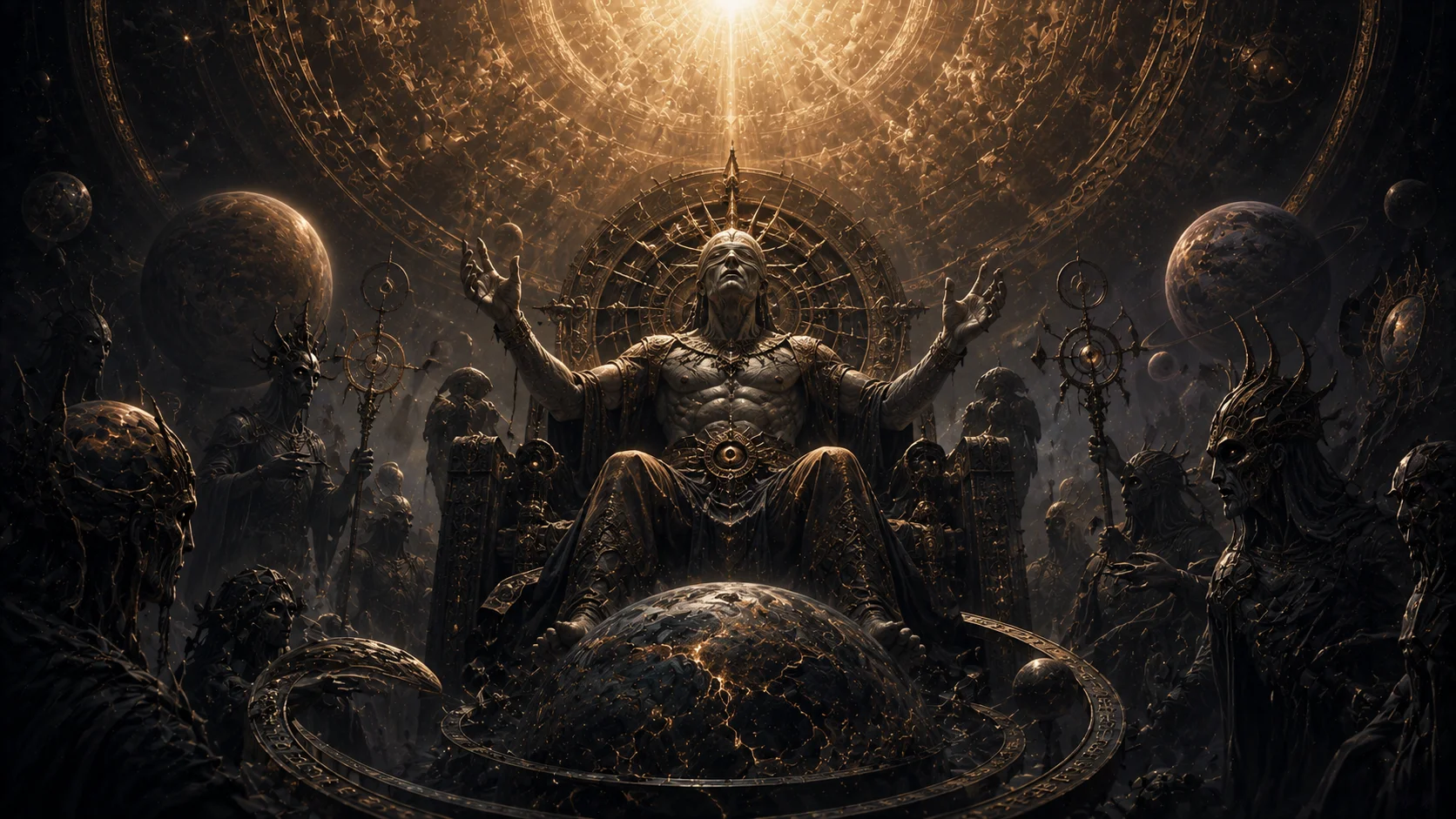
The defining sin of the Demiurge is his ignorant arrogance. Ruling over the material world he has made, and over the Archons (his planetary servants), he proclaims: “I am God, and there is no other beside me” — a boast that the Gnostics read as the very mark of his blindness, for he does not know of the true God and the Pleroma above him. In many Gnostic systems he is explicitly identified with the creator-god of the Old Testament, the jealous law-giving deity — a startling and deliberately provocative reinterpretation that cast the God of orthodox Judaism and Christianity as the lower, false creator, and the true God as the hidden, transcendent Source revealed only through gnosis.
Jailer of the Divine Spark
The Demiurge’s creation, the material world, is in Gnostic thought a prison: within it, fragments of the divine — the sparks of Sophia’s scattered essence — are trapped in human souls, ignorant of their true origin in the spiritual world above. The Demiurge and his Archons rule this prison, keeping souls bound to matter and ignorance. The Gnostic path of salvation is to awaken to the saving knowledge (gnosis) that reveals the truth: that the material world and its creator are not the highest reality, that the soul’s true home is the Pleroma, and that liberation lies in transcending the Demiurge’s dominion and ascending past his Archons to the true God.
Legacy
The Demiurge endures as one of the most influential and provocative concepts of Western religious thought — the false creator, the ignorant god who mistakes himself for the Absolute, the fashioner and jailer of the material world. From the Platonic craftsman reimagined as the Gnostic counterfeit god (most vividly named Yaldabaoth), the Demiurge has profoundly shaped esoteric, heretical, and philosophical thought, and remains a powerful symbol of the critique of the material world and of false or limited conceptions of the divine. As the maker of the flawed cosmos, the Demiurge stands at the dark center of the Gnostic vision.
The Shape He Was Born In
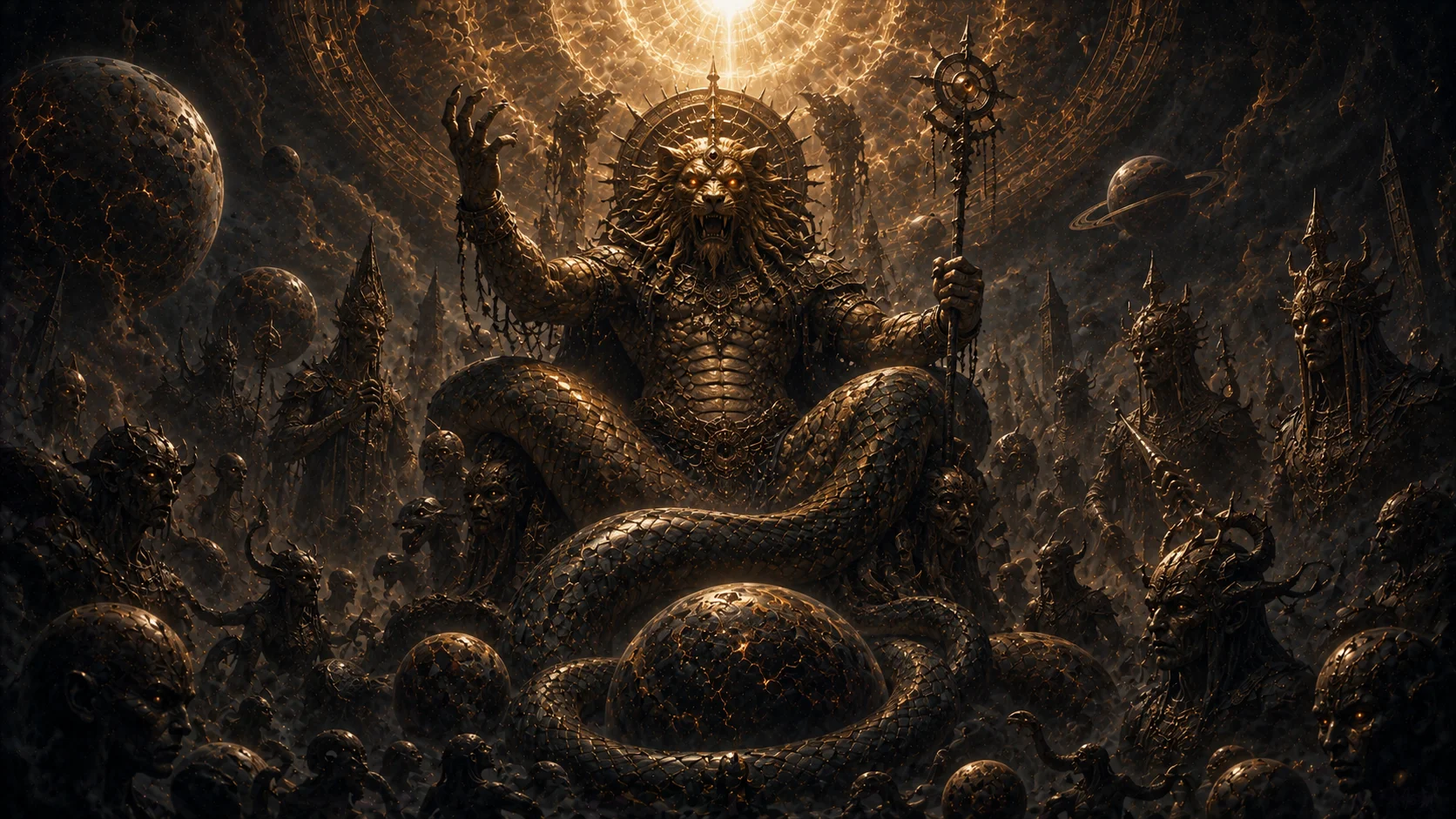
The Apocryphon of John — the Sethian text that preserves the fullest surviving account of the Demiurge’s birth — does not leave the matter to summary. It describes what Sophia saw when she looked at what her solitary act had produced, and it is not a reflection of herself but something monstrous: a serpent with the face of a lion, its eyes flashing like fire. She had acted without her consort and without the consent of the invisible Spirit above her, and what came of it appalled her. Rather than destroy the creature, she hid it — surrounding it with a luminous cloud, setting a throne in the middle of the cloud, and placing it apart so that none of the immortals would see what she had done. Then she named him. Yaldabaoth grows up inside that concealment, sealed off from the Fullness above and from the mother who made him, which is exactly why, when he finally opens his mouth to say what he is, nothing in his experience is there to contradict him.
Seven Thrones, and One Rebel
Yaldabaoth does not stay alone in the dark for long. He generates a court of rulers in his own ignorant likeness — seven where the accounts count them by the planetary heavens, twelve in the fuller list of the Apocryphon of John — and sets them to govern the world he is building. Most inherit their father’s blindness without ever questioning it. One does not. In both the Hypostasis of the Archons and On the Origin of the World, the Archon Sabaoth hears Sophia rebuke his father for his boast and turns against him, condemning Yaldabaoth outright — and is rewarded rather than destroyed for it. He is caught up out of chaos and enthroned in the seventh heaven, above the father he denounced, with Sophia’s daughter Zoe — “Life” — seated at his right hand to teach him about the Eighth, the realm still above them both, and the angel of wrath set at his left. Sabaoth becomes, within the story’s own logic, a just ruler inside a system he did not choose and cannot leave. It is a small crack in the myth’s architecture, and a telling one: even the Gnostics who told it were unwilling to damn every power equally.
The Garden Read Backwards
To one strand of early Gnostic thought, the serpent of Eden was not the villain of the garden but its only honest witness. The Ophites — a label their opponents built from the Greek ophis, “serpent” — are known chiefly through the system Irenaeus set out to refute, in which the prohibition in the garden is the jailer’s work and the transgression is the first act of waking up. The Hypostasis of the Archons makes the mechanism explicit: the spiritual Instructor enters the serpent and tells Eve that she will not die at all, that the ruler forbade the tree out of jealousy. The moral poles of the biblical scene are deliberately reversed, and the reversal only holds once the premise is granted — that the god who set the rule was never the true God, only the counterfeit who had built the garden as a cage.
Not Every System Agreed
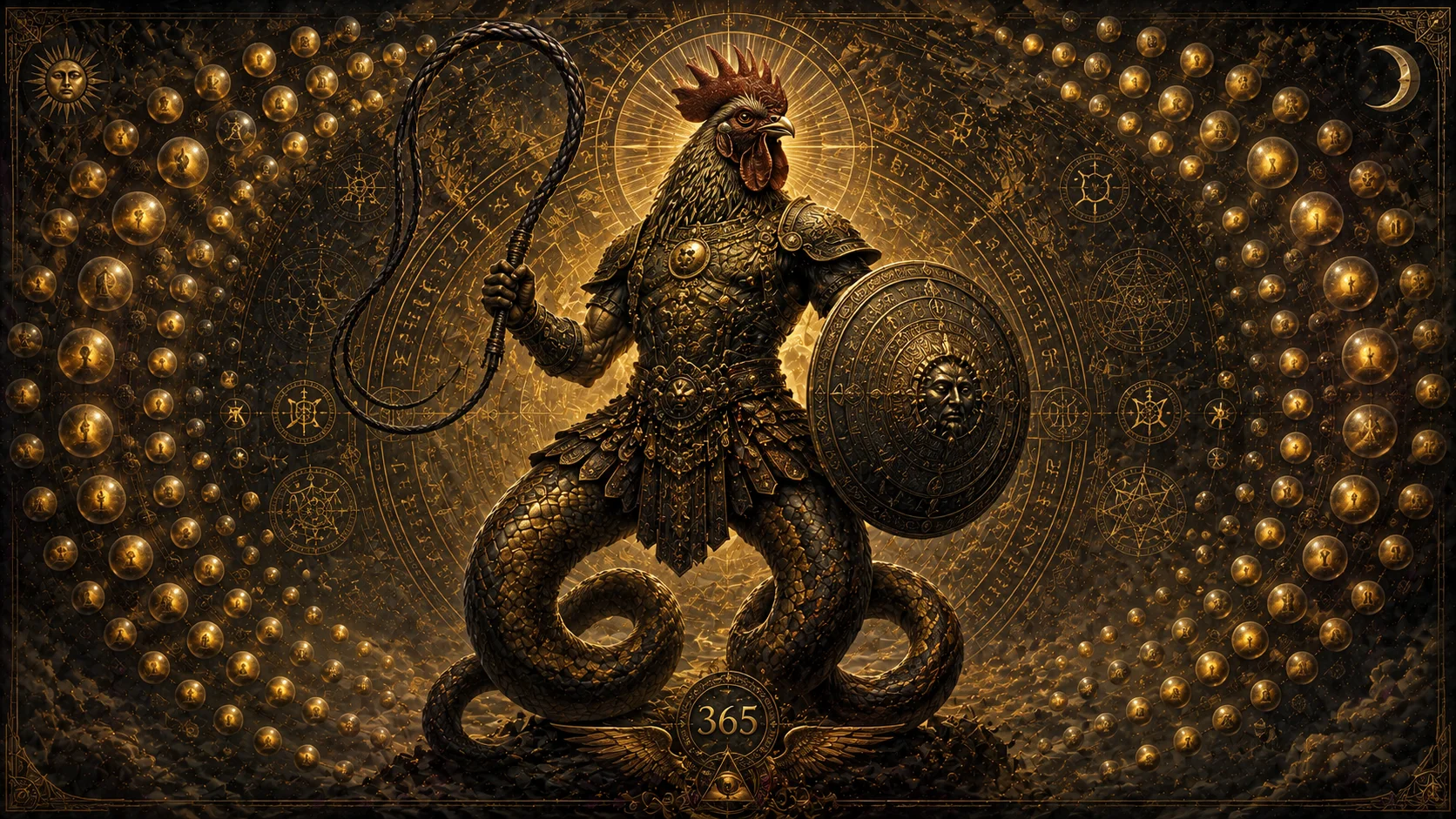
There was never one official Demiurge. In the Sethian tradition that produced the Apocryphon of John, he is close to irredeemable: a jealous, ignorant tyrant with no real path to correction. Valentinus and his followers, teaching in the same century, painted a softer figure — still limited, still unknowing, but capable of unwitting service and, in Irenaeus’ report of their teaching, of eventual instruction once the spiritual elect had been gathered in. Basilides, teaching a generation earlier in Alexandria, built a different hierarchy again: rulers descending through three hundred and sixty-five heavens, one for each day of the year, from a Father so remote that his followers preferred not to name him directly at all. Each school was working the same suspicion — that the god of this world could not be the highest one — into a different shape, and none of them thought the others had got it exactly right.
Marcion’s Rival Diagnosis
A contemporary of the Gnostic schools reached a strikingly similar conclusion by a completely different road. Marcion of Sinope, teaching in Rome in the mid-second century, argued that the vengeful, law-giving god of the Hebrew scriptures could not be the same being as the loving, unknown Father proclaimed by Jesus: two gods, not one, the lower having made the world and the higher having come to rescue humanity from it. Marcion built no Pleroma and told no story of a fallen Aeon; his dualism was scriptural and moral rather than mythological, argued from the texts themselves rather than from a cosmic drama. But the shape of the idea — a merely just creator set against a good stranger — sat close enough to the Gnostic Demiurge that Tertullian devoted five books to demolishing it. Marcion had been a wealthy benefactor of the Roman congregation; Tertullian records that his substantial donation was handed back to him when he was expelled, in or around the year 144. The money was returned. The logic was not so easily disposed of.
Buried, Then Recovered
For most of the last two thousand years, almost everything known about the Demiurge came from his enemies. The systems described above survive chiefly because Irenaeus, Hippolytus and other orthodox writers described them at length in works written expressly to refute them — a hostile witness is still the only witness. That changed in December 1945, when a jar of leather-bound papyrus codices was uncovered near the Egyptian town of Nag Hammadi, likely buried centuries earlier to protect them from a purge of texts deemed heretical. Among the works inside were the Apocryphon of John, the Hypostasis of the Archons and On the Origin of the World themselves — the Demiurge’s own scriptures rather than the summaries of the men who despised them. A copy of the Apocryphon had in fact been sitting in scholarly hands since 1896, bought in Cairo in the codex now known as the Berlin Codex; through a chain of delays and two wars it went unpublished until 1955, so the buried jar reached print first.
The Blind God After Gnosticism
The idea of a lesser, deceived or actively hostile creator did not end with the ancient sects that first told it. The Neoplatonist Plotinus devoted an entire treatise to attacking it — the one his editor Porphyry placed as Ennead II.9 and later readers know as Against the Gnostics — refusing the notion that the material cosmos, which he considered beautiful and fundamentally good, could be the bungled work of an ignorant craftsman. Carl Jung came to the same material from the opposite direction, reading it as a map of the unconscious rather than a literal cosmology; he was working from the heresiologists long before Nag Hammadi was found, and in 1916 wrote his own Gnostic-flavoured meditation, the Seven Sermons to the Dead, signing it with the borrowed name of Basilides. Fittingly, one of the recovered codices was later purchased for his institute in Zurich and is still called the Jung Codex. In the twentieth century the novelist Philip K. Dick built the late works gathered as his VALIS trilogy around an explicitly Gnostic premise: that the world taken for reality is a flawed and possibly false construction, administered by a power that is not what it claims to be. None of them agreed on what followed from the idea. All of them found it worth returning to.
Why the Counterfeit God Persists
Strip out the Aeons and the Archons and one question is left standing: what if the authority that made the rules is not the authority it claims to be? That is a question about power before it is a question about cosmology, which is why the figure keeps being picked up by people with no particular interest in second-century metaphysics — Plotinus arguing against it, Jung reading it inward, Dick writing it as science fiction. The Gnostic answer to it was bleak and strange: not a justification for suffering, and not a reassurance that the world is secretly fine, but the claim that the world is exactly as wrong as it looks and that the being running it does not know what he is. What that offers is not consolation. It is the possibility that the jailer is not omniscient — and that the way out is the one thing he was never able to see.
Sources & traditions
- EncyclopediaWikipedia — Demiurge
- TraditionGnostic texts, grimoires and later commentary
Myths change from area to area and from time to time. This chronicle follows the most widely told versions; tellings in other villages, regions and eras may differ.