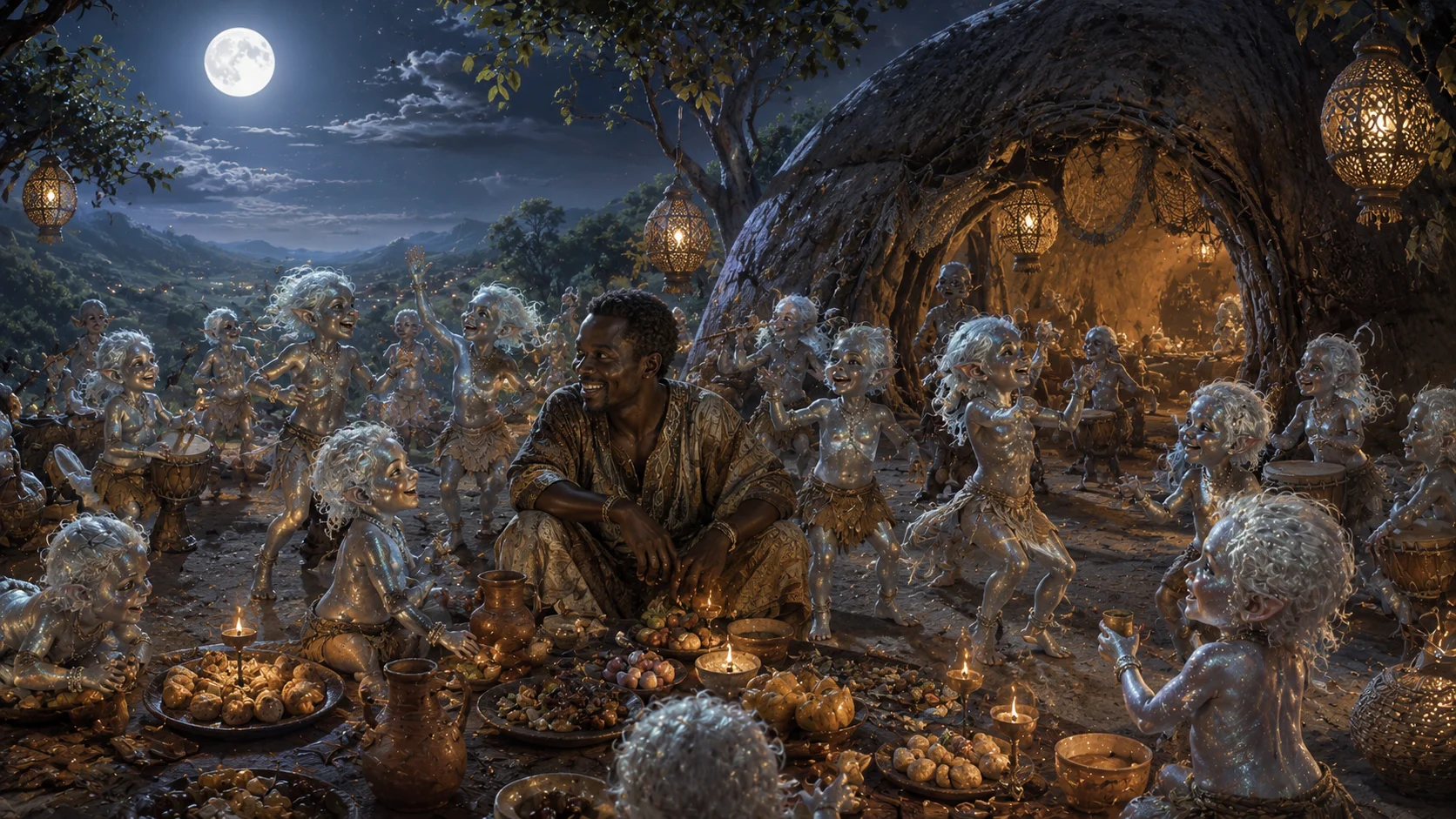
The Yumboes are the fairy-folk of West Africa — small, benevolent, pale-skinned spirits of the lore of the Wolof people of Senegal, who dwell beneath the hills, feast and dance by moonlight, and are known with affectionate respect as the "good people." Among the most charming of all West African spirits, and famous as one of the few African fairy-traditions recorded in the wider world's fairy-lore, the Yumboes are the dancing, feasting little folk of the Senegalese night.
The Good People of Senegal
The Yumboes (also called the Bakhna Rakhna, "the good people") belong to the folklore of the Wolof of Senegal, and especially to the lore of the region near the Cape Verde peninsula and the city of Dakar. They are described as small spirits — about two feet high — with pearly or silvery skin and white hair, in this resembling the fairy-folk of European tradition, with whom they were compared by the nineteenth-century French colonial-era collectors who first set the tradition down in writing, material later summarized in English-language folklore anthologies. They dwell beneath the hills — the Paps, the twin hills near the Cape Verde peninsula, were said to be their home — in unseen subterranean halls, and they come out by night to revel beneath the moon.
A Name Chosen to Turn Away Harm
The Wolof name Bakhna Rakhna, glossing as "the gracious ones" or "good people," is not simply a description but a deliberate act of caution. Naming a spirit kindly, whether or not its temperament warrants the compliment, is a widely attested apotropaic practice — a way of speaking that hopes to keep a potentially dangerous power calm by addressing it as one would a respected neighbour rather than a thing to be feared. The convention has close parallels across the world's fairy-belief traditions, where the "fair folk" or the "good neighbours" are named with careful politeness precisely because provoking them is thought unwise. Whether the Yumboes were ever considered genuinely dangerous, or the name simply preserves an older habit of respectful address toward any unseen power, the naming itself speaks to a worldview in which words spoken about spirits are never idle — they are a form of conduct.
Beneath the Twin Hills of the Cape Verde Shore
The Yumboes are tied, in the recorded lore, to a specific and nameable place: the Paps, or Mamelles, hills of the Cape Verde peninsula near Dakar, said to conceal their underground dwelling. This is not a vague otherworld reached through mist or dream, as in some fairy traditions, but a landmark a person could point to from a village rooftop. The spirits were said to live in an organized society beneath that hill, entering and leaving through the hillside at night, so that the physical landscape itself became a kind of threshold between the human world above and the unseen community below. That pattern — a hidden spirit-society occupying its own territory alongside, and largely unseen by, human settlement — recurs throughout West African belief more broadly, and the Yumboes' hill stands as one of its most specifically located expressions.
When the Moon Calls Them Out to Dance
The central and most repeated motif in every account of the Yumboes is their nighttime revelry. By moonlight they were said to emerge from their hill to dance and to feast, filling the dark hours with a merriment closed to ordinary human eyes unless one happened to catch a glimpse from a safe distance. This lunar association — spirits whose activity rises with the moon and who are most themselves in its light — belongs to a motif found across an extraordinary range of unrelated folklore traditions worldwide, from the fairy rings of the British Isles to nocturnal spirit-dances recorded on other continents entirely. Scholars are careful to treat this as a striking convergence rather than evidence that the traditions share a common root; peoples separated by oceans and centuries seem, independently, to have imagined the night's fullest light as the hour when the hidden world comes out to play.
Borrowers in the Dark
Village accounts describe the Yumboes slipping into nearby settlements after dark to borrow cooking implements, pots, pestles, or food, always with the understanding — sometimes honoured, sometimes tested — that what was taken would be returned before the sun rose. This is the "borrowing fairy" tale-type, and it appears, in one dress or another, in fairy and spirit lore from many unconnected parts of the world: a hidden people who need what mortal kitchens hold, and who repay the loan on their own schedule and their own terms. As with the moonlit dance, the resemblance is treated by folklorists as a structural parallel — a shape stories tend to take when imagining beings who live alongside humanity but keep their own economy — rather than as proof that one tradition borrowed from another. Within Wolof lore itself, the motif casts the Yumboes as neighbours in the fullest sense: near enough to need a cooking pot, and trusted, at least in the story's own logic, to bring it back.
A Society Unseen, Ordered Like Our Own
The picture that emerges from the recorded material is not of a handful of solitary sprites but of an entire community beneath the hill — halls, gatherings, a social life that mirrors, in miniature, the shape of a human settlement. This is consistent with a much broader West African pattern in which the unseen world is not empty or chaotic but populated by organized societies of spirits, going about their own business largely indifferent to, or at most occasionally intersecting with, human affairs. The Yumboes' nightly emergence to feast and dance is best understood not as a performance staged for human witnesses but as the ordinary life of that hidden society, glimpsed only at its edges by the rare person awake and watching at the right hour.
Gracious, Yet Not to Be Taken Lightly
For all their good-natured name and their reputation as benevolent rather than malicious, the Yumboes were not regarded as harmless in the sense of requiring no care at all. As with comparable fairy-type beings the world over, proper respect and correct conduct toward them were expected, and misfortune was the understood consequence of carelessness or disrespect. The precise shape of that expected conduct — what specifically pleased or offended the Yumboes — is one of the areas where the surviving record is thinner than the core motifs of stature, hill-dwelling, and moonlit dance; the nineteenth-century sources that preserved the tradition were more interested in describing the spirits themselves than in cataloguing a detailed code of taboos. What survives clearly is the general principle: gracious does not mean inconsequential, and a spirit named "good people" is still a power whose favour is worth keeping.
Seen Through a Traveller's Eyes
Much of what is known of the Yumboes in the English-speaking world descends from a small number of nineteenth-century French colonial-era ethnographic compilations, material associated with collectors such as Bérenger-Féraud, later distilled into English folklore anthologies including Thomas Keightley's survey of fairy mythology. This means the Yumboes reached a wide audience largely through outside eyes, framed from the start as an African counterpart to the fairy traditions of Europe — a comparison that says as much about the collectors' own frame of reference as it does about how the Wolof themselves classified these spirits. Independent, contemporary Wolof ethnographic confirmation of the finer details is comparatively thin, a gap worth stating plainly rather than papering over: the core shape of the tradition — small stature, hill-dwelling, moonlit dance, nighttime borrowing — is well and consistently attested, while more specific claims should be held a little more loosely.
Fairy Is a Borrowed Word, Not a Wolof One
It is worth pausing on the label itself. "Fairy" is a framing that nineteenth-century European scholarship applied to the Yumboes because the resemblance in size, moonlit habits, and borrowing behaviour was too striking to ignore — but it was not a Wolof category to begin with. The Yumboes belong to their own indigenous classification of the unseen, and treating them as simply an African version of the European fairy risks flattening a distinct tradition into a shape more familiar to outside readers than to the people who first told these stories. The comparison is a useful bridge for understanding, not a translation with nothing lost.
Neighbours of the Jinn, but Not the Same
Senegalese Wolof belief also carries the Islamic-influenced concept of jinn, and in popular usage the line between jinn and Yumboes is sometimes blurred, the two spoken of in overlapping terms. The sources that document the Yumboes as a distinct, named, regionally rooted category treat them as belonging to an older indigenous nature-spirit tradition, predating or at least standing apart from the Islamic framework that jinn belief carries with it. Where exactly that boundary sits, and how firmly it has held as the two vocabularies have lived side by side for generations, is flagged in the record as genuinely uncertain rather than settled — a reminder that living traditions rarely keep their categories as tidy as an outside observer might wish.
Gracious Hill-Folk Against a Wider Map of the Unseen
Wolof cosmology, as recorded, does not populate its unseen world with a single undifferentiated class of spirit. The Yumboes represent one distinct kind among several: a largely peaceable, intermediary presence tied to a specific landscape feature close to human settlement, in clear contrast to more fearsome figures of Senegambian and wider West African river-and-swamp lore, such as the serpentine Ninki Nanka. Placed side by side, the two illustrate a worldview built on multiple, differentiated classes of the supernatural — some to be welcomed cautiously as near-neighbours, others to be avoided outright — rather than one broad, undifferentiated category of "spirit." The Yumboes occupy the gentler end of that spectrum, near enough to human life to borrow a cooking pot, far enough from it to remain, in the end, genuinely other.
What the Record Does Not Say
The documented sources on the Yumboes stop short of placing them into any defined family tree or hierarchy alongside named Wolof or Senegalese deities or other specific spirit figures. No lineage, no rivalry, no formal alliance is recorded connecting them to a broader pantheon. This absence should be read as precisely that — a gap in the written record — rather than as proof that no such relationship exists or ever existed in living oral tradition, where connections between spirit figures are often carried in memory and local practice long before, if ever, they reach the page of an outside collector. The honest position is to note the silence rather than to fill it.
The Hill That Keeps Its Own Hours
What endures most vividly across every retelling of the Yumboes is a very particular image: a hillside on the Cape Verde shore, quiet and ordinary by day, and beneath it, once the moon rises, a hidden community keeping to its own feast, its own dance, its own borrowed pots returned before the village wakes. It is a tradition built on proximity rather than distance — spirits who live close enough to know their neighbours' kitchens, and who are, by their own chosen name, gracious about it. Whatever remains uncertain in the finer details of custom and taboo, that central picture — small, pale, dancing, and named with careful kindness — has carried the Bakhna Rakhna from Wolof oral memory into the wider record of the world's fairy-lore, still recognisably themselves.
Sources & traditions
- EncyclopediaWikipedia — Yumboes
- TraditionWest African folk and village traditions
Myths change from area to area and from time to time. This chronicle follows the most widely told versions; tellings in other villages, regions and eras may differ.